Analytics

Saturday, April 25, 2020

Post #4576 Commentary: Some Comments on COVID-19 and Public Policy

For those of us who live in colder climates, typically in freezing winter, you see it when you exhale: a fog of icy water/breath vapor, more clinically known as "Exhaled Breath Condensate". These droplets, not visible in warmer weather more gaseous forms, are a medium in which respiratory viruses, like COVID-19, can spread to others. You can somewhat think of a fog following you around, and things like windy weather can spread your fog wider. Of course, an infected person's imperceptible microbes   could mix in your personal space/fog that you breathe in.  Certain behaviors, like coughing, sneezing, laughing, talking, yelling and singing, can spread more perceptible droplets, including elements of saliva or mucus, often in a more extended space. Particularly worrisome is the fact that viruses can be sticky, clinging to surfaces after its watery host evaporates, including, say, if you cover your mouth with your hand when you cough or sneeze. The virus could transfer to commonly used surfaces, like door or toilet handles. The virus might live from hours to days.

Now part of the problem is that professional-quality (hospital-ready) personal protection equipment (PPE) is in tight supply. Conventional/homemade face masks or gloves may be too porous or fragile (e.g., easy to rip) and/or difficult to maintain for reuse (one reason you often see an emphasis on disposable items for health personnel); for example, Betsy McCaughey claims homemade face masks (vs industry standard N95 units) are ineffective against 97% of microbes. In the meanwhile, lockdowns are impairing industry efforts domestically and internationally to scale up to meet soaring demand, never mind regulatory hurdles and trade policies for new suppliers; China is also running into notorious quality control problems as the leading exporter. To give one example from recent news, Governor Hogan (R-MD) welcomed a shipment of 500,000 COVID-19 test kits from South Korea today (there are issues with certain Chinese test kits; his wife is Korean-descent).

There are a lot of nuances that really don't fit simple heuristics, like the 6 feet of separation rule. For example, is the wind blowing with the person approaching you? When I tweeted recently against  Hogan's order mandating the use of face masks, part of what I had in mind that I have personally been unable to find N95 masks available, at least on sites like Amazon, no doubt in part to the health professionals' complaint of consumers diverting part of the supply in the midst of a industry shortage. I do have masks my RN sister has made for me, but they likely (as McCaughey points out) are unable to filter most, if any microbes I might encounter. So what's the point? Maybe it captures some larger drops of spittle, mucus, etc., if and when I cough or sneeze in the presence of others, which almost never happens. Not to mention you have to maintain masks (i.e., launder them). But over the last several weeks, I've rarely met others except passing people in the grocery store. Is it possible that I could have passed by asymptomatic shoppers or handled grocery items touched by them? Yes, but not probable. And strategies of avoiding touching one's face, especially near breathing passages, and washing one's hands can mitigate those risks.

Probably the most serious issue that the COVID-19 alarmists are seizing on is the fact that asymptomatic and presymptomatic individuals can spread the virus. The latter, individuals who eventually manifest various symptoms (common symptoms: fever, tiredness, dry cough. Others: .
aches and pains, nasal congestion, runny nose, sore throat, loss of appetite, diarrhea; shortness of breath or difficulty breathing, chills, repeated shaking with chills, muscle pain, headache; new loss of taste or smell; emergency ones include "trouble breathing, persistent pain or pressure in the chest, confusion or inability to arouse the person, or bluish lips or face.") within 2 to 14 days of infection reportedly shed the most virus within a couple of days of manifesting symptoms. So a person may still look to be healthy but be infected and exhale virus to infect others, without telltale symptoms like coughs and sneezes; one study showed nearly half of infections spread by the infected happened during the presymptomatic stage. By some heuristics (e.g., a cruise ship case study: see Vox link below), up to half of so of the infected individuals showed no immediate symptoms but up to half of those eventually developed symptoms; some one-fifth to one-quarter remained without symptoms.

There is still we don't know much about virus spreading from asymptomatic individuals. Most of the cases I've seen documented have been of presymptomatic individuals during the symptom-free incubation phase and/or people with mild symptoms, such as CDC documented of a mildly-symptomatic (cough? fever?) family friend in Chicago who attended a funeral and subsequent birthday party which propagated a cluster of 16 infected, three of whom passed from COVID-19 complications. There does seem to be some anecdotal evidence that truly asymptomatic individuals (who do not develop signature symptoms) can infect others.

This can lead to a certain paranoia, because there is no clear way of distinguishing healthy or true asymptomatic vs presymptomatic individuals. Currently there are two types of tests (in dubious/short supply): testing for COVID-19 RNA, the genetic matter of the virus directly (this is the one most people implicitly reference); the second is an antibody check for the disease, sort of a check for naturalized immunity via COVID-19 exposure. There are a number of technical issues with the later (regarding reliability and validity). Still, some studies suggest an undercount of reported infections by a factor of 50 or more, e.g., from Santa Clara county. The "good news" is the fatality rate, artificially inflated by mostly rationing RNA tests to people showing symptoms, plummets to a fraction of a percent, still a serious multiple of the seasonal flu. For more discussion on antibody testing, see here.

Part of the problem is that we don't know much about acquired immunity through COVID-19 infection:
But not all antibodies are created equal -- tremendous variance is seen in immune system responses to different viruses. Some antibodies confer early and long-term immunity, while others take longer to develop and are short-lived, providing a limited period of protection. It's now known that antibodies produced in patients who contracted SARS, which emerged less than two decades ago and belongs to the same coronavirus family as COVID-19, confer protective immunity for several years.
(There's some evidence of short-term immunity in monkey studies.) What people, of course, are focusing on is herd immunity. I haven't seen any randomized studies (to mitigate factors like selection bias), but I've seen numbers ranging from 2 to 30% infection rate across international studies. The Santa Clara rate was still below 5%. We are multiples of infections and/or vaccinated (unlikely for at least a year) to reach herd immunity.

There are some anecdotal reports of COVID-19 reinfection (i.e., the person showed negative results at the end of infection to positive results again), although the rates are fairly low and no reports of propagating infection. Obviously not knowing the interval of any immunity has an implication for testing strategy, say among employers. The costs of repeated testing (even assuming it is feasible in terms of testing supply) on a uniform basis would likely exceed benefits. You might want to focus instead on randomized testing and expand testing with significant hits.

The emphasis on "bending the curve" has to do with accommodating the capacity of our hospital systems to handle the influx of COVID-19 patients with serious health complications, e.g., admission to the ICU and/or access to ventilators. The point is that to the degree that hospitals lack the room, supplies, and/or manpower to accommodate the demand for services, we are likely to see an escalating fatality rate and who gets access to life-saving resources becomes more of an arbitrary decision. We saw this become an issue with the tragic circumstances in Italy.

One key related metric is doubling time. The longer the doubling time, the slower the rate of increase, the more sustainable the pandemic can be handled by our healthcare systems.  Since we don't have tools like vaccines, we have had to resort to extreme measures, including stay-at-home, social distancing, etc., in order to lengthen doubling time, According to this model, we likely peaked on April 16, with a doubling time of about 21 days, increasing about a few hours shy of a day each day.

The large-scale shutdown of the American economy is not sustainable long-term. For a huge percentage of  "non-essential" workers, many  were living paycheck-to-paycheck before the shutdown with limited, if any rainy-day funds. Modest government stipend checks don't begin to address the shortfall. It's not just that, but healthcare providers have had to shift priorities, including interruptions in service for people with serious conditions, e.g., stroke, diabetes, cancer, etc. (One of my RN nurse nieces has been reassigned in the interim to other duties.) There will likely be an opportunity cost in terms of lapsed care for these individuals. Dr. Atlas, among others, has argued for a more risk-based approach to COVID-19, focused, e.g., at people with age or medical condition vulnerability associated with higher mortality risks.

The COVID-19 alarmists ominously warn of a second wave of COVID-19 if and when current shutdown regulations are relaxed, even as their models (calculated with existing restrictions) have overshot infection and mortality counts. I have gotten my own share of targeting by alarmist trolls on Twitter. My biggest mention in March got nearly 1200 impressions (I don't think I can access it to embed it, so I'll have to copy/paste it below):

@raguillem So only 3,936,000 die. A lot of people might get really mad at a #COVIDIDIOTS such as yourself. pic.twitter.com/HTqXYey5BY
Let's be clear: I do see a role in society or its proxy, local government, enforcing a quarantine for public health purposes, particularly for symptomatic infected individuals, and special regulations for certain shared facilities, e.g., hospitals, nursing homes and prisons, especially with at risk populations, like the elderly or chronically ill, or large densely-populated areas or gatherings, like sports stadiums and auditoriums, public transits like subways, etc. I think it's worthwhile for employers to leverage or transition to remote computing arrangements for knowledge workers. For a good discussion of relevant issues, including the constitutionality of quarantines and state-based health regulation, see this discussion via Pacific Legal Foundation.

 What bothers me is government micromanaging details to the extent of ignoring voluntary compliance and making arbitrary distinctions, e.g., essential vs. non-essential businesses/employees, which have little, to no impact on disease propagation.

Let me give two examples (arbitrary selections) to make a point over COVID-19 alarmism: (1) Rand Paul's infection and (2) the recent Wisconsin primary:

Rand Paul proactively took a COVID-19 test, tested positive, went into quarantine and has since recovered. But he came under personal attack from political whores like Sen. Sinema (D-AZ) for using a swimming pool at the Capitol while waiting for results. Let's be clear: Paul was asymptomatic. He took a test because: (1) a neighbor attacked him a while back causing him to lose part of his lung. COVID-19 is a respiratory virus, with obvious implications. He had been at meetings with reportedly positive-diagnosed presymptomatic individuals, although he didn't recall being in direct contact. He had had done a lot of travel and could have been exposed. So he took a test, never mind the political attacks of elected officials getting tests over other people. He did not expect a positive result. To date, I have not heard of a single person being infected by Rand Paul, including members of his family (at least my Google search hasn't pulled up an immediate relevant result) or other lawmakers. I'm absolutely sure if there had been, the media would have picked up on it.

The Wisconsin primary was ominously attacked as a death trap, despite over a million absentee ballots. Many Democrats argued that they hadn't gotten absentee ballots and were forced to vote in person; the Democratic governor tried to defer the primary schedule, and the courts rebuffed him. Now, maybe it's an artifact of what I've pulled up, but I couldn't find an aggregate number on how many physically voted in person (I just saw fragmented totals, like this city here and there), but I saw an estimate of 70% or so voted absentee and saw over a million absentee ballots, so quick math on the back of an envelope is maybe 475K voted in person. The point is we have seen recent headlines that some 7 to 19 people who worked or voted at the polls have been diagnosed with COVID-19. Never mind this could just be a coincidence with the people being exposed elsewhere. The main point I'm trying to raise here is even if we accept for the sake of argument the people got infected at polling places, this is a statistically insignificant percentage of those who voted in person--something the sensational media aren't pointing out.

Now let us briefly point out some examples of regulatory excess, some of which are discussed in this Reason post:

  • there have been reports, e.g., in New Jersey and Pennsylvania, of asymptomatic individuals being arrested for not wearing face masks
  • a woman was fined in Pennsylvania for pleasure driving, despite no social contact with others possible
  • people have been arrested in New York for violating social distancing rules, actually being put in COVID-19 vulnerable overcrowded jails, never mind the fact that a large number of cops have themselves been tested positive for COVID-19
  • a paddleboarder in California, out in open water, not in presence of others, was arrested.
  • in Michigan, the governor put restrictions against buying/selling non-essential goods, say while on a grocery run at Walmart
  • cars were ticketed in Kentucky while a few dozen passengers attended Easter services. (Never mind alarmists had spread nails on roads to discourage worshipers.)
  • Mississippi worshipers were ticketed for attending drive-in church services.
  • An Idaho mother was ticketed for letting her kids play in a closed playground.
I'm sure there are literally dozens, if not hundreds or more of other petty policies being implemented or enforced with little merit, if not counter-productively (e.g., jailing offenders). Just to make a simple point: people need to exercise. Why put restrictions on hiking, jogging, swimming, etc., in parks or other open places? Why are we prioritizing scarce resources like police in enforcing petty, unproductive restrictions?

I remember driving home from a recent grocery run past this poor guy, not wearing a face mask, carrying a bag of groceries or whatever, walking home alone. I was silently praying that he wouldn't get ticketed by some state trooper or cop for being in defiance of Gov. Hogan's face mask policy. I mean, there wasn't any social contact, period.

The crisis has also unmasked some burdensome regulations on business that have gotten in the way of goods and services under current economic constraints. For instance, Gov. Abbott (R-TX) has relaxed certain trucking regulations (weight, registration, etc.), including using alcoholic beverage trucks to transport food and billing restrictions on telemedicine. Boston's mayor has suspended permits for food-to-go services. 

Where do we need to go from here in terms of public policy? Avoid undue complexity and restrictions, paternalism. We need more of a risk-based effort; we know particular groups of people, in particular, the elderly and individuals with challenging health issues like compromised immune systems, are most at risk for mortality. There should be an emphasis on restricting symptomatic individuals. We need to focus on voluntary compliance and provide the flexibility to businesses to reopen and operate; they have a vested interest to ensure the health and safety of their personnel and customers. 


An extensive strategy is beyond the scope of this post. For interested readers, I recommend reviewing FREOPP and Avik Roy's strategy here. I've also read discussions on testing-based approaches, such as the Harvard proposal, discussed here. (I have been a vocal critic of CDC/FDA's sluggish, incompetent rollout of testing and a failure to engage the private sector from the get-go.)

Friday, April 24, 2020

Post #4575 M: McClanahan on Neo-Federalism; Woods on Ignored Questions of Coronavirus

Quote of the Day

Government is not reason; 
it is not eloquence; 
it is force! 
It is a dangerous servant 
and a terrible master.
George Washington  

McClanahan on Neo-Federalism


Woods on Ignored Questions of Coronavirus


Destructive Aspects of COVID-19 Legislation


Choose Life


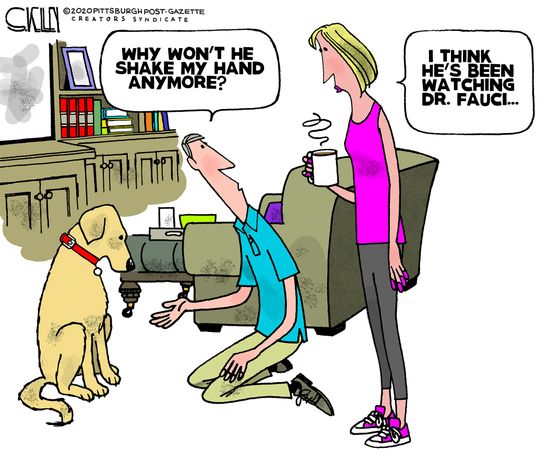
Political Cartoon

Courtesy of Steve Kelley via Townhall

Musical Interlude: My Favorite Vocalists

George Benson, "On Broadway"

Thursday, April 23, 2020

Post #4574 M: Woods on Mediocre Biden; A Liberty Take on Tiger King

Quote of the Day

In religion and politics, people's beliefs and convictions are in almost every case 
gotten at second hand, and without examination.
Mark Twain  

Woods on Mediocre Biden


A Liberty Take on Tiger King


Choose Life


Political Cartoon


Musical Interlude: My Favorite Vocalists

George Benson, "The Greatest Love of All"

Wednesday, April 22, 2020

Post #4573 M: DEAD WRONG: COVID-19 Conspiracy Theories; Hornberger v Amash 5: The LP Debates

Quote of the Day

The wise man in the storm prays to God, 
not for safety from danger, 
but for the deliverance from fear. 
It is the storm within that endangers him, 
not the storm without.
Ralph Waldo Emerson 

DEAD WRONG: COVID-19 Conspiracy Theories


Hornberger v Amash 5: The LP Debates


How To Save the Economy From COVID-19


Choose Life


Political Cartoon

Courtesy of Robert Ariail via Townhall


Musical Interlude: My Favorite Vocalists

George Benson, "This Masquerade"

Tuesday, April 21, 2020

Post #4572 M: Stossel on Coronavirus Policy Overreach; Will New York Recover?; Hornberger v Amash 4: Evil Sanctions

Quote of the Day

Always forgive your enemies; nothing annoys them so much.
Oscar Wilde  

Stossel on Coronavirus Policy Overreach


Will NY Recover From COVID-19?


Hornberger v Amash 4: Evil Sanctions


Choose Life


Political Cartoon

Courtesy of AF Franco via Townhall


Musical Interlude: My Favorite Vocalists

Harry Chapin, "The Cat's in the Cradle". Harry's signature #1 hit ends our retrospective. The final vocalist in my list is George Benson.

Post #4571 J: Some Biographical Notes; Marriages in the Current Age

Weird Dreams: A Birthday Party

I had a dream about my college students throwing me a surprise birthday party for my 18th birthday. There were a number of oddities about that; first, my earliest teaching role was as a calculus teaching assistant at the University of Texas at the age of 19. Second, my birthday falls on Dec. 30; there are no college classes held on that holiday week stretching Christmas to New Years. Third, I wasn't very popular with my own students, as a teaching fellow at the University of Houston or during my 5 years as a professor (the last a temporary visiting professor at Illinois State). If they ever had a party to celebrate my leaving the college, I was never invited. I think over 8 years, I got one invitation: one of my Mexican (not hyphenated) students at UTEP invited me to his family's graduation celebration; I had to decline because I was scheduled to attend my baby sister's graduation at UTSA the same day.

Mom has pictures of my first birthday party in the family album (on Cape Cod where my USAF Dad was reassigned several weeks after I was born). It was my Dad's longest military assignment; my next 4 siblings were born there and I had started primary school before Dad got reassigned to the Florida panhandle. It had to be hard on my Mom; I think my maternal grandmother/godmother was initially diagnosed with colon cancer when Mom was pregnant with me and I think they didn't want to break the news to her at the time. (My Mom had married at 18, and I was born 13 months later.) I wasn't 3 years old by the time Grandmother died. Oddly enough, my bilingual Grandmother didn't go by mémère but signed "GrandMa" in a card to me. (Both parents' homes were primarily French-speaking, and in fact, French was my first language, which became an issue when I started kindergarten.)

I turned 18 during my sophomore/junior year at OLL. My family was in Europe after the south Texas USAF base (when I had attended a local high school) was shut down; my Dad was reassigned to Germany. (The shutdown was rumored to be over a morale issue. It seems that Mexican whores in Nuevo Laredo preferred not to service black GI's.) My folks had wanted me to go with them to Germany and attend classes taught by the University of Maryland's global campus; I really didn't want to lose credits for certain classes that wouldn't transfer. So my maternal Grandfather paid expenses for me to visit him in Fall River, just across the state border from Providence, RI. (I still have relatives in the area who technically live in RI.)

The "highlight" of my birthday was when Grandfather proudly escorted me for mandatory registration for the Selective Service system. Now in fact, even though we were still in South Vietnam at the time, the draft lottery had finally ended sometime before my birthday. I still thought it was weird that my Grandfather would have been fine with his first grandchild getting his ass shot in Vietnam. I, in fact, had been a silent objector to our military involvement in Vietnam (I didn't oppose military service for defensive wars); I didn't want to make waves as a military brat. I remember as a kid pretending to be a TV news anchor during the war. Walter Cronkite would rattle off the war casualties as casually as reporting the stock market indexes for the day of trading. Somehow the war seemed as perpetual as the stock market; I saw the TV footage, but it came across as surreal, like some Hollywood war flick. Until my Dad got assigned there. I was 12 years old, the oldest of 7 kids. I wasn't ready to become the man of the house if my Dad died there. Yes, I know he wasn't in the Army infantry, fighting on the front lines. But just being in a war zone was like opening Pandora's box. I refused to see him off at the airport heading to Vietnam. It's difficult to explain. It was like he had to come back because we hadn't said goodbye to each other. Somehow Dad's orders got changed to Thailand by the time he arrived in Vietnam (thank God).

The war changed Dad; even Mom notes that he wouldn't talk about it to her either. I remember a candid moment years later when I confronted him over whether he felt proud of his part in the war (a
mechanic of jets pounding Southeast Asia, causing massive collateral damage and civilian casualties). He refused to respond to the bait. I think Dad in a sense felt trapped in the military, tied down by a large family he needed to support and the difficulty of starting a second career. (In fact, I qualified for the free school lunch program all though high school; my folks basically lived paycheck to paycheck on his meager enlisted pay. The folks always put the kids first; we didn't go hungry.) He finally made the decision to retire while in Germany and struggled for a while in the first few years of military retirement (I especially remember his making just over the minimum wage as a contractor mechanic at the San Antonio airport) before joining the USPS.

I arranged for the college (OLL) to give the family a couple of rooms in the men's dorms for a couple of days as Dad looked for a family residence in the San Antonio area as he served out the balance of his military service. I still remember Mom commenting about smells coming from adjacent rooms; I remember laughing, explaining to her they were smoking marijuana. (I never personally smoked anything. but I recognized the smells.) I cringed as my baby sister (maybe about 6) loudly pointed out our RA (TP) had a missing leg. (TP was a Vietnam vet who lost his leg in the hapless stalemates of Hamburger Hill.) Tom had a prosthesis, but often didn't wear it, hopping around on one foot and/or using crutches.

TP had a very pretty, petite Latina coed girlfriend Sally, another personal friend. I would have dated Sally in a split second. Her personality was very similar to Anne, my Navy crush. (See my essay blog for a post on Anne and my Navy experience.) We worked together as dishwashers at the college cafeteria my freshman year. I used to tease her that she could serve as a model for a Latina doll; she would respond by throwing gross stuff at me. The college grounds included a residence for Roman Catholic sisters/nuns (CDP: Congregation of Divine Providence), including older/retired ones. The sisters occupied the left dining hall, and the students used the right. One day (don't ask me why Sally raised the topic) Sally started discussing sexual positions (she preferred being on top) and solicited my opinion. I was a virgin and not an expert, but I didn't have an issue with her preference. To this day, I have to wonder if any of the sisters overheard our conversation while rolling their trays down our chutes.

What's Happened to Old-Fashioned Marriage?

First, an item I would have normally included in my COVID-19 diary segment, but I didn't have enough material to justify its own segment. My nephew's sister-in-law recently gave birth to premature twin girls. So they are going to be in the NICU for a while; I think one of the babies needed mechanical breathing assistance at the start of her stay, but a recent text mentioned that she is now breathing on her own. I remember one of my nieces was in a NICU while I was earning my doctorate, and I drove to the San Antonio area to visit her. Visitation was already highly restricted--I think only immediate family and grandparents, so my RN sister had to smuggle me in to see her newborn daughter. So it turns out that under prevailing COVID-19 policies, visitation is even more restrictive. The twins' mother was discharged fairly early from the hospital, and there're a lot of hoops and hurdles for her to go through to visit her own babies. Hopefully they'll transition to more humane policies. Thoughts and prayers for these two beautiful gifts from God.

My niece, mentioned above, became an elementary school teacher. She has had a difficult time since the Great Recession. She was laid off at a Colorado public school under seniority retention. She struggled to find work thereafter, also weighed down by college loan payments from her South Dakota private school alma mater. (One reason she went there is that she is a talented euphonium player; I had gone to her college's performance in Washington DC to see her play.) She eventually made her way to briefly staying with my baby brother's family in the San Antonio suburbs; she landed an hourly-paid music teacher position at a local private school. Her youngest sister, also an education major (but more like a junior high math/robotics teacher), had landed a position in a Kansas public school district, and she eventually got a job offer from the same school district where I think she worked for a good 2-3 years and got along well there, until her private life intervened.

I don't get a lot of gossip from my siblings or my nephews and nieces. But my understanding is she met this guy through the fitness club they both belonged to. Long story short, they got married and eventually had a firstborn son. (She did tragically miscarry a second baby, a girl, about halfway through her pregnancy; my understanding is the umbilical cord had wrapped around her throat.) To this day, I've never met my nephew-in-law or my grandnephew. I've had encounters with the nephew-in-law, mostly through Facebook; I had accepted his friend request and then found my news feed swamped with these dark abortion-abolitionist posts. Today I would probably simply toggle off following status, but I found his obsession rather disturbing and messaged my niece that he needed to tone things down. He responded with a flurry of personal attacks, mocking my professed pro-life views as hypocritical. Now, to be honest, I seem to attract enemies like a lightning rod and people disagreeing with me is more the rule than the exception. What puzzled me was the hair-trigger escalation and ferocity of response; I thought there was anger issue here, and I doubt that I was the first or only target. I began to get concerned about my niece's safety.

I don't recall the exact sequence but, as I've mentioned in earlier posts, she posted some teacher propaganda piece about how we don't appreciate the extra hours teachers put in. I responded something to the effect that a lot of us work extra, unpaid hours (for example, a lot of database maintenance, patching, and upgrades take place on off-peak hours--nights, weekends, and holidays when users aren't accessing the databases); other relatives joined in, and my niece melted down over the disagreements. Her better half (?) soon came to her defense, concentrating his fire on me. He quickly jumped from the meme kerfuffle to resuming his attack on my pro-life "hypocrisy". I don't mind a disagreement over opinions, but his personal attacks were out of line. I warned if he didn't tone it down, I would defriend him. Let's just say that he beat me to it.

I don't know the specifics (I have my suspicions), but somehow the relationship had ruptured to the point my niece left her stable teaching job in Kansas and moved to her folks' Colorado home. She once again ran into issues finding teaching work. I think she got some work at a Montessori school and/or other lower-paying/hourly teaching work. My nephew-in-law also had an unstable work history and if anything, my niece brought in more money to the household. At some point, they reconciled and moved to his home base around Springfield, MO. I was personally skeptical that the nephew-in-law had "changed", and my niece really didn't have a support system in Missouri. I think one of my nephews at the time taught school in the St. Louis area across the state. Again, my niece struggled through a series of lower-paying jobs (I think some of them non-teaching).

In the meanwhile, my sister and her husband retired from civil service, sold their house to my RN goddaughter,  and moved to my brother-in-law's home base near Cincinnati. Something happened (I suspect spousal abuse but unconfirmed), and she and her son moved to my sister's Ohio home.

Among other things, trying to teach in another state runs into reciprocity recognition issues, which might range from taking additional courses to passing other tests. I think my niece has picked up some income through substitution teaching (dried up during the COVID-19 shutdowns) but recently messaged she passed some Ohio qualification test with super-high scores and should get her Ohio license soon.

My sister texted out my niece has finally filed for divorce. It's sad to see, of course, although my niece's health is a higher priority. That makes 5 divorces among 4 sibling families (one sibling has no married children yet, and the other has one married daughter). Several nephews and nieces are unmarried (up to 3 are gay), out of the 21. In the case of my 3 divorced nephews, it wasn't their idea; their wives no longer wanted to be married. In the case of my other niece, her husband decided he didn't want to be tied down.

It's sad. My parents were still in love by the time my Dad died from sepsis following major back surgeries. My married aunts and uncles (except maybe one uncle) had lifelong marriages. My 6 siblings also have lifelong marriages.

Monday, April 20, 2020

Post #4570 M: Hornberger v Amash 3: Amash's Rationalizations; The COVID-19 Crisis and Open Source Applications

Quote of the Day

Two roads diverged in a wood, and I - 
I took the one less traveled by, 
And that has made all the difference.
Robert Frost  

Hornberger v Amash 3: Amash's Rationalizations


The COVID-19 Crisis and Open Source Applications


COVID-19, Socialist Planning and "Nonessential Businesses"


Choose Life


Political Cartoon


Courtesy of Henry Payne via Townhall


Musical Interlude: My Favorite Vocalists

Harry Chapin, "W.O.L.D."