Analytics

Showing posts with label GOP. Show all posts

Tuesday, October 19, 2021

Post #5398 M: Stossel on American Optimist; McClanahan on the GOP Being the Stupid Party; Woods on Airline COVID-19 Mandates

 Quote of the Day

The secret of your future is 
hidden in your daily routine.
Mike Murdock  

Stossel on American Optimist

McClanahan on the GOP Being the Stupid Party

Woods on Airline COVID-19 Mandates

Choose Life

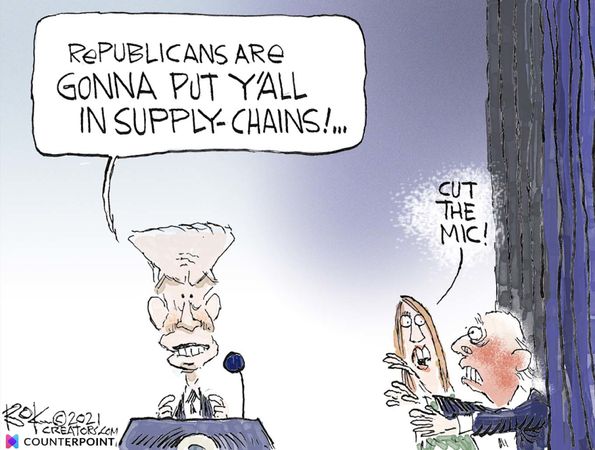
Political Cartoon

Courtesy of Chip Bok via Townhall

Musical Interludes: #1 Hits of 1979

The Eagles, "Heartache Tonight"

Saturday, October 2, 2021

Post #5371 M: George Will on Trumpism; George Will on Biden and the Future of the GOP; Woods on His Experiences During the Pandemic

 Quote of the Day

I am free of all prejudices.
I hate every one equally.
W. C. Fields  

George Will on Trumpism

George Will on Biden and the Future of the GOP

Woods on His Experiences During the Pandemic

Choose Life

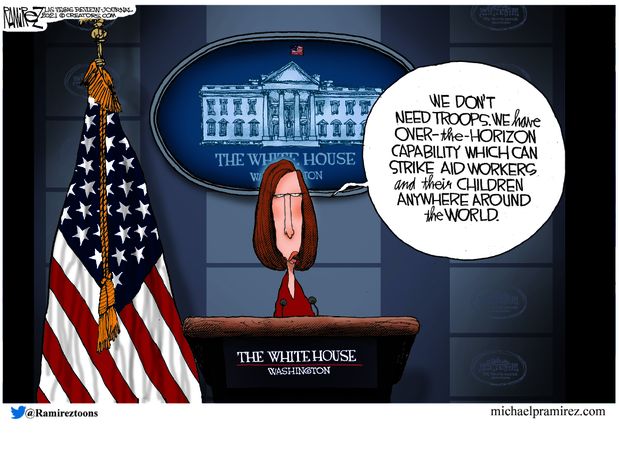
Political Cartoon

Courtesy of the Michael Ramirez via Townhall

Musical Interlude: #1 Hits of 1979

Rod Stewart, "Do Ya Think I'm Sexy?"

Monday, November 4, 2019

Postt #4329 M: Jolly's Rant on the GOP; Counterproductive Vape Bans; College Students and the First Amendment

Quote of the Day

Our life is frittered away by details...Simplify, simplify.
Henry David Thoreau  

Jolly's Rant on the GOP

In fact, I published my own rant over the weekend.

via Twitter


Counterproductive Vape Bans


College Students and the First Amendment


Choose Life


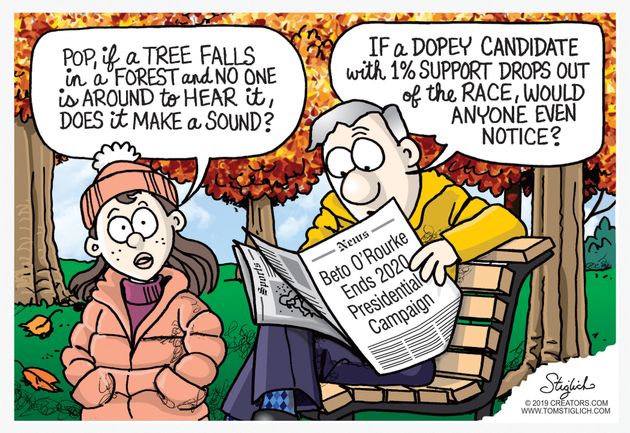
Political Cartoon


Courtesy of Tom Stiglich via Townhall

Musical Interlude: My Favorite Vocalists

Eric Clapton, "Change the World". One of my favorites.

Monday, April 23, 2012

Miscellany: 4/23/12

Quote of the Day 

Never cut what you can untie.
Joseph Joubert

Political Potpourri
Election Eve: The Northeast Super Primary

Okay, I just made up the name 'Northeast Super Primary': New York, Rhode Island, Connecticut, Delaware, and Pennsylvania. I haven't seen many RCP-reported state-specific polls since Santorum's withdrawal (I think I saw a New Jersey one a few days ago), but Romney had been leading the polls except for maybe Pennsylvania before the withdrawal.

I checked for reports from Missouri over the weekend but didn't see any. The Wall Street Journal delegate count shows that Romney got 12 delegates (for a grand total of 697) to 7 for Santorum and 4 for Paul. Missouri has around 50 delegates, so I expect those will be awarded a few weeks from now at their state convention. Some 231 delegates are up for grabs tomorrow. We should see Romney get the lion's share, maybe even past the 900 delegate mark. It's now just a matter of grinding it out. This is just a case where Romney got the quick lead in delegates and never looked back.

 Looking at the general campaign, I find it intriguing that less than a week ago Obama was 5 points behind Romney in the Gallup poll and today he's 3 up--plus reached 50 percent in approval. That's really odd because I would have thought with the recent Colombia sex scandal, if anything, he should have done worse. I will point out that the poll showed 9 percent undecided. If you do NOT already believe in Obama, you probably aren't going to vote for him as an undecided. I think Romney still isn't as well known to voters and I think he's still recovering from a rough primary campaign. However, he's struggling in some key battleground states. I have to say, though, that Romney's campaign has been much better than McCain, and I don't think I really believe some of these polls--it's one thing for a fresh-faced Obama to win 53% of the national vote, but only the most partisan voter believes that Obama has done a good job. Washington is more divided than ever; we're still tied down in the Gulf region; Europe is a mess; the economy and job growth are weak. We have nearly doubled public debt (i.e., not counting social security reserves) I think a lot has to do with how Mitt Romney runs the general campaign. I think he's a better politician than people think--this is a guy whom ran one of the strongest campaigns against Ted Kennedy as a political novice.

It's Time to Hold Obama Responsible 
For Failure of Leadership
on Social Security and Medicare

I have been repeatedly focusing on unfunded entitlement liabilities. What do we mean by unfunded liabilities? In short, we are looking at the aggregate of the cumulative estimated benefits a current worker (and/or survivors) are expected to receive directly or have paid on their behalf (e.g., health care provider) over his/their lifetime from related cumulative estimated assets (e.g., employee/employer contributions, fund investment returns, any relevant Medicare premiums, co-pays, etc.)  Actuaries will factor into account relevant inflation/adjustments, wage growth, early retirement options, new or projected benefits, final income basis for pensions, etc.

Let me point out a few inconvenient facts from a relevant USA Today column last year:
  • there are 77-78M Baby Boomers (1946-1964), including the first year for Medicare enrollment
  • demographic challenge: longer lifetimes and/or retirements (including early retirements), greater proportion of longer-living white collar vs. physical labor workers
  • of the 48M current Medicare participants, 13M were added over the past 20 years: an additional  33M--a nearly 250% increase--will be added by 2030
  • there is nearly a $25T shortfall in Medicare funding--and that includes unrealistic savings assumptions from ObamaCare, like a 30% cut in physician payments this year; last year alone the unfunded liability grew by almost $2T (almost a year of total federal revenues)
  • there is nearly a $21.4T shortfall in social security funding, and that grows almost $1.2T annually
  • these computations involve accounting procedures used in the private sector; the federal government uses different numbers, e.g., by not counting Treasury IOU's in the social security reserve and by counting the tax contributions of younger workers but not their future benefits.
  • there is a $3.6T shortfall in military retirement/disability. Do you really  think the government contributes resources as states and private companies have to? 
  • there is a $2T shortfall in civil service retirement/health benefits. Do you really think the government contributes resources like states and the private sector have to? 
Note that almost all of these programs have early retirement (i.e., before 65) options, including social security. There are some hard decisions that will have to be made.

Some progressives will make suggestions about changing from a piecemeal reimbursement approach analogous to things I've mentioned in the past (e.g., see Sullivan's post here), but they have an ideological addiction for "well-managed nonprofits" like Mayo Clinic versus the private sector, that profits stand for rationing at the expense of the patient. They also believe, despite decades of mismanaging Medicare (pricing issues, fraud, etc.), the government bureaucrat or nonprofit person is able to micromanage a whole sector of the economy (despite an inability to manage its own internal affairs). Manhattan Institute points out a salient observation: "No health-insurance system, whether private or public, can “cover” all individuals or all medical services because resources are limited always and everywhere. This means that both private and public health-insurance systems must impose limits on the consumption of health care: Some classes of services will be denied to patients, and some classes of patients will be denied given services." For example, there are quite a few anecdotes about Canadians coming for treatment south of the border because of resource allocation problems.

And yet most policyholders are happy with the private-sector health coverage they have... Go figure. The truth is that the private sector has an incentive to look for cost savings--which doesn't come at the expense of the patient but in terms of being vested in cost savings for a given level of service.

Before going further, because I am annoyed by the polarizing rhetoric of certain fear-mongering senior citizen advocacy organizations (e.g., AARP), consider the following graph of what these organizations claim that their members paid for. Look very carefully at the Medicare line at the top: at minimum, each beneficiary type is expected to collect almost 3 times or more of what they/their employers paid into Medicare. Under what logic is this "fair" from an intergenerational standpoint? Clearly we have some obligation to people whom have paid into the system over the past four decades, but these kind of discrepancies cannot be overcome by the Democrats' favorite prescription of economically-crippling soak-the-rich, the-public-sector-can-manage-it-better policies:

Courtesy of urban.org

So what led to this rant? A new report from the trustees today. According to The Hill:

The Medicare trust fund will be “exhausted” — meaning it won’t have enough money on hand to cover the benefits it’s supposed to provide — by 2024, the trustees said, the same time frame anticipated in a report last year. Social Security will reach that tipping point in 2033, three years earlier than predicted last year. “Under current law, both of these vitally important programs are on unsustainable paths,” Trustee Robert Reischauer said Monday.

Obama has shown little leadership here; in fact he has pushed on a string for a temporary reduced payroll tax (without a commensurate cut in pension payments). He utterly failed to take up the Bowles-Simpson deficit reduction committee. Don't get me started on the post's discussion of comments by Treasury Secretary Geithner: I've had to bite my tongue as this guy parroted Obama's talking points all through recent Sunday talk soup.

I will simply point out that the progressive obsession with lowering Medicare prices already below market is not going to be a fruitful endeavor, and a lot went into into playing games with baseline budgeting. We had a class warfare Medicare tax hike (surprise, surprise), but instead of offsetting unfunded liabilities growing over $1T a year, they are being used to help fund a new health entitlement program.

Whether Romney operatives are technically correct in arguing cuts from Medicare (versus decreases in baseline budgeting baked-in increases), senior citizens do have a legitimate gripe which they haven't been expressing that well: Obama and his Democratic cronies are getting their ObamaCare funding disproportionately from money needed to shore up runaway entitlement costs, instead of a more broad-based approach of government revenue collection. That simply is not fair.

I'm not going to outline a full solution here; I would like to treat poverty support consistently across age groups and privatize the senior entitlement programs from middle class and above. The chances of that happening are remote, given the partisan divide. That being said, we could at least set a sustainable ceiling on aggregate program costs and work backwards from that standpoint. For example, we could argue for a cap on higher-income benefits relative to their contributions, set a high-deductible based on income/wealth considerations, etc.

Also, I would like to see more market-oriented reforms, e.g., liberalizing immigration quotas for in-demand medical personnel, delegating routine medical matters to less costly trained non-physicians, allowing the marketing of health services across state lines, providing incentives for government-sponsored patients to seek out quality care or meds at lower prices, rollback unnecessary bureaucracy, paperwork, and procedures,  etc.

An Interesting Partisan Tidbit

Although I joke about these things, I can't believe that we're spending as much time as we have over the GSA scandal, the Colombia sex scandal, Romney's means of transporting a family dog on vacation 30 years ago, and Obama's encounter with eating dog meat. Don't get me wrong: I think $44 taxpayer-paid breakfasts are wrong, but we are talking about the $5T Man in the White House.

The left wing of American politics is so far off the charts in terms of incivility, it's ridiculous. I'll never forget seeing a website back in 2008 where somebody was pretending to be pregnant teen Bristol Palin's unborn child screaming out for someone to put him out of his misery. I also remember when Obama, just before the House passed the Senate's corrupt ObamaCare bargain, had a bipartisan summit and then routinely interrupted with Republican Congressmen disagreeing with them. This was after GOP gave the Democrats fair opportunities to express their opinions without interruption. I can't count the number of times I've heard Debbie Wasserman Schultz talk over Republicans, whom gave her a chance to do her usual political spin. I used to be a Democrat; I once held more liberal positions on things until I took my first economics courses in the process of earning my MBA. (And the economics professors had no political agenda.) I had a favorite niece and nephew whom were strident Obama supporters in 2008. But I figured if I did something stupid in my salad days of supporting Jimmy Carter, they had a right to make their own mistakes. There are a lot of young people whom supported Obama in 2008 and have gone through a particularly brutal job market.

A lot of conservatives started out as liberals (e.g., David Horowitz, Dennis Miller, and Charles Krauthammer (once a Mondale speeechwriter)). A number of us started out as idealists and then as we approached midlife found our views had changed. Anyone reading my opinions realizes that I'm not a typical conservative: I've been an outspoken critic against intelligent design, I've been a strong supporter of the separation of Church and State, I hold many libertarian positions (e.g., on the military, legalizing the underground economy, and protecting privacy rights) and I have been a tough critic of populist Republicans like Sarah Palin.

Still, I enjoyed this tidbit from the Daily Caller:

The Pew survey [showing Republicans outscored Democrats on politics and political history according to “Partisan Differences in Knowledge"] adds to a wave of surveys and studies showing that GOP-sympathizers are better informed, more intellectually consistent, more open-minded, more empathetic and more receptive to criticism than their fellow Americans who support the Democratic Party.

Is the European Contagion Spreading?


Worries in Europe are climbing as a potential Hollande Presidency in France could cut the region-wise drive for austerity to contain unsustainable programs. It's even affecting Holland as failure to resolve budget negotiations in a recession which has driven unemployment up to 6% may result in a new government, as Dutch bonds now require the widest spread against (preferred) German bonds in years. I have not been discussing them in the blog, but I've been reading a lot of rumors about German unrest about carrying the rest of Europe on its shoulders, with voters increasingly irritated by German calls for fiscal responsibility, about German going back to its own currency (versus the euro), of others leaving the euro to go to their own currency (and escape the austerity regime), subsequently devaluing their currency. Some of the options being discussed are not allowed within the framework of the European Union.

Musical Interlude: My Favorite Groups

The Rolling Stones, "Get Off Of My Cloud"
Wednesday, March 7, 2012

Towards a Liberty Conservative Party

I think we're on the verge of a major upheaval in the American political system. We've seen third parties: for example, Ross Perot's Reform Party, the Green Party, the US Constitution Party, the Libertarian Party and various other parties. I'm not talking about one of those parties moving forward; I'm referring to a less ideological, more pragmatic center/right of American people.

There are a few reasons I say this:
  • the status quo is unsustainable: the national debt is at the credit limit, the federal budget is out of control, and the entitlements are drastically underfunded, while ages are increasing. 
  • the Democratic Party overplayed its hand nationally in the 111th Congress by failing to revive the economy in a meaningful way (a principal fact underlying 2008 results in the aftermath of the economic tsunami) and squandered its mandate by pursuing a decidedly politically liberal expansionist agenda at a time federal tax receipts were down by as much as 40%. A large percentage of the centrists elected  during the 2000's were swept out of power in the 2010 mid-terms, and others have since retired. This is not only happened on the federal level, but at the state/local area as Democrats find themselves with chronic pension funding shortfalls, handcuffed from meaningful reforms because of their ties to labor
  • the Republican Party finds that its credibility on fiscal conservatism and regulatory reform was badly damaged during the Bush years, and the Bush era was characterized by weak economic/job growth, and Bush's massive federal interventions during and after the economic tsunami undermined free market principles; we found our military forces overextended, tied down to an obscure region of dubious strategic importance
For me, there has been a shift. I transitioned from a liberal to conservative Democrat in the early 1980's after taking (nonpolitical) economics courses in graduate school. I had always been a fiscal hawk and became increasingly disenchanted with House Democrats over failure of fiscal discipline. I had always held traditional values (including pro-life views); for me the crucial moment was when the Democrats sabotaged the SCOTUS Bork nomination.

I have always been a military hawk based on having grown up as a military brat. Little did I realize that I was starting to question military policy even as I had endorsed John McCain as President. The issues I had were not reflected in conventional Democratic talking points over "fighting the wrong war", unconditional withdrawals, etc: at the same time, I was troubled by Bush's failure to manage post-invasion Iraq, the military brass failure to adapt to changing conditions and tactics (not to mention manpower staffing),  and the decision to go to war in the first place. I found it difficult to believe that Hussein could mount a credible military threat against the US under various sanctions and logistics.

I wasn't happy with Obama's leadership either, with the Afghanistan surge decision based on lower staffing/high risk and in essence telegraphing withdrawal without reference to mission success; I think that his terminations of military leaders were based more on pettiness (e.g., officers caught saying the wrong thing about US or Afghan leadership) than performance.

At the same time I was troubled by moral hazards of Obama's domestic policy, I started having the same concerns about moral hazards in foreign policy--and I become even more concerned by Obama's expansion of drone bombing raids, meddling in the affairs of Egypt, Libya and (in a limited sense) Syria. Just as I opposed  the spread in federal intervention and meddling on the domestic side, I started seeing scope creep in international intervention. I have been unnerved by the Republicans' (except for Ron Paul) support for much of this, if anything, tossing the Iran chip onto the table.

As I see Ron Paul being marginalized and litmus tests in ideology being applied to candidates to each party, I think the major parties have left us, not the other way. I've been slowly transitioning to the point of view of finding a different way. I have telegraphed my transition in multiple ways: several weeks ago I wrote and published a description of the blog summarizing several key principles; I modified the name and layout of the blog; I've expanded coverage of libertarian issues.

What about the other salient existing parties? The Libertarian Party has positions (e.g., expansion of marriage options) which I think may have unintended consequences. Drug legalization is another one; I favor certain steps towards decriminalization and streamlined reform of relevant laws and penalties. The US Constitution Party is too tied to protectionist trade policies and immigration restrictions.

I propose the concept of a Liberty Conservative Party, one based principally on unalienable rights, classical (economic) liberalism, limited, enumerated government powers, non-interventionist policies, and decentralization or privatization of incidental functions, deference to or empowerment of  traditional social institutions and more localized government services. An initial agenda would be based on ensuring the long-term viability of  government commitments. I would hope that future elected officials commit to basic pragmatic principles of civility, competence, integrity (direct versus scripted messaging), flexible (but limited, feasible, transparent) policies, and unconditional negotiations. (I would expect such a party to be at least initially allied with the Republican Party.)

Monday, January 16, 2012

Miscellany: 1/16/12

Quote of the Day

A leader is a dealer in hope.
Napoleon Bonaparte

Newsweek Slams Conservatives:
'Why Is Andrew Sullivan Are Obama's Critics So Dumb?'

I'm late getting this post out and will review this Andrew Sullivan piece in more detail in a future post. So far the reaction has more to do with Sullivan's provocative article title than the content. Newser had a better collection of conservative comments on the content. But let me point on all the so-called "successes" of the 111th Congress, Obama was more Cheerleader-in-Chief than Leader/Coach-in-Chief. Deciding to add thousands of pages of new business regulations (after all, over two centuries of regulations on banks have worked so well, Mr. Sullivan, you just KNOW they got them right this time around, right?) And Barack Obama as senator or President hasn't said a word about artificially low interest rates/monetary policy which encouraged rampant malinvestment by, among other things, enabling/artificially putting high-risk homeowners into houses under unrealistic expectations of future income.

Andrew Sullivan could at least write something more interesting than soundbites of preposterous talking points that Obama "saved" a $15T economy by delayed disbursements of $862M (most after the time economists decided the recession was over) investing in Keynesian policy broken windows, state or local bailouts, government boondoggles, and temporary pizza-buying tax cuts or disingenuously claims the EXPEDITED LAYOFFS AFTER AN ANTI-BUSINESS PRESIDENT AND CONGRESS WERE ELECTED: GO FIGURE! somehow belong on the ledger of a lame-duck President Bush. (Apparently Mr. Sullivan believes that businesses invest and make job-creating decisions based on irrelevant past economic policy, instead of the future... He probably talked to a White House economist attending that Alice in Wonderland party!) And EVERYONE knows that crony union-based auto bankruptcies are MORE EQUAL than those which respect traditional higher-standing bond holders. What investor WOULDN'T want to invest in businesses and jobs in an Obamanomic future?

No, Mr. Sullivan has fallen in love with the profoundly intelligent idea of smothering a fragile economic recovery by ineffectual, feckless, spendthrift "broken-window" spending, dumping thousands of pages of new regulations put together in corrupt sausage making by frenzied lawyers over a few days in a manifest contradiction of "transparency", creating dozens more of various unaccountable boards spewing out unpredictable rules and regulations on business?

All while increasing the national debt by almost 50% in just 3 years, with projected trillion dollar deficits as far as the eye can see--each trillion dollars is roughly HALF of federal revenues in ONE YEAR--all while an empty suit who never even had prior responsibility for running a lemonade stand, never mind a payroll, doesn't do a single thing to save money as we've reached our natural debt limit and uses "smoke and mirrors" kaleidoscope accounting even the chief government actuaries won't stand by, to justify EXPANDING the government's intervention into health care (no doubt as competently as they've managed banks and the GSE's!) EVEN AS THE CREDIT BUREAUS ARE LOWERING THE US GOVERNMENT'S CREDIT RATINGS!

Andrew Sullivan says, just be patient;  have faith in the all-powerful Wizard of DC, the Pied Piper of Failed Liberalism: Obama is plenty smart. We just need to have some patience and to trust in His judgment. After all, Obama knows how to set priorities: what's important in national defense is not so much new threats in cyber warfare, unfriendly nations or unconventional enemies, inadequate resources for research  and development and supplies: it's recruitment. The real reason why the military apparently mustn't be able to make their recruitment targets with an official 8.5% unemployment rate must be because gays refuse to serve unless they can talk publicly about their sexual identity! (Of course, straight guy better not leave in view a sexy picture of their wife or girlfriend at their cubicle... It's not like they'll be backed up by those feminist-supporting Senate Democrats quashing those silly impeachment counts against President Clinton,whom upheld the US Constitution by not testifying truthfully about his inappropriate sexual harassment policy violations with government subordinates in front of an Arkansas judge. I bet those CEO's at Bendix, Boeing and HP wish they had had Senate Democrats on their boards!)

Like I said, I'll comment more in a future post, but just in case you're wondering: I think I'll probably be giving Andrew Sullivan's op-ed a THUMBS DOWN!

Meet the Press GOP Debate - Jan 8: Thumbs UP!

I've only recently reviewed the debate and haven't parsed it yet for the blog, but I was surprisingly entertained. I don't like listening to rehearsed soundbites, so I generally haven't followed the debates unless I see some controversy coming out of one. I'll write more about some of my favorite quotes in a future post.

You Also Heard It Here:
Gingrich Slams Santorum

I was already writing my Political Potpourri commentary yesterday and was not aware of the independently published The Hill item published  yesterday afternoon:
I think Gingrich has to go after Santorum, or he's done. This is like a pro wrestling match  where two heels (bad guys) take on the babyface. You know the heels have to turn on each other at some point, and the primary weapon you have available is the element of surprise. I don't know yet when or how it'll happen, but he can't afford to let Santorum knock him out of an expected second place. 

The Hill piece notes "It's a marked contrast to his earlier suggestion of a loose alliance between the two and might indicate an attack line [for the upcoming FNC debate]."

Consider the following Gingrich excerpt (my edits):
If you vote for Sen. Santorum, somebody who set the all-time Pennsylvania record for the size of their defeat,   in effect, you’re functionally voting for Gov. Romney to be the nominee.It’s a mathematical fact  Any conservative who votes for anyone but Newt helps elect a moderate as the nominee.
What I failed to anticipate was the nature of the attack, electability. That shouldn't have been surprising given the fact that Gingrich brought up the point first-time candidate businessman Mitt Romney failed to beat Ted Kennedy, whom never lost a Massachusetts election from 1962 to his relatively recent death. I think it's very logical that Gingrich raised that issue because the issue has been raised to him. I think Gingrich has a fatal personality flaw in that, in my view, he seems to want to get even with the critic and/expose the critic's hypocrisy. There are a couple of things wrong with that: (1) you shouldn't let your opponent define you and/or jerk your chain; (2) you shouldn't choose an attack that is double-edged sword (and probably be used more effectively against you). Right now we have two candidates (Mitt Romney and Ron Paul) whom, in the latest polls (both Fox News and CNN) are the only ones within a statistical tie with Barack Obama, even though the President has a net negative approval rating.

The next broad point I would repeat against Gingrich on using the electability argument against Santorum is that if you look at the Gallup daily tracking poll of the GOP candidates and the Fox News beauty contest, Romney leads by more that the combined support for both Gingrich and Santorum.

Finally, in this commentary, I want to point out a couple of reasons why Gingrich's muddled, inconsistent arguments against Romney just make my eyes roll. First, Gingrich argues that Romney is a "Massachusetts moderate" while he is the consistent conservative. But Gingrich is or has been to the left of Romney on immigration, capitalism (e.g., his favorable commentary on a close relationship between business and government and the populist attack on business turnarounds at Bain Capital), and climate change. He then tried to argue that Romney is just another in a series of Massachusetts statewide officeholders like Dukakis and Kerry. But at the same time he argued that Romney had a low approval rating as governor and may have not won reelection and he failed to acknowledge that Dems overrode hundreds of Romney vetoes on spending (and certain RomneyCare policies).

And then Gingrich attacks Romney's losing to John McCain  as a measure questioning his electability. But by any measure, through Florida, UNLIKE GINGRICH,  Romney finished in the money in all the races, the overall runner-up in vote percentage (despite dropping out early in the race), and the runner up in states carried (11 states in west/central and northeast) while it was McCain whom carried the lion's share of moderate/independent voters, and self-classified conservatives supported Romney after Huckabee starting in Iowa.

Musical Interlude: My Favorite Groups

The Doors, "Touch Me". Hands down, my favorite Doors songs and one of all-time favorites.

Sunday, February 20, 2011

Miscellany: 2/20/11

Quote of the Day  
Great spirits have always encountered violent opposition from mediocre minds.
Albert Einstein

Sunday Talk Soup

Like last Sunday, I'm primarily focused on Meet the Press. My issue this week isn't so much with host David Gregory (although he continues to do a mediocre job of substantively challenging his progressive guests), as with Dick Durbin (D-IL), whom is part of the Senate Democratic leadership. Although I have never agreed with Durbin (including during the years I was an Illinois resident), I gave him some kudos for being one of the senators on the President's bipartisan deficit reduction commission. Among the issues discussed by the commission: entitlements, especially social security.

So when I heard Sen. Durbin specifically claim that social security doesn't add one dollar to the federal deficit this year (in line with state-of-denial Democrats), we are faced with one of 2 conclusions, which I'll leave to the reader to decide: either Sen. Durbin is incompetent in understanding one of the biggest parts of the federal budget, or he deliberately lied to the American people. Did David Gregory challenge Durbin's false assertion? Of course not.

Let's go to SSA Summary of the 2010 annual reports released LAST AUGUST:
Social Security expenditures are expected to exceed tax receipts this year for the first time since 1983. The projected deficit of $41 billion this year (excluding interest income) is attributable to the recession and to an expected $25 billion downward adjustment to 2010 income that corrects for excess payroll tax revenue credited to the trust funds in earlier years. This deficit is expected to shrink substantially for 2011 and to return to small surpluses for years 2012-2014 due to the improving economy. After 2014 deficits are expected to grow rapidly...
A couple of comments here: first, what is significant about the year 1983? This was around the time of the last social security reform measure. The Democrats saw the writing on the wall back then, but we are running a deficit now, and the Democrats are singing 'don't worry, be happy'. Now of and by itself, from a life cycle perspective, an operational deficit in retirement funds isn't surprising, e.g., a retired worker stops contributing to his 401K and starts taking distributions. The issue is whether the distributions are sustainable or whether you are eating into investments throwing off income, in which you face a possible issue of outliving your assets. The point is, the baby boomers are only starting to turn 65, and we are facing a problem because there really isn't much of a nest egg--basically we take the payroll revenues and send them out to beneficiaries, depositing the difference (if applicable) into the reserve. A one or 2-year blip wouldn't be a major problem, except you consider the trend--and the SSA is not expecting a recession for that shortfall after 2014.  What the report goes on to say is that the actuaries to expect the principal behind the current reserve to be exhausted by 2024. The remaining years of full funding will be off cumulative interest. During the distribution period, of course, Uncle Sam has to find the money to pay the bonds and interest and can't count on a captive source for funding its own operational deficits--with trillion dollar deficits as far as the eye can say. This is unsustainable.

But even if you disregard this, keep in mind that this year, as part of lame duck session compromise, in an effort to goose the economy, there is a partial payroll tax cut--this actually adds to the EXISTING social security deficit--which, in fact, counter to Durbin's misleading (and outright false) allegations, ADDS TO THE FEDERAL DEFICIT:
This year alone, Social Security is projected to collect $45 billion less in payroll taxes than it pays out in retirement, disability and survivor benefits, the nonpartisan Congressional Budget Office said Wednesday. That figure swells to $130 billion when a new one-year cut in payroll taxes is included, though Congress has promised to repay any lost revenue from the tax cut [i.e., adds to the deficit one way or the other].
The CBO, which came up with the revised figures above, also had something to add about their (and the SSA's) prior expectation noted above (i.e., that we would see net contributions would come to a small surplus in the coming couple of years), as economic assumptions involving employment pickups have moderated:
New congressional projections show Social Security running deficits every year until its trust funds are eventually drained in about 2037.
You remember the CBO, right? The same organization that evaluated what I refer to as the kaleidoscope budget of the Democratic Party Health Care Law (you shake and bake numbers by matching 6 years of outflows against 10 years of inflows based on double-counting improbable cost savings in Medicare) and purposefully keeping doc fixes out of the mix to come up with an intellectually dishonest "surplus". The Democrats accused Republicans of being "hypocritical". In fact, Bush spent considerable political capital early in his second term, 6 years ago, trying to reform the social security system.

And this isn't even taking into consideration that the federal government operational budget is having to pay interest on what it owes the social security reserve. If that interest payment is not fully funded by existing general tax revenues, it adds to the deficit. Durbin is demonstrably wrong on multiple levels.

Unethical Doctor(s) at the Madison, WI Protests

The idea of professionals abusing their privileges is not a new one. For example, in the years preceding Roe v Wade, therapeutic abortion for "mental health" reasons was grossly abused by sympathetic providers and/or disingenuous patients, surprising even lawmakers drafting the original legislation. Of course, progressive professors for years have blurred the line between scholarship and ideology, and the recent ClimateGate scandal demonstrated the extent to which the critics of the dominant climate change paradigm were intentionally marginalized. Let's not forget how pages and interns at the national level have been sexually pursued by elected officials. All of these individuals have cast a shadow of the credibility of the institutions they represent or have certified them.

Among the related stories of the collective bargaining kerfuffle I tracked via Drudge Report, is the following item from the MacIver News Service:


I don't think being "sick of Governor Scott Walker" is generally accepted as a medical condition. And, and can you cough a little more convincingly when you go up to an excuse-mill "doctor" complaining you might have caught a little 24-hour cold while on an illegal strike attending a protest rally? These "doctors" should be brought up on professional ethics charges and stripped of all related privileges. Any protesters presenting these forms to a public sector employer should be terminated for cause and prosecuted for fraud by the state of Wisconsin. Furthermore, if any of the "doctors" are public sector employees e.g., affiliated with a University of Wisconsin medical school or facility, they should be terminated--they are hardly independent of the status of fellow employees; professional standards require not only independence in fact, but also in appearance. I don't have an issue with the right of any Wisconsin citizen to their political beliefs, but when they are involved in a conspiracy for fraud, they have crossed the line.

Taking Republicans to the Woodshed

I've tried to be patient with the Republicans, but I think some criticisms are overdue.

First, Lindsey Graham (R-SC) on Meet the Press today suggested means-testing of benefits. (Speaker Boehner has mentioned the same.) I want to point out that the amount of savings from the relatively small number well-to-do people is limited since the maximum payout is under $30K a year. Moreover, for higher-income seniors, social security distributions are already partially taxed, and there are studies showing the rate of returns for higher-income people are less than for lower-income people. I think there is some argument that could be made that wealthier citizens should not expect more than what they/their employers have put into the system and certain benefits (e.g, prescription drug coverage) should have higher-deductibles. Basically, I want Graham and Boehner to hear me: we need to hear shared sacrifice and not get sucked up into class warfare language like means-testing and eliminating the income ceiling. The government made a contract with each of us that if we contributed and met the criteria, we get the income, which is not a gift but repayment for what we contributed. If the federal government wants to supplement lower-income senior citizens, it should do so out of general revenues, consistent with other poverty programs across classes of citizens. You cannot change the rules of the game once the game has been played. If you want to exclude seniors from future distributions after the fact, you need to give them what they paid into the system. Otherwise, what's being proposed is blatantly unconstitutional (at minimum, the Fifth and Fourteenth Amendments).

Second, Governor Scott Walker (R-WI). I think if you're going to take on the unions, you should have thought bigger and communicated better. For meaningful reform to empower decision makers at the school level, we need to discuss substantive reforms empowering school administrators, including streamlining work rules, teacher termination, and market- and performance-based compensation. Walker's nuanced approach to collective bargaining is not obvious, probably the first step towards real reform, which is what the unions really are reacting to; the compensation adjustments on health care and pension contribution certainly help county/district administrators coping with a limited personnel budget. I mentioned in an earlier post what Governor Guillemette would do: in particular, converting a defined-benefit pension into a defined-contribution (403-B) system (even the former Democratic Michigan governor on MTP mentioned that she had done that in a union-happy state). But Governor Walker, even with these concessions, with or without union consent, still has a budget deficit of over $3B to deal with.

Investment blogger Joel Bowman has a good summary of states facing the days of reckoning: (We are now reaping the rewards of years of unsustainable progressive legislation and commitments at all levels of government.)
States from coast to coast are facing budget shortfalls of a magnitude heretofore unseen, unfathomable, even. More than 40 states are in the red for a combined budget shortfall of $125 billion for fiscal year 2012. ...How did it come to this? As it turns out, the state is almost as costly as it is unnecessary. Monopolizing entire sectors of the economy with increasingly expensive, terminally inferior products and services is an expensive hobby, one that drains billions from the productive, private sector in the process... According to figures from the Bureau of Labor Statistics, 22.5 million Americans, comprising 17% of the entire workforce, now work for the government. The average government employee makes $47,000 per year, while private sector workers pull down an average of $45,000. The average public sector employee pays $3,600 for healthcare. Construction workers, for comparison, pay an average of $4,100. Those in the services and retail industry pay $4,200. Only 20% of workers in the private sector have what are known as “traditional” retirement plans, compared with 79% in the public sector. And, while most private employees don’t get health insured benefits in retirement, 87% of public workers do.
Finally, the kerfuffle over the amount of deficit reduction: 4% of the deficit, after a 25% ramp up of discretionary spending? Is that all? But nothing like a 9% haircut, across the board, because you don't trust Obama's choices? Isn't that recycling the argument made by the pro-earmark legislators, that if they couldn't spend it, Obama would make other choices? The House should make it clear that the Obama Administration cannot reuse federal dollars allocated, e.g., from canceled projects, that federal salaries over the median income are subject to a haircut and all step-increases frozen immediate, that agencies need to look at staffing cuts (including civil servants and contractors) and pooling resources, etc. We should look at selling federal buildings and property and privatizing operations when feasible: in other words, look at what states and cities are doing to balance their budget, and put those efforts on steroids. So THUMBS DOWN! on just a 4% cut--we need more than just pent-up, long-time desires to strip public broadcasting, Planned Parenthood, etc. We also need to accelerate disposing of government-owned stock, e.g., any remaining shares of the auto companies, the GSE's, and AIG.

And here's where I'm going to differ from the military conservatives: I particularly disliked Defense Secretary Gates doing the Chicken Little act on reductions of military spending. DoD bureaucrats are no more productive than domestic ones.

Finally, we need to look at raising revenues while cutting or holding spending flat. It has to be across the board and significant enough to start paying down debt. Even during the surpluses just over a decade ago were not operational surpluses--they consisted of payroll tax inflows, net of outflows. If you don't have the will to eliminate or reduce programs, you have to pay for them. I have repeatedly encouraged a national sales tax; since our trade partners already implement the same, it's consistent with international trade agreements.

Political Humor

A few originals:
  • The unions are also economizing. For example, noticing a link between George Walker Bush and Scott Walker, they are reusing their old anti-Bush signs...
  • When told IBM's Watson with artificial intelligence won the game show "Jeopardy" against two humans, President Obama countered that Central Intelligence's Sherlock Holmes is in constant jeopardy against more foes.
Musical Interlude: My Favorite Groups

The Bee Gees, "(I've Just Got to Get) A Message to You"