Analytics

Showing posts with label Man of the Year. Show all posts

Tuesday, December 9, 2025

Post #7474 Man of the Year 2025


Pope Leo XIV, the First American Pope
courtesy of CNN

This year's selection did have competition. I have been increasingly alarmed by the Roberts Court's majority tilt towards expanding the authority of the Presidency.

But as a firstborn Franco-American (French Canadian descent) son, my heritage/culture centered on the Catholic Church. My favorite paternal aunt (Grace) was a sister/nun educator, and my beloved maternal Uncle Roger. Mom's only older sibling was a priest/pastor. From second through early sixth grade, I spent at least part of the year in Catholic school. I was one of the few altar boys who served the entire post-Vatican transition of the Mass from Latin to English (liturgy). I remember starting out as an 8-year-old cross-bearer through heading the altar boys at a South Texas AFB, serving the 6 AM mass daily. during high school. We still had tough restrictions when I was in early primary school. For example, we attended Mass at the start of the school day. I couldn't eat breakfast at home and still take communion during mass, so Mom would pack a breakfast as well as lunch, typically a hard-boiled egg sandwich (which I still love). We still observed fish on Fridays, etc.

I was very young then, but I remember and took pride in the first American Catholic President, JFK. I can still remember my third-grade teacher, Mrs. Darby. a Protestant. (I was her "boy doll" and Lisa was her "girl doll".) Then came that terrible day. Someone knocked on our classroom door, and Mrs. Darby started crying. She sent us out in the courtyard with our rosaries to pray for the soul of our murdered President.

I had a huge interest in American history, and it didn't take long to discover there was an anti-Catholic sentiment in the US. Via Google AI:

The KKK, in fact, targeted my New England French-Canadian heritage:


New England Anglos were paranoid about rapidly-breeding French Canadians, who segregated themselves from integration with the pervasive WASP culture. particularly in early public schools:

My own ancestors (at the great-grandparent level) in the late nineteenth century had emigrated from Quebec as part of a diaspora, as farmland was insufficient to support the growing population. The WASP media, including the Gray Lady. were obsessed with a conspiracy theory that Quebec and the Church were plotting to annex New England. My grandparents and parents were born Americans, bilingual from birth, mostly French at home. So was I, and French was my dominant language until I started kindergarten, and there was talk about holding me back until they gave me an IQ test; the folks responded by speaking only English to me and my growing number of younger siblings. We still maintained some cultural ties; for instance, cretons, a savory spiced pork spread, remains my favorite sandwich of all time, and the last meal my late Mom cooked for me was a Tourtière. I largely lost my French fluency from disuse, although I did well in a French literature course at OLL.

My Mom's generation was almost fanatical about assimilation. Two paternal uncles had proudly served in WWII; my dad, the youngest, and his closest brother both served in Korea. and my dad, Vietnam. My two brothers and I were part of the Roots generation and obsessed about our genealogy. Not our Uncle Roger; when I once talked to him about the separatist movement in Quebec, he curtly told me that if I was interested in Quebec, I should move there. (I've never visited even once.) Uncle Roger did not want to be assigned to a dying French parish in the diocese and kept his fluency in French low profile around the bishop of his diocese. An amusing side story: Uncle Roger kept records of our family's genealogy from Normandy in a strongbox at the rectory. It was stolen, and I'm amused thinking of the thief's discovery that the box had contents only relevant to my family. Uncle Roger had no interest in having a replacement made.

As I've mentioned in past essays, I thought I had a religious vocation when I went to OLL as a 16-year-old freshman. I didn't see myself as a parish priest like my uncle; I saw myself as possibly part of a teaching order like the Jesuits or the Oblates. I did have a conversation with a Jesuit. but they never followed up (I guess I didn't pass the audition). There were mostly 2 reasons I think it didn't work out. I didn't really date before going to college, and even I could date in a former women's college. This was an issue because of a priest's lifelong vow of celibacy. Second, I was more of a traditional Catholic focused on sin, prayer, and doctrine than social reform and cultural responsiveness. I loved the old Latin mass, the pomp and circumstance, incense and sung liturgies, Gregorian chants, etc. For me, what ended even the pretense of a vocation was a mass on the UT campus while I was earning a Master's in math; the priest had given a sermon on Olivia Newton-John's hit, "Have You Never Been Mellow". Don't get me wrong; I love the song and the singer, but it's not material for a homily.

Modern America is maybe 19% Catholic, probably the largest religious denomination, although Protestants as a whole are roughly twice as many. Up to half of SCOTUS and roughly just over a quarter of Congress are Catholic. Former POTUS Biden is Catholic, as is current VP Vance. 

When I was growing up, popes almost invariably were selected from a powerful group of Italian cardinals. Even as recent Popes were Polish, German, and Argentinian, I don't think anyone expected American-born Cardinal Robert Prevost, also a citizen of Peru, for his sustained missionary activity there, to be elected Pope.

Thursday, December 26, 2024

Post #7064 Man of the Year 2024


Courtesy of David Hume Kennerly/Getty Images via History

Donald Trump, President-Elect

Let me point out a couple of things at the outset here; my personal view of Trump has not changed since before 2015; I have never supported Trump for political office, I categorically reject his signature immigration and tariff policies, I supported his conviction on both impeachment charges and all his recent civil and criminal lawsuits. Second, I was not influenced by the fact the fact that Time also named him Person of the Year earlier. If anything, I considered varying twists, like the Trump judges or prosecutors because I didn't like the appearance that I was influenced by their process. I have not accessed their related post and any similar points they discussed are coincidental. Some of them are fairly obvious in nature.

Probably the most compelling reason is Trump became only the second President in American history to win  nonconsecutive terms. Only Democrat Grover Cleveland in the late nineteenth century had achieved it.. I was personally skeptical that someone with such highly unfavorables could win over independents; I thought that that he had topped out at about the 46% level. I also thought that he had had highly toxic issues running against him--the whole 2020 spoiled loser tantrum never to this day conceding his loss, his pressure on Pence to reject enough slate slates to throw the election to the House where he expected to win the votes of a majority of states to prevail, his attempts to convince GOP leadership in red/purple states he lost to reverse election results/change the electoral college slates. then there was the J6 riot from his mob on Capitol Hill that interrupted ratification of electoral college results; it would be at least 4 hours before National Guard units appeared on site to secure the Capitol under Trump's dereliction of duty. His second impeachment trial, over J6, resulted in a majority (57) for conviction but short of the 67 for removal and ineligility for future office. 

I wasn't sure how Trump would ever survive the stigma of his loss; Hoover, Carter, and George HW Bush are prior Presidents who never attempted a follow-up run after losing, but those were more blowout losses. Trump had come close enough in multiple battleground states to potentially win despite a record number of votes by Biden, millions more than Trump received in the recent election, although electoral votes, not popular votes, win the election. How do I explain it? 

i think Biden didn't manage expectations very well. For one thing, he ran as a centrist but ran his Presidency from the left. Biden heavily pushed for EV's and related infrastructure like charging stations, while EVs, despite government subsidies, have been struggling to maintain market share. But the majority of car owners ran on gas, facing global supply chains, never mind the access to Russian exports after the Ukraine invasion, Biden had been closing off new oil exploration. Despite record production off preexisting fields, energy prices skyrocketed on his watch. He tried to empty the strategic reserves in an effort to drop prices. Trump benefited from reduced driving and lower gas prices during the early pandemic  

But energy prices were only part of the inflation prices, in large part reflecting easy money polivies of the Fed which misjudged early signs of inflation as temporary, not to mention massive federal spending. (Trump himself contributed to that  but a lot of stimulus spending was on Biden's watch.)  We also had a sluggish economy and real household income fot the most part fell on his watch.

Biden had a blind spot on economic uncertainty; Bidenomics was working; voters just needed to be educated on economic numbers. But Biden also badly stumbled over the border, which played to Trump's advantage. Biden had not anticipated the overwhelming response to the expiration of Title 42 nor had he set expectations for a more orderly migration process.

Trump had certain advantages in his pursuit of a third nomination; he had an unusually personally loyal activist base; he had a high job approval with an overwhelming  majority of the party base. Unlike his lesser known competitors for the nomination, he is universally known, he is media-savvy, and is highly charismatic, unlike many politicians.

What has astonished me is that Trump has become somewhat of a Teflon politician. Back in the 1964 GOP campaign Nelson Rockefeller found himself dogged  by his affair, divorce and remarriage. In contrast, Trump bragged in one of his books of his affairs; He's had children with each of 3 wives. He cheated on his third wife, when youngest son Barron was a baby, with a porn actress, later paying hush money during the 2016 campaign, illegally passing it off as a business expense. yet through it all, he has held unflinching support from evangelicals like Franklin Graham  This is no longer the "Family Values" GOP.

Then there were all the lawsuits: the Carroll civil suit from an encounter in the mid-1990's where Trump was convicted of sexual misconduct (digital penetration) and a relevant defamation suit over Trump 2019 comments, which he also lost; the NY state criminal case where Trump was convicted of 34 felony counts of falsifying business records over hush money to Stormy Daniels; the Georgia state 2020 election interference criminal case against Trump;  the federal criminal 2020 election obstruction case against Trump; and the federal criminal  classified data case against Trump. Sentencing on the second case has been delayed in part pending consideration of  a SCOTUS ruling on Presidential immunity. The latter case has also deferred action on the two federal criminal cases. The latter federal  case was also dismissed on the novel ground that the Special Prosecutor is constitutionally ineligible despite the Nixon precedent and it's under appeal. The Georgia case has been on a hold because the Fulton County DA was involved in a possible conflict of interest with a personal relationship on the team.

It's not clear why voters shrugged off the lawsuits, especially the guilty verdicts. perhaps they bought his self-serving rationalization that he was a "victim" of a "weaponized" Justice Department, despite the Special Counsel (in this context, Jack Smith) is technically independent and the indictments came through a grand jury. Perhaps they felt the offenses were minor or that Trump would be exonerated. i can only speculate because  I didn't support him.

Then there's the improbable election campaign. We hadn't seen an incumbent President withdraw from a race since LBJ. Biden did it after he clinched the nomination, Then came the infamous debate with some Biden incoherent responses, shining the spotlight on Biden's unprecedented age. Biden had been struggling in the polls against Trump, in part, struggling with a near 40% approval. Of course; I wasn't sure of the accuracy of polls, given what I call the "bashful Trump voter". (Not every Trump voter necessarily wants to admit they are supporting a socially undesirable Trump.) Personally, I thought Trump had topped out at 46% of the vote in his 2 prior runs. I didn't think independents would flip back to Trump. I was wrong.

Then Biden withdrew leading the Dems to replace him with VP Harris. Harris did flip the age issue back on Trump. The Democrats seemed reinvigorated behind Harris and the polls appeared to surge modestly ahead of Trump, including a debate most saw as a win over Trump. Harris, like Biden, heavily ran on abortion post-Dobbs. She tried to run as a moderate in contrast to her 2020 campaign as a progressive, but I don't think she ever adequately responded to Trump's issues on inflation and the border. One should note that her candidacy was just a little over 3 months long.

The end result was a decisive electoral college win sweeping all the battleground states, the biggest electoral vote count since Obama's reelection. He did win the plurality vote just under a majority. I don't agree whe won a mandate with slender majorities in Congress. (Four Senate seats went to Dems in the battleground states he won.)

Thursday, December 14, 2023

Post #6538 Man of the Year 2023


        Javier Milei, new President of Argentina

Photo via Google Images                                  

I'm sure many that pundits are drawing comparisons among the right-wing populist movements og Trump, Milei, Wilders, and others. If there is a common element, perhaps it's a reaction to Statist leftism. Arhentina is suffering from economic chaos and a high inflation economy where nearly a third of citizens' livelihood is tied to State disbursements. The Dutch uprising seems tied to the effects of high immigration in a welfare state along with the burden of the EU burearucracy and the high costs of the climate change agenda. Like the US, Argentina has been historically pro-immigration, I did a search on the issue for Milei. I didn't notice anything similar to Trump's Muslim ban, but Milei's Friedman-like concerns of immigrants being drawn by generous social welfare policies. Of course, Trump was elected in a low-inflation economic expansion. If he did tap into something comparable, it probably dealt with a growing middle-class disenchantment with the political establishment, decisionmaking of the elite unresponsive to their key concerns. Trump was not vested in the status quo: he was an outsider. In a similar way, Milei has outsider credentials and opposed leftism, which dominated the status quo.

To be sure, Milei and Trump differ on economic policy, except possibly on tax reform. Milei is an Austrian School economist  who e.g., favors free trade and a free banking system. If you listen to the first clip, you'll hear Milei speak articulately on the nuances of prospetive dollarization, discuss the precedents of Ecuador and El Salvador, etc. This is not like Donald Trump running for Commander in Chief but unable to discuss the nuclear triad strategy. I'm not going to put words in Milei's mouth, but I don't think as a matter of principle he would agree with Trump's tariff war with China, his lobbying the Fed Reserve to set negative interest rates to enable a beggar-thy-neighbor foreign trade war or his mercantilism update of NAFTA which targeted Mexico auto workers and imposed quotas, so, e.g., Canadian infant formula suppliers could not ship poduct during the recent shortage. In relation to the latter point, he criticized South American trade pacts as politically corrupt, playing to the advantage of politically connected suppliers. That being said, Milei wants good US relations and will find some way if necessary to deal with Trump's massive ego and economic illiteracy.

Let's not underestimate the difficulties Milei wll face with possibly unrealistic expectations and a legislature not dominated by like-minded fellow reformers. [Trump inherited a GOP Congress and never proposed an austere budget. He had no intention of tackling unpopular senior entitlement reforms.]  One can remember how newly elected President Reagan inherited Volcker's sky-high interest rates, which didn't help his job approval on the economy in the short term. To be fair, Milei is trying to reset expectations warning of shock therapy to the economy in the short term; what does that mean?

  • "weakened the official exchange rate to 800 pesos per dollar, Economy Minister Luis Caputo said"
  • "The government will slash spending equivalent to 2.9% of gross domestic product"
    • "Cuts to energy subsidies will save 0.5% of GDP, while reductions to transport subsidies will save 0.2%
    • "Reductions in social security and pensions to save an additional 0.4% of GDP. The government plans to end indexation of pension payments"
    • "Halving the number of ministries, cutting transfers to provinces and suspending public works. At the same time, Argentina will boost certain social welfare programs, Caputo said."
I wish Javier success. He is, to my knowledge, the highest ranking libertarian ever to achieve national office. His success could ignite a global movement for liberty.

Friday, December 9, 2022

Post #6017 Man of the Year 2022

 Samuel Alito and the Dobbs Majority

Courtesy of USA Today

Samuel Alito F1, Brett Kavanaugh B1, Clarence Thomas F2, Neil Gorsuch B3, Amy Barrett B4


First, to the less familiar reader, this is an annual blog tradition. I maintain the name as a protest against political correctness, in the traditional, gender-free context of 'man'. I refuse to appease petty feminist ideologues trying to control speech; I grew up with 4 little sisters and 2 little brothers, and we all got treated equally growing up. I was part of the "in group" of Catholic Newman at UH. There are a couple of relevant incidents I've mentioned in the blog. The first involved lectors for the two readings before the gospel at Mass. Those were normally split between male and female students. One of the readers no-showed (the lady) and a coordinator reached out to me to substitute just before Mass. All hell broke loose after Mass ended. My coed friends saw me as part of some male chauvinist conspiracy; I thought I was doing a favor. The second thing was when I opened a missal and found, in the traditional Nicene creed, "for us men and our salvation" with "men" scratched out in ink--and not just my missal but all the others. It was pathetic, presumptuous and petty. We were all raised in a faith that celebrated female saints. Arguing the translation of the Nicene creed was sexist and exclusionary was patently absurd. I have included women in my selections, including Justice Amy Barrett here, Ms. LePen in 2015, and a female central banker., not to mention in a group of independent voters.

Second, I did consider other candidates including but not restricted to Musk for his epic takeover of Twitter, Biden somehow evading a conventional midterm rebuke in the Senate despite poor approval numbers, Zelensky staving off a huge Russian invasion, and transition in the UK in the monarchy and the PM leadership. 

It's hard to overstate the impact of the Dobbs' decision. which basically overturned the Row and Casey precedents, sharply restricting state regulation of abortion over the first 2 trimesters of pregnancy., minimally until the preborn child is viable outside her womb. In the nearly 50-year tenure of Roe, over 2 generations of women were born, all but guaranteed unfettered access to abortion services for any or no reason. There was this sense of a vested recognized legal right woven into our culture. Let's point out that a number of legal scholars had issues with the original reasoning behind the Roe decision, even pro-abort late Justice RBG. Many SCOTUS nominations later, the status of the Roe precedent continued to be a top priority for feminists and socially liberal politicians. As the court grew more conservative, the states gained measured regulatory authority. With Chief Justice Roberts more moderate on divisive cases, it seemed unlikely there would be a majority necessary to reverse precedent--unril RBG died, leaving Trump with a nomination he used to name another conservative, Amy Barrett. The Dobbs case gave Sam Alito the opportunity needed to revisit the abortion precedents. Alito pointed out that abortion is not an enumerated general government responsibility but fell under state responsibilities of police power and health regulation, that abortion had been regulated under common law or statutory authority by the early twentieth century. The federal overwrite of state authority wasn't constitutional, and the precedents were overturned. (Not the first time the court has done precedents.)  States resumed their traditional regulatory authority.

The decision was originally leaked several weeks prematurely, creating an immediate firestorm. Pro-aborts targeted homes of justices for protests, and apparently Justice Kavanaugh was the target for a reported murder plot. We heard horror stories of "forced pregnancies" for 10-year-old rape victims. The Dems reversed the GOP's lead in mid-term polls, it became a key mid-term issue for Democrats, a key issue in special elections, and the subject of nearly half a dozen state initiatives. I haven't seen hard data, but it could have been a deciding factor in GOP Senate races costing them control of the Senate.

As a pro-lifer, I have mixed feelings. While my Church has opposed abortion for over 2000 years, my opposition to abortion came from the fact human life begins at conception. I was the first-born in a large family. I was young when Roe was decided. I knew, before Roe, abortion was already liberalized in states like California, and multiple blue states had "Roe-proofed" their laws if abortion regulation reverted to states. I knew the left would argue for popular exceptions for rape and incest. . Pro-lifers would get stereotyped; none of us favor punishing a woman who has lost her child. Short of a police state, we still have to rely on persuasion, not force. 

Whatever your personal view of abortion, the Dobbs decision was consequential and hence subject of my choice for Man of the Year.

Monday, December 14, 2020

Post #4925 Man of the Year 2020

The Scientists Behind the Initial Proven COVID-19 Vaccines

 I was at first confused by Time's decision to name a "kid of the year" (apparently is a new recognition), which I had confounded with its Person of the Year. (I maintain the traditional "Man of the Year", mostly as a protest against political correctness. I may have blogged in the past an incident stemming from my days at Catholic Newman while a graduate student at UH;  One day I opened up a missal and saw that someone had scribbled out in ink "men" in the Nicene Creed phrase "for us men and for our salvation". I quickly noticed the same in every other missal nearby. The term "men" was meant in a general sense as both males and females. The Church had honored female saints through its 2000-year history. That ideological feminists wanted to engage in symbolic rubbish, judgmentally distorting the meaning in context, was infuriating to me. I detested the idea that ideological feminists stood in judgment over centuries-old religious texts. In fact, some of my women friends were among those. I remember one personal incident in particular. We had usually mixed-gender lectors for the two readings before the gospel. I was an active lector, but we had a long rotation. One Sunday morning, the assigned woman didn't show up, and the coordinator was scrambling at literally the last minute prior to Mass to find a replacement and solicited me to fill him. I don't think I was aware of who/what gender the originally assigned lector was, and I agreed. The ideologues were incensed by two male lectors; I was incensed by the judgmental hypocrites. I had not solicited the opportunity to serve; I was doing a favor for the coordinator, and somehow I was being attacked as part of an absurd sexist conspiracy; obviously they spent more time of speaking vs. reading what's in the Bible.

I don't know why Time named Biden and Harris as Person of the Year; it's not unlike Obama for being named Nobel Peace Prize winner over not being George W. Bush, only in this case it's for being "Anybody But Trump". 

There was a reason I waited to publish this post until the first day of Pfizer's initial rollout of its COVID-19 vaccine. The fact that Pfizer, Moderna and others have succeeded (or will succeed) in launching a viable vaccine just months after the impact of this destructive novel coronavirus is a staggering triumph of our free market system. Congratulations and thanks to Hamilton Bennett and countless other fellow scientists who worked tirelessly and almost anonymously to bring us the light at the end of the tunnel for an end to this tragic pandemic.

Monday, December 2, 2019

Post 4363: Man of the Year 2019

Justin Amash (I-MI)

It's no secret to any follower of my blog or Twitter feed that my favorite pro-liberty, conservative legislators are: Rand Paul (R-KY), Tom Massie (R-KY), and Justin Amash (I-MI), the former a senator and the latter Congressmen. I'm currently at odds with the former two, dropping following them on Twitter because of unduly accommodating positions sympathetic of Trump in the context of impeachment, such as Paul's unlibertarian attitude on whistleblowers and a preposterous argument the House investigation is violating Trump's sixth amendment rights. (Trump would be tried in the Senate.)

Amash, unlike his pro-liberty cohorts, has been a consistent critic of POTUS overreach by Obama and Trump. He has in the past been targeted by establishment Republicans as an independent vote on . spending bills and other issues; not only was he likely to be primaried but he was more recently ostracized by the Freedom Caucus which he had co-founded.

Amash is good on most pro-liberty issues, especially his opposition to the Patriot Act, American support to the Saudi intervention in Yemen, and the Ex-Im Bank and his support for the Balanced Budget Amendment. He is particularly well-known for posting the rationale for his votes on social media.

Amash last July 4 quit the Republican Party and looks to get reelected next year as an independent. Running as an independent is an obvious disadvantage; only a handful of successful candidates come to mind (Sanders of Vermont, Ventura of Minnesota, Murkowski of Alaska). Others (including yours truly) have suggested his Presidential candidacy for the Libertarian Party next year. My read at the current time is that he sees reelection to his House seat as the most practical challenge to the political duopoly.

Sunday, November 25, 2018

Post #3890 Man of the Year 2018

The Independent Voter


Trump thinks it's obvious he should be man of the year. There was a time I seriously considered it, at least when it looked like a breakthrough summit with Kim Jung-Un might lead to a formal peace treaty, denuclearization of the Korean peninsula, perhaps even reunification, in the late spring, although the euphoria seems to have worn off, with North Korea recently complaining about joint US-South Korean exercises.

Time Magazine isn't much better, with Pelosi, unemployed quarterback Kaepernick, US Open meltdown runner-up Serena Williams, and a variety of other celebrities. To some, Pelosi deserves the honor given what currently appears to be a 38-seat gain to end the House's 8-year Dem exodus during GOP control, but the fact is that many House seats converted were in areas Clinton won in 2016, Trump had abysmal job approval ratings, and mid-terms generally result in gains by the opposition party. A 38-seat swing is nontrivial but hardly as epic as the 2010 mid-terms.

Were there other candidates under consideration? Yes, Big Tech, including social media. This is particularly pertinent to those of us with conservative/libertarian views (I myself have found myself temporarily suspended twice over the past year.)

I would include myself as one of the independent voters, although my vote didn't count except for the reelection of incumbent Gov. Hogan (R-MD). Trump will insist to anyone who is receptive to his nonsense that the reason the GOP lost the House is because the losing candidates weren't Trumpian enough. Nope; that's absurd hubris. In fact, liberty Republicans Amash and Massey, both noted Trump critics, won their districts by double-digits, and the Trumpkin who primaried liberty Congressman Mark Sanford found herself losing the historical GOP-held seat.

That the Democrats had been counting the days since losing both Congress and the White House in 2016 is an understatement. There is also evidence that the GOP were motivated by Dem missteps like the attack on Justice Kavanaugh.

But Trump made a strategic error in crafting an agenda that focused on his party's narrow control of Congress. And he has been high maintenance, constantly stirring the pot (including his seeming tolerance or appeasement of white nationalists, e.g., the Charlottesville, VA murder), attacking judges, his own party's legislators, the Mueller probe, "fake news", NFL protesters, and 101 other things. The Republicans are justifiably concerned over their loss of support in suburbia.

Trump, like it or not, even with the advantage of incumbency, is facing a difficult reelection battle. He was all but shut out in key states providing him a narrow victory in 2016: PA, MI, WI. He lost key Senate seats he was vested in, in states he won in blowouts in 2016, including WV and MT.  By some accounts his approval among independents is around 31%.

It's always possible that the Democrats could fritter away 2020 by nominating a leftist nominee, but I've seen some polls putting Biden in the lead. Biden would likely take away states from the Trump coalition.

While party memberships have eroded in each party, independents now become the deciders, and Trump will need to rebuild their confidence  if he hopes to win in 2020.

Sunday, December 10, 2017

Man of the Year 2017

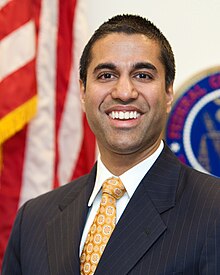
Ajit Pai, Chair, FCC
Just a reminder that my annual mock awards come with no special trophy, stipend, certificate, etc.; maybe a few dozen pageviews and modest exposure in cyberspace.

No, I didn't pick Trump again; it wasn't because he wouldn't agree to a deal to praise my blog or Twitter account. Last year Trump was an obvious choice because of  his unlikely nomination and even less likely victory over Clinton, who had dominated their pairwise polls over the preceding year. It certainly wasn't an attempt to replicate Time Magazine's own choice (in fact, I don't remember reading their announcement at the time). Be clear: I was, then and now, a Never Trumper, but I was a Never Hillary person, too. There was a moment or two after I changed party affiliation to the LP after Trump clinched the GOP nomination I had flirted with the idea of casting a protest vote for Clinton, but given Clinton's lead in the polls, I never really seriously considered it. Granted, I had been curious why the Bush-Clinton fatigue that killed Jeb Bush's candidacy hadn't also hit Clinton's campaign, and even in Trump's election, I saw merit in the end of the Bush-Clinton era of politics.

So who did I consider this year? Well, obviously, you could argue that Trump's first year in office has been consequential; I've never seen the nearly daily soap opera--high-profile resignations, clashes with the press, threats of renewed conflict with North Korea, the unilateral recognition of Jerusalem as Israel's capital, failed ObamaCare reform, the tax reform kerfuffle, the seemingly endless Twitter provocations, the anti-Muslim travel ban, inappropriate comments on judicial proceedings, etc. I despise his economic illiterate positions against trade and immigration. Nevertheless, Trump has had certain silver linings, like his constructive regulatory reform and judicial appointments, particularly Justice Gorsuch. But there were other developments which were more significant and worthy in my judgment, including but not restricted to:

  • The Rise of the FANG Stocks, i.e., Facebook, Amazon, Netflix, Google. All of these are centered in the sweet spot of the surging Internet economy. Much of the stock market rise this past year is due to their success. It's also been a day of reckoning for many brick-and-border chains struggling to compete in a transformed marketplace; some, like WalMart, are shrewdly mounting a late but impressive initiative (including free pickup at local stores). I thought that Time Magazine, with its shortlisting of Bezos, Amazon's CEO, came closest to the trend. In fact, my employer's recent Christmas party, featured Amazon device door prizes. (I already owned a Fire stick, Fire tablet, and Echo Dot. Amazon's signature eclectic Prime membership not only covers free 2-day shipping but free video, music, and reading content)
  • The End of the ISIS Caliphate. We need to be wary of repeating George W. Bush's notorious "Mission Accomplished" moment; there are still a number of very dangerous militants out there, and I'm worried about Trump's continued intervention of Obama's drone wars and the recent unilateral Jerusalem recognition as Israel's capital.
  • The Overthrow of Zimbabwe's Mugabe. The economically ruinous policies of the socialist Mugabe is a step forward towards freedom and a more open economy. Can we dare hope the liberation of Venezuela is next?
  • Bitcoin and Blockchain Technologies. There are a number of trends I'm bullish on (although not necessarily at current prices), including cybersecurity, biotechnology, robotics, and cloud computing. Anyone not aware of the market-leading digital currency isn't paying attention; at the beginning of the year a Bitcoin had a market value of under $1000.  The latest quote from Google shows a current value over $15,000. Just a month ago it was about half that. We are seeing volatility unlike anything I've seen like up to 20% daily spikes or corrections. Comparisons to Tulip Mania are already being made. Obviously a decentralized currency has an obvious appeal to us libertarians, wary of inflationary fiat currency policy, legal tender laws and central bank monopolies. But I think the real story is Blockchain which has all the markings of a disruptive technology, particularly in financial services.

Who earns my choice? Ajit Pai, the pro-market FCC chair, who has signaled that he is prepared to rollback Obama's regulatory foothold of government interference under the misleading oxymoron construct of so-called "net neutrality".  This is one of the bright spots in a Trump Administration which in other areas seems to be expanding the imperial Presidency, and it seems one of the things that authoritarian Statists do is try to regulate content and/or other policies over the Internet.

Saturday, December 17, 2016

Man of the Year 2016

Via Mother Jones
I picked this picture especially because Trump hates it--but it was his decision to give a goofy expression in public.

I was somewhat annoyed when Time Magazine selected Trump for its award, because that had zero to do with motivating my decision; I was initially surprised because I thought Indian PM Modi had been selected (but it turned out he won the readers' poll, not surprising given a high number of Indian-Americans in Silicon Valley elsewhere). [Modi would not win the support of libertarians, although he ran as more of a free market guy back in 2014, because of his manipulation of currency, essentially cancelling certain higher currency notes except for limited nominal exchanges; this is presented as an anti-corruption measure, an attack on the black market. This is not the first time demonetization policy has been tried in India. Modi is trying to address the symptoms rather than the disease; you have a counterproductive top-heavy government bureaucracy which is supported by taxing more successful sectors of the economy, which is dysfunctional (the old law of supply and demand). Government tax and regulatory burden must be lower and more universal/consistent. If and when government abuses its money monopoly, the long-term response may well be exploring digital currency, e.g., Bitcoin, beyond the government's control.]

Why did I select him? Certainly not because of his nationalist policies and rhetoric, not because of his economically illiterate and disastrous policies of mercantilism/anti-trade, anti-immigration, his disregard of individual liberty (e.g., eminent domain, data privacy, etc.) I despise his manipulative, opportunist populism. Even his signature position against immigration was blatantly disingenuous; he had publicly attributed Romney's 2012 loss to the latter's self-deportation immigration stance: is a policy that implies use of force in deporting unauthorized immigrants any less cruel?

I found Trump's behavior obnoxious and unfit for the Presidency: launching unprovoked personal attacks against Rosie O'Donnell, Megyn Kelly, McCain, Carson, and others, inflammatory claims of the Mexican prisons being emptied across the border, etc. His obsession with Twitter is not a productive use of time. His knowledge of policy is paper-thin; he doesn't seem to understand the principle of federalism (the separate powers of state and federal government); he has no public policy track record. He openly admires strongman authoritarian rulers, like Putin, which troubles me: an imperial Presidency conflicts with the ideals of liberty.

Then why choose him? Well, his election is one of the biggest upsets in political history; even I didn't see this one coming. Clinton often had up to a 2-digit percentage lead consistently in head-to-heads over the prior year to the election; only a couple of national polls showed Trump leading and the "smart money" had Clinton with an almost 80% chance of victory. The black vote was less than under Obama, and Trump did better among black men (somewhere around 16%) than his predecessors. Even around 1/3 of Latino voters came out for Trump, which many had written off over his blunt immigration rhetoric.

His unorthodox path to the GOP nomination was unlikely: who would have thought that Republicans, after getting burned by class warfare attacks on multimillionaire Mitt Romney in 2012, would have turned to an ever richer nominee and even less public service experience? Trump's anti-trade and anti-immigrant policies departed from past GOP Presidential policies.

I still don't understand why GOP voters would turn to someone who just 10 years ago was a registered Democrat, who publicly attacked popular George W. Bush's policies and flip-flopped on past stands (abortion, immigration, etc.), even within the campaign (refugees), and who refused to address entitlement reform. Even worse, he had contributed to his coming highly unpopular opponent (Hillary Clinton)'s past campaigns.

Still, there was a time when the three insurgent candidates (Trump, Carson, and Fiorina, not one of whom spent a day in the public sector) amounted to 60-70% of early poll support, and you had 14  experienced governors and legislators, basically squabbling over who got the opportunity to face Trump. I had seen polls suggesting, like Dole v. Buchanan in 1996, the conservative survivor would consolidate the anti-Trump vote. But Cruz himself was almost as unpopular as Clinton, and Trump had survived the Southern primaries with a huge lead so he could win majority votes in the NE/mid-Atlantic primaries.

Trump expertly played conquer-and-divide, and voters were much more reluctant to support the perceived Establishment-supported candidates, like Jeb Bush. They bought into the notion that Trump's wealth made him "incorruptible" and his 6 bankruptcies were a feature, not a bug. But Trump also ran an unpredictable campaign and exploited his opponents' initial reluctance to attack him (because they hoped to attract his supporters if and when his campaign crashed and burned). He additionally ran a shoestring campaign, manipulating the national media into almost $2B of "free" coverage. His opponents were less successful and starving for press attention.

Trump was able to exploit a change election year, even with Obama's high approval ratings and his endorsement for Clinton, where two-thirds don't like the direction of the country. There was a sense that Clinton had "earned" and deserved her nomination, but voters no longer believe in the elitists' agenda works to their advantage. More importantly, the election ended the long Bush/Clinton era which has spanned decades. True, Clinton had found it difficult to dispatch socialist gadfly Bernie Sanders. But maybe the Democrats didn't get the message voters were sending with Jeb Bush's failed candidacy.

Trump brilliantly exploited the people's dislike for political correctness and sold himself as a successful businessman who knows what it takes to create jobs; he was also able to dismiss his more experienced opponents as part of the problem, not the solution. His opponents were unable to counter his attacks effectively.

Saturday, December 19, 2015

Man of the Year 2015

The Year of the Economic Nationalists

Marine Le Pen, National Front France via Business Insider
Donald J Trump via votesmart

Sen. Bernie Sanders, I-Vt.
Bernie Sanders via USA Today
Wikipedia defines economic nationalism as:
a body of policies that emphasize domestic control of the economy, labor, and capital formation, even if this requires the imposition of tariffs and other restrictions on the movement of labor, goods and capital. In many cases, economic nationalists oppose globalization or at least question the benefits of unrestricted free trade. Economic nationalism may include such doctrines as protectionism and import substitution.
Now control of the economy is not necessarily left- or right-wing; it's simply authoritarian. (Some leftists argue that authoritarians are exclusively right-wing; there are studies of left-wing authoritarianism, e.g., here.)

It's not that difficult to find examples of these policies. For example, "progressives" are furious about the current omnibus bill which finally relaxes a decades-old ban on US oil exports. The net effect of the ban has been to limit the market to domestic suppliers, which favors domestic buyers. In fact, over the last few years, West Texas sweet oil has trailed the more global Brent price. Much domestic oil is easier to process and should, in theory, command a premium price. The leftists/populists think that artificially low crude prices under an export ban should translate into lower prices for refined products like gasoline and heating oil. This is not just a left-wing phenomenon; right-wing populists like Bill O'Reilly often bash the "oil speculators" and see some corporate conspiracy against the little guy behind "high" retail prices. (He's less likely to gripe about declining prices in the current global glut.)

A lot of it has to do with labor protectionism; countries see exports as a way of boosting employment but see imports and immigration as threats to employment, a "race to the bottom". Labor unions try to restrict competition through regulations like occupational licensing and minimum wages. Consider this excerpt from Bernie Sanders:
Bernie Sanders
Open borders? No, that’s a Koch brothers proposal.
Ezra Klein
Really?
Bernie Sanders
Of course. That’s a right-wing proposal, which says essentially there is no United States. ...
Ezra Klein
But it would make ...
Bernie Sanders
Excuse me ...
Ezra Klein
It would make a lot of global poor richer, wouldn’t it?
Bernie Sanders
It would make everybody in America poorer — you're doing away with the concept of a nation state.…
What right-wing people in this country would love is an open-border policy. Bring in all kinds of people, work for $2 or $3 an hour, that would be great for them. I don’t believe in that. I think we have to raise wages in this country, I think we have to do everything we can to create millions of jobs.
Keep in mind that the GOP, stemming from predecessor parties like the Federalists and the Whigs, favored high tariffs, over and beyond its use as the principal source of revenue for the federal government until the sixteenth amendment, as a protectionist measure. Hoover, in fact, jawboned employers against cutting wages, worrying that lower discretionary income would dampen consumer demand and exacerbate the Depression. Unions also joined in with Big Business, knowing that pressure of import goods on prices would lead to cost-cutting measures, potentially including staffing and compensation, if not an existential threat to an employer and its jobs.

In reality, when government picks winners for protection, it also creates less politically connected losers. Take, for instance, this assessment of "conservative" GW Bush's 2002 steel tariffs:
As a result of a Section 201 (“safeguard”) investigation brought at the behest of the U.S. steel industry, President Bush in March 2002 imposed tariffs on imports of certain steel products for three years and one day. The tariffs, combined with other challenges present in the marketplace at the time and in the months that followed, boosted steel costs to the detriment of American companies that use steel to produce goods in the United States. The resulting negative impact included job losses for thousands of  American workers. The Consuming Industries Trade Action Coalition (CITAC) Foundation requested a formal examination of the impact of higher steel costs on American steel-consuming industries, and in particular, a quantification of  employment losses at those companies. This study employed straight-forward and widely accepted regression analysis using a variety of price and employment data to maximize the reliability of the results. We found that:
• 200,000 Americans lost their jobs to higher steel prices during 2002. These lost jobs represent approximately $4 billion in lost wages from February to November 2002.3
• One out of four (50,000) of these job losses occurred in the metal manufacturing, machinery and equipment and transportation equipment and parts sectors.
• Job losses escalated steadily over 2002, peaking in November (at 202,000 jobs), and slightly declining to 197,000 jobs in December.
• More American workers lost their jobs in 2002 to higher steel prices than the total number employed by the U.S. steel industry itself (187,500 Americans were employed by U.S. steel producers in December 2002).
Artificially high prices subtract from alternative consumption or savings (future consumption), which also support jobs, not to mention leave the consumers better off.

I shouldn't need to explain what 15 years of low economic and job growth have meant: worse-off household income, declining assets, a decades-old labor force participation rate. Younger people have a harder time finding a job, even with a college education. This leads to scapegoats, even though government has exacerbated economic insecurity through counterproductive taxes and regulations: immigrants, refugees, liberalized trade, etc.

Trump's economic nationalism is obvious: he has argued that US trade representatives are "stupid", have given away the store to wily foreign governments; he threatened to slap tariffs on Ford vehicles manufactured in Mexico; he has promised to deport 11M immigrants, many of them productive workers supporting our economy and tax burden. His motto, to make America great again, is explicitly nationalist.

Why have I included far-right French nationalist Marine Le Pen in the group? First, she's not the only example outside the US, but second, she recently led an impressive early round of elections (although the last round went against the National Front).  There is a nationalist backlash against the a more US style free market among states, the European Union: Brussels rule trumping French policy preferences, the Syrian refugee crisis, sticky high unemployment, etc.


I am citing them, not because I agree with them (I've discussed these topics before in the blog and won't repeat them here)--in fact, being pro-liberty I am opposed to authoritarianism in all forms. But they have caught the public's imagination this year--the unprecedented Trump phenomenon in the GOP Presidential race, Sanders' unlikely summer competition to Hillary Clinton, and as cited above, the recent French elections. I find this uprising very troubling, because I know we need to do exactly the opposite of what these demagogues are demanding. I could easily see a global recession gapping into a depression if and when we engage in related global economic warfare.

Thursday, December 18, 2014

Man of the Year 2014

Charles and David Koch
In making this year's selection, part of what I wanted to do was to focus on this fall's historic mid-term elections--but who would I select? Barack Obama, whose disastrous and tragic policies have repressed economic growth and united his political opposition like no other Democrat in my lifetime? RNC chair Reince Priebus, who finally succeeded in the GOP's third consecutive attempt to recapture the Senate? RGA Chair Chris Christie, who managed to help expand the GOP governors' reach into deep-blue Massachusetts, Illinois and Maryland while staving off tough reelection opponents in Wisconsin, Kansas, and Florida?

But I finally decided to thumb my nose at outgoing Senate Majority Leader Harry Reid, whose ludicrous, quixotic attacks on the libertarian Koch brother billionaires were inspired by crackpot leftist conspiracy theorists, that the Koch brothers were "buying" elections. Libertarians are in an intrinsically difficult situation: they argue that we have to reform an unsustainable welfare state, an out-of-control regulatory state that chokes out entrepreneurship and innovation, an entitlement state where over two-thirds of the inadequately financed federal budget is spent on individual vs. common-purpose expenditures;  libertarians have to play bad cop, to say 'no' to business as usual, while social liberals/"progressives"  resort to fear-mongering the general public over changes to house-of-cards senior entitlements with liabilities exceeding the global domestic product, a Ponzi scheme far greater than anything Madoff ever dreamed of.

I have raised this point in prior posts; I have never met or been contacted by the Koch brothers or their surrogates; I've never seen or been offered a single penny by them. I do have a relative who works for one of their subsidiaries. That fact played a role in a negative personal experience. In post-2001 Chicago, my professional DBA opportunities had dwindled; I had a particular in-demand specialization doing upgrades of Oracle's ERP software (E-Business Suite). I had gotten an unsolicited project-availability query from a third-party agency on behalf of an undisclosed Kansas client. (Quite typically the agencies will not disclose salient details in fear, say, of tipping off a candidate who might cut a deal directly with the client, something I've never done.) Upgrade projects typically run from a few weeks to a few months; I normally asked for a very competitive hourly rate plus expenses, a fraction of what Oracle Consulting had charged for my services. The gig had progressed to the point I was asked to book my first week of travel to Wichita, and the client was identified as a Koch Industries entity.  I had not been in Kansas for years, and I thought maybe instead of going home my first weekend, I might stay with my relative and contacted him. Instead of responding positively to an unexpected visit, he went apeshit, screaming incoherently about a company nepotism policy--never mind the relative did not know the specifics of what I did for a living, never presented me with any information about Koch opportunities and did not work for the operating unit in question. Almost immediately after my call, my contact with the agency in question went completely dead--no returned phone calls or emails. I had pulled myself off the market for the gig and did not have a fallback position. I had no interest in permanent employment in Kansas; it boggled my mind that Koch would drop a win-win contract over the incidental fact of my relative's employment status. Years later my relative contacted me, saying that Koch had reformed their nepotism policy and encouraged me to apply; I suggested that the Koch brothers might do something anatomically impossible;  they hadn't merely burned their bridges to me, they had nuked them.

As most people know, David Koch ran on the Libertarian Party ticket in 1980, the same year I stood in a Texas Democrat precinct caucus for Ted Kennedy. As David Koch said during a recent Barbara Walters interview, he's socially liberal (e.g., gay rights agenda, abortion) but an economic conservative (i.e., free markets, sound money, etc.) There is no question that the GOP's stances with fewer regulations, lower taxes and spending, pro-trade, etc. are more consistent with his free market perspective than the Democrats' centralized Statist views; there can be little doubt that Statist policies exacerbate poverty and other issues. As to a more socially liberal agenda, keep in mind that the GOP are not running on an agenda, say, to criminalize gay relationships, to implement a federal ban on early-stage abortion, etc.; for the most part, conservatives want to devolve social issues to state/local regulation. "Social agenda" items include things of the government "leave me alone" variety: e.g., decriminalize victimless crimes, keep your nose out of my private communications, etc. Some "conservitarians" like Rand Paul, Massie and Amash do address these issues, although we're still in the minority of the GOP.

Is the GOP the reality of a libertarian's dream? No. It's still an uphill battle to shelve the Patriot Act, to stop perpetual military interventions, to defend civil liberties given a sympathetic law-and-order perspective, to balance the budget, including shrinking the bloated Defense budget. But the GOP is the only game in town when it comes to reforming the Fed (in particular, ending the full employment mandate), addressing the unsustainable federal budget, and devolving authority and  resources to the states. Unless we deal with the collapse of economic liberty and the subsequent rotting, morally hazardous, welfare state that robs people of their liberty and dignity and makes them slavish dependents on the fruits of legal plunder, it's difficult to know how we manage to restore other aspects of liberty.

Sunday, December 15, 2013

Man of the Year 2013

The Rise of the Libertarian Republican:
Rand Paul and Justin Amash


Sen. Rand Paul (R-KY) led historic filibuster on drone policy at Brennan CIA chief nomination
Courtesy of the Grey Lady
Congressman Justin Amash (R-MI) , courtesy of AP via Politico
NSA Reform Amendment drew significant bipartisan  support
I don't want to set unrealistic expectations here; for example, a bipartisan majority steamrolled over libertarian resistance to renewal of the Patriot Act in 2011. And Congressman Amash found himself stripped of his coveted Budget Committee membership after last year's election (House GOP leadership was unhappy with his more libertarian/independent voting record). Speaker Boehner has been chafing over an increasing assertiveness of a conservative/libertarian coalition dissatisfied with baby steps on fiscal and healthcare reform; he has accused Tea Party and conservative groups of putting their ideological agenda above the interests of the American people in the ObamaCare defunding government shutdown several weeks back (which showed the GOP taking a temporary hit in the polls before the ObamaCare website debacle) and the recent Ryan-Murray budget compromise. (Note that the bipartisan vote for the compromise carried better than 3-1.) Big businesses, disliking uncertainty over federal fiscal policy, are openly talking about backing more conventional challengers to, e.g., Justin Amash.  Certainly to the extent Boehner is taking on these groups, he feels that he is holding the upper hand and doesn't consider them a threat. I certainly don't underestimate the difficulty of finding common ground with a spendthrift Dem-controlled Senate and White House, but, for example, we felt the recent Ryan compromise as a giveback on the hard-won sequestration achievement.


So in what way do I consider the year of the libertarian Republican? After all, the Dems would not be constantly and ludicrously attacking the Tea Party, if the soundbite didn't work in focus groups; the Tea Party has become a pejorative, a scapegoat for dysfunctional Washington. As I've mentioned, Speaker Boehner has become more assertive in his criticism.

I think the answer is, we have to recast what we consider political victory. The Democrats have taken big hits on ObamaCare and can't co-opt blame with the GOP because not one Republican voted for it; it's not just a badly implemented website. Gitmo is still open; 5 years into a recovery, the economy still isn't adding enough jobs to make a dent in the long-term unemployed picture. As senator, Obama promised to cut the deficit in half (from Bush levels) and voted against raising the debt ceiling.  He had concerns over our involvement in the Middle East/Gulf Region;  he did not support Patriot Act fishing expeditions, and the unilateral use of military force by the President (vs., say, his actions on Libya, drones, etc.) Many Democrats have been uneasy over President vs. Senator Obama's policies. This has provided an opportunity for libertarian  Republicans to fashion a distinctive agenda with bipartisan appeal.

Ron Paul started this agenda by working with Alan Grayson on a limited Fed audit a couple of sessions back, and he did get a more comprehensive audit bill to pass the House last session (although Reid killed it in the Senate). Rand Paul used the nomination of counter-terrorism guru John Brennan  to protest drone policy being extended by the Administration over domestic skies.  (I have also been sharply critical of Obama's use of drones in countries which Congress has not specifically authorized: I consider the use unconstitutional, and as for domestic purposes, I have constitutional objections to any use without due process for any relevant target.) There was a 'Mr. Smith Goes to Washington' look and feel to Paul's filibuster that captured the nation's imagination.

Then Amash, in the wake of the Snowden NSA revelations, got  205 votes bipartisan votes, a baker dozen votes shy of carrying (or 7 vote flips) in reining in the NSA.

What's next on the libertarian Republican agenda? Can they maintain their momentum? Well, Amash is preparing to make another go at NSA reform. I'm not sure; at some point, I think we could see movement on federal decriminalization of marijuana on tenth amendment grounds, given decriminalization in certain states. (Note: I personally oppose weed, but I'm worried about the high cost of  prosecuting the ineffective War on Drugs and among the highest incarceration rates among the developed economies.) I could also see a more pointed attack on ObamaCare, in particular the universally despised IPAB and attempts to address the federal government's exposure in the college loan bubble and home mortgage market. There are possible issues with so-called financial reform (and "too big to fail"), and corporate tax reform is long overdue. But I also expect the Obama Administration to continue to overplay its hand, just as it has in aggressively pursuing leaks and whistleblowers.

A number of other libertarians have singled out Snowden for Man of the Year honors. As I explained in a recent post, I do think the American people have a right to know about the government spying on them without due process (like a warrant). However, he violated his contract and the conditions of his security clearance, and his theft went beyond the published NSA revelations.                                                                                                                                                                                                                                                                                                                                      

Saturday, December 22, 2012

Man of the Year 2012

The Year of Monetary/Fiat Currency Meddlers
  • Central Bankers
  • Ben Bernanke, US Fed Chief
Courtesy of Google
  • Mario Draghi, ECB Chief
Courtesy of Google
 National Leaders
  • Shinzo Abe, incoming Japanese PM
Courtesy of Google
  •   Cristina Fernández de Kirchner, Argentinian President
Courtesy of Google
  •  Hu Jintao, President, People's Republic of China
Courtesy of Google
While Time website voters chose the latest descendant of North Korea's fusion Communist monarchy and its insipid, self-deluding editorial board chose Barack Obama for the second time in 5 years, putting lipstick on a pig of his dismal record (skipping by his more than doubling the public-held debt, the first credit downgrade in US history, his failure to produce a viable budget or address out-of-control entitlement spending, his utter lack of proactive leadership (e.g., his procrastination on expiring tax cuts in 2010 and 2012 and on the debt ceiling last year), material policy failures (e.g., civil liberties, climate change and immigration), his expanding, unsustainable  house of cards of government meddling in health care, i.e., ObamaCare (disingenuously promoted as "deficit-reducing" using accounting gimmicks like cost-shifting and double counting), responsibility for the trillion dollar college student loan bubble, the lowest labor force participation rate (for which he has no response except excuses and finger-pointing), "financial reform" which implements a crowning jewel of crony capitalism, "too big to fail",  escalating drone attacks and meddling in the Middle East, more than doubling American casualties in Afghanistan, and much more).

Is the emperor wearing clothes? We now seem to be in the age of the printing press. This is NOT a turn for the better: fiat currency is faux wealth; it  is simply a medium for exchange--it doesn't create goods or services, the real economy. The absolutely last thing we need is a vicious cycle of "beggar thy neighbor", in a race to the bottom, to export a country back to prosperity on the backs of other countries' consumers. The same holds true of rigging interest rates; artificially low rates encourage malinvestments and punish saving and future consumption. But the real problem with government printing is the loss of purchasing power and/or ruinous inflation.

Being named in this post is no honor but it reflects power and influence over an economy;  that power is intrinsically illusory, wrong-headed, anti-consumer and disastrous in the long term. I believe in free markets and the free market, including floating currencies. Monetary policies create uncertainty and obfuscate business decision making. The above list is not intended to be exhaustive, but illustrative. I will briefly comment on each leader.

Ben Bernanke is listed for the this "honor" a second year in a row. Why? Among other things, Bernanke has been a beneficiary as foreign investors have looked for the safety of the world's reserve currency in the midst of the European crisis.  However, Bernanke has vowed to maintain quantitative easing (bond-buying) and indefinitely keep interest rates near zero for most of Obama's Presidency, well below the core rate of inflation, at least until official unemployment is 6.5%. (In part, Bernanke is hoping that the real interest rate below zero will get savers to spend or invest rather than risk further real erosion of their savings: he himself takes credit for stock market growth. In tact, bargain-basement mortgage rates have boosted the home builder sector. However, China and Japan, the largest foreign holders of US debt, have shown little appetite for buying new Treasury debt, leaving the Fed to pick up the slack, essentially monetizing the debt.

Draghi is extending some of the same Fed powers and policies in a European context. The ECB has gained supervisory oversight of European banks and  motivated by investor reluctance to buy Italian and Spanish government debt,
The ECB had long resisted using its most powerful tool—its printing press—to save struggling European governments from the debt crisis. The Bundesbank, Germany's influential central bank, warned of dark consequences if the ECB tried that. Now Mr. Draghi, the ECB's Italian chief, was signaling that it would defy its biggest shareholder .By agreeing to create money to purchase struggling countries' debt without limit, the ECB has ushered in the decisive phase of Europe's battle to save the euro. 
Shinzo Abe has vowed to weaken the yen to bolster Japanese exports and snap the Japanese economy out of its generation-long deflationary slump. (Of course, be careful of what you wish for: inflation hurts consumers, bondholders, and costs of doing business including imported commodities in a country with limited natural resources, especially energy, and other goods.)

I have criticized President Cristina Fernández de Kirchner on multiple occasions. Persistent high double-digit inflation has resulted in major protests; the government has been publishing unrealistically high GDP numbers, low inflation numbers and criminalizing independent, higher numbers, exacerbating tensions with the IMF.

I'm not engaging in China bashing in the pegged currency manipulations. (In essence in a trade imbalance, the demand for yuan exceeds the supply .To satisfy the demand the Chinese central bank prints yuan and buys dollars; it has then used dollars to purchase interest-bearing US Treasury bonds (among other things). To control domestic inflation, it sells domestic bonds. See also here.  Peter Schiff has a very good relevant essay here.) But by manipulating the market the Chinese pay more than they should for imported resources and consumers are worse off. The Chinese economy succeeds despite of, not because of central planning and political monopoly.

Monday, December 26, 2011

And the 2011 Man of the Year Is...

Photo of Ben S. Bernanke
Chairman of the Fed Ben Bernanke
Photo Courtesy of the Fed Reserve
There are a number of big stories this year: the largest majority GOP House in decades,  in particular influenced by the Tea Party rebellion to an out-of-touch progressive President and Congress, and its titanic struggle with Senate Democrats and President, working hard to consolidate and make permanent their superspending ways in the 111th Congress; there was the contrived counter-revolutionary Occupy Wall Street, a motley crew of dissidents trying to scapegoat the upper 1% based on flawed economics; there were the epic state budget battles, particularly in Wisconsin, Ohio, Illinois, New York and California, with Gov. Scott Walker (R-WI)'s  public sector reforms opposed by privileged public sector unions; there was a tumultuous year in foreign policy, especially in dealing with the "Arab spring" Middle East, with Obama aggressively expanding the scope of drones and intervening in Libya and elsewhere; there was the volatile, most wide open GOP Presidential race in decades.

Within this context, I considered Mohamed Bouazizi, the Tunisian whose death sparked a cascading set of popular revolts across the Arab world, notably Egypt and Libya; Hillary Clinton who, as Secretary of State, has had to deal with a number of international crises; Governor Scott Walker (R-WI); and Grover Norquist, whose "no-new-tax" pledge has played a pivotal role in Congressional and GOP Presidential politics.

But to me, the big story of the year has to be the global economy, in particular, the cascading fiscal crises spreading across the European union, shaking the euro, a key currency competitor to the dollar. The budgetary crises were inevitable: a slow-growing or even declining population, expanding retirement lifespans without additional revenues or reserves to accommodate pensions, government employment regulations which discourage new hiring, an increasingly unsustainable social welfare net unable to keep up with increased demand, and sluggish economies. We are seeing a cascading affect on various countries, with Greece, Ireland, Spain, Portugal, and Italy (all of the above except Italy with deficits running at 10% or the above in 2009 and heavy national debts overall). Even France and England have seen strong protests to modest reforms in things like phased age eligibility for retirement and increased user shared costs for universities. One can only wonder how German Chancellor Angela Merkel, listed by Forbes as the most powerful woman in the world, can continue or extend policies potentially morally hazardous, aiding irresponsible European neighbors.

I have not focused to date in this blog of a very important event that occurred at the close of November. Consider the following summary from PIMCO's Crescenzi:

Federal Reserve Chairman Ben Bernanke continues to show he is one of the few true deciders these days on the global policy stage. On 30 November, the Federal Reserve, along with five other central banks including the ECB, announced enhancements to their existing U.S. dollar liquidity swap arrangements. These provide for the Fed to swap dollars in exchange for other currencies, in unlimited amounts, through 1 February 2013, at a rate of about 60 basis points (bps) – down from about 110 bps previously....For Europe, the swap line enables the ECB to borrow dollars and then lend those dollars to European banks, which are sorely in need of funding because the world is playing hot potato with their debts...Keep in mind that any use of the Fed’s swap facility expands the Fed’s monetary base: All dollars, no matter where they are deposited, whether it be Kazakhstan, Japan or Mexico, wind up back in an American bank. This means that when the Fed’s swap line is used, the Fed will create new money. This in some ways makes the swap line a backdoor way to engage in quantitative easing.

Crescenzi is a big Ben Bernanke fan, which was clear in an earlier post, "Ben Bernanke the Decider":

[Filling the void of leadership] is Ben Bernanke, the veritable Sultan of Swat. From the very beginning of the financial crisis, Bernanke has been unflinching and audacious, never compromising, going to bat for the American people even under great criticism. Where political leaders have failed Bernanke has succeeded in providing continuous leadership at a time of crisis. There are many who are nonetheless critical of Bernanke and the Fed, believing the Fed’s actions pose substantial costs and risks to the United States...While it is true that the lowering of interest rates and the creation of $1.6 trillion of excess bank reserves poses substantial risk to price stability, this notion applies only when the transmission effects of monetary policy behave normally... what is both remarkable and instructive for the outlook for monetary policy is how active the Fed remains even though it has reached the zero-bound for interest rates. We today find ourselves contemplating a long list of potential Fed actions, ranging from several variations of QEIII to an abundance of communications strategies, including the potential for targets on inflation, growth, and/or employment, or perhaps guidance related to the size of the Fed’s balance sheet. 
Among other actions taken at the end of November was the Chinese agreement to lower its bank reserve requirements, which have been pumped to help constrain inflation hitting lower-income people (e.g., food and energy prices). The worry in this regard is the increasing global importance of a vibrant Chinese economy which has led to huge imports of materials from, say, Australia, South America, and Africa.

Crescenzi rightly points out that the European government bond problem is one of chickens which have come home to roost. The European central bank rightly focuses on price stability but it is prohibited from lending to governments (versus banks). It is also clear that the Europeans failed to require individual countries to make the tough decisions necessary in order to provide a sound base for the euro currency.

I agree that we are not going to see a significant lift to lending until we see American businesses and individuals feeling more confident in a secure economic future with a government that has learned to operate within its means and a more limited agenda. But among other things, I think that Ben Bernanke's activism is disconcerting; I am not heartened by the fact that the Chinese realize that soaring food and energy costs are a problem, but Bernanke has signaled that near zero interest rates will continue to be the policy for the indefinite near future. Just as European banks' chickens have come home to roost, a world awash in dollars is not going to end well.

The idea that we shouldn't increase interest rates because banks aren't lending anyway is, in my opinion, wrong-headed; raising rates now would signify that the US is going to defend the dollar for intrinsic reasons (not simply as a refuge from a sinking euro). A stronger dollar would enable us to manufacture value-added products at a more competitive price and make the dollars of lower-income workers go further; inflation is a very cruel tax consequence of wrong-headed neo-Keynesian economic policies.

I have concerns about American dollars being used to shore up European banks: after all, isn't it moral hazard  by essentially helping the Europeans stabilize their current crisis instead of finally facing the hard decisions they have to make (e.g., having the European central bank buy up government bonds and  as its price, demand fiscally responsible policies?)

And I don't like the fact that "Helicopter Ben" Bernanke is pursuing an activist role without the same transparency of the Congress (e.g., during TARP). Whereas there is a lot to be said about shielding central bankers from incessant administration and Congressional demands (from both parties through recent American history) for easy money vs. combating inflation, I have problems with Bernanke having a blank check to deploy potentially trillions of dollars globally, all of which can come back to haunt us in the long run. I have not seen enough use of the bully pulpit from Bernanke in dealing with Obama's upcoming decade of trillion dollar deficits and even steeper credit bureau rating drops.

Whether or not you approve of Bernanke's moves, there can be no doubt but his has become one of the most important voices during and after the recent economic tsunami; for that reason, I'm naming "Helicopter Ben" Bernanke my 2011 Man of the Year.