Analytics

Showing posts with label quotes. Show all posts

Friday, August 16, 2013

Miscellany: 8/16/13

Quote of the Day
Fret not yourself because of evildoers; 
be not envious of wrongdoers! 
For they will soon fade like the grass and wither like the green herb. 
Trust in the Lord, and do good; 
dwell in the land and befriend faithfulness. 
Delight yourself in the Lord, 
and he will give you the desires of your heart. 
Commit your way to the Lord; 
trust in him, and he will act.
Psalm 37:1-40

Facebook Post of the Day
The "progressive" Nation magazine has finally agreed to pay its interns minimum wage. But courtesy of the Dept. of Unintentional Humor, and Making the Other Side's Point to Boot, The Nation says:"This fall we are anticipating hiring ten interns rather than twelve." - Tom Woods
As the cost of hiring interns increases, fewer interns are hired. Or what happens when you raise the minimum wage of interns?

Original Quote

This comes from an unpublished email to one of my often-cited free market economists:

Libertarians would rather kill the heretic than the infidel.

America's Longest Failed War

Former Secretary Schultz is spot on; the demand is there, otherwise there would be no suppliers, domestic or otherwise. Anyone who uses drugs in my opinion is a loser, and he or she stops being a loser by becoming healthy. Instead of spending ungodly amounts of money in law enforcement and prisons, I would really prefer to see part of  the savings used to heal addicts and other users.


Rand Paul Joins Pat Leahy on Prison Sentence Reform: THUMBS UP!

Recall my criticism of Holder's announced policy of working around charges associated with minimum sentences, that this violates the rule of law and what we really need are policy reforms originated from the Congress? It's almost as if the senators read my post:
Attorney General Eric Holder's decision not to pursue mandatory minimum sentences for certain drug cases is an encouraging step. Few have criticized the merits of his proposal, but some say that it is for Congress, not the executive branch, to take action. To them we say: we are ready. Join us.
 In just the last three decades, the federal prison population has soared by almost 800 percent. Our bill would expand that safety valve to more defendants in more types of cases and has earned support from across the political spectrum, including conservative columnist George Will, Americans for Tax Reform President Grover Norquist, former National Rifle Association President David Keene, the New York Times, Families Against Mandatory Minimums, and more than 50 former federal prosecutors and judges. 
George Will explains the motivation behind the Leahy/Paul reform:
Approximately 80,000 persons are sentenced in federal courts each year. There are an estimated 4,500 federal criminal statutes, and tens of thousands of regulations backed by criminal penalties, including incarceration. There can be felony penalties for violating arcane regulations that do not give clear notice of behavior that is prescribed or proscribed. This violates the mens rea requirement -- people deserve criminal punishment only if they intentionally engage in conduct that is inherently wrong or that they know to be illegal. No wonder the federal prison population -- currently approximately 219,000, about half serving drug sentences -- has expanded 51 percent since 2000 and federal prisons are at 138 percent of their supposed capacity. The Leahy-Paul measure would expand to all federal crimes the discretion federal judges have in many drug cases to impose sentences less than the mandatory minimums.
Of course, the real action is in STATE courts because by the Constitution, states retain police functions. Reddy and Vikram in their recent NRO post show, as usual, Obama has been leading from behind on this issue:
Since 2010, conservative legislatures in Ohio, Georgia, Pennsylvania, and South Dakota have passed significant reform packages. In all of these states, conservative governors supported the reforms and signed them into law.
Texas is perhaps the most prominent state to be involved. In 2007, the state’s Legislative Budget Board insisted that legislators would need to spend $2 billion on the 17,000 additional prison beds that would be necessary by 2012. Texas legislators were rolling in a multi-billion-dollar budget surplus at the time — but, led by house corrections-committee chairman Jerry Madden (a Republican from north Dallas), they opted to veer from Texas’s longstanding strategy of simply building more prisons. Instead, the legislators worked to develop a reform package that required a far smaller amount of money than would have been spent on prisons, and spent it on alternatives to incarceration for nonviolent offenders. These alternatives included drug courts, electronic monitoring, and enhanced parole and probation supervision. The reforms were signed into law by Governor Rick Perry. When 2013 finally arrived, Texas’s crime rate was at its lowest point since 1968, and the legislature had authorized three prison closures. Texas had succeeded while spending less on prisons.Texas succeeded in part because, unlike the federal government, its courts are not cramped by mandatory-sentencing laws. 
Of course, counterproductive minimum sentence laws did not happen on their own. For example, populist cable news pundit Bill O'Reilly sees stiff sentences as necessary given liberal justices with victimization perspectives and sees them as ways of being "tough on crime". What is there about having one of the highest incarceration rates  and the most, overcrowded, expensive prisons among the developed economies that leads O'Reilly and similar populists to believe we are "soft" on crime?

Cato Institute Event, "Immigration Overhaul: How to Fix a Broken System": Thumbs UP!

This is more of a moderated Q & A session with Alex Nowrasteh. (Note: Nowrasteh gives a more cohesive overview (versus a fragmented interview-style approach) in his ending presentation to the 2013 Libertarian State of the Union address available here. I found his discussion of how the bracero program worked and how it lowered unauthorized immigration rates in the mid 1950's compelling. In terms of citizenship, he noted the overwhelming majority of participants eventually returned to Mexico, not making use of options to gain permanent residency (i.e., a green card).)

Although I often do background research for my commentaries, I don't have the time to do exhaustive research on each topic. So for instance when I read an open borders grumpy economist dismiss the concept of work visas as a means of exploiting foreign-born workers, I was startled; most of us have been looking to fix a broken immigration system and expand opportunities for legal status work. Not everyone who comes to work here wants to stay here. For instance, I've known Indians whom intend to build up savings to retire back in India where the cost of living can be much lower. I was criticizing the work visa quotas in the Senate bill as too limited; that was my personal reaction. I wasn't aware whether the work visa issue was even being discussed by other libertarians--it seemed all the oxygen was taken by discussions of border security and path to citizenship; Nowrasteh, in fact, has a perspective which is uncannily highly consistent with mine on question after question, only he is much more familiar and dexterous with studies and statistics. One of the best Q and A's I've seen on any topic. Highly recommended.

One Blog Not Making my Blogroll

I was intrigued when I first ventured onto the Libertarian Republican blog: the first thing you see are images of Friedman, Rand, and Goldwater (?). The latter choice is enigmatic in the sense Goldwater had broken with the Old Right. Quoting Nisbet:
Of all the misascriptions of the word ‘conservative’ during the last four years, the most amusing, in an historical light, is surely the application of ‘conservative’ to the last-named. For in America throughout the twentieth century, and including four substantial wars abroad, conservatives had been steadfastly the voices of non-inflationary military budgets, and of an emphasis on trade in the world instead of American nationalism. In the two World Wars, in Korea, and in Viet Nam, the leaders of American entry into war were such renowned liberal-progressives as Woodrow Wilson, Franklin Roosevelt, Harry Truman and John F. Kennedy. In all four episodes conservatives, both in the national government and in the rank and file, were largely hostile to intervention; were isolationists indeed..
"The Old Right's devotion to anti-imperialism were at odds with the spreading of progressive culture and global democracy, the top-down transformation of local heritage, social and institutional engineering of the political Left and even some from the modern Right-wing." For example, consider the Bush Doctrine, which at one point rationalized intervention in the Gulf region as spreading American democratic ideals; Bush's radical expansion of the federal government's role in education, his encroachments on liberties through the Patriot Act and expansion of Medicare benefits were major departures from twentieth-century conservative thought; I guess I would be part of the revived Old Right.

Goldwater was an interventionist; but both he and Reagan had libertarian streaks. I'm more used to libertarians referencing Reagan; I have sometimes referred to a 1975 Reason interview. But the blog references a belief in a strong national defense. (A lot of conservatives credit Reagan's policies for winning the Cold War, and I think would prefer to promote the winner of two landslide elections than the loser of one. I'm not judging the editors; I just thought it was an odd selection.)

But the editors differ from me in a number of respects; for example, they seem to be obsessed with stories about Muslim radicals, the spread of sharia law, and various protests and violence, in the States and Europe. I do, on occasion, cover stories like how certain Egyptian Muslim radicals have been targeting Copt Christians, churches and property, but the vast number of their stories don't interest me. They also cover a lot more election politics than I do. I've tapered off my discussions of elections; I did write a recent signature Political Potpourri segment

What really ticked me off today was this post headline: "New Poll just released: Native Americans SCREAMING at Congress - NO MORE VISAS FOR LOW-SKILLED WORKERS TAKING AMERICAN JOBS."  A short while back the editors pushed a post referencing a Daily Beast smear calling Tea Partiers "nativist". The editor wrote something like "Hey! That's us--nativist"; I commented that wasn't a good thing, something like the xenophobic Know-Nothing's or KKK. I then pointed out that immigration was a win-win for the economy and criticized anti-immigrant labor protectionism. (Someone at the blog called me an [expletive deleted] on the latter point, making a judgment about Mexican worker flow.)

At least the editor is no longer referring to himself as a nativist, but 'Native American' is generally a synonym for American Indians. He's not referring to Indians, of course, but American citizens by birth. But I never thought I would have to explain the good economic growth story behind immigration to an editor with an image of Ayn Rand on the home page. No, when there is unrequited demand for labor, it will attract a supply, including the underground economy. A lot of Americans work those jobs--but often, not enough. Let me provide a case example of the counterproductive effects of state immigration laws in the rush to emulate Arizona in the Old South:
Mayor Paul Bridges of the small farming community of Uvalda, Ga., could have been speaking for counterparts all over the country last week when he pleaded with a Senate panel for passage of an immigration reform bill. The draconian law passed in Georgia in lieu of action by Congress, he said, “will only devastate our local economies.”
Georgia’s farm workers are in the crosshairs of a new law that gives local police expanded powers to enforce immigration laws, and also targets anyone who gives undocumented immigrants a helping hand. These workers are critical to the state’s $6.5 billion agricultural economy, but many have chosen to look for work elsewhere. Though the law remains suspended due to a lawsuit, the Georgia Agribusiness Council reports that farms have already lost $300 million due to a lack of workers and healthy crops have been left to rot in the field.
“This law isn’t immigration reform,” the mayor complained. “This law is government intrusion of the worst kind. It threatens our economy. It threatens our way of life. And it simply makes no sense.” And that’s the sworn testimony of a self-described “conservative Republican mayor” from Georgia.
Fear-Mongering Over Fracking


Political Humor

Other than the obvious nonsense of political correctness run amok, hey, look at the bright side: in this case, they can't say that Obama is "all hat and no cattle". No word yet on whether the rodeo clown has been banned from Halloween parties, trick or treating, or First Daughter birthday parties... But I'll use any excuse to embed my favorite Spinners hit.


Political Cartoon
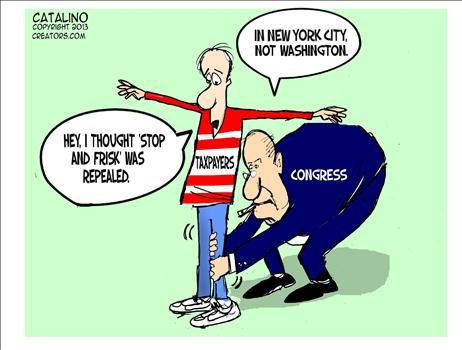
Courtesy of Ken Catalino and Townhall
Musical Interlude: My Favorite Groups Redux

The Beatles, "The Long and Winding Road". The final of the Beatles 20 #1 hits. Ironically Paul cited Phil Spector's reworking of the track as one of his reasons for leaving the Beatles. I did like the later released "naked" version (second  video)


Thursday, March 28, 2013

Miscellany: 3/28/13

Quote of the Day
But for the act to be virtuous,
the donor must give to the right person, 
for the right purpose, 
in the right amount, 
in the right manner, 
and at the right time.
Aristotle

Guest Quote of the Day

Courtesy of the Illinois Policy Insitute

Where Does YOUR State Stand on the 
Personal/Economic Liberty Index?

The BOTTOM 5: California (49). New York (50), New Jersey (48), Rhode Island (46), Hawaii (47). In case you are wondering, my current state barely missed the bottom 5:
Where Maryland fails is the personal freedom dimension, where it is the second-worst-ranked state. Maryland boasts the seventh-strictest gun control laws in the country: carry permits are expensive and rarely issued; “assault weapons,” cheap handguns, and large-capacity magazines are banned; sales are banned unless by licensed dealers; and so on. Its marijuana laws are fairly harsh as well, except that the first offense of high-level possession is only a misdemeanor, and the state has an almost-useless medical marijuana exception. Maryland’s impositions on personal freedom also include extensive auto and road regulations, tight gambling laws, a ban on raw milk, a law allowing police to take DNA from certain felony arrested, burdensome private and home school laws that require private school teachers to be licensed and effectively subject curricula to government approval, very high drug arrest rates (though incarceration and other victimless crimes arrest rates are low), lack of same-sex marriage or equivalent status (since enacted by the legislature and confirmed by popular vote), high tobacco taxes, and an airtight, statewide smoking ban. 


One Voice of Reason Off the Left Coast


Education Of, By and For the Students Teachers


A New Kind of Housing Bubble

A few prospective homeowners wrote to an investment newsletter. Here are excerpts:
  •  Having just spent a couple of years in Scottsdale, I have seen the 'local' market be propped up by Blackstone, etc. They bought the entire supply of houses regardless of condition. Propped up the real estate market overnight. - Jimbo
  • Last year, my husband and I could not sell our house for what we paid in 2002 (in Westchester County). This week, our realtor advised us to re-list at 20% over last year. Bidding wars everywhere. - Elida
  • "My wife and I moved to Las Vegas, Nevada in June, 2012. The city is loaded with vacant houses, but they're not for sale. The banks are holding them, we are told, waiting for prices to increase. We saw perhaps 25 houses and made offers on four of them.  One example: a 70,000 deal fell through, and we quickly looked the house over and placed a 70,000 cash offer. We didn't get the place, because some investor offered 80,000! That kind of thing happened several times, and we decided to call it quits and rent an apartment… - Marty
No doubt easy money is behind this speculation, and the Fed loves seeing a housing recovery, but a surging stock market and sharp price increases  in low-growth and stagnant income America are unsustainable. I would be very concerned about fickle speculators propping up prices and banks sitting on inventories of foreclosed properties.

Political Cartoon

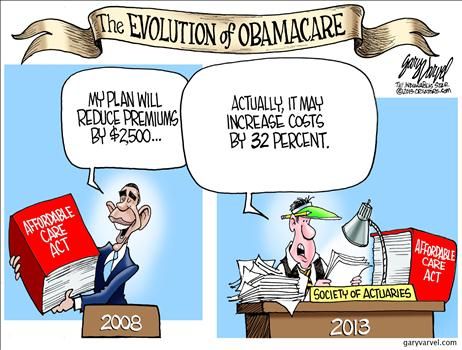
In response to the Society of Actuaries study, the excuses have already started:
"These folks will be moving into a really fully insured product for the first time, so there may be a higher cost associated with getting into that market," Sebelius said.
No, pricing reflects a government-manipulated market with special-interest mandates, and arbitrary policies that outlaw consideration of factors correlated with health costs (e.g., age).

Courtesy of Gary Varvel and Townhall
Political Humor

Remy is back parodying another clueless self-important Hollywood progressive celebrity.


Legendary singer Dionne Warwick filed for bankruptcy, claiming she has only $25,000 in assets but owes more than $10 million in unpaid taxes. She owes 400 times what she has. She could end up serving three years — as the White House budget director. - Jay Leno

[In trouble with the IRS? I say a little prayer for you.]


A new survey found that the average American stays at his job for about four-and-a-half years. That is unless they're a late-night host on NBC. - Jimmy Fallon

[Or the first man in history to run up over a $6T deficit...]

Entertainment Potpourri

American Idol. The women are all but a lock to clinch this year's crown; my top 3: Candice Glover, Kree Harrison, and (below) Janelle Arthur. (If I had to name a favorite, Kree.) I was swerved by group pairings and performances in this week's Motown themed show; I know the Material Girl was raised in Michigan, but I don't consider her Motown; hearing Kree and Janelle make my favorite hit of hers a duet was a treat (I liked the performance better than the judges). I was disappointed there weren't more mixed gender pairings (I'm so used to hearing the Temptations on "I'm Going to Make You Love Me"); I would have loved to hear a Marvin/Tammi cover, some Ike and Tina, or even an R&B ballad like "With You I'm Born Again" or "Endless Love". (I'm writing before the elimination show; they often cover other era hits.) Or a medley of "My Guy"/"My Girl". I can't stand Nicki Minaj as judge (the bisexual flirting bit is growing old--it comes across as a cry for attention), and Keith Urban is easily the best new celebrity judge in years (I'm not a contemporary country fan and have none of his material in my collection; I know he's married to a famous actress, and they have a couple of daughters).

Janelle has an innovative arrangement of "You Keep Me Hanging On", one of the best I've heard. The inner record producer wants to tweak it at points, but this is flat-out one of the best covers I've ever heard. And how cool for it was it to see Smokey Robinson, one of the classiest singer-songwriters ever, on the show? I loved hear the back story to 'Tracks of My Tears'. (If the emhedded video is not functional, try this link.)


Musical Interlude: My Favorite Groups

Earth, Wind and Fire, "Sing A Song"

Saturday, January 26, 2013

De Tocqueville, a Quote, and the "General Welfare"

Any regular blog reader knows that I love quotes: I start my signature miscellany format posts with one, and I maintain an abridged original collection of blog quotes in a webpage (see a link just below my profile on the right side of the blog).

I have, at times, come across misattributed quotes on occasion. I scrupulously check sources, within practical constraints of writing a blog and Internet-accessible resources. For example, my favorite attributed Bastiat quote is: "Treat all economic questions from the viewpoint of the consumer, for the interests of the consumer are the interests of the human race.", which is certainly consistent with Bastiat's other writings. I first came across the quote in a (Mark Perry) Carpe Diem post. Perry didn't link a source to a source in that post; I was baffled why I couldn't find that great quote on Bastiat webpages or websites.. I emailed Perry, and I think he referenced another blogger (Perry sometimes republishes the quote and in one of those posts he mentions a blogger while suggesting Bastiat wrote it while ill during the final days of his life.) I then emailed that blogger whom wrote, as I recall, that it is from a letter excerpt published in the foreword of a Bastiat volume he had purchased years earlier.

So I saw a great attributed de Tocqueville quote and found it and others at, e.g., BrainyQuote and here;
  • The American Republic will endure until the day Congress discovers that it can bribe the public with the public's money.
  • A democratic government is the only one in which those who vote for a tax can escape the obligation to pay it. 
  • A democracy cannot exist as a permanent form of government. It can only exist until the voters discover that they can vote themselves largesse from the public treasury. From that moment on, the majority always votes for the candidates promising the most benefits from the public treasury with the result that a democracy always collapses over loose fiscal policy, always followed by a dictatorship. The average age of the world's greatest civilizations has been 200 years.  Alexis de Tocqueville, also here, here, and as quoted by Maine's GOP governor
Of particular controversy is the last one; the same or a very  similar quotation, attributed in print since 1951 to the eighteenth century Scottish judge Alexander Fraser Tytler:
A democracy cannot exist as a permanent form of government. It can only exist until the voters discover that they can vote themselves largesse from the public treasury. From that moment on, the majority always votes for the candidates promising the most benefits from the public treasury with the result that a democracy always collapses over loose fiscal policy, always followed by a dictatorship. The average age of the world's greatest civilizations has been 200 years.
Great nations rise and fall. The people go from bondage to spiritual truth, to great courage, from courage to liberty, from liberty to abundance, from abundance to selfishness, from selfishness to complacency, from complacency to apathy, from apathy to dependence, from dependence back again to bondage.
The first paragraph is referred to as "Why Democracies Fail" (WDF) and the second the "Fatal Sequence". The latter  is now  attributed to a mid-1940's speech by a company executive Henning Prentis. WDF has not been traced to a known Tytler work; Collins mentioned other than the obscure 1951 Oklahoma newspaper reference (NOTE: goodreads attributes it to Elmer T. Peterson, whose op-ed appeared in the Daily Oklahoman).  There was an unanswered "who wrote this?" to WDF in the Gray Lady in 1959. In 1961 John Swearington attributes this version of WDF to de Tocqueville: "A democracy cannot exist as a permanent form of government. It can only exist until the voters discover they can vote themselves largess out of the public treasury." It really isn't until Reagan in a 1964 speech uses the quote, attributing it to Tytler, that we see it hit the mainstream.

I've seen a number of posts critical of the de Tocqueville attribution. Christopher Falle, who notes the high number of Internet search hits on 'Tocqueville' , 'Congress', 'bribe' (around 200K at my count),  intriguingly quotes Macauley's 1857 letter to Randall (Macauley is paraphrased in influential Russell Kirk's 1953  The Conservative Mind):
I have long been convinced that institutions purely democratic must, sooner or later, destroy liberty, or civilisation, or both. In Europe, where the population is dense, the effect of such institutions would be almost instantaneous. What happened lately in France is an example. In 1848 a pure democracy was established there. During a short time there was reason to expect a general spoliation, a national bankruptcy, a new partition of the soil, a maximum of prices, a ruinous load of taxation laid on the rich for the purpose of supporting the poor in idleness. Such a system would, in twenty years, have made France as poor and barbarous as the France of the Carlovingians. Happily the danger was averted, and now there is a despotism, a silent tribune, an enslaved press. Liberty is gone: but civilisation has been saved. I have not the smallest doubt that, if we had a purely democratic government here, the effect would be the same. Either the poor would plunder the rich, and civilisation would perish; or order and property would be saved by a strong military government, and liberty would perish. 
Amy Fried, who teaches American political thought and has presented scholarly papers on de Tocqueville, is incensed by the quote, which she seems to be inconsistent with de Tocqueville's 2-volume masterpiece. Democracy in America. Luckily for the interested reader, the University of Virginia has the work online. She then goes on to mount a vigorous defense of the federal government's expansion through the general welfare clause. Not surprisingly, I completely disagree and will return to the topic. I have not reviewed Ms. Fried's work, but if her post is representative, her self-cited 2000  New England political science award for her work on de Tocqueville and $5 will buy a cup of joe at Starbucks. But before continuing, I want to note that de Tocqueville devoted much thought in the second volume focusing on the dangers of democracy. Consider this excerpt from Chapter 4, What Sort of Despotism Democratic Nations Have to Fear:
Above this race of men stands an immense and tutelary power, which takes upon itself alone to secure their gratifications and to watch over their fate. That power is absolute, minute, regular, provident, and mild. It would be like the authority of a parent if, like that authority, its object was to prepare men for manhood; but it seeks, on the contrary, to keep them in perpetual childhood: it is well content that the people should rejoice, provided they think of nothing but rejoicing. For their happiness such a government willingly labors, but it chooses to be the sole agent and the only arbiter of that happiness; it provides for their security, foresees and supplies their necessities, facilitates their pleasures, manages their principal concerns, directs their industry, regulates the descent of property, and subdivides their inheritances: what remains, but to spare them all the care of thinking and all the trouble of living?
Thus it every day renders the exercise of the free agency of man less useful and less frequent; it circumscribes the will within a narrower range and gradually robs a man of all the uses of himself. The principle of equality has prepared men for these things; it has predisposed men to endure them and often to look on them as benefits.
After having thus successively taken each member of the community in its powerful grasp and fashioned him at will, the supreme power then extends its arm over the whole community. It covers the surface of society with a network of small complicated rules, minute and uniform, through which the most original minds and the most energetic characters cannot penetrate, to rise above the crowd. The will of man is not shattered, but softened, bent, and guided; men are seldom forced by it to act, but they are constantly restrained from acting. Such a power does not destroy, but it prevents existence; it does not tyrannize, but it compresses, enervates, extinguishes, and stupefies a people, till each nation is reduced to nothing better than a flock of timid and industrious animals, of which the government is the shepherd.
In fact, morally hazardous progressive government undermines the very foundation of our independence from Britain.

But the reader might wonder, what inspired this essay? A relative seems to forward a copy of every email hoax out there. I have discussed websites debunking urban legends (e.g., Snopes). One I received this week is the McCain/Obama version of  WDF email attributing "Tyler" (vs."Tytler") debunked by Snopes here. Whereas I'm sympathetic with the underlying philosophic views, I would never have posted the item in question  (that's why I discussed checking on the Bastiat quote). I thought the quote was  from de Tocqueville and researched  the topic. But whether the quote came from some unidentified work by Elmer T. Peterson, Macauley, Tytler or de Tocqueville or was written by an anonymous conservative author last century, it's still a great quote. [I've found two attributions in past posts I've corrected: here and here.]

Now let me return to the progressive delusion about using the 'general welfare' clause as a constitutional loophole.  According to the dictionary welfare refers to 'health, happiness, and good fortune; well-being; prosperity". The Constitution doesn't say 'welfare', but 'general welfare'. The states also retain powers to promote health, safety, and welfare of the community. In theory, the states retain powers (not violating individual rights). Let me give a small example to make the point. State/local officials should be empowered to contain a contagious health condition. The federal government retains control over immigration. Hence, the federal government has a responsibility to ensure immigrants do not pose a relevant health risk.

I see the federal role more as facilitating travel, residency and commerce across state and national borders. It should be reinforcing free markets among states,  insurance pooling across state lines. eliminating barriers to entry and exit (e.g., local residency requirements).

The federal government is one of enumerated and limited powers. We have all sorts of checks and balances to guard against majoritarian abuses: multiple chambers of Congress; veto override thresholds, Senate minority (filibuster) protections, judicial reviews, etc. I wrote a rant against progressive tax rates earlier this week, explicitly noting that the double standard in taxation, a violation of equal protection. Madison in Federalist #10 warned against volatile/unsteady factional government:
Complaints are everywhere heard from our most considerate and virtuous citizens, equally the friends of public and private faith, and of public and personal liberty, that our governments are too unstable, that the public good is disregarded in the conflicts of rival parties, and that measures are too often decided, not according to the rules of justice and the rights of the minor party, but by the superior force of an interested and overbearing majority... the most common and durable source of factions has been the various and unequal distribution of property... Hence it is that such democracies have ever been spectacles of turbulence and contention; have ever been found incompatible with personal security or the rights of property; and have in general been as short in their lives as they have been violent in their deaths
Obama has deliberately been playing with fire with his divisive, morally hazardous policies. We have such weighty, convoluted, unknowable laws that liberty is all but eviscerated; we have use of discretion (vs. rules advocated by monetarists) by the Fed's monetary policy, Barack Obama's use of discretion in executive orders (to bypass political opposition and compromise) and military operations (Libya) which intrinsically violate the rule of law.

For a slightly different view of general welfare, Reagan2020, sponsored by PatriotPost, presents what they call the "quintessential conservative" New Federalist platform, they present their view here. Faithful reader know I've coined the term "Free Federalist" to characterize my political views.  (There are some nuanced differences which I may elaborate in future posts: e.g., I winced in reading the discussions of trade embargoes and infrastructure construction; I prefer discussions of more principled free trade and privatization efforts. But they are closer to my views than the Dems or the GOP.)

Friday, October 5, 2012

Miscellany: 10/05/12

Quote of the Day
A hero is a man who does what he can.
Roman Rollard

Voter Quote of the Day
Berlin resident David Viger says Obama’s tax and regulatory policies have hurt and in some cases shut down local businesses. The 61-year-old auto repair shop owner says he is eager to vote for Romney.
“Romney is a successful businessman. Obama is not,” Viger said. Obama has no clue on how to run a business. Obama couldn’t run a lemonade stand.”
If Obama had his way, 16 federal agencies would be promulgating conflicting regulations for lemonade stands, checking for violations of child labor laws. and Ms. Obama would prohibit its presence on school grounds. Obama would run a $5K deficit and make the rich kids in line pick up the check.

Implausible "October Surprise" Job Numbers

Nonfarm payrolls increased only 114000, which at best merely keeps pace with new labor force entrants and what shadowstats calls statistically insignificant. So how do you get a huge Obama-favorable drop from 8.1 to 7.8, below 8.0  for the first and only full month since Obama took office. It's not good news {i'm not referring to the politics but employers don't hire with slowing GDP numbers and the Fed specifically noted the poor labor market in recently announcing QE3)--for example, lower attrition could reflect people fearful of getting a job elsewhere, or as Romney points out, people have dropped out of the labor force and hence are not counted in official statistics. There is a huge increase in the household vs. establishment survey. One can't help but wonder  if Obama is the beneficiary of some apples-and-oranges methodology change.

The Latest Nauseating Obama  Campaign  Ad

The fact is that Chinese entrepreneurs have access to a vast pool of inexpensive low-skilled labor. The Obama campaign labor protectionist nonsense is little more  than a culturally biased,economically illiterate  state of denial. One has to look at the cost of living; for example, I got my highest salary offers in California but my state income  taxes tripled, my food costs probably went up a third, and my rent up by half. A newly engaged Indian female project  manager I knew 3 years ago talked about an $1800/month apartment lease in DC; I have a good Indian friend whom will tell you how far $1800/month goes in India.

We have to respect economic liberty and stop engaging in unwanted busybody paternalism, a characteristic of this administration kowtowing to its special interest Big Labor bosses. The fact is that these jobs were based on a failing business model; even if these jobs left China they would find accommodating governments in Vietnam and other developing nations in Asia, Africa and elsewhere.

This administration is at its core anti-consumer. It is not ethical to put arbitrary constraints  on their ability to stretch their income on inexpensive goods. Perhaps labor-saving production technology can make a difference, e.g., some possibilities with 3D printing.

Don't get me wrong, This blog has been a consistent critic of Romney on China--on the philosophic grounds of free markets and free trade. But Obama is 10 times worse on those criteria.


 The Truth About Sweatshops

  Musical interlude: My Favorite Groups

 Alan Parsons Project, "The Raven"

Saturday, September 22, 2012

MIscellany: 9/22/12

Quote of the Day   
I used to say, 'Things cost too much.' 
Then my teacher straightened me out on that by saying, 
'The problem isn't that things cost too much. 
The problem is that you can't afford it.' 
That's when I finally understood that the problem wasn't 'it'
the problem was 'me.'
Jim Rohn

Economics Quote of the Day
[Adam] Smith it seemed unlikely that the “artificial direction” given to the economic efforts of society would be better than the direction it would have taken “of its own accord.”  But here as elsewhere in The Wealth of Nations, the question was ultimately not one of theory but of fact.
History showed that governments habitually mismanaged economic affairs, that such mismanagement was difficult to correct (in contrast to the market’s swift correction by bankruptcy), and the the whole bias of government projects was toward things that were big and showy rather than useful.  A government will often create works “of splendour and magnificence” to be seen by those whose applause will flatter its vanity and promote its political interests but will neglect “a great number of little works” which may have “extreme utility” but present no “great appearance” to “excite … the admiration” of passers-by.  Down through the centuries governments have been prone to operate at a deficit, often using tricky fiscal devices to conceal just how much they were in debt. -Thomas Sowell HT Cafe Hayek
This was written in 1979  isn't it amazing how prophetic Sowell was back then, we have  Democrat-controlled Senate  hasn't put up a budget in over 1000 days, a President whose own budget was  rejected even by his Senate partisan colleagues,  Obama has been pushing white elephant boondoggles like high-speed trains, Keynesian spending binges dressed up as "stimulus spending". We have baked-in spending increases for most of the budget and Obama's disingenuous idea of "shared sacrifice" is current class warfare tax hikes with deferred cuts in budget increases late in the decade to follow beyond any second term.          

There is a hot best seller largely and predictably  ignored by the fawning mainstream  coverage of the Empty Suit (by way when Clint Eastwood channeled his inner Bob Newhart with the empty chair bit, I thought it would have been much funnier if he had brought  an empty suit to put on the chair next to him]. I know for a fact that I would be at least 5 times a better President--to start with I wouldn't be a whiny bitch scapegoating my  predecessors; you know, you punk, you ran 2 years for a position you weren't qualified for; you know, man up. be careful of what you wish for; at least I have the stones to own up to my performance. There was a rumor around the time of my dissertation defense  some troublemakers might show up, and I was a cocky young academic saying to my chair, they should "bring it on."  I can think of at least half a dozen failing projects I've personally turned around. Those of us who are legitimate overachievers scoff at the pretentious Barack Obama;granted, he won the Presidency with the thinnest resume in  American history, but a yellow dog could have won in an open election with the incumbent at a record low rating; if you elected me President with a conservative Congress I would change the world.

Going back to Edward Klein's bestseller The Amateur, which  I have not read yet, the following comes from the jacket:
In this stunning exposé, bestselling author Edward Klein—a contributing editor to Vanity Fair, former foreign editor of Newsweek, and former editor-in-chief of the New York Times Magazine—pulls back the curtain on one of the most secretive White Houses in history. He reveals a callow, thin-skinned, arrogant president with messianic dreams of grandeur supported by a cast of true-believers, all of them united by leftist politics and an amateurish understanding of executive leadership.
In The Amateur you’ll discover:
  • Why the so-called “centrist” Obama is actually in revolt against the values of the society he was elected to lead
  • How Obama has taken more of a personal role in making foreign policy than any president since Richard Nixon—with disastrous results
One should note  that the cited credits are not exactly conservative periodicals;

Can lightning strike twice for this snake oil salesman? Fool American voters once, shame on you, if the American people re vote easily the worst, most incompetent President in American history shame on them

Some brief political notes: Romney is tied with Obama in the more accurate Rasmussen and Gallup polls;  if I was in the Obama campaign, I would be worried. it's not just losing the post-convention bounce (which usually dissipates} but Romney has been on the defensive  the last couple of weeks, and apparently their ubiquitous ads are not connecting. If I were Romney, I would campaign as the anti-Obama: no excuses up to the challenge, give me a GOP Congress, the same thing you gave the Democrats, and we'll put the government on a diet that goes beyond the student lunchroom. I'll let free enterprise heal the economy, while Obama can heal the planet in the private sector. I'll get the government out of the way of our businesses producing insanely great  products and services.

Congressman  Gutierrez is quoted as ensuring Obama will deliver a Latino-friendly immigration reform. This is the same scam Obama pulled in 2008, Not going to happen with a filibuster-vulnerable Senate, There was a deal on the table in 2007 which Obama sabotaged in favor of his union bosses. The idea he's going to deliver reform without revamping a visiting worker program is a pipe dream.And I'm  sympathetic on  immigration reform: trust me: any Latino who believes Obama can deliver on that promise is delusional. he couches his language on regaining an overwhelming Dem majority which won't happen. ironically just as anti-Communist Richard Nixon opened the road to Red China, Romney may be the one candidate whom can deliver comprehensive immigration reform.

Around the World
  • IDB editorial, 'You Broke Mideast, Mr. President, Now You Own It", Thumbs UP! I got an email alert over the weekend talking about Obama's surge troops now removed: was the operation worth the large casualty count?. This is mostly a rehash of Obama's amateurish foreign policy including one of appeasement to Muslim dissidents, in  particular Egypt, and critical of Israeli policies.I would have talked about the mixed message of expanding drone attacks and Obama's uneven treatment of Iran's green revolution.  There is also a possible link between the Libya consulate attacks and Obama's military actions.
  • The Argentina economy  slumping under  Kirchner the reelected widow whom has slowed growth by about two-thirds with counterproductive loose money, nationalized companies and imports and currency controls, etc, Inflation is skyrocketing  and the IMF is threatening censure.
  • ECB Bond Buying? Thumbs DOWN!  I think the bailouts amount to moral hazard. 
Unacceptable Law and Order  

A double amputee (one arm and one leg)  was shot and killed after cornering the police officer's  partner in a corner of the group home with his wheelchair and threatening him with a pen in a swiping motion. two armed officers can't disable a one-armed man without using deadly force. No excuses: unacceptable!

Musical Interlude: My Favorite Groups

The Commodores, "Oh, No". One of my favorite Richie songs, I put him next to Paul McCartney in writing memorable pop melodies; I've all but stopped listening to current music. Very few songs with a memorable hook. This song reminds me of a petite lady, one of the daughters of  a UT engineering professor. She was a math ed graduate student and shared an office down the hall from mine, and I had an unrequited crush on her.  Unfortunately for me, she was already involved with an engineer. I had expected to join the USAF as an officer (a meteorologist trainee), but I got passed over and was living inexpensively off campus trying to find work--this was before Austin, then in a no-growth, quality of life mode, grew to its present size. I used to venture onto campus to scan want ads at the library (the placement center  refused to help because I wasn't a current student); I was trying to get a job teaching at a community college to no avail. I tried to go back to pick up high school teaching credentials, but I needed financial aid; my parents refused to submit paperwork, saying they refused to enable my becoming a "professional student". My little brother was enrolled at UT, and I pointed out my parents' data were already on file, but the college bureaucrat claimed using it would violate my brother's "data privacy" (expletive deleted).

Anyway, my crush saw me crossing me campus one day and called me over. I found myself losing myself in those warm brown eyes once again. She was excited to tell me something. She proudly showed off her sparkling new engagement ring, I tried to be happy for her, but my world was crumbling down inside. There was no romantic past, but she knew I liked her; there's more to the story; she understood and handled it gracefully. We've briefly been in touch via social networking over the recent past; her family is multi-generation orange (UT Longhorn); she's a football fan, and one of my nephews had a prominent role with the marching band, but alas two of his brothers are Aggies.

Her friendship has been one of God's blessings in my life; when you love a woman you have no choice but to wish God's blessings on her each and every day of her life, even a life without you.


Friday, August 24, 2012

Miscellany: 8/24/12

Quote of the Day 
The States can best govern our home concerns 
and the general government our foreign ones. 
I wish, therefore ... never to see all offices transferred to Washington,
where, further withdrawn from the eyes of the people, 
they may more secretly be bought and sold at market.
Thomas Jefferson

Satirical Quote of the Day

Mark Perry of Carpe Diem, channeling his inner mirror Barack Obama:
Look, if you’ve been unsuccessful, you didn’t get there on your own. If you were unsuccessful at opening or operating a small business, some government official along the line probably contributed to your failure.  There was an overzealous civil servant somewhere who might have stood in your way with unreasonable regulations that are part of our American system of anti-business red tape that allowed you to not thrive.  Taxpayers invested in roads and bridges, but you might have faced city council members who wouldn’t allow you to use them.  If you’ve been forced to close a business – it’s often the case that you didn’t do that on your own.  Somebody else made that business closing happen or prevented it from opening in the first place. You can thank the bureaucratic tyrants of the nanny state.
My Greatest Hits: August 2012

If you haven't read these posts yet, here are my top five posts over the past month. I'm intrigued the top two (tied) are one-offs (not political) posts. The second one is a 3-year-old post which for some reason has spiked interest over the past month:
George Will, "Why Government Needs a Diet": Thumbs UP!

I am a great admirer of George Will, but I doubt that he's ever heard of me. We have different styles.  He is very measured and unflappable, and he has a way of hooking his audience into what he's writing or saying--he's building to a point in a compelling way that grabs your attention. It's happened to me on a few occasions; I've referred to it as being in the zone: you're talking, and you are aware that you have the attention of every other person in the room, wondering what you will say next. George Will has almost infinite patience; I've never heard him raise his voice, get excited, or interrupt someone. If someone interrupts him, it's like he bookmarks his place and resumes when given an opportunity to do so. (I'm referring a lot in this paragraph to his participation in ABC This Week's roundtable, where he is routinely outnumbered by mediocre progressives.)

What's worse is when Paul Krugman makes an appearance. Krugman is even more annoying in person than in his columns: he has this eye-rolling, dismissive, condescending, know-it-all tone; I'm dying for George Will to prick this guy's inflated ego. Will reminds me a lot of my Uncle Roger in temperament. Except I don't think I've ever heard Will crack a joke or laugh.

I've always hoped that maybe my little blog would catch the eye of some newspaper column syndicate, or maybe a newspaper would approach me about writing op-eds. (If they have, I'm not aware of it. Considering the fact a Georgia reporter reached out to me after I wrote my Zinkhan post, I'm sure they could find a way. No one has even asked to republish one of my pieces...)  I've written some things in this blog unlike anything I've ever read on the Internet. I have an eclectic style: very organized, anecdotal, frequently pointed and direct, poignant or sentimental, with touches of humor.

Any familiar reader knows that I love playing with words, double entendre. Just to give an example: one of my academic articles is titled, "What Readers Mean By 'Good Documentation'" I have used a bipolar scaling method, called the semantic differential; Charles Osgood developed the scale, and a key source book is called "The Measurement of Meaning". The relevant title refers to the connotative meanings of relevant constructs, so another semantic differential researcher would automatically understand my title in context; at the same time, I wanted to use the title as a hook to draw the curious attention of technical writers, managers, and others less familiar with research methodology.

In a similar way, George Will is using double meanings: he is referring to federally-funded anti-obesity campaigns and then the size of government itself. Cafe Hayek loves his opening line:
Because the possibility of effectively supervising government varies inversely with government’s size, so does government’s lawfulness. 
Will basically looks as certain expenditures as a sort of Big Government starter dough: e.g., using tax dollars to fund advocacy for new taxes, say, punitive anti-obesity consumption taxes. Yet this is technically illegal (as per the above quote):
The law prohibits the use of federal funds “to influence in any manner . . . an official of any government, to favor, adopt, or oppose, by vote or otherwise, any legislation, law, ratification, policy, or appropriation.
Will points out that Big Nannies try to implement one of 2 failed approaches to combat obesity, neither one really effective:
  • additional information (e.g., calorie counts)
  • punitive consumption taxes
Speaking as a fat person, I can tell you (as well as the libertarian authors Will cites) that I am very well aware of the social stigma of being fat: most women, for instance, will not even make eye contact with an obese man; clothes are difficult and expensive to buy; you get routinely humiliated in ways most people don't understand (e.g., having to use for a buckle extender on an airline flight). When I lived in California, I was routinely working long days, and my fitness club membership wasn't accepted locally. I gained weight in a stealthy manner; it wasn't so much I was eating more but exercising less. For one gig, to save on expenses, I drove to Los Angeles along I-5 and had a tire blowout (not unlike an incident I describe below). It was boiling hot, I was trying to replace my tire with stuck lug nuts. I really wasn't feeling well to begin with. There were cars traveling north, slowing down, rolling down their windows to shout out at me "Oink! Oink!", quite pleased over their (lack of) originality. I'm not singing "poor, poor pitiful me"; I take responsibility for my weight problem; I have more than enough incentives to lose weight. I know about health problems linked to obesity. It's a complex problem; changing food intake also affects metabolism

Will  points out that these type progressive incentives only work on moderate users at the margins. Sooner or later, progressives resort to coercive rules.

We need to cut government which can't even regulate its own growth to stop it from even more Draconian suppression.

An Aside: My Academic Bio Excerpt

I'm quoting below from the biography I wrote for the above-cited article. UTEP had recruited me principally to support their pending application for AACSB (business school accreditation); they had only one other published MIS faculty member, and my prospective department chairman wanted to ensure my vita (academic resume) was on file in time for the review board (not necessarily the deciding factor but probably a form of insurance).  I'll never forgot it was raining on the day of my campus visit--and El Paso boasts of something like 330 days of sunshine a year. I had gotten a new employee packet which, among other things, had a pamphlet on how to survive a rattlesnake bite.

By the time I arrived on campus, they had won accreditation, and it was a classic case of "what have you done for me lately?" In many schools, like this one, the MIS faculty are in a joint department with production logistics and/or quantitative methods professors; in this case, the chairman was a PLM professor, and he was a particularly nasty piece of work. It wasn't clear to me what the problem was; it was almost like being a high school freshman again, subject to unprovoked bullying by upperclassmen. To give a minor telling example, I was supposed to get a well-configured PC; instead, I got something out of some warped sense of humor: I think it had two 5.25" floppy drives, no hard drive, and a monochrome monitor. (For those who don't remember floppy drives, at the time there were two standard sizes: 5.25" and 3.5" media drives. I wanted the flexibility to handle both standards.) The chairman claimed that they had tried to find me (no call on my home answering machine, no message in my office mail sorter compartment) but had to make a quick decision on configuration. I eventually got a more reasonable configuration.

The situation deteriorated from there. I had befriended the resident tenured MIS professor with his own publication record whom didn't adequately brief me on what was going on. For example, the department had a popular lecturer with ties to the local business community but arbitrarily redesigned the courses he taught (e.g., he didn't teach data structures in the data structures course, and he redesigned the database course to be a practicum). We had talked about the course structure, and I came up with a course structure consistent with his. I required something like a handful of programming exercises during the semester, fairly typical, but I was astonished as more than half the class had dropped after the first week or two. I went to talk to my colleague, whom then clued me in on the fact that students didn't like the way he taught the same class either--when he was talking to me he was just describing how he thought the course should be taught, and the lecturer was getting all the students because he was known as an easy A whom didn't require computer assignments. I said, "Don't you think that I should have been briefed on this beforehand?"

In the meanwhile I had inherited this lecturer's students in my database class, for which data structures was a prerequisite, and 90% of the students didn't know what a linked list (a basic data structure) was. This was a clear management failure, in particular, the department chair. I realize that PLM professors don't necessarily understand MIS curricula, but he had a responsibility to reach out to those of us from accredited programs for our assessments.  I was angry with my tenured colleague whom had failed to exercise necessary initiative and leadership.

One of my Latino colleagues I was going to do a research project with (I wanted to focus on critical success factors for Maquiladores) had a certain reputation: the scuttlebutt I heard was that the department had once tracked him down to a hotel room where a coed answered the phone.

I've already written about a couple of my UTEP database students whom violated my explicit academic honesty requirements for assignments (see my June 12 post on the most ridiculous lawsuit of the month). I mention in the post that the Dean of Students office did a kangaroo court "investigation" of the charge, which, as I mention in the post, the protagonist herself confessed to in front of the whole class. (I had opened lecture with a warning that a couple of unnamed students had violated policy; the protagonist asked, "Is it me?" Self-incrimination in front of a whole class of witnesses? Not even Perry Mason ever managed to achieve that. Case closed. I would have made some prosecutor...)

The Dean of Students conducted a sham investigation which excluded my input in entirety and materially violated my faculty rights. It wasn't just that: he called me up one day to warn me not to carry out a totally slanderous charge made by the protagonist--it was like pulling teeth trying to get the allegation out of him--that I had supposedly threatened to blacklist her on the job market. (This was utter detachment from reality; I had no recruiter or hiring manager connections, no motive to blackmail a cheating student...But then again, I wasn't dealing with a professional or intelligent Dean of Students. How gullible do you have to be not to suspect the motives of a student whom has been caught cheating trying to make the professor the issue? It's the oldest trick in the book. I've heard a lot of Deans of Students start out as lawyers--if so, that explains a lot.)

As I mention in the other post, it later turned out that this senior had decided to use ME--a first-semester professor--as one of her references on job applications submitted before the cheating incident, without my knowledge or consent (a major faux pas)--and now was in a state of panic over what I might do or say if employers contacted me about her. (A single company, Eastman Kodak, sent me a postcard query about her. Kodak recently filed for bankruptcy; I don't know if they hired my ex-student...)

In any event, this Indian student also attended another class with this young woman; she headed his group project. She had enlisted him in her appeal, figuring that he would back up whatever case she was trying to make. It turned out that the Indian student was not going to back up her lies, and he told me that the Dean of Students (siding with the protagonist) was actually arguing with him about the facts. He finally came to see me because she had retaliated for his "betrayal" by locking him out of the class project, and he was hoping that there was something I could do. This is the same young man whom took my picture just before the end of the school year, saying he took pictures of the people whom had made a difference in his life, and I later read the back of the photo, on which he had written: "Most sincerest appreciation for some "real" education. Couldn't have made it without your help." He was on his way to the University of Virginia to pursue an MBA.

The plaque on the wall on the right side of the screen was from my 1985 ICIS Doctoral Consortium; the one just off my left shoulder was for my first IT article published in a venerable academic/practitioner IT journal. (The journal gave me the option of a small payment or a plaque.) In the lower left corner of the photo you'll see my trusty hotpot. I'm not kidding about working at least 60-70 hours per week, mostly on campus. I usually had powdered coffee, creamer and sweetener in a desk drawer. I mentioned in other posts a couple of incidents back at UWM when I was filling the same hotpot at one of the sinks in the men's restroom on my floor: in one case, a couple of guys rushed into the restroom by me and went into--the same stall. (I didn't ask; I didn't tell. I never used that stall again.)

In the other case, I opened the restroom door just to be overcome by a putrid stench. I saw a bathroom entirely smeared in excrement. The first thing I thought was, nobody is going to believe this. I called up the university police and said, "I have to report something, and you're never going to believe it." The policeman on the other end said, "Try me." So I explained, and what was probably the most amazing part was his nonchalant response: "Yeah, they've done it before on the first and second floor. It's drugs. It was only a matter of time before they made it up to your floor." I left for the evening, and the next morning I hesitated on entering the bathroom. The bathroom was spotless; it was almost as if the prior evening hadn't happened--a very surreal experience. I presume that it was some union worker(s) whom cleaned it up (hosed it down?) I've made criticisms of labor unions before in this blog, but the closest I've come to this is maybe changing the occasional baby's diaper (not that often as a bachelor uncle); whoever cleaned that up earned his pay--it's a job I wouldn't want.

Resuming my UTEP story, I was demoralized by the time DSI and ICIS (in Boston) came around; normally some academic job screenings take place at the conferences. I had a 3-year contract (or so I was led to believe: my offer letter specifically discussed, in unconditional terms, summer stipend awards over my first 3 summers at UTEP) but I did some low-key window shopping at ICIS. Louisiana Tech had made an overture, and what was unusual was the fact they insisted on doing a campus visit right in the middle of finals week; I tried to defer until the spring semester, but they were inflexible. For whatever reason, Louisiana Tech declined to make an offer. The situation at UTEP continued to deteriorate, and I finally went on the market for another tenure track position. It was too late in the recruiting cycle; the only thing I could find at that point was a 1-year visiting professor position at Illinois State.

One curious thing happened at ICIS. Unlike Mark Perry, I LOVE academic conferences. I remember the first time I introduced myself to Blake Ives. Blake Ives, a prominent University of Minnesota graduate (Minnesota was the birthplace of MIS as an academic discipline), has written or co-authored a number of well-known MIS articles (including one I've criticized in passing in this blog). He had no clue whom I was, but I name-dropped one of my former professors, Maryam Alavi (whose CACM article I proofread along with a colleague's wife, but Maryam had already sent back the proofs before I reported some sequencing problems with her bibliography, which still makes me cringe to this day). Blake just gushed when I mentioned Maryam: "Oh, I just love her."  Blake is a huge guy, maybe a foot taller than I am; what's amusing about that is that he co-wrote this one famous paper where he speaks of being unobtrusively observing MIS managers going through their everyday tasks. I just couldn't imagine an IT manager being unaware of Blake's presence.

In any event, I was at this one cocktail party when this academic heard that I was at UTEP, and he pulled me aside to ask me what I knew about my colleague. (I had read one or 2 of  my colleague's articles in passing but we had different research interests; I don't recall him trying to explore joint research projects at the time.) The academic said, "Did you know that he used to be on faculty back at Missouri-[branch school]? What do you know about his leaving?" I hadn't really thought about it. I knew the guy had a PhD from Texas Tech, probably closer than any other state university to UTEP. I figured that maybe he had some roots in west Texas. The guy was unspecific but implied that there was a plagiarism issue (self-plagiarism?); the implication was that he had been asked to leave. "Just ask him." So after we return, I asked my colleague, "I met this guy whom told me that I should ask you about what happened at Missouri-[branch]." I never expected my colleague's reaction: he was livid, shaking with rage and vowing that his lawyer would sue me if I dared to say a word to anyone else. For the record, I never discussed the issue with the administration. To be honest, I was giving my colleague the benefit of a doubt; I had no motive to threaten him. I felt if someone was talking behind his back, he had the right to tell his side of the story. I didn't even know the specifics of the allegation; when people start threatening lawyers over unspecified allegations, there really is fire under the smoke.

This guy was a creep anyway. One day he boasted while a Texas Tech PhD student of having had an affair with a prominent female PhD candidate. What annoyed me even further than this juvenile boasting of his romantic conquests was his joking ad lib to the affair, "Hey--it's Lubbock; what else is there to do in Lubbock?"

My last days at UTEP were unpleasant, and the university system still owes me money; life isn't fair, and you have to move on with your life. I had already begun to feel like I was serving a 3-year sentence at UTEP; there was a reason I did a campus visit to Louisiana before the university and I had a discussion about my leaving.

The last argument with my former department chairman dealt with commencement. To provide context, my baby sister was graduating with an accounting degree that spring from a San Antonio university. I had already made flight arrangements. Even as I was making arrangements to box up my stuff in the office, my department chairman stopped by and ordered me to attend UTEP commencement on the same day. Noting that he had given me no advance notice (I don't believe that I was asked while at UWM), I refused to change my plans.

Even my visit to San Antonio had a story to it. I used to love answering machines (before voice mail became a common add-on). I was very creative when it came to recording my outgoing messages. I constantly changed messages, did voice impersonations, jokes, quotes, whatever. People were calling me up just to hear my latest answering machine message. I swear this really happened: I answered the phone one day, and my friend told me to hang up and not pick up, because he wanted to hear my outgoing announcement!

I had been futilely arguing with my Mom (I am my mother's son) to buy one, but she refused: didn't want one, didn't need one, etc. These were the old days when you didn't have cellphones or have to arrive at an airport hours before your flight to fight through long lines and TSA security. I left myself some margin for error--but not enough for a major tire blowout on the way to the airport. It is not fun in 100-degree heat to try to budge stuck lug nuts. It took me about 15-20 minutes, but I finally mounted my spare and headed out to the airport--but missed my flight. I had to book the next flight, which I think was another 2 or 3 hours off.  None of my contacts were home. I eventually got home and someone picked me up.

And my folks finally got an answering machine.

Originally published in my Miscellany: 1/06/10 post.
Ronald A. Guillemette is an Assistant Professor of Information Systems and Mayfield Research Fellow at the University of Texas-El Paso. He received his PhD in Management Information Systems from the University of Houston in 1986. He has published several articles in the technical communication literature, and his work has also appeared in International Journal of Man-Machine Studies, Information & Management, and ACM DATA BASE. His research interests include human factors in MIS, information systems engineering and behavioral analysis and measurement. Dr. Guillemette is a member of ACM, DSI, IEEE Computer Society and the Academy of Management.
Political Humor

They're now worried that Tropical Storm Isaac could hit Florida during next week's Republican convention. But Florida is ready for it. Thanks to President Obama's economic policies, many businesses down there are already boarded up. - Jay Leno

[And the banks have volunteered to help with the evacuations of homes with underwater mortgages.]


It’s now being reported that Joe Biden will go to the Republican convention to try to cause problems for Mitt Romney. Then after that, he will go to the Democratic convention where he will definitely cause problems for President Obama. - Jay Leno

[The good news for the Republicans is that the 1912 GOP convention was held in Chicago.]

Bonus celebrity joke:


Khloe Kardashian got in an accident. She was on the freeway and rear ended someone. There was no little or no damage. On a scale of 1-to-Lohan, it was a 2. - Jimmy Kimmel

[Are you sure that it wasn't Kim Kardashian whom rear ended someone? Or maybe Jennifer Lopez?]

Musical Interlude: My Favorite Groups

Toto, "99"

Monday, July 23, 2012

Miscellany: 7/23/12

Quote of the Day 
A man may fall many times 
but he won't be a failure 
until he says someone pushed him.
Elmer G. Letterman

If thou art a man, 
admire those who attempt great things, 
even though they fail.
Lucius Annaeus Seneca

Veronica Moser, 6, was killed and her mother Ashley was shot three times and is still in surgery
Veronica Moser-Sullivan, 6 years old
Gift from God
Aurora Movie Massacre's Youngest Angel
Courtesy Daily Mail
Veronica's uncle, Robert Sierra, describes her this way: "Veronica wanted to be a princess, everybody loved her. Her laughter was infectious, when she laughed everybody laughed. She was only young but she had ambitions and goals, she wanted to go to college. She would have so much fun playing, all you would hear through the house was her laughing and giggling."

Veronica was attending the movie with her 25-year-old pregnant mother, Ashley Moser. Moser was shot in the stomach, but as of the time of the article, her preborn child is still alive. Thirteen-year-old Kaylan was heroically applying CPR on Veronica, when another, larger victim fell on top of the 6-year-old. My thoughts and prayers to all the victims and their families, in particular for the rapid recovery and good health of Ms. Moser and her preborn baby; I cannot imagine her broken heart. It's young people, young ladies like Kaylan whom give me confidence in our nation's future.


Life is a journey, sweet Kaylan... You are a remarkable young woman, and I'm proud of you.

Go the Distance (excerpt, my edit) by  Alan Menken and David Zippel

And I won't look back
I can go the distance
And I'll stay on track
No I won't accept defeat
It's an uphill slope
But I won't lose hope
Till I go the distance
And my journey is complete
But to look beyond the glory is the hardest part
For a heroine's strength is measured by her heart
Like a shooting star
I will go the distance
I will search the world
I will face its harms
I don't care how far


Reminder: H.R. 459, the Audit the Fed Bill Up 
For Vote Tomorrow/Wednesday

I believe that the House leadership will attempt to suspend the rules. Translating legislative jargon, usually bill opponents will try to weaken the effect of a bill with amendments. In essence, suspending the rules (with limited debate) is more of a take it or leave it but to carry the bill, you need to carry it with a two-thirds vote. I regard this as one of the most important votes in years: we need more accountability and other fundamental reforms of the Fed. This is a long-overdue, critical first step in the process of true bank reform: we need to stop manipulation of interest rates and the government currency printing presses.

Barack Obama Quote of the Day

The fact that we are here today to debate raising America's debt limit
 is a sign of leadership failure. 
America has a debt problem and a failure of leadership. 
Americans deserve better. 
I, therefore, intend to oppose the effort to increase America's debt.
Barack Obama
aka the $5T Man

America has a debt problem and a failure of leadership. 
Americans deserve better. 
Vote for change 2012

Political Potpourri

How many commentaries have I written on how Romney should be running his campaign? And really, it's not just Romney's abysmal campaign to date but the GOP in general (including Boehner, McConnell, Ryan, etc.): they have just been inarticulate in framing the issues.

Romney has a few glaring problems: (1) the rest of the country doesn't know him well; (2) he has earned a reputation as being unprincipled; (3) his messages have been inconsistent and convoluted. And his campaign has been doing a terrible job dealing with these.

On the third point, I was listening to an earlier Fox News Sunday regarding the Romney campaign's inept response to the ObamaCare decision. Romney called the mandate a tax (as per Chief Justice Roberts' decision) while a campaign spokesman referred to it as a penalty.

Let me comment on the health care/RomenyCare/ObamaCare issue. The Democrats are drafting off Romney's own rhetoric. They think they have taken Romney's opposition out, because of surface-level similarities between the programs. So, for instance, they talk about the freeloader problem (i.e., uncollected costs because of government-mandated emergency hospital care regardless of the ability to pay).

This is disingenuous for a reason I pointed out the NCPA health care proposal earlier this month. For one thing, the federal government already subsidizes health insurance as a tax expenditure (which I discussed earlier this week) for employer-supplied healthcare. There's an equal protection argument here: people without health care insurance should be entitled to a tax credit benefit relevant to out-of-pocket costs: they are paying higher taxes than they should to offset tax expenditures on employer-provided health care. (One of the NCPA points is for the government to offset provider uninsured costs with related tax credits.)

There are a number of problems driving up health insurance costs (including an aging population with costs correlated with age), the most critical one being deviations from free market principles and the hidden costs of health care. For example, state regulations (in particular, special interest benefit add ons) are a form of protectionism, and however well-intended, policies like guaranteed issue and community rating basically enable below-cost coverage for high-risk individuals. Subsidies are also a perversion of the free market, because they artificially lower policy costs. Health insurance really isn't insurance at all in the sense but bundled health costs: government policy is effectively a tax dodge which encourages cramming out-of-pocket ordinary health costs (e.g., birth control and preventive health care) into insurance (the equivalent of which would be like including gasoline purchases, oil changes, tolls,  etc., in your auto insurance policy). We need more vesting of the consumer in the purchase of health care goods and services. Large businesses can self-insure across states with a common basket of benefits; on the other hand, if you live in a lightly-populated state,  there may not be sufficient economies of scales: what we need is more regional or national pooling of risks.

The hidden costs include the employer share of premiums and the effects of tax subsidies. From the standpoint of business, your cost is your wages plus the business contributions to your benefits. When progressives talk about having the employer pay the costs, they are really talking about increasing the hidden costs of your compensation. From the perspective of business, this is a zero-sum with the balance of your compensation. You may THINK you are paying $7500-$10K for a family policy because that's what you see but you're really paying $15-20K.

Policies like guaranteed issue and community rating really mean high-cost individuals socializing their health expenses, i.e., paying below cost. Who makes up the cost? The other, healthier people in the program. You are paying more than your fair share, and  higher premiums in part reflect those passed along costs. Many states have risk pools where the high cost individual pays somewhat higher rates and the rest of the premium is subsidized (e.g., by a tax on premiums).

Getting back to Romney, I've argued what he needs to say something like this:
  • Massachusetts before reform had the highest percentage of the insured; government costs would be much higher in other states, and today's government is struggling to cope with existing commitments in a low-growth economy, never mind the higher costs of an aging population
  • Obama's promises of government "saving" families on policies were unrealistic, with any alleged savings more than offset by the additional costs of an older population, loss of market competition, and "free" or otherwise artificially low prices for health care goods and services driving demand exacerbating sector costs
  • The federal government cannot sustain its current health care costs, with Medicare alone over $20T in unfunded liabilities
  • Government regulations and mandates, especially from Washington, are driving up costs in the sector
  • There are market aberrations, like restricted supplies of medical personnel, government price-fixing in Medicare/Medicaid, and ordinary medical expenses, which do not properly come under the concept of insurance
Romney is getting pressed for an alternative. I have repeatedly mentioned that he should propose (as Sen. Dole did back in the days of HillaryCare) catastrophic health insurance, shoring up assigned risk pools, and allow marketing of policies across state lines.

On the tax vs. penalty question: Romney should stick with the tax angle because tax issues can get resolved through budget resolution, which is easier than dealing with a filibuster-sustaining Senate Democratic minority, requiring 60 votes for passage.

Going back to the first two points I raised: I do not like the fact that the Romney campaign is essentially letting the Democrats define Mitt Romney. Mitt Romney needs to define himself, why he wants to be President, that he's not a "finger-in-the-wind" guy or changes his mind as often as he changes his socks:
  • My trust lies in the private sector, not government intervention
  • I will bring my knowledge in managing private sector turnarounds to the federal government: consolidating operations, selling or leasing more assets (including natural resource development), and focusing on core competencies and privatizing other operations
  • I believe in old-fashioned American values, like thrift, self-reliance, and hard work, and traditional institutions like marriage, family, and church
In particular, I think he needs to define himself in contrast to Obama, e.g.:
  • we believe in decentralized authority back to the individual and state; 
  • we need to streamline regulations to promote market competition;
  • we need to cut spending across the board and streamline/simplify tax preferences and expenditures to enable lower tax rates.
  • we must confront head on unsustainable federal spending and entitlement liabilities  
I do wish that Romney would look for clearer ways to distinguish himself from Obama, e.g.,
  • the Bush/Obama record on: low-growth economic policies; unsustainable federal deficits and  spending increases; open-ended, expanding operations in the volatile Middle East and Gulf Region; and government intervention in the economy (bailouts, etc.)
  • a strong dollar policy, including reining in the Federal Reserve 
  • a significantly smaller federal footprint in terms of individual rights and the private sector
Looking at the fall elections, I've actually found it remarkable that Romney continues to do well, splitting major polls. Even in polls where Obama leads, there's a significant undecided, which I would interpret as leaning Romney. I saw a Gallup blurb earlier today touting that Romney's Bain Capital experience is regarded as a net positive by voters.

However, it looks like Romney's position in the battleground states has slightly deteriorated, no doubt due to saturation negative ads. I saw one recent electoral projection suggesting that it all comes down to Ohio. A few suggestions to Romney: Obama has been pushing his "save" of GM and Chrysler. I would take that head on, pointing out that the federal government is still in the deep red on its auto "investments", even with Obama's $7500 federal tax rebate going to upper-income yuppie purchases, Obama's favored Volt is well below sales projections. I would point out that a reorganized GM/Chrysler under traditional bankruptcy would still have sold vehicles.

But I would also point out that many of the factory closures in Ohio had more to do with unsustainable cost pressures, but we have had other higher-value manufacturing gains in the economy.

Whereas I'm not calling Senate races at this point, I think there are good chances of pickups in Nebraska, North Dakota, Wisconsin, Virginia, Florida, Montana and Missouri. I rate Scott Brown as a slight favorite to hold onto his seat in Massachusetts, and the biggest threat to GOP seats seems to be in Maine where the GOP candidate is trailing a distant second to former Governor King, an independent. I think the GOP has a decent shot at the seats in Connecticut, Ohio, New Mexico and possibly New Jersey, Pennsylvania and Washington. I'm definitely unhappy that the GOP has not been more competitive in states like Minnesota, California, New York, and Rhode Island. I'm happy with the GOP Senate nominee (Bongino) in Maryland, but I haven't heard much from him since the primary; Maryland is an uphill state for the GOP, with roughly a 2-1 registration advantage for Democrats.

A final note: it may sound as if I'm being partisan here. I'm more of a pragmatic free marketer. I have a number of issues with Republicans, e.g., Sen. Marco Rubio has not been helpful in dealing with sugar subsidies, I'm uncomfortable with Romney's China-bashing, and I share Dwight Eisenhower's concerns about the military/industrial complex. The interesting thing is how policies have flipped over time: the Federalists/Whigs/Republicans used to be the mercantilist/big government/high tariff party, and the Republican Democrats/Democrats used to be the small government/free trade/free banking party. I have always been a fiscal hawk, even during my salad days. There are few legitimate conservative Democrats today (speaking as a former conservative Democrat), and the few there are been largely marginalized by progressives locked into leadership positions. Yes, I'm very aware that Republicans have not applied the principle of small government to Big Defense, and they've done their fair share of earmarks, tax preferences/expenditures, etc.

Penn State Gets Sanctioned by the NCAA: 
A Critical Response

According to a CBS News alert:
The NCAA has delivered stiff sanctions to the Penn State football program in the wake of Jerry Sandusky child sex abuse scandal, including a $60 million fine, a four-year ban from bowl games, a reduction in initial scholarships from 25 to 15 a year and the voiding of all wins from 1998 to 2011. The school has also been placed on probation for five years. 
This is overdone, disproportionate and counterproductive. I'm sure that the NCAA believes that it is sending a message by dealing out a Draconian punishment, but I think what it's done is wrong.

I do not have a vested interest here: I have never been a student or faculty member at Penn State, and I am not, and never have been, a fan of the Penn State football team.

Let me be clear before expressing my opinion here on the NCAA action. As a conservative and a Christian in the Roman Catholic tradition, I consider that sexual exploitation, physical abuse, or negligence of minors are unconscionable crimes. Libertarians have issues with the nature and extent of positive rights of the child, i.e., what parents must do on behalf of a child, but certainly in a trustee guardian role, we would expect them to be responsible for basic developmental needs of the child, e.g., food, shelter, safety, clothing, basic literacy and life skills, etc., to be met. (Libertarians are more likely to distinguish between legal and moral responsibilities.)

First, former Assistant Coach Sandusky alone is responsible for the unconscionable crimes of which he has been found guilty.  I think that the attacks on Penn State are attempts to mitigate Sandusky's responsibility by socializing the blame.

To what extent is an institution responsible for crimes done without its knowledge or consent? The primary responsibility for reporting a crime lies with the witnesses, and as far as I know, the state is not prosecuting a case against them. I have not read the Freeh report; it would be wrong if a university official attempted to intimidate a witness from coming forward. If I'm not mistaken, the two young victims in the 2000 and 2002 alleged incidents have never been identified, the witnesses have given varying accounts of what was seen and what was said to university officials, there are questions about reliability of memories years after an event. I suspect that the reason the district attorney did not bring a case against Sandusky in 1998 was a perceived lack of evidence.

What were Schultz' and Curley's responsibilities to report poorly substantiated allegations? I am not familiar with Pennsylvania law at the time of alleged incidents. Personally, if I had been part of the Penn State University administration, especially given the 1998 circumstance: (1) Sandusky would have been prohibited from unescorted access to facilities; (2) if and when any subsequent Sandusky-related incidents came forward, I would have documented a good faith effort to follow up the allegations, encourage witnesses to report the incidents, and present to the district attorney any findings from internal investigations.

But what, if anything would the district attorney have done about the 2000 and 2002 incidents, even if they had been dutifully reported to local authorities? Sandusky no doubt would have denied the allegations, and the burden of proof would have been on the authorities. I think Schultz and Curley would have been better off leaving that decision to the district attorney.

I do believe that the university banned Sandusky from bringing a child to campus facilities after the 2002 internal investigation. I have not seen any subsequent allegations from the Penn State campus. Even if one argues wrongdoing through 2002, why is the NCAA sanctioning Penn State for crimes committed outside the campus, i.e., stripping Penn State of its victories from 2003 through 2011?

Second, the nature and extent of sanctions are arbitrary and unfair. If and when sanctions are invoked, they should be as immediate as possible after the time of the original infraction. The NCAA should not be setting rules, regulations, and sanctions on an indefinite post hoc basis: to what extent, if any, does the NCAA require registration of any alleged crimes on campuses? How fair is it to decide the rules after the game is played? How can university administrations years after the fact be held responsible for events where the quality of evidence, the reliability of witnesses, etc., deteriorate over time? How can universities address the problems to mitigate the nature and extent of sanctions if someone surfaces with allegations years after the fact?

To what extent are these sanctions comparable to those of other offenses? For instance, what about rape accusations, involvement with illicit drugs and/or steroids, gambling, etc.? To what extent should a football team be sanctioned for events not involving players?

Third, the Draconian punishment may result in unintended effects. For instance, witnesses may find themselves targeted by the local community, alumni, etc. for coming forward; we really want an environment where witnesses are supported for coming forward, not worried about being seen as disloyal or blacklisted in the local area. Universities could be threatened by malcontents with dubious claims. In many cases, crimes could simply displaced, not eliminated. For instance, the fact that Sandusky wasn't allowed to bring boys to facilities after 2002 didn't seem to deter his behavior; he just found other ways, and my guess is that the majority of his offenses over the years were off-campus. Once you set up rules, eventually motivated people will find ways around them.

Finally, the NCAA is unfairly unfairly punishing the late Coach Paterno and the football team. I can't speak as a former college athlete, but men of honor do not win by fiat but their efforts on the field. I want to see a single football player whom played against Penn State who would boast of any such unearned victories; any man among men would reject this. Sandusky wasn't on the gridiron: he didn't tackle or score on them. Are we sports fans supposed to have amnesia over the reality of Joe Paterno's coaching success after 1997? Pretending that Coach Joe Paterno and his teams from 1998-2011 did not earn their victories fair and square on the gridiron is a state of denial.

Let me be clear to the NCAA: Coach Joe Paterno is, and will remain, the football coach with the most wins: 409. I and all other genuine college football fans declare your ruling NULL and VOID. Until another coach passes Paterno with 410 wins, Paterno remains on top. I'm not saying this as a Penn State fan or as a Paterno fan, but I count wins earned on the gridiron, not in the offices of college bureaucrats.

One last point: the penalties in the form of reduced scholarships, ban on bowl appearances, etc., all but ensures that Penn State will be unable to field a competitive team in the near future. Already talented recruits are seeking their releases. I was like any red-blooded American boy: I dreamed of playing on a glorious crisp fall afternoon for the right to play in a bowl game. I was never blessed with the size, talent or speed to win a college football scholarship, but there are kids whom have been working for years to get that chance and to have a bunch of bureaucrats take that away as a knee-jerk overreaction to the alleged perverted actions of a former coach and the botched university responses to internal incident reports is fundamentally unjust.

Musical Interlude: My Favorite Groups

The Babys, "Turn and Walk Away"