Analytics

Showing posts with label On the Reading List. Show all posts

Thursday, October 10, 2013

Miscellany: 10/10/13

Quote of the Day
You are not superior just because you see the world in an odious light.
Vicomte de Chateaubriand

Guest Quotation of the Day
For unlike the rest of us, government sells no productive good or service and therefore earns nothing. It can only get money by looting our resources through taxes, or through the hidden tax of legalized counterfeiting known as “inflation.”...The government gets the money by tax-coercion; and the public creditors, far from being innocents, know full well that their proceeds will come out of that selfsame coercion. In short, public creditors are willing to hand over money to the government now in order to receive a share of tax loot in the future...Both parties, therefore, are making agreements about other people’s property, and both deserve the back of our hand .- Murray Rothbard
Pro-Liberty Thought of the Day

Courtesy of LFC  on FB
My Favorite Dan Hill Song

I always knew, this time would come
still I'm not ready, is anyone?
As a child I believed daddies lived on and on
I guess I was wrong.

Daddy your love for my mother, your wife,
moves me more deeply than all else in my life.

In the hospital bed, she holds you 'till dawn
loves all that lives on

As a child I believed daddies lived on and on
perhaps I wasn't wrong.


The GOP and Spending: Hypocrites?

This includes the trite observation that Republicans are little more than Big Spenders Lite, that Washington is just one big Kabuki dance, maybe a $200B difference off a $3.7T budget. If you read the above-cited Rothbard piece, he talks about Republications crying over being asked to approve the first trillion dollar debt ceiling; they had hoped that Reagan would have pushed hard for a balanced budget, making raises in the debt ceiling unnecessary. He doesn't quite put it in these terms, but once you've lost your virginity, it's easier to rationalize subsequent indiscretions. They tried to rationalize it, of course: deficits don't matter, we owe it to ourselves, and similar nonsense.

I tend to be more empathetic; in fact,in a recent FB post, I started off telling commentators to knock off the GOP bashing; I mean comparing the GOP to the Dems on spending is like comparing the minimally sexually active young adult to a whore. Few of the programs were GOP initiatives, and voting to cut spending is like handing your next election populist opponent a gift issue. I want the GOP to talk about various proposals forwarded by tax and spending watchdog groups, agency resource sharing, across-the-board spending cuts,  business process reengineering, asset sales, privatization efforts--in short, anything cities and states have been doing to close budget gaps. You are not going to close a $700B deficit by just attacking Big Bird... I understand the GOP is wary of facing MediScare campaigns, etc., but I think the public will be supportive of bold action. I think the Demagogue-in-Chief is paying a political price for his handling of this, down to 37% approval in a recent poll.


This Will Anger Sarah Palin: The Obama Shutdown is Hurting Joe Six-Pack...

From the AP (HT ABC and Bastiat Institute):
The shutdown has closed an obscure agency [the Alcohol and Tobacco Tax and Trade Bureau, or TTB, a little-known arm of the Treasury Department] that quietly approves new breweries, recipes and labels], which could create huge delays throughout the rapidly growing craft industry, whose customers expect a constant supply of inventive and seasonal beers. Mike Brenner is trying to open a craft brewery in Milwaukee by December. His application to include a tasting room is now on hold, as are his plans to file paperwork for four labels over the next few weeks.
On the Reading List

There are actually a couple of podcast items I like and recommend;

  • "Terms of Engagement: How Our Courts Should Enforce the Constitution’s Promise of Limited Government": I want to read this book. Cato Institute often offers authors of certain liberty-related books a platform to give a related talk and invites one or more discussants to review it. I found Clark Neily, an Institute for Justice attorney (I heart Institute for Justice)  a compelling speaker. I draw your attention to his indirect reference to Footnote 4, or as I call it "the Footnote From Hell"; he makes reference "fake judging", how in many circumstances, judges will become de facto government legislative advocates in finding a rational basis in dubious laws. He points out that the government is given ludicrous wide discretion (he makes a good example of the atrocious Kelo decision and the sophistic gymnastics to reinterpret the Fifth Amendment) and how it's easier for the legislature, say, to ban a product than challenge the messaging on the same product, a patently absurd outcome.
  • Tom Woods Show, episode 11.  I'm no Lincoln fan. I've cited a couple of talks by economist DiLorenzo. Woods, a historian with a similar Austrian School perspective, says that of the thousands of pages he's written, only a few have been about Lincoln. He is responding to a reader whom found herself rebuked by her condescending Lincoln-loving pastor. Woods does an epic rant here with a multi-point indictment of Lincoln and points out the smears of the conventional Lincoln apologists on Lincoln critics, often libertarians, as suspect Confederacy sympathizers. Libertarians, of course, see slavery as a violation of the unalienable right of liberty but felt that the institution would have gone away as it did in England and Brazil, without killing thousands of fellow American citizens, atrocities against innocent civilians, or ignoring the Bill of Rights.

Facebook Corner
Via LFC on FB
The chart is too simplistic. I'm more in the minarchist camp, but minarchists generally don't believe in unrestricted powers (e.g., military) or exclude voluntary elements (e.g., vs. conscription, for privatized marriage, etc.) Also, positive rights, like health, education, welfare, and old-age entitlements are the outgrowth of modern/social liberalism. Might I suggest an alternative where you have a rights continuum from negative to positive rights versus locus of control from individual to collective? You could have a collective constraints hierarchy from basic safety (law and order) to economic regulation.

Since questions seem to be popular lately, I'd like to pose one of my own. Was the Great Depression caused by excessive economic growth of the Roaring 20's, and the failure of the Fed to reign it in? Much like Alan Greenspan used the Fed to put the brakes on the economy in the mid-90's? I'm a college student, and I've been getting every library book on economics and libertarianism I can. Thanks in advance. (LFC group question)

There's so such thing as "excessive" economic growth (maybe bad monetary policy). Most of us agree that American banks were hobbled by dysfunctional regulations that constrained, say, diversifying their customer base across state lines. We had numerous panic and depressions that were relatively short-lived before the Fed (turning 100 this year). Also Canadians before 1935, with a more deregulated banking system, did not have the nature and extent of bank failures that we did. My understanding (I'm not an economics historian) is the Fed engaged in errors of commission and omission, so monetary policy had a lot to do with it, but Hoover and FDR's economic policies, exacerbating regime uncertainty among other things, also hampered recovery
LFC on FB
Voting for positive rights basically promotes morally corrupt undue subjugation of the individual to the collective and often obstructs or discourages voluntary acts of charity. As taxpayer Scrooge noted in A Christmas Carol, "Are there no workhouses? Prisons", i.e.,I've done my part--I've paid my taxes. As if force-based, monopolistic "charity" is a substitute for the more competitive private-market charities!

This year for Halloween I'm going as IRS commissar Sarah Hall Ingram! - Matt Drudge
Dan O'Brien Looks like she went as Ben Franklin for Halloween
A penny saved is a penny taxed.

Is Keynesianism the only school of economics with an answer to long term unemployment? (submitted via LFC on FB)

Loaded question, like did you kill your mother with an ax? Keynesian economics offers no answer to long-term unemployment. We promote employment by eliminating barriers to entry to the labor market, like wage controls, occupational licenses, benefit mandates, etc., and by promoting economic growth through a limited tax/regulatory burden, less regime uncertainty, etc. In short, promote free markets and free trade .

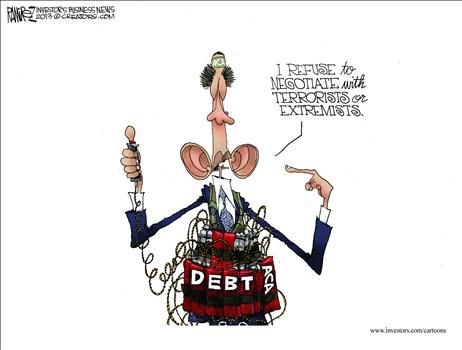
Political Cartoon

Courtesy of Michael Ramirez and Townhall
Musical Interlude: Motown

Barrett Strong, "Money"

Thursday, July 19, 2012

Miscellany: 7/19/12

Quote of the Day 

Have you ever observed that 
we pay much more attention to a wise passage 
when it is quoted 
than when we read it in the original author? 
Philip G. Hamerton

Retrospective: Obama, Dems and the Budget

A year ago last April, around the time of the initial budget negotiations between Obama and Congress,  FT.com noted (my edits):
To meet the 2010 pledge by the Group of 20 countries for all advanced economies – except Japan – to halve their deficits by 2013, the US would need to implement tougher austerity measures than in any two-year period since records began in 1960, the IMF said. The US was the only advanced economy to be increasing its underlying budget deficit in 2011, at a time when its economy was growing fast enough to reduce borrowing. The US lacks a “credible strategy” to stabilise its mounting public debt. On its current plans the US would join Japan as the only country with rising public debt in 2016, creating a risk for the global economy.
So how has Mr. Obama exercised his leadership and commitment on reducing the $1.3T deficit by next year? Let us recall the initial budget deal made just a year ago between Barack "Just Call Me 'Mr. Green Shade'" Obama and the House leadership. According to the AP:
The $38 billion in spending cuts agreed to last week [4/12/11] won't keep this year's budget deficit from setting another record high, estimated at $1.5 trillion. Details of the budget cuts are emerging, and they show that most of the cuts either affect only future budgets, or amount to accounting gimmicks that won't reduce actual spending. Obama, meanwhile, is expected to insert tax increases back into the budget debate when he outlines his new deficit cutting proposals tomorrow.
Okay, got that? That amounted to about 2.5% of the projected deficit for the year or 1% of the entire federal budget and most of that was sleight of hand budget gimmicks, not real cuts in existing budgets. But Obama has a plan: class warfare tax hikes. Never mind that pesky law of economics--you know the one (supply and demand: when you raise the tax on high income, you shrink the income base). Recall that the high bracket went from 28% in 1989 to 39.6% in 1993 under Clinton. Did federal spending go DOWN with the tax hikes? Of course not. Estimates of revenue gains for restoring the Clinton tax hike have been $70-80B: maybe 2% of the whole budget: how does that solve a problem where you're borrowing 40 cents out of every federal dollar spent? And keep in mind that $70-80B is money being taken out of upper income spending and investing in the real economy (remember Bastiat's "things seen and unseen"?) Note that this tax grab occurs at the expense of economic growth.

Let us review what the Tax Foundation has to say about data following the Bush tax cuts (here and here):
Each year from 2005 to 2007, the top 1 percent's constantly growing share of income earned [21.2-22.8%] and taxes paid [39.4-40.4%] set a record. In 2009, the top 1 percent of tax returns paid 36.7 percent of all federal individual income taxes and earned 16.9 percent of adjusted gross income. Overall, these data on high-income tax returns appear to confirm that the continued economic stagnation had the same diminishing effect on income inequality that most recessions have, and that it occurred for the same reason: a sharp decline in income at the high end. [Note: It's worth pointing out [where effective tax rate dips for the 0.1%] that in the case of capital gains and dividends, income derived from these sources has already been taxed once by the corporate income tax, which is not included here, meaning the average effective tax rate numbers can be somewhat misleading.]
Not to mention taxes are based on nominal, not adjusted, interest and capital gains. where income is effectively overstated--in addition to any double counting (not to mention state, local and other taxes). The Obama/Dem attacks on Romney's income and wealth are morally reprehensible; Warren Buffett is a tool being used by corrupt statists whom choke out real competition in the economy with ruinous meddling regulations. I am certainly not impressed by the likes of Bill Clinton and Barack Obama whom have made millions off their political notoriety and think that thus they can speak with integrity on behalf of the people making widgets in the real economy.

Okay, America: do you think Obama will make good on his 2010 international commitment to get the budget deficit down to under $700B next year? Or will it go the way of his other broken pledges to close Gitmo, his 2008 campaign rejection of an individual mandate for health insurance, etc.? Obama thinks that his performance in office merits an A- or at least a B+.

On the Reading List
  • Steve Horwitz, "Some Thoughts on Obamacare, Part I: Big Insurance wins"; Some Thoughts on Obamacare, Part II: Unintended consequences". After ranting in yesterday's talk soup over O'Malley's preposterous assertion that the free market in health insurance "failed" and pointing out that the effect of ObamaCare would mean attrition in competition and crony mandate scope creep, I'm delighted to see Horwitz making observations entirely consistent with my own. Mandate/regulatory creep, dominated by crony interests, is very similar to lawmaking/budget creep in general: it's almost if politicians or bureaucrats think that they're not doing job if they don't make new policies telling other people what to do! It's like what Speaker Boehner said to CBS FTN moderator Norah O'Donnell when she asked hopefully whether all that was needed was some minor tweaking of ObamaCare, and Boehner was insistent that you've got to pull ObamaCare out by the roots.
  • Reuven Cohen, "Google Predicts Mitt Romney To Win Fall Election?". This Forbes post accordingly notes that at least one academic study pours cold water on the idea that search counts on political candidates correlate with election outcomes. I will point out that Mitt Romney isn't well known by a significant portion of the electorate (in particular, the electorate outside of perhaps New England where Romney served one term as governor just under a decade ago). I'm amused, but if I was running the Romney campaign, never underestimate the power of incumbency, a personally popular President, and hundreds of millions of dollars in negative campaign funds.
  • Lee Habib, " This Land Is Your Land?" I remember learning  to sing Woody Guthrie's signature song in grade school. But I never knew the "secret verses". I encourage the reader to read Habib's article, but basically Woody Guthrie didn't care for Berlin's "God Bless America", and his song was a response. I had never read or heard the controversial fourth and sixth verses until recently: 
As I went walking, I saw a sign there,
And on the sign there, It said "Private Property"
But on the other side, it didn't say nothing!
That side was made for you and me. 

In the squares of the city, In the shadow of a steeple;
By the relief office, I'd seen my people.
As they stood there hungry, I stood there asking,
Is this land made for you and me?
Okay, I've officially heard "This Land is Your Land" one too many times. Those verses are so divisive and toxic I need an antidote. With all due respect to Kate Smith and Céline Dion, here's my favorite version:

Economic Liberty and a 13-Year-old  Entrepreneur

You would think when it comes to hot dogs, Nathan Duszynski was born to sell them: after all, he has the famous name for it (HT Carpe Diem). Duszynski wanted to earn some money to help out his folks and save towards a future car and college and settled on buying a hot dog cart; his cash-strapped folks agreed to put up half the money towards an $1800 cart. The rest he raised from savings, birthday money, and odd jobs around the neighborhood. Another $700 or so went in cart repairs, supplies and a $208 temporary food vendor permit purchased from the county. A sporting goods businessman in the downtown district in the city of Holland and a mentor to Duszynski agreed to let the boy operate his cart in his parking lot. 

Unfortunately, the city of Holland has zoning restrictions in the relevant area (except during annual festival time), Duszynski didn't qualify under a narrow set of exceptions, and the city shut down his business. There were other zoning areas where the business could operate, but he would need to obtain another permit. The dejected young man's spirit was crushed; given a tight family budget in a tough economy (the family is living with friends in the area), having to start over again and raise money for a new permit is probably the straw that broke the camel's back. Duszynski is looking to sell his cart.

I have written a number of commentaries, particularly on the topic of child-operated lemonade stands. One of the reasons I wanted to draw attention to this story (I encourage the reader to read the original post at the above cited link) was a couple of posted comments. Blackhorse's sarcastic remark, clearly a dig at Obama and government in general (see next commentary), is brilliant and flips the trite "privatize gains / socializes losses" saying on its head. (By the way, do you think these ideologues will ever figure out that the free market system doesn't allow for socialized losses? It's the statists whom want a "too-big-to-fail" concept. I suspect the real motivation of progressive Democrats and other statists for "too-big-to-fail" is because they can't pull the strings of a robust, genuine free market banking system.) 

The second comment by "Mr. Protectionist" Allbusiness is typical. Libertarians don't have a problem with the rule of law; the problem we have is when local business interests subvert the law through crony political influence to establish high-cost anti-competitive barriers to entry, masked under misleading, disingenuous appeals to "rules are rules". Remember one of my favorite Bastiat quotes: "Treat all economic questions from the viewpoint of the consumer, for the interests of the consumer are the interests of the human race." The consumer benefits from variety of choice. 

A storefront brick-and-mortar restaurant has a number of advantages or alternatives that a food truck or vendor doesn't have (e.g., climate-controlled environment, hosting for special events, more comfortable seating, multiple checkouts, alternative formats (e.g., self-service, freshly-prepared food, cook-to-order, etc.),  reservations and delivery services, more scalable operations, greater variety, etc.); they enjoy around-the-clock public services. Food trucks and vendors are often targeting a different type customer (e.g., convenience, finger foods, etc.) and often specialize to provide alternatives to nearby restaurants (e.g., ethnic specialties).

Beth Kregor responds that Allbusiness and others like him should address unfair tax burden with local politicians, not their competition. Besides permits, portable/mobile food vendors collect local sales taxes and any relevant local income taxes; they typically have local suppliers and purchase goods and services in the local area. No doubt  a successful portable food vendor can and can be the first step to a storefront as their customer base reaches a critical mass.
Apparently, Nathan did not hear what Obama said the other day. No one who owns a business, did it alone. The government is responsible for your success. However, if your business fails, it is the owner's fault. Nathan, you did not do ENOUGH to insure your success. - Blackhorse
Food trucks or wagons are regulated in every city everywhere. Everyone has to play by the rules, whether your a cute kid or a smelly hippie or a right-wing neocon. As for downtown merchants, yes, they play by a huge set of rules too. The property owners, and ultimately their tenants and customers, paid huge assessments to rebuild the sidewalks and streets, snowmelt, the hardscaping and landscaping, lighting, parking, etc. They deserve some say in who gets to sell at their front door. 
The unfair advantage a food vendor has is the real issue; They don't pay property taxes, parking assessments, snowmelt assessments, PSD (marketing) assessments, etc. It is right that this kid can undersell Gregordog (for example), taking away his business, when the kid doesn't contribute one dime to the infrastructure that he takes advantage of?  - Allbusiness


Barack Obama and the Politics of Economic Success

What is this infatuation Barack Obama seems to have with Massachusetts progressives? First, you had the "sound bite heard around the world" back during the Democratic nomination battle in 2008 where he self-righteously said, "Don't tell me words don't matter." His speech clearly paralleled one made two years earlier by eventual Democratic nominee and gubernatorial winner  Deval Patrick, where 3 of 4 quotes are identical and the phrase "just words" occur multiple times.

So now we have this famous "Cherokee Liz" Warren quote I cited in the January 1 post:
You built a factory out there? Good for you. But I want to be clear: you moved your goods to market on the roads the rest of us paid for; you hired workers the rest of us paid to educate; you were safe in your factory because of police forces and fire forces that the rest of us paid for. You didn't have to worry that marauding bands would come and seize everything at your factory, and hire someone to protect against this, because of the work the rest of us did. Now look, you built a factory and it turned into something terrific, or a great idea? God bless. Keep a big hunk of it. But part of the underlying social contract is you take a hunk of that and pay forward for the next kid who comes along.
Before going on, let me respond briefly to this beyond my cited earlier post where I pointed out the economic efficiency of a land value tax in contrast to other taxes: "Standard economic theory suggests that a land value tax would be extremely efficient – unlike other taxes, it does not reduce economic productivity." Of course, businesses and citizens do pay off their fair share of relevant bonds and public sector operations (police, firemen, teachers, etc.) through various taxes (income, sales, excise, property, etc.)

But let me point out that many of the functions she lists--schools, police, and firefighters, can easily be privatized. Many individuals or businesses employ or use private security services. I attended Catholic elementary/middle schools and a Catholic university; I have at least a few relatives whom have been home-schooled. Many roads are privately-built; it's just that progressive governments ruled out competition of privately-established highways. Heaven knows how badly maintained a great deal of our infrastructure has been (unlikely in a privatized system). But that doesn't mean we give local government a blank check. And we would much prefer being spared of the unnecessarily nearly quarter of the GDP being ineptly managed and spent by the federal government, excess government costs (especially competition-killing overregulation) occur at the expense of economic growth.

Here are relevant excerpts from a recent Obama speech in Virginia:
There are a lot of wealthy, successful Americans who agree with me -- because they want to give something back.  They know they didn’t -- look, if you’ve been successful, you didn’t get there on your own.  You didn’t get there on your own.  I’m always struck by people who think, well, it must be because I was just so smart.  There are a lot of smart people out there.  It must be because I worked harder than everybody else.  Let me tell you something -- there are a whole bunch of hardworking people out there.  (Applause.)
 If you were successful, somebody along the line gave you some help.  There was a great teacher somewhere in your life.  Somebody helped to create this unbelievable American system that we have that allowed you to thrive.  Somebody invested in roads and bridges.  If you’ve got a business -- you didn’t build that.  Somebody else made that happen.  The Internet didn’t get invented on its own.  Government research created the Internet so that all the companies could make money off the Internet.
The point is, is that when we succeed, we succeed because of our individual initiative, but also because we do things together.  There are some things, just like fighting fires, we don’t do on our own.  I mean, imagine if everybody had their own fire service.  That would be a hard way to organize fighting fires. 
I could spend a full week of posts debunking the intellectual drivel in the whole speech, but the most newsworthy excerpt is this section. You don't have to be a rocket science to see many of the same concepts advanced by Elizabeth Warren raised by Obama: schools, roads, firefighting, etc. A couple of points: first, Obama is doing a bait and switch: he's using local public sector services effectively to argue for his spendthrift policies in the federal government. Second, he's making a straw man argument. Libertarians accept basic economic principles about division of labor, the law of comparative advantage, etc. (Unfortunately, we can't say the same of Obama, at least by the campaign he's running, demonizing outsourcing.) The same argument could be made about growing our own food, building our own houses, etc.

As for Barack Obama's argument about the Internet, it is partially true, but the inference Obama intends is false. The Internet, or something like it, was INEVITABLE. The concept of a decentralized network is hardly novel (in fact, if Obama really understood the Internet, he would never have used the example: the idea that the states could operate independent of a central planning authority in the federal government, our ideal of limited government and federalism, is something Obama would never knowingly promote)

It is true that the government had a specific use: worried about a centralized hub being knocked out by say a USSR attack, the Pentagon wanted a mechanism for communicating flexibly about sites independently of each other. A government subcontractor from Rand Corporation designed the basis of the original ARPANET among 4 universities by the Nixon Administration. It soon developed in unexpected ways, e.g., for electronic messaging. Obama would not care for Klein's assessment: " It is only thanks to market participants that the internet became something other than a typical government program: inefficient, overcapitalized, and not directed toward socially useful purposes." In fact, Obama is dismissive of individual achievement, and he confuses voluntary, cooperative behavior with statist coercion. 

No, the government is not responsible for individual achievement; as usual, Obama is in a state of denial. There are 101 ways that government stands in the way of individual achievement; individual achievement occurs despite of, not because of government. Anyone who has ever battled bureaucratic inertia or managerial intransigence in the government or Big Business knows exactly what I'm talking about. 

To give a minor example, I had a client, the female IT VP of an international tax-free shop chain, whom decided, because of internal bickering between accounting and HR over the ERP system (the accountants had been convinced of false rumors by troublemaker consultants that installation of the new HR functionality caused problems with basic accounting functionality) that, like Solomon, she was going to give accounting and HR their own separate ERP systems. I had to spend several days battling this self-destructive proposed "solution"; the VP even found at least one other IT manager whom had claimed to have done the same thing. Given the VP had power over my continued deployment and I was the replacement to a DBA whom had been fired from the account after 2 weeks by the same VP, the fact that I prevailed was due solely to my efforts, and I know of few professionals whom would have done the same: most would have gone with the flow.

Yes, Sir Isaac Newton may have said, "If I have seen further it is only by standing on the shoulders of giants." But there was only one Sir Isaac Newton; of billions of people on earth, there are few master investors like Warren Buffett, inventors like Edison and Kamen, songwriters like Paul Simon, Paul McCartney, and Diane Warren, businessmen like Henry Ford, Thomas J. Watson (IBM) and Ray Kroc (McDonald's), or PC entrepreneurs like Bill Gates and Michael Dell.

Just to bring a real-life perspective: around 1987-88 a major state university wanted to hire me as a professor for their scientific and technical communication program, and I never took a class or worked as a professional tech writer at the time. I never met a professor in the discipline. They wanted to hire me based solely on articles I wrote. Nobody suggested a topic or an idea; each article was written from scratch. Many fiction authors do the same thing. I know of at least a dozen IT projects which were failing when I joined the project (I was the only change in the team), and I got us across the finish line almost invariably ahead of schedule.

It's called leadership, and leadership makes a difference. This fall, the American people will face a choice, and it will involve whether the people are satisfied with leadership at the top. When I hear only one American in 3 think we're heading in the wrong direction, that suggests the American people have a problem with their leadership. Right now, by any objective measure  Barack Obama is a failed leader. A lot of people like Obama. That's fine--I like Barney the Dinosaur, but that doesn't mean I think he's qualified to be President.

Aaron Ross Powell / Cato Institute, Obama's 'Elizabeth Warren Moment'


Musical Interlude: My Favorite Groups

The Babys. "Isn't It Time?"

Tuesday, June 19, 2012

Miscellany: 6/19/12

Quote of the Day

I like long walks, 
especially when they are taken by people who annoy me.
Fred Allen

Give and You Shall Receive:
The Federal Reserve
(The Dems' Idea of "Financial Reform":
Double-down Responsibility on the Fed)

From RT via the Daily Bell:
A report just released by the US Government Accountability Office explains how the Federal Reserve divvied up more than $4 trillion in low-interest loans after the fiscal crisis of 2008, and the news shouldn't be all that surprising. When the Federal Reserve looked towards bailing out some of the biggest banks in the country, more than one dozen of the financial institutions that benefited from the Fed's Hail Mary were members of the central bank's own board, reports the GAO. At least 18 current and former directors of the Fed's regional branches saw to it that their own banks were awarded loans with often next-to-no interest by the country's central bank during the height of the financial crisis that crippled the American economy and spurred rampant unemployment and home foreclosures for those unable to receive assistance.
(As aside to RT: don't Russians already have more than their own share of blue funk? MYOB. It's bad enough that the press in the US and Russia have been arguing over whose middle-aged President looks better topless... Can you imagine Russian politicos pointing and laughing at former Congressman William Jefferson, caught with $90K in his freezer and convicted of bribery, money laundering, fraud, and racketeering? What an amateur! At least the FBI didn't find the money in his washer...)

I've already discussed the GAO audit in a couple of posts (in more detail, here, with a plug for up-for-a-vote-soon Ron Paul's HR-459 with 238 co-sponsors).

Let's recall a bit how we got the first audit. Former Democratic Congressman Alan Grayson, who I have criticized in other contexts (think healthcare), was interrogating Inspector General of the Fed Elizabeth Coleman; it is astonishing that the head of the  internal audit function of the Fed can't answer basic questions on the status of over $9T in Fed funds in off-balance sheet transactions--that's probably more than all the federal revenues  that Obama will pull in his first term. The Daily Bell comments here on the hearing excerpt I've embedded below.


Let's recall how "Helicopter Ben" responded in the aftermath, and the final outcome (cf here):
The first ever GAO(Government Accountability Office) audit of the Federal Reserve was carried out in the past few months due to the Ron Paul, Alan Grayson Amendment to the Dodd-Frank bill, which passed last year. Jim DeMint, a Republican Senator, and Bernie Sanders, an independent Senator, led the charge for a Federal Reserve audit in the Senate, but watered down the original language of the house bill(HR1207), so that a complete audit would not be carried out. Ben Bernanke(pictured to the left), Alan Greenspan, and various other bankers vehemently opposed the audit and lied to Congress about the effects an audit would have on markets....What was revealed in the audit was startling: $16,000,000,000,000.00 had been secretly given out to US banks and corporations and foreign banks everywhere from France to Scotland. To place $16 trillion into perspective, remember that GDP of the United States is only $14.12 trillion. The entire national debt of the United States government spanning its 200+ year history is “only” $14.5 trillion. The budget that is being debated so heavily in Congress and the Senate is “only” $3.5 trillion. In late 2008, the TARP Bailout bill was passed and loans of $800 billion were given to failing banks and companies. 
The GDP and national debt numbers are dated, and of course there's a distinction between fiscal and monetary policy. I wouldn't use the term "lie"; it can be difficult to predict how the markets will respond. But it's clear that there was a material bait-and-switch, and there's no doubt that there's no such thing as a "free lunch": all things being equal, in the long run, more money chasing the same amount of goods and services means inflation, which eviscerates savings and is an indirect form of taxation, lowering the standard of living.

The Daily Bell's current post continues:
One of the biggest memes of the elite is that the economy needs the ministrations of good, gray bankers to fix the price and volume of money. Price fixing, in fact, never works and only redistributes wealth from those who created it to those who didn't and may not utilize as efficiently.
Low interest rates have fed the bond bubble (just like there was a stock market bubble and a real estate bubble). Peter Schiff and other Austrian School economists warn that a bond sell-off could be explosive.

I don't want to speculate, but there was a violent sell-off a quarter back: the market felt it needed Fed bond purchases to maintain prices. But, among other things, the currency markets are aware of a glut of dollars, rates are BELOW the inflation rate (implying real losses in bond holdings), there are bonds in other currencies offering higher interest rates, and foreigners, who hold half of US Treasuries,  may be reluctant to risk holding or adding to bond holdings given currency fluctuations and US bond prices at an unsustainable high peak. A declining dollar puts US manufacturers at risk from import resource or component prices (eroding margins in competitive markets), and under tough market conditions, banks, businesses or individuals may need to sell bonds (lowering prices / increasing interest rates).

On the Reading List

Bob Boudreaux seconds Todd Seavey's post comment assessment that Deidre McCloskey's post "Factual Free-Market Fairness" is "the greatest blog entry ever written".

I have made a few back-of-the-envelope logical arguments against "modern progressivism" or social liberalism, e.g., redistributive policies inevitably result in the moral corruption of a large number of target recipients; redistribution transfers from the productive to the nonproductive; any government must be bound by  resources, and since the law is fixed, non-innovative, and since rights and responsibilities are diffuse, inefficient.

To provide some context, McCloskey is writing an essay reflecting on a recently published book by John Tomasi, "Free Market Fairness". Tomasi attempts to establish a third way between F.A. Hayek's economics liberty focus and John Rawls' social justice.

One of Tomasi's collaborators (on other projects) is Jason Brennan. Brennan distinguishes among libertarians, classical liberals, high liberals, and neoclassical liberals. [Tomasi and Brennan classify themselves as neoclassical.] Brennan's typology focuses on two principal dimensions: economic liberty and social justice:
[Libertarians are classified as rejecting positive liberty.] Classical liberals who (somewhat begrudgingly) accept some welfarist principles, thus making their theory of justice a little more humane than libertarians’, if not quite as humane as high liberals’. Instead, neoclassical liberals go “all in” in accepting strong principles of social justice, but at the same time has a broader, more expansive conception of personal liberty than high liberals do. 
High liberals have a thin conception of economic liberty. They think that freedom of occupation and freedom to own personal property are among the basic liberties. In contrast, classical liberals, libertarians, and neoclassical liberals think that the basic liberties also include strong rights to freedom of contract, freedom to own and use productive property, freedom to buy and sell on voluntary terms, and so on. They regard these rights as on par with civil liberties, while high liberals regard them as lesser rights, or in some cases, not rights at all. 
McCloskey, an economics historian, fleshes out high liberalism, I think quite well:
The High-Liberal political philosophers such as Anderson and Freeman and Dworkin and Nussbaum rely, against Kant, on a factual story which they take to be so obvious as to not require defense. The story is, in a few brief mottos to stand for a rich intellectual tradition since the 1880s:  Modern life is complicated, and so we need government to regulate.  Government can do so well, and will not be regularly corrupted.  Since markets fail very frequently the government should step in to fix them.  Without a big government ee cannot do certain noble things (Hoover Dam, the Interstates, NASA).  Antitrust works.  Businesses will exploit workers if government regulation and union contracts do not intervene.  Unions got us the 40-hour week.  Poor people are better off chiefly because of big government and unions.  The USA was never laissez faire.  Internal improvements were a good idea, and governmental from the start.  Profit is not a good guide.  Consumers are usually misled.  Advertising is bad.
McCloskey then sets the record straight:
No.  The master narrative of High Liberalism is mistaken factually.  Externalities do not imply that a government can do better.  Publicity does better than inspectors in restraining the alleged desire of businesspeople to poison their customers.  Efficiency is not the chief merit of a market economy: innovation is.  Rules arose in merchant courts and Quaker fixed prices long before governments started enforcing them.
How do I know that my narrative is better than yours?  The experiments of the 20th century told me so.  But anyone who after the 20th century still thinks that thoroughgoing socialism, nationalism, imperialism, mobilization, central planning, regulation, zoning, price controls, tax policy, labor unions, business cartels, government spending, intrusive policing, adventurism in foreign policy, faith in entangling religion and politics, or most of the other thoroughgoing 19th-century proposals for governmental action are still neat, harmless ideas for improving our lives is not paying attention. 
As an aside: I find it particularly interesting that as my political perspective has transitioned, I have organically adopted concepts like "innovation" and "publicity (versus statist regulation)" independently of the literature.

If you want a typical social liberal (or high liberal) greatest hits, you can find Elizabeth Anderson's referenced  essay here; you will wonder how how we would have ever gotten past rat feces in sausages without government (it's not like, say, the free press uncovered the scandal, and customers lined up at the door  for sausages with a double dose of rat feces! And heaven knows how orthodox Jews ever had confidence in the food they ate before government food inspectors came along...) I would have preferred that McCloskey had also dispatched the propaganda about NASA, the Hoover Dam and the Interstates. (Hint: it may surprise the reader to know that the government did NOT build the first airplane, over half the dams in the United States are privately-owned, and thousands of miles of privately-operated US toll roads existed before the twentieth century.) My personal opinion is that the private sector would have done things better, faster, and cheaper across the board...

But McCloskey does an excellent job comprehensively and relentlessly refuting the high liberal case, showing how high-cost high liberal programs and policies (e.g., minimum wages) have had unintended, devastating consequences on the people they were designed to help. Highly recommended essay.

Notable Quotes/Excerpts on Politicians

Plus ça change, plus c’est la même chose. Mencken and Hayek had passed away long before Obama ever rose to power...
  • "His business is never what it pretends to be. Ostensibly he is an altruist devoted whole-heartedly to the service of his fellow-men, and so abjectly public-spirited that his private interest is nothing to him. Actually he is a sturdy rogue whose principal, and often sole aim in life is to butter his parsnips. His technical equipment consists simply of an armamentarium of deceits. It is his business to get and hold his job at all costs. If he can hold it by lying he will hold it by lying; if lying peters out he will try to hold it by embracing new truths." - H.L. Mencken
  • "No matter who wins the government gets elected." - Alex Tabarrok
  • "F.A. Hayek famously argued in The Road to Serfdom, that in politics, the worst get on top, and outlined three reasons this is so. First, Hayek makes the point that people of higher intelligence have different tastes and views. So, as Hayek writes, “we have to descend to the regions of lower moral and intellectual standards where the more primitive instincts prevail,” to have uniformity of opinion.
Second, those on top must “gain the support of the docile and gullible,” who are ready to accept whatever values and ideology is drummed into them. Totalitarians depend upon those who are guided by their passions and emotions rather than by critical thinking.
    Finally, leaders don’t promote a positive agenda, but a negative one of hating an enemy and envy of the wealthy. To appeal to the masses, leaders preach an “us” against “them” program."
    - Douglas French, "The worst rise to the top" (writing on the GOP field, not Obama)
    • "[Psychopathic criminals] do possess certain personality traits that can be exploited, particularly their inherent narcissism, selfishness, and vanity. Specific themes in past successful interviews focused on praising their intelligence, cleverness, and skill in evading capture. Interpersonal traits include glibness, superficial charm, a grandiose sense of self-worth, pathological lying, and the manipulation of others. The affective traits include a lack of remorse and/or guilt, shallow affect, a lack of empathy, and failure to accept responsibility. 
    Some of  [these] character traits may be observed in many within the political arena. [Except for violence], many political leaders display varying degrees of anger, feigned outrage and other behaviors. They also lack what most consider a "shame" mechanism. Quite simply, many professional politicians must mimic what they believe, are appropriate responses to situations they face such as sadness, empathy, sympathy, and other human responses to outside stimuli." - Jim Kouri, "Serial killers and politicians share traits" (my edits)
    This segment is NOT intended to bash politicians so much as to analyze related phenomenon. Obama is an interesting case; there is no way anyone can legitimately argue that his political positions, nominally different than his much more experienced, accomplished Democratic competitors, were the reason that he got the nomination. He won the nomination in the caucuses; it had more to do with his charisma, oratorical skills, and idealism, novelty and style.

    But ironically Obama has always had an Achilles heel: he had an almost professorial air about him and tended to be long-winded in a Democratic debate format that favored sound bites versus overly long explanations. The interesting point is that by the time it came to the general Presidential debates, I think that Senator McCain was overly confident, while Obama was well-prepared, concise and clearly anticipated McCain's predictable talking points. However, if you ever listen to or read his speeches, they are typically poorly organized, meandering, defensive, abstract professorial messes replete with trite observations, logical fallacies and political sound bites.

    Now Romney had started the 2012 campaign as the man to beat: he had paid his dues since his 2008 race. But he found himself with stiff challenges from contenders whom had never held a public sector administrative position, including two 2008 supporters, Herman Cain and Rick Santorum. (Huntsman and Johnson were also former governors, but they were obscure and barely registered at the polls.)

    On paper, Romney was the obvious choice: he had 25 years as a phenomenally successful business executive dealing with startups and troubled companies; he had won a statewide election in the bluest of states; he had helped saving the Salt Lake City Olympics. He looks the part as President, he's an able, excellent debater. 

    But he found himself being battered silly on the question of RomneyCare, as if somehow he was responsible for highly unpopular ObamaCare, toxic among party activists. He was  fending off populist attacks from Newt Gingrich and Rick Santorum. He was being dogged by policy shifts made since running in a very socially liberal state like Massachusetts. He was finding himself  defending a nearly 38 point economic plan while the former CEO of Godfather's Pizza went around to wild applause simply saying, "9! 9! 9!" He lost a primary to a former House Speaker whom had been rebuked by Congress in an ethics probe and had lost almost every poll by double-digits to Obama; he lost caucuses and primaries to a former GOP senator whom had lost reelection by an almost unprecedented landslide in a purple state to a less charismatic politician than Obama.

    Romney found himself being hit hard by populists; many primary voters were voting on totally meaningless  red meat sound bites, not whether their candidate ran better against Obama (they didn't) or the fact that they had no chance of enacting their agenda over a Democratic Senate minority or majority with the power to filibuster.

    There are notorious moments when Romney was seen to be "out of touch" with middle-class voters, e.g., the $10,000 bet with Governor Perry, multiple cars, car elevators, liking to fire people or joking about closing a plant, etc. There are some of these things I would have handled with my sense of humor. For example, there was the kerfuffle over driving on a family vacation with his family dog housed on the vehicle's roof. I probably would have joked something like, "There have been times I've been in the doghouse with Ann... It was cold up there; thank goodness I had that windshield."

    I have already written several things I would do in Romney's case. I suggest that Romney focus on traditional virtues (thrift, hard work), marriage and family and bringing those same values to the White House. I"m not suggesting that he talk down to people, but he doesn't want to come across as a policy wonk and go over the head of his audience; he wants to convey Reagan-like confidence, humor and optimistic attitude. (Oh, and going into the debates, if I was Romney, I would find a way of delivering sound bite tweaks of Obama. For example, Obama is forever talking about "saving" the auto industry; I would remind  voters that GM already had a negative net worth in 2006 and counter with "saving the taxpayer from UAW bailouts".

    I have written about Obama's narcissism on multiple occasions (see my blog tags); anyone who doesn't see the obvious connection to the above quotes is simply in a state of denial: his self-graded report card very high, the Bush bashing, etc.

    Finally, a brief criticism of Hayek's analysis: I think, at least in the American experience, there have been some very strong, erudite leaders, like Thomas Jefferson, Abraham Lincoln and William Taft (however, the latter was a poor politician). I do think that strong administrators or very bright people may lack suitable political or communication skills or focus on long-term versus short-term expectations.

    Word Games

    From the Hill:
    On Friday, Obama said the DHS would immediately allow people who don't pose a national security risk to ask for temporary relief from deportation proceedings and apply for work authorization. While Schweikert's bill would prevent DHS from enforcing executive orders on immigration, Obama's policy change came only in the form of a memo on prosecutorial discretion from Homeland Security Secretary Janet Napolitano, not an executive order.


    Musical Interlude: My Favorite Groups

    Tom Petty and the Heartbreakers, "Don't Come Around Here No More"

    Monday, June 11, 2012

    Miscellany: 6/11/12

    Quote of the Day 

    Insanity: doing the same thing over and over again and expecting different results.
    Albert Einstein

    Progressives Just Can't Help Themselves:
    Opining on the Regulation of Marriage

    I know what my readers must be thinking: what does this never-married bachelor know about marriage? In fact, I am concerned: most comparative divorce statistics consistently show the United States among the highest rates in the world (almost half of new marriages, e.g., here).

    I have mentioned to readers before (e.g., in discussion of infant mortality rates) that one should always look at comparative statistics with caution because there are often apples-and-oranges issues. In fact, since marriage and divorce are regulated (without common standards, statistics gathered, etc.) by the states (not the federal government), we have another layer of apples and oranges. Typically, we see the comparison of marriages and divorces per 1000 in the population. It's not a clean comparison, because most marriages last longer than the 72 days it took for celebrity Kim Kardashian to file for divorce after her first wedding; the divorce rate includes couples whom have been married any number of years. Looking at marriages over time, the divorce rate lowers to about 40%. A number of factors are associated with longer marriage, e.g., socioeconomic success (e.g., income, higher education, etc.) and children.

    I would venture to guess that couples whom are regular church-goers, like my parents and siblings,   also have more stable marriages overall. All six siblings have had successful marriages. Interestingly enough, 4 of my siblings married non-Catholics; 3 of those in-laws have since converted to Catholicism, the oldest and longest married one just recently, and the remaining spouse has regularly gone to Mass with my sister since they were married years ago. To be honest, almost every couple I have ever known is still in their original marriage. (I think that a nephew and one of my cousins had divorced their wives. There were unusual circumstances in these cases; for example, my cousin decided that he didn't like living in Australia.)

    Of course, I have known some divorced people. The year after I left the Navy, I flew to the Orlando wedding of my best friend and fellow Navy instructor Joe whom married Lynne, also a fellow math instructor, whom had divorced her idiosyncratic first husband (e.g., he once locked her out of their house). As an ensign, I had had a bit of a crush on unavailable Lynne; I remember one day Lynne, who had magnificent long, curly dark hair, came to work with a hairstyle without curls. I protested to Lynne: why mess with perfection? Joe then said, "Lynne, pay no attention to Ron: I like your hair just the way it is." So we were arguing about her hairstyle, and Lynne seemed to be thrilled with the attention. Later, I said, "Joe, remember the first time I met Lynne, you told me to cool my jets, that she was taken? Why did you just score points with Lynne at my expense?" Joe said, "Well, you never know what'll happen..." How ironic it was a couple of years later, when I went on my first date with this tall girl; she was upset at me for some reason. I later found out that she had her hair done for our date, and I hadn't seemed to notice or complimented her on it.

    We also see statistics cited predicting even higher rates, allegedly based on US Census statistics, for second or third marriages (e.g., 60 to 70%). As an empirical researcher, I'm deeply suspicious about "statistics that lie", so this is a good time to excerpt a relevant discussion from Kalman Heller (my edits):
    A false conclusion in the 1970s that half of all first marriages ended in divorce was based on the simple but completely wrong analysis of the marriage and divorce rates per 1,000 people in the United States. A similar abuse of statistical analysis led to the conclusion that 60 percent of all second marriages ended in divorceThe commonly quoted numbers are overstated myths, the more accurate numbers reflect complex factors, and that our society really has two very separate divorce rates, a lower rate (by half) for college-educated women who marry after the age of 25 and a much higher rate for poor, primarily minority women who marry before the age of 25 and do not have a college degree. It is now clear that the divorce rate in first marriages probably peaked at about 40 percent for first marriages around 1980 and has been declining since to about 30 percent in the early 2000s.
    What started this rant? Jennifer Nagy, a recently divorced 29-year-old PR analyst whom married at 19,  published a Huffington Post commentary, advocating pushing the minimum age of 25. Comedian Steve Crowder (remember the conservative rap video "Mr. America"?) wrote a worthy rebuttal (also see the embedded video below).

    I understand that Ms. Nagy is jaded and her perspective is warped through the prism of her own experience and interpretation of misleading statistics, but what incensed me, for obvious reasons, was the way she ended her rant:
    Who knows? Maybe there are 20-year-olds that get married and stay madly in love for their whole lives. Maybe puppy love can last forever.
    Could be. Maybe there is such thing as fairies and unicorns too.
    Just saying...
     You see, my Mom was 18 when she married my Dad, who had himself just turned 21. And she was 19 when I was born 13 months later. My folks had to put up with the Jennifer Nagy's of their own back then. So, before resuming my commentary, I want to dedicate one of my folks' favorite songs to them:


    Nat King Cole had it right. My folks are still the cutest in-love couple I know. And they made it without college, with 7 kids, and an enlisted man's salary (which wasn't much back then). Five of the kids have college degrees, and a third sibling is working on her first Master's degree. Two of my siblings married while their husbands were still in college, a third just after graduation, and a fourth (no college) got married around the same age, all below Nagy's cutoff. All of those marriages are going strong.

    Now, let me get to the policy issue: as a libertarian-conservative, the social conservative side of my philosophy wants to support the institution of marriage, e.g., raise barriers both to entry and exit. I don't like quickie Vegas weddings, etc.

    Do I know some people should never get married? Yes. I'll give an example to make my point. This is not a story. I was doing a gig in the western suburbs of Chicago in the mid-to-late 1990's; the business was a packaging products business (e.g., box sets for CD or DVD collections). The consultant DBA on the ERP project was supposed to transition to me. Let's just say many DBA's I've met are odd people. He was a shorter white guy whom I think used to work for Oracle Consulting and had started his own consulting business. He was a survivalist (remember the Y2K scare?), a huge fan of the Backstreet Boys (not most grown men I knew were) and a fitness fanatic whom, I believe, offered to give me $50 if I threw out everything in my refrigerator and pantry and bought "healthy" stuff. He gave me my first envelopes of EAS Myoplex, totally out his pocket; he was genuinely concerned about my health. (I was working out every other day, so I wasn't in bad shape at the time.)

    He had recently married a woman of color, whom was pregnant with their first child. (I never did meet her.) I'm trying to recall the exact context of the conversation; I mostly remember the outrageous things he said in response. I probably asked him something like, "Are you hoping for a boy or a girl?" "A girl. It had better be a girl."  Now in hindsight, I should have just stopped the conversation there, but I was curious why it had better be a girl. He turned,  looked at me straight in the eye and said, "Because I don't want a little black boy looking up at me and calling me 'daddy'."

    I still can't believe anybody said that; I think it's one of the most heartless things I've ever heard another human being say. I tried to regroup and said, "But chances are that your daughter will be black, too." "That's different. I like black girls. My wife is black. I just don't want a black son." I must have asked him at some point what was the story of their relationship (my guess is they must have met at some fitness center). He was quite clinical: "I wanted to have sex with her. I'm a Christian; I don't believe in sex outside of marriage. So we got married." The odd thing was that he never said 'love' once in the whole discussion. And he said similar type things again on subsequent occasions.

    There was a part of me that wanted to reach out to his wife and warn her to leave this guy. (Heaven knows what danger she was in; some of these fitness buffs use designer steroids.) Had she heard what I heard? How could she not know how he really felt about her and their baby? Maybe she knew but was in a state of denial: he'll change the first time he holds his first-born son... "Oh, I can change him..." Talk about fairies and unicorns!

    But on the other hand, it was none of my business, and I didn't want to be the reason for a marriage splitting up, not to mention the circumstances of a pregnant woman, perhaps having to raise a child on her own.

    However, as you may suspect from my libertarian opinions, I have a definite opinion about this: the one thing I'm sure of is that the government is certain to be wrong in any policy it prescribes for fixing the marriage / divorce problem.

    I think the broader issue is the culture. If it was in my power, I would have K-12 study the list of virtues, of the responsibilities as well as the rights of being a citizen, read things like JFK's Profiles in Courage. (Perhaps if we "banned" Profiles in Courage, teenagers would actually be motivated to read it!) As far as I'm concerned, there's far too much collectivist claptrap in the schools.


    Chicago Teachers Set to Strike? Thumbs DOWN!

    Can you believe that Chicago is bragging about finally achieving a 60% graduation rate? (I have become so cynical; I wonder if they did like Florida and lower the passing grade on standard tests...)

    Okay, most readers know where I stand on public education: PRIVATIZE, PRIVATIZE, PRIVATIZE. I want to go further than tweaks at the edges with vouchers.

    But given the political reality, where do we stand? I find myself in the unprecedented position of cheering on Mayor Rahm Emanuel. The union is angry with Mayor Emanuel rescinding a 4% raise. Emanuel also wants to bump up the school day by 20% (thumbs UP!)  So Chicago Public Schools is offering a 2% raise guarantee, but the union wants 20% (that, of course, the chronically underfunded city does not have....)

    I'm sure my two niece teachers don't want to see their crazy old uncle engage in union bashing, but I think it's arrogant to demand more and more from the taxpayer without necessary productivity increases; we have a profession that does a lousy job weeding out the bad apples, rejects market/merit-based pay and raises and protects seniority-based preference in layoffs.

    (When I was a professor, I wasn't on the clock: it was whatever hours it took for me to do the job I expected of myself in the classroom; I didn't get paid extra for working 70 hours a week. It would have been a lot easier to teach courses without new preps and few assignments or exams. I remember one of my  former conspiracy theory students actually accused me of trying to make the course hard so people would drop out and thus I would have fewer papers to grade!)

    The teacher union has authorized a strike by significantly higher percentage votes than necessary. It should be interesting to see how Mayor Emanuel responds to the challenge; initially he seems to be paying lip service to public service, but arguing that they simply don't have the money. Former Mayor Daley is on the second webpage nauseatingly still pandering to the unions, reminding people that his sisters are teachers and saying the trite paeans.

    When I was a professor, I wasn't in it for the glory: I was doing my job, and I worked to a higher, internal standard of performance. I also knew professors whom, in my opinion, didn't measure up to my standards of the profession. What did I think of generic praise from people whom never sat in on one of my classes, unearned praise that also served to reinforce the already inflated egos of mediocre colleagues whom had no business being in a college classroom?

    Mayor Daley, you should be ashamed of yourself; you know on your watch hundreds, maybe more tenured teachers were no credit to the profession; good teachers don't need a union. Thousands of kids graduated, or didn't graduate, from a school system that at the end gives them a pretty piece of paper that some of them can read: how do you sleep at night?

    On the Reading List

    I embed links in my posts all the time, but usually they have to do with the general political nature of the blog. (I do feature a daily quote and some in memoriam and entertainment items; these are related more to my miscellany post format). This new feature will feature links that don't fit in the overall context of the blog or my miscellany format.

    I'm straight, and I don't have any gay acquaintances (to the best of my knowledge). I've known since I took my first psychology course years ago that homosexual behavior exists across species. As a Christian in the Roman Catholic tradition, I hold with the Church's consistent teachings on sex and marriage, but I also accept people as they are, children of God.

    Josh Weed is happily married to Lolly; they are devout Mormons and have 3 beautiful little daughters. There's one difference: Josh claims to be gay, a fact that the couple grappled with before they dated and married. You can find a copy of his viral well-written post here. I don't understand their relationship, but I don't have to: it works for them. I honor their integrity and courage in speaking out. God bless them and their beautiful children.

    Political Humor

    "In an event celebrating her 25th anniversary of being elected to Congress, Nancy Pelosi revealed that the ghost of past feminist leaders spoke to her at her first White House meeting as speaker. In a related story, doctors now say, 'Yes, Botox can cause hallucinations.'" - Jay Leno

    [Jay, Jay, Jay.... Those brownies she brought back from San Francisco? It turns out that you need to eat the brownie to find out what's in it...]

    "Guantanamo Bay detention center is now undergoing millions of dollars of upgrades that include a new soccer field and cable TV.  Remember when Obama was campaigning? Didn't he say he was going to close Guantanamo Bay? Didn't he say that? Apparently, he just meant for renovations."  - Jay Leno

    [Well, you see, there were morale problems at the prison after the Guantanamo Four were sent to Bermuda, where, at US taxpayer expense, on the first day of captivity there, they proceeded to eat butter pecan ice cream, took a sunset dip into the ocean, fished, stayed in beach cottages, and dreamed of opening the first Uighur restaurant...]

    "Enriching-your-life classes for Guantanamo detainees include learning to paint and writing a resume. Why do they need a resume?"  - Jay Leno

    [Jay, you're confused:  it's called an "obituary"...]

    Musical Interlude: My Favorite Groups

    Tom Petty & the Heartbreakers (with Stevie Nicks), "Stop Draggin' My Heart Around"