Analytics

Showing posts with label Sunday talk soup. Show all posts

Tuesday, October 6, 2015

Miscellany: 10/06/15

Quote of the Day
Integrity is the essence of everything successful.
R. Buckminster Fuller

Image of the Day


TPP: A Step Forward: Thumbs UP!

See the Cato Institute clip at the bottom of the post (Facebook video embed issues), and I also disussed in FB Corner above. I am very much a critic of mercantilistic trade deals, but up to a third of the global economy involves the Pacific economies. Any positive step forward in opening markets across the region is win-win from an economic standpoint.

Sunday Talk Soup: OK, I've Had My Fill of Hillary Clinton's Bullshit

It wasn't until last weekend that I whittled down my podcasts to the Sept. 27 Meet the Press.  Chuck Todd does ask some decent questions along the way, but basically Hillary Clinton basically goes through her memorized politically spun rationalizations, without serious challenge from Todd, of maintaining her official emails on an insecure home server, how she exploited some sort of regulatory gap or loophole "for purposes of convenience" in bypassing professionally maintained email systems "like other Secretaries of State" while her own State Department was cracking down on email practices of suhordinates with less access to state secrets.

There was this quote from Clinton, from before she became Secretary of State:
HILLARY CLINTON (ARCHIVE):
I want to have a much more transparent government. And I think we now have the tools to make that happen. I want to have as much information about the way our government operates on the internet. So the people who pay for it, the taxpayers of America can see that.
It would take too much of my time and effort to debunk each bit of garbage uttered by Clinton (it reminds me of an email exchange I once had with Don Boudreaux when I asked him why he didn't go after Paul Krugman for saying such-and-such nonsense, and he responded that it would be a full-time job just to keep up with everything Krugman says or writes). But just to give a taste:
And so there was about a month where I didn't have everything already on the server and we went back, tried to, you know, recover whatever we could recover. And I think it's also fair to say that, you know, there are some things about this that I just can't control. I can't control the technical aspects of it. I'm not by any means a technical expert. I relied on people who were. 
So we already have an admission, even before we discuss the potential security problems of that home server, that some emails were likely missing and others had to be restored from backups. When did she discover the gap? Recall that even under liberalized rules, she was supposed to turn in copies of messages on a timely basis to be in compliance with federal records retention. Wouldn't have gaps in records point out problems with her use of a home server and get her to be in full compliance with government-maintained email accounts? Not to mention that I have no trust in Hillary Clinton's lawyers, who are paid by her, to determine what's in the public interest. In the discussion she tries to use anecdotal evidence, e.g., that the government returned some emails as personal, to suggest she's returned more than enough. The problem is that we don't know all of the emails Clinton received or sent. It's possible that she may have purged politically inconvenient emails. We only have the word of the fox in charge of the henhouse, not a truly independent third party, like I've repeatedly called for. She also wants to suggest that the government should have copies of emails anyway, assuming the emails came from or went to at least one government email account:
You know, my assumption, because this system was there before I became secretary, it was there when I left, my assumption was anything that I sent to a .gov account would be captured.
CHUCK TODD:
But, you know, that's very difficult to capture all of your emails by going through to perhaps thousands of people and their .gov accounts. It would've been a lot easier if it was sent to your .gov account.
HILLARY CLINTON:
Well, but when you communicate with people in other parts of the government, you're not sending it to TheStateDepartment.gov. And that would've been true either way. Look, I think I have done all that I can 
I would have to look at technology at the time, but I'm sure that there were ways to maintain archive copies. For example, Gmail allows you to auto-forward emails to other accounts and maintains an automatic archive (all mail), Outlook enables cc or bcc account rules, Thunderbird lets you set up incoming filters to copy or forward emails, e.g., when the email sender is from a ".gov" account, and you can also configure cc or bcc of outgoing messages (beyond maintaining an automatic copy in the sent folder). I'm not attempting to discuss these features as exhaustive or distinctive.

But what really annoys me is her sarcastic tone, notable at the end of the exerpt. No, to the best of my knowledge, there isn't a centralized email system for all government accounts; it's very possible that Hillary Clinton's emails went across various email domains beyond state.gov, e.g., dhs.gov, *.mil. It would be almost impossible to know what emails Hillary Clinton sent without recipients stepping forward. Moreover, the emails may have been deleted in the interim. She is just being disingenuous here: "Look, I'm not a geek--how did I know they didn't keep records of messages going between my email account and government email accounts?" The problem is they could have configured controls and archivals for email accounts under their control. Hillary Clinton knew there were risks with using her own account; she went out of the way to use her own account--and none of this had anything to do with transparency. Maybe stupid people will buy her email excuses, but anyone with a tech background knows that she's full of shit.

The other parts of the interview were equally disingenuous. Watching her justify her politically convenient flip-flops on marriage redefinition and the Keystone pipeline was disgusting. Consider this soundbite after an earlier more positive statement on Keystone:
When it comes to Keystone, you know, I was at the beginning of the process of trying to evaluate what was the best outcome. I did feel that I shouldn't jump in before the president and Secretary Kerry and make my views known, because they're still in the middle of that process.
But it was, frankly, uncomfortable to have so many people asking me and my saying, you know, I'm waiting and waiting and waiting, and it still hasn't happened. I don't know when it will happen. It may have to happen when I'm president, I hope. So I've said, "Look, I'm against it." On the total evaluation, when I made that statement years ago, we did not have the kind of energy profile that we now have.
We did not have the full understanding of how the particular oil that would have been extracted from those tar sands was of a different degree of dirtiness and polluting in terms of greenhouse gasses.
So, you know, I'm not going to sit here and tell people that I make up my mind. That's the Republicans. They make up their mind. They're never bothered by evidence.
Let's be very clear: the oil sands oil at the higher prices we've seen for most of the past decade will be sold at the right price. Right now a number of frackers are playing an end game becaused by the Saudi price war; production is already falling while the shale developers desperately try to make their loan payments by dumping oil on a saturated market. We have the refiners to process that heavy oil--and we haven't been energy self-sufficient for decades. The Chinese have already expressed interest in Canadian oil. At least she isn't trying to argue, unlike thousands of oil and gas pipelines crisscrossing the US, the Keystone pipeline is some leaky anomaly. Clinton is just acting totally political here, and it's all bullshit. She knows that Sanders and Biden have already sold out to the environmental crackpots of the Democratic coalition. She needs to explain why we are spurning one of our biggest trading partners for oil that can and will be bought in the future, with or without us.

Choose Life: The Gift of Adoption


Crony Brick-and-Mortar Restaurants and Unconstitutional Barriers to Entry for Food Vendors


Choose Life: I Wanna Hold Your Hand


More twin magic...


Facebook Corner

(Cato Institute). [See video below.] "TPP is not Adam Smith's view of free trade. TPP is managed trade, and certainly the TPP will contain components that we don't like. But, on net, if the agreement is good for taxpayers, it's good for consumers, workers, businesses...let's not make the perfect the enemy of the good."
Unfortunately, many of the Presidential candidates from both parties will engage in economic populist demogoguery, including Rand Paul. (Ron Paul notoriously opposed NAFTA on the basis of ideological purity). Of course, most of us who want free trade would unilaterally declare free trade, but the bottom line is, whatever allows greater price competition and variety for the consumer is win-win; corrupt political whores sell out the many consumers on behalf of the few politically connected crony capitalists and unions.

Political Cartoon
Courtesy of the original artist via LFC
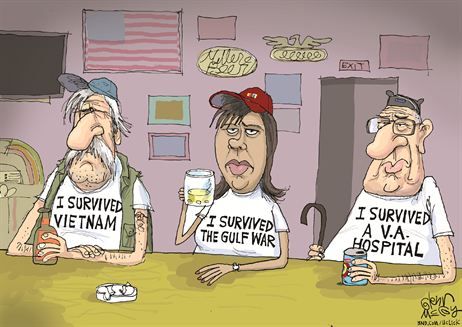
Courtesy of Glenn McCoy via Townhall
Musical Interlude: My Favorite Vocalists

Roberta Flack, "Jesse"


TPP: Not Free Trade, But Freer Trade


TPP in Perspective: 150 Years of U.S. Trade Policy in Less tha...
"TPP is not Adam Smith's view of free trade. TPP is managed trade, and certainly the TPP will contain components that we don't like. But, on net, if the agreement is good for taxpayers, it's good for consumers, workers, businesses...let's not make the perfect the enemy of the good."
Posted by The Cato Institute on Tuesday, October 6, 2015

Tuesday, September 22, 2015

Sunday Talk Soup and the Economic Idiocy of NYC Mayor De Blasio

The quoted sections below come from Sunday's ABC This Week transcript, available here. I was listening to the audio podcast while I was focused on another task yesterday, when I heard someone rebuke Marco Rubio with a crackpot version of Christianity. Now I get rather annoyed when "progressives" try to use Christ to fit their odious political philosophy; I wrote my own take complementing a fine essay by FEE's Reed in this post;  I have been critical of Pope Francis (see here and here) and others (see here and here). I interrupted what I was doing, hoping the moderator would identify the speaker at the end of the interview--and he did--one of the most nauseating "progressives" in the country, namely De Blasio. I'll comment after excerpts.
STEPHANOPOULOS: Pope Francis coming to the United States this week, his first visit to the United States, the first pope ever to speak to the Congress.
I know you agree with the pope on the issues of abortion and marriage. Many conservatives have criticized him for his views on climate change, income inequality. Rush Limbaugh even suggested he's a Marxist.
One, do you agree with that criticism?
And what do you hope to hear from the pope this week?

RUBIO: Well, I'm a Roman Catholic. For me, the pope is the successor of Peter he's the spiritual head of the church, who has authority to speak on matters, doctrinal matters and a -- and theological matters. And I follow him 100 percent on those issues, otherwise I wouldn't be a Roman Catholic. And so I believe that deeply.
The pope, as an individual, an important figure in the world, also has political opinions. And those, of course, we are free to disagree with. He obviously opines about this views of the church's role or the -- what we should be doing with the climate or things of this nature, on the economics.
Those are issues that -- that the church talks about as regards to their social teachings, or their j sorry, the -- the way you balance government with society.
On the social teachings, essential issues, like the sanctity of life and things of this nature, those go deep to the theology of this -- of the faith. And I do believe -- those are binding and I believe strongly in them.
On the economic issues, the geopolitical issues, the pope is just trying to bring people together. That's his role as a spiritual leader. And I respect that very much.
I have a job as a United States senator to act in the best interests of the United States and of our people. And from time to time, they -- that may lead to different opinions about different things.
But I have no problem with the pope and I wish he would meet with dissidents in Cuba when he's there this week, but I would reserve judgment to see what he says when given the chance to address the public there.
My hope is that he will discuss human rights and freedoms.
Limbaugh's conclusion is incompetent and absurd. In fact, as a bishop/cardinal, Pope Francis earned a reputation as an opponent of (more Marxist) liberation theology. I think we should note that if prior Catholic popes as well have been critical of some purported excesses of the markets, they have been far more critical of socialism. Barron has a relevant discussion:
One of the most significant constants in that tradition is a suspicion of socialism, understood as an economic system that denies the legitimacy of private property, undermines the free-market, and fosters a class struggle between the rich and the poor. The modern popes, from Leo XIII to Benedict XVI, have all spoken clearly against such systems...Fr. Robert Sirico, Michael Novak, Arthur Brooks, and many others are therefore right in suggesting that Catholic Social Teaching does not represent a tertium quid beyond capitalism and socialism; rather, it clearly aligns itself against socialistic arrangements and clearly for the market economy. 
I wish that Rubio would have answered more directly (no, Rubio does not share in the pope's political opinions). This is my take of what he said, within my pro-liberty perspective: the Holy Father's leadership is in faith and morals. Whereas the Pope is right to point at individual responsibility and charity in our dealings with others and in wise stewardship of God's gift of this world and its creatures, the Pope should not focus on the means to those ends or buy into disingenuous Statist rhetoric. The State use of force has historically been unjust (consider unnecessary wars and imprisonment) and ignores the importance and role of free will and the voluntary associations for the common good.
 STEPHANOPOULOS: And you say this trip is a tremendous moment for New York.
What are you most excited about?

And I wanted you to respond. You heard Senator Rubio earlier in the program...
DE BLASIO: Yes.
STEPHANOPOULOS: -- talking about the pope's trip, making a distinction between the pope's teaching on social issues and his teachings on economic issues.
DE BLASIO: I would strongly urge Senator Rubio to go back and reread "The Sermon on the Mount." Clearly, the core of Catholic teachings and Christian teachings talks about the economic realities that people face, and has for thousands of years.
So I was very surprised to hear them make that separation.
Let me give you two sentences from His Holiness, talking about trickle-down economics he says, "This theory, which has never been confirmed by the facts, expresses a crude and naive trust in the goodness of those wielding economic power and the sacrolyzed (ph) workings of the prevailing economic system, meanwhile, the excluded are still waiting."
That's Pope Francis talking about something that's been at the core of Catholic teachings for 2,000 years. I'm surprised Mr. Rubio doesn't understand that.

STEPHANOPOULOS: But what do you say to those conservatives about this, who says this is not the pope's area of expertise?
DE BLASIO: I think the church has always devoted itself to talking about fairness in every sense, including economic fairness. I think that's one of the foundational concepts of the religion. And His Holiness has captured the imagination of the entire world, Catholic believers and non-believers and people of all faiths, because he's talking about what a moral structure looks like that actually is inclusive.
That's the power of this pope. Yes, he is an incredibly compelling personality and communicator. But it's his ideas that are actually calling people to a different kind of world order.
And I think, when he comes here to a country he's never been to before and talks before the United States Congress, I think it's going to be one of those moments we look back on and say this was a moment where American society and politics are to change.

STEPHANOPOULOS: Let's talk about politics for a minute. You have not endorsed a presidential candidate yet. And I wonder if you're caught between your head and your heart.
You worked for Hillary Clinton. But you line up, as I said earlier, with Bernie Sanders on a lot of the big issues.
So how are you going to decide? What more do you need to know?

DE BLASIO: Well, first of all, I'm very proud to be a Democrat right now because the Democratic field is talking about income inequality, talking about how to help working families, how to restore the middle class, talking about the rest of taxation, I think, quite honestly and forthrightly. The Republican field is not only attacking each other, they're offering very divisive visions about this country that I think are actually going to turn off a lot of the American people. 
First of all, to the best of my knowledge, De Blasio is not a practicing Christian/Catholic and is the last person who should be hypocritically judging other Christians (one of Jesus' most notorious sayings). Second, Jesus most emphatically did NOT confound His ministry with a political mission. He repeated pointed out His Kingdom was in heaven, not earth. (I've covered this point in numerous cited posts and in numerous FB posts, including one republished over the weekend). I will, however, point out again how Jesus rebuked the envious brother who asked him to settle what he considered an inequitable division of his father's estate with his brother; Jesus reminded him of the grave sin of coveting his brother's goods. There is no doubt in my mind whatsoever Jesus would take a rather dim view of envying a rich man's goods and stealing them, even if it was rationalized in terms of redistribution to the poor.

For this piece of work to lecture on the Sermon on the Mount? This guy is absolutely clueless on the meaning of the Beatitudes (the poetic segment of the Sermon), which literally has nothing to do with poverty in the common sense of the word; Jesus is really speaking of the preparation for the Kingdom of Heaven, of a humble, contrite presence and spiritual development through the trials of  this life before God; if wealth presents a false idol to worship in place of God, better to be rid of this corrupting condition of wealth. For further discussion of this point, see here.

De Blasio forgets a key point I've raised in my posts: Jesus says the greatest commandment is to love God unconditionally--not to love one's neighbor. This is not to say that charity is unimportant, but Jesus is unmoved by ostentatious plays of charity, prayer, etc.--and I'm fairly certain that Jesus would prefer voluntary charity of the pro-liberty followers to morally hazardous State redistribution by professional bureaucrats at gunpoint. Just because we of the pro-liberty persuasion don't believe in the use of force doesn't mean that we are insensitive to the plight of the poor; as the above-referenced Arthur Brooks pointed out, conservatives generally give more of their income to charity than social/modern liberals. (Apparently "progressives" think their part is to vote for the tax collectors to plunder the other guy's pocket.)

Let De Blasio put lipstick on the pig of Statist public policy failures; his smug moral self-superiority is based on an economically illiterate state of denial.

Monday, May 25, 2015

Miscellany: 5/25/15 Happy Memorial Day

Do NOT Let Traitors Undermine the Freedom 
For Which Patriots Paid the Ultimate Price


Quote of the Day
Murphy's Seventh Law: Left to themselves, things tend to go from bad to worse.

Image of the Day

McDonald's Answer to Minimum-Wage Nonsense HT ZeroHedge

Osseointegration, FDA Approval, and Wounded Vets

Whereas Memorial Day primarily focuses on those who have died in America's wars, a number of wounded vets must deal with horrific disabilities for decades, including missing limbs.

There are, of course, prosthetics manufacturers who serve a market need for those with amputated limbs. I've briefly mentioned in past posts that my first college RA was a disabled Vietnam War vet who lost one of his legs. Tom didn't always like to walk around his prothesis, often hopping around on his good leg or using his crutches. (During my family's visit to the dorms, my baby sister saw Tom without his prosthesis and to my dismay loudly pointed it out.) There have been some technological advances since then towards more natural prostheses:
Osseointegration refers to a direct structural and functional connection between ordered, living bone and the surface of a load-carrying implant. Currently, an implant is considered as osseointegrated when there is no progressive relative movement between the implant and the bone with which it has direct contact.
I stumbled on this related story in one of today's emails:
I recently met [Joe, one of those recent veterans who lost his right leg] while in the US, and he has an unbelievable story.
Despite losing a limb in combat, Joe can’t get a new leg because the FDA won’t approve the procedure that he needs.
It’s called osseointegration. And the FDA thinks that it might be too risky for Joe.
Risky. Kind of like being in a combat zone in a country that never should have been invaded to begin with for reasons that were all lies, all to support a war that only makes the country less free.
So since the government doesn’t think that Joe is responsible enough to make his own decisions, he now has to go overseas and pay tens of thousands of dollars out of his own pocket.
Joe doesn’t have the money; so a family member set up a donation page on the Internet trying to get help. (I’m not publishing the link here because I’m going to take care of it myself.)
It’s amazing when you think about it– a combat veteran who lost a leg supposedly fighting for ‘freedom’ can’t have the medical procedure he needs because a destructive government bureaucracy.
I have not reviewed this issue in depth, but I do believe there have been trials scheduled. At least one source suggests that the real story is not-invented-here syndrome and crony prosthesis manufacturers lobbying for protectionst policies. In any event, this blog repeatedly beats the drum for FDA reform or (preferably) privatized.

Sunday Talk Soup and Martin O'Malley

This holiday weekend gave me me an opportunity to catch up on some podcasts. The May 3 MTP focused on the Baltimore unrest over the Freddie Gray incident. Former Baltimore Mayor and Maryland Governor Martin O'Malley, a widely expected challenger to Hillary Clinton for next year's Dem Presidential nomination, was a guest. Expect him to concede decades of failed public policy at the local and state level? Think again...
FMR. GOV. MARTIN O'MALLEY:
Oh, I think the problem is the fact that we have built an economy that's leaving whole parts of Baltimore, Philadelphia, New York, so many citizens behind. I mean, I was giving out food there at St. Peter Claver's in the aftermath of this unrest, and there are people in whole parts of our cities who are being totally left behind and disregarded.
They are unheard. They are told they are unneeded by this economy. And that extreme poverty breed conditions for extreme violence. People are frustrated. They're angry. And they feel like people aren't listening.

Now it couldn't be social welfare policies are at least in part morally hazardous in contributing to single-parent household and up to a 75% illegitimacy rate? Or public union controlled schools are abysmal failures/? Or government employment mandates (e.g., minimum wages), sky-high incarceration rates or a dysfunctional war on drugs.

That an unaccomplished political whore like O'Malley would try to engage in political spin pretending that he is on the side of the urban underclass whose lots did not improve under his tenure as mayor and governor boggles the imagination. The fact is that government is part of the problem, not the solution. O'Malley is trying to sell the vision that all we need is a huge urban city bailout from a central-planning federal government. To be fair, Todd does point out that the government has thrown an ungodly amount of money at urban issues, but O'Malley tries to deflect the blame on the federal government not throwing even more money at the problem:
CHUCK TODD:
And this morning's Baltimore Sun has this headline or, excuse me, Washington Post: "Why Couldn't $130 million Transform One of Baltimore's Poorest Places." $100 million was poured into this community over the last 20 years. Are we not spending the money correctly? What are we getting wrong here? Money has been there; what are we getting wrong?
FMR. GOV. MARTIN O'MALLEY:
No, Chuck, that's just not true. We haven't had an agenda for America's cities for at least two decades.
Facebook Corner

(IPI). Two bills promoting criminal-justice reform from the liberty perspective passed through the Illinois General Assembly this week.
House Bill 218 addresses the sentencing system for low-level cannabis possession and House Bill 494 removes automatic lifetime barriers to employment in schools and helps give former offenders the opportunity to prove themselves rehabilitated and able to work.
It's sad that we need to explain to the crony prison industrial complex and their misguided supporters why an incarceration rate multiple times any other democracy in the world and a discriminatory government prohibition on employing those who have paid that debt to society violate the very principles on which this republic was founded.

(LFC). A pretty remarkable thing. A fast food restaurant that can feed thousands of people per day with custom orders, with only a few employees. You mad, commies?
You know, if the economically illiterate fascists were more transparent in their morally contemptible intervention, wage-price prohibitions on labor-market clearing wages, they might want to consider redistribution via, say, the earned income tax credit, rather than penalizing low-skill/low-experience workers or the plurality of small businesses hiring them operating on paper-thin profits. Bottom line: if you aren't a jobseeker willing to work for less money than some number a corrupt demagogue political whore picks out out of his ass or if you're not a small business owner trying to manage your budget, mind your own business!

(FEE). Requiring inventors to get permission from the government before using technologies is a sure way to stunt innovation and economic growth.
The protectionism and the cronyism of those with a vested interest in the status quo are predictable; I think to some extent there is going to be some resistance of change, some fears of economic uncertainty in the context of creative destruction. A country, however, has to foster innovation and trial and error in the private economy if it expects to remain relevant in a growing global economy. If, say, IBM had been obsessed with cannibalization of its mainframe business by low-cost personal computers, competitors would have been more than willing to take IBM's market share. Try as they might, the Luddites can'r put the genie back into the bubble. We need to fend off the special interests who fear-monger and rule at the expense of consumers, who benefit from greater competition and variety of goods and services.

(Rand Paul 2016). Is there a bigger idiot than Peter King?
Peter King, by sacrificing individual liberties in his mindless fearmongering defense of Big Brother run amok and his feckless support of throwing American lives and treasure at unsustainable foreign interventionism, is the true national disgrace.

Political Cartoon

Courtesy of Scott Stantis via IPI
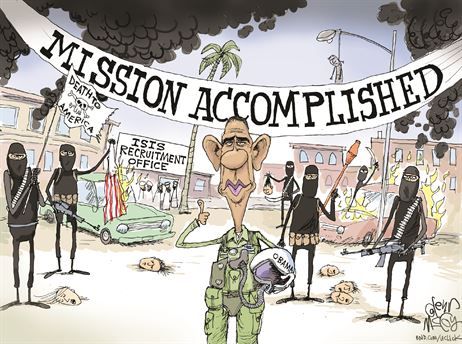
Courtesy of Glenn McCoy via Townhall
Musical Interlude: My Favorite Vocalists

Cat Stevens, "Wild World"

Sunday, May 3, 2015

Miscellany: 5/03/15

Quote of the Day
Do not spoil what you have 
by desiring what you have not; 
but remember that what you now have was 
once among the things you only hoped for.
Epicurus

Image of the Day


Obama, Baltimore and Politics

Let's be clear where libertarians stand in the Baltimore kerfuffle:
  • the Freddie Gray arrest was unconstitutional (making eye contact and/or running from police are not crimes), and the police, at minimum, are morally responsible for Gray's death. Even under the assumption that Gray was legitimately arrested, Gray was entitled to a presumption of innocence and the local government had an obligation to protect him so he had his day in court before a jury of his peers. There is no justification for a severe spine injury, which was a factor in Gray's death, on the way to the police station under grounds of due professional care.
  • there is no justification whatsoever for criminal rioters assaulting people and property, rationalizing the cause of Freddie Gray. The people who are being attacked are not responsible for what happened.
  • whereas there has been political fingerpointing by both sides of the partisan divide, let's be clear: government has a lot to do with urban issues: law and order (or lack thereof), failing public schools, a dysfunctional war on drugs, a failed war on poverty, occupational licensing, minimum wages and other barriers to job entry, regulatory barriers and high taxes to business formation or growth, etc.  And let's be clear: most of the large urban centers have been controlled for decades by local Democrats, and on the federal level  the federal government has spent an ungodly amount of money on public housing, healthcare, and schools, among other things.  All this government really hasn't changed the facts on the ground like a seemingly permanent underclass.
Obama, who promised a post-racial Presidency, has been particularly pathetic, trying to blame the GOP for blocking his special interest infrastructure boondoggles, early childhood education initiatives (despite education is more of a local responsibility and there's little scientific evidence that the benefits of early education persist beyond a few grades). The reforms that will mean something include deregulation by all levels of government, allowing a true free market in education, encouraging business growth with less government burden. Obama's answer is just more of the same failed redistributionist and Keynesian economics. But, worse, he's going to leave behind around a $20T debt and maybe $100T in unfunded liabilities

Sunday Talk Soup and Alleged Government Sponsorship of Discrimination Against Gays

Stephanopoulos, moderator to ABC This Week, in late March kept trying to tie the recently enacted Indiana RFRA law to the sanctioning of discriminatory activity against gays. First of all, RFRA protects the religious liberty of people from the MONOPOLY STATE; in the private economy, there is no "natural monopoly". If I were a photographer or baker who didn't want to work for a "gay wedding" as a matter of moral or religious principle, I should not be attacked by a government on behalf of a fringe special interest group. Any kind of restriction--say, driving, immigration, voting, etc.--could be viewed as discriminatory. As a bookseller, I may choose not to sell pornography; I may own a shop that markets to extremely tall women. Gay bars specialize in serving certain customers. So if I choose to specialize my business in supporting traditional marriage, why should it matter if I leave money on the table? I may choose not to support "gay marriage" for the same reason I don't support plural marriages. If gay bars managed to launch as an alternative to "straight" bars, why not gay bakeries or photographers?

Was a desire to protect the religious liberty of Indiana small businesses a factor behind Indiana RFRA? Maybe; so what? Over a dozen states have passed their own RFRA's well before the current politically correct LGBT push. The idea of a vast anti-gay conspiracy is ludicrous. I, as a straight, lived in Houston and heard about their gay community some 30 years ago--in a conservative state, long before the current lesbian mayor got voted into office. There are gay officeholders when the percentage of gays by most accounts is less than 5% of the population. Nobody is proposing a Jim Crow-style policy against the marketing of goods and services against gays. And RFRA goes beyond gay issues; I believe the initial motivation was the use of certain drugs as part of traditional Native American rituals. Let's hope that mainstream media tools like Stephanopoulos can move beyond the talking points of politically correct fascists.

Political Cartoon


Courtesy of the original artist via Patriot Post

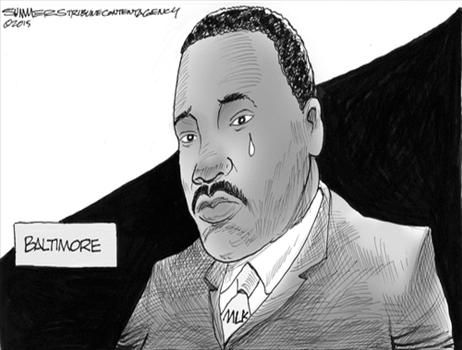
Courtesy of Dana Summers via Townhall
Musical Interlude: My Favorite Vocalists

Olivia Newton-John, "Hopelessly Devoted to You"

Monday, March 9, 2015

Miscellany: 3/09/15

Quote of the Day
Teachers open the door, but you must enter by yourself.
Chinese Proverb

NOTE TO READERS:  For the rest of the week, it is likely my daily emails will be briefer than usual and/or prescheduled. I expect to resume normal posting by the weekend

Emailgate and Sunday Talk Soup 

I knew it from the first time Barry Obama opened up his mouth on the Hillary Clinton government emails via her private email server kerfuffle: we've heard this before, very predictable (paraphrased): "I heard about it the same way you did, through news reports." Why? Because the minute you concede it, the next question is when did you know and why didn't you do something about it? Of course, the Administration did admit today that Obama had emailed Clinton--it was impossible to believe that over 4 years where Ms. Clinton travelled extensively around the world, that the Blackberry-loving President hadn't emailed her. It's possible, but unlikely, that Obama didn't understand the significance of an email domain 'clintonmail.com' vs. say 'obama.senate.gov'

Before going further, let me explain part of my personal interest in this story. For over 20 years, I've made a living as a database administrator. DBA's have an obsession with backups. In 1999, I was corporate DBA for the American marketing/service subsidiary for a Japanese computer chip testing manufacturer (with prominent clients like Micron, Intel, and IBM). I also administrated the company's ERP system (integrated applications, everything from invoices to financial statements). One accounting manager (who didn't like me because I had replaced her friend, who had left the company because he had not been named to fill the vacant IT manager's position) was in charge of payroll, part of which involved processing with a prominent third-party vendor. This processing occurred outside of our ERP system. I was shocked to discover it was basically a standalone PC under her desk. She was paranoid that I wanted access to the system to review what company employees were making. (Guess how I found out what the company paid for my relocation? Ms. Confidentiality herself talking to other employees.) My sole interest was wanting to ensure that the PC was being backed up because it represented a risk to operations (say, a hard drive failure); I wasn't asking to do this or control it; we had a networking/desktop group.

As an IT consultant, my issue with Hillary Clinton's private email service, beyond other things (e.g., I used to mock Lois Lerner's 18-minute gap in her emails, a reference to a critical gap in the Nixon Watergate tapes), was that it potentially posed an intelligence vulnerability without critical oversight and protection by government security/tech experts. Ms. Clinton wasn't just an ordinary government official but receiving/sending highest-level privileged communications. Pretending that she didn't know the risks doesn't wash: she specifically attacked email issues under the Bush Administration, Sarah Palin's external email account was hacked during the 2008 campaign. Even if Ms. Clinton is not technically knowledgeable about email security issues, any and all government personnel are required to receive training, particularly if you have a security certification

I haven't even reviewed all the Sunday morning shows, but I had enough just listening to Fox News Sunday. (Chris Wallace conducted, as usual, the best interviews in the business.) The issue dealt with interviewees Lanny Davis (a longtime Clinton loyalist) and Neera Tanden. Basically, I don't even want to acknowledge evasive, defensive, unresponsive talking points like 'Colin Powell [Bush's Secretary of State] did it'; 'the use of private email servers/accounts were not restricted until Obama's second term when Clinton was no longer in the administration', 'Clinton complied with the spirit and letter of the law', etc. These sorts of sham defenses are totally disingenuous.

The use of government infrastructure, including Internet services, for personal purposes is discouraged; my colleagues and I were not allowed to bring cellphones into a secure facility. You are explicitly warned that there is no expectation of privacy. They powered on their cellphones, e.g., when they left the facility on a lunch break. There are some minor exceptions for brief personal messages, e.g., timesheets, meal breaks, scheduling issues, family emergencies, illnesses, etc. But generally speaking, you were encouraged to leave the building and use your own cellphone. And it was not out of the question to have multiple email accounts, with one being dedicated to secure messaging. Email accounts are often rigorously backed up, e.g., every 2 hours. Government emails often explicitly identified on different levels of classication, and every government employee is trained in their proper use. It is forbidden to leave secure documents in the open in a secure facility; quite typically there are paper shredders for disposing relevant items. Violations of security policies can and do result in terminations.

There is no rational excuse for using a private email account for government work, period. The idea that there are different controls, procedures for handling privileged information is untenable. If Ms. Clinton did not want personal emails stored on a government system, fine; use clintonmail.com on your own time, on your personal cellphone, etc. But you use government infrastructure for official purposes; I can remember state and local facilities not even allowing VPN access; I remember in 2002 having to drive into Chicago at 11PM to do a 5-minute task in person. But saying, for instance, I want to check whether Bill stuck to his diet during lunch does not mean having classified emails to an unsecure server/location. We don't know, for instance, whether Hillary left a printout of a secure document out in the open, whether she arbitrarily deleted the paper trail to key documents (say, Benghazi; we have no way to knowing the completeness over what she does turn over. We don't know if there were efforts to hack into the Clinton email server and gain unauthorized access to privileged information. This Administration took a vow to increase tranparency, and Ms. Clinton understood what that meant. But the idea that Clinton could sidestep a paper trail by leaving her the gatekeeper of official correspondence by asking, are there any holes in government rules and regulations for me to bypass recordkeeping? It's clear by the very timing of setting up the email server--around her confirmation hearing--this was a deliberate act.

Saying Powell did it? I don't know, but even if he had, shame on him and two wrongs don't make a right; as to whether laws were incomplete, the fact is we have a rule of law and nobody is above the law. Clinton would have the highest level of sensitive government information--if anything, her communications should have been subject to a higher level of scrutiny and recordkeeping. That government rules and regulations did not foresee Ms. Clinton's use of a private email server? Ask me if I would be surprised by a drafting error in government regulations. Compliance with the intent of federal recordkeeping laws? Give me a break !

Freedom v. FCC Control of the Internet

HT Don Boudreaux of Cafe Hayek. I agree with Don that this video is great. Almost inevitably on forums in discussing this issue, I get the usual attacks that I am a shill for cable providers, am getting money from the Koch brothers, that providers could aribrarily abuse their "monopoly powers" to maximize "pay to play" revenue. There are plenty of counterexamples; for instance, broadband Comcast owns the NBC family of national broadcast and cable companies; it has always licensed third-party content, including ABC/ESPN, and it has continued to license its acquired content for obvious reasons (e.g., its geographic reach as an ISP is not national, and it can extend viewers, critical for advertising revenues). (Similarly, supermarkets offer more than their own private brands; customers often look to purchase nationally-advertised brands.)

The real point is competition. I am very well-aware that competition makes a difference, and that's the main point. During my most recent move, I had to wait a week and get off work early to accommodate the cable guy; similarly, when I've had to go to a GM dealership for service, I can't get it done during more convenient evening or weekend hours. But my local Wal-Mart is open 24 hours a day, and I can order almost anything online at any time and have it delivered to my door. As Google Fiber expands its reach of municipalities, many of the incumbent providers find a way to upgrade their upload/download speeds, often at no extra charge. We also have to look at innovation; at one time, we had the Pony Express, telegraphs, long-distance calling, overnight delivery, dial-up/DSL, email/instant messaging,  broadband, VOIP (e.g., digital phone service), wireless calling/Internet, etc.

The idea that providers can restrict content arbitrarily is short-sighted and little more than conspiracy nonsense. There are often technological ways to circumvent restrictions. I'll give a simple example: one day I was trying to play a Céline Dion French track on Youtube, and I got a message that the video was not authorized for play in the US. But if I was so inclined, there are Internet services which could spoof that my PC was in Canada, and I am sure there are ways to purchase the diva's recordings/videos not released in the US. In the music industry, there have long been "bootleg" copies of concert recordings. The fact is that you still have supply/demand factors, and the content provider will often find that it can maximize revenues by cutting price and/or extending its customer reach. And competition works: windfall profits attract competitors. I fully expect wireless capacity for data transfer to upsize dramatically. What is really needed is for government to get out of the way of competition and/or not to guarantee/enforce exclusive delivery by itself or favored players.

Anyone with modicum of business understanding knows there are risks in mergers like Comcast's. There is the well-known disaster of Pepsi's fast food acquisitions. Coke and Pepsi were locked in a fierce battle for market share in the 1970's. Fast food chains often played the soft drink giants against each other. Pepsi decided to acquire notable pizza, chicken and Mexican food chains. Well, of course, they now had 3 captive chains that would serve Pepsi products. But the bigger move on the chess board was that it gave Coke sales reps a new arrow in their arsenal to fast food rivals of the 3 chains: do you really want to give your competitors the profits to compete against you? I can't speak for Comcast's strategy here; it could be that it's worried about commoditization of the cable or ISP business and sees content as a higher-margin business, spinning off its maturing broadband business. (Who knows? Maybe Google could acquire it as a way of ramping up its Fiber service.)

The only way you can judge the contributions of an acquisition is through the pricing mechanism of the market; if you unduly restrict content or price your services too high, you provide a business opportunity to an actual or prospective competitor. The only way a private-sector company can guarantee revenue is through some crony relationship with government.


Choose Life: The Gifts of Autistic Children


Choose Life: Adoption and the Parent-Child Reunion


Political Cartoon
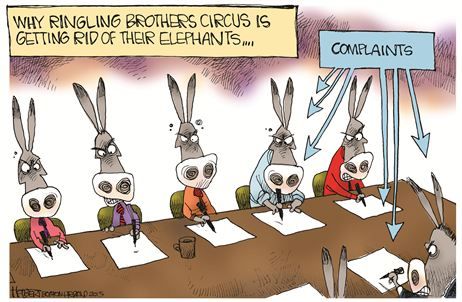
Courtesy of Jerry Holbert via Townhall
Musical Interlude: My Musical Interlude

Carly Simon, "Haven't Got Time For the Pain"

Wednesday, November 26, 2014

Miscellany: 11/26/14

Quote of the Day
The man who strikes first admits that his ideas have given out.
Chinese proverb

Earlier One-Off Post: "Progressives" in a State of Denial

Chart of the Day


Via Libertarian Catholic
Image of the Day

Re Broken Window Fallacy: via Dollar Vigilante
Fee-Greedy Towns


Entertainment Potpourri: My New Favorite Hallmark Cable Movie

Corrine, trying to rebound from a failed relationship, makes a wish for a great romance on a Christmas tree ornament. The context for the song is that her once pregnant newlywed grandmother had gotten serial arrangements of a song melody from her husband at war, who died before sending the final segment; at one point in the movie, Dave, a secret admirer and co-worker, asks her if she ever wrote anything, and she mentioned as a 7-year-old she had tried to merge the immortal "Twas the Night Before Christmas" with "Come Home For Christmas".  Harold, an angel with a mission, gets a job at the same music store with Dave and Corrine and tries to get them together. (Of course, the nefarious Tim returns to resurrect his relationship with Corrine.) Corrine overhears Harold playing her grandfather's whole song, including the missing part. Dave, in a bid to win Corrine's heart, bribes the community group with free musical instruments to get Corrine the solo part; the song happens to be a variation of the granddaughter's lyrics on the grandfather's melody. (Who wouldn't fall in love with Corrine, a real sweetheart?) I love the song and arrangement; the backing choir is brilliant.


Guest Post Comment

From Libertarian Republican:
Australian Senator David Leyonhjelm today (26 November) introduced his long-awaited gay marriage bill in parliament. The straight Liberal Democrat told the upper house that he supported gay marriage 'because I think people ought to have the freedom to choose their own life path.'
'To most people, marriage equality means the right to get married irrespective of gender or sexual preference,' he said. 'But it is much more than that; it is the right to live your life as you choose and not have the government impose a particular view on you.'
The Freedom to Marry Bill proposes to change the definition of marriage to 'the union of two people', rather than a 'man and a woman.'
In keeping with his Libertarian values, it also gives non-government religious and civil celebrants the right to refuse to marry gay couples
No, the true libertarian position is NOT to change the legal definition of marriage, but rather to privatize the concept of marriage.

A Reappraisal of Bork

Familiar readers know that during the life of the blog I've sometimes shifted my perspective; e.g.,  I went from backing McCain in 2008 to publicly distancing myself from him in a 2012 post. But more specifically I finally dropped my Democratic Party affiliation (by that time, I was a rare conservative Democrat; I had been a pro-life liberal Democrat until I took my first economics course at UH;  my professor was non-ideological) over the borking of his failed SCOTUS nomination. In fact, I can recall ordering a number of Bork volumes during the early years of the blog; I don't think I ever found the time to read them.

But just like I developed nagging doubts about McCain, the same thing started to happen with Bork. I still believe that he was the most brilliant jurist ever selected for SCOTUS in my lifetime; that doesn't mean I always agreed with him, i.e., the infamous inkblot with respect to the ninth amendment. But it wasn't until I learned that he and Holmes had a majoritarian deference  that I suddenly realized how libertarian my perspective has evolved.

Sunday Talk Soup

Today I was listening to a backlog of MTP with Chuck Todd when I came across a rather brutal prosecution of Bobby Jindal by an argumentative Todd. It was one gotcha after another; e.g., you  have a high disapproval rate in LA--how do you expect to compete in a Presidential primary; you enacted a tax cut and then boom, you have a billion dollar deficit;  etc.  It was so one-sided; the only good thing was that Jindal is one of the brainiest politicians on the planet. He can land 3 or 4 spot-on talking points before Chuck Todd could draw a breath.

There was also a softball interview on ObamaCare where Todd was reinforcing  (in fact, finishing their sentences) administration talking points  about cost containment, cuts in the uninsured. GOP  resistance was regarded as totally political, and there were allegations that several Republicans were for ObamaCare before the stereotype Tea Party allegedly cracked down on them. It's the same nonsense that annoyed me about David Gregory.

Not to mention there was this whole discussion about how the Dems will have much different, favorable turnout in 2016, more minorities and some of the Senate seats (e.g., CO and NC)  would have gone the other other way, that in 2016 the Dems will start out with 240 or so votes, only a few states shy of the magic number. I will simply point out 2016 is a change election and Reagan's landslide victory over Carter was not expected. Too much emphasis that minorities will vote for Dems 4-1.

Facebook Corner

(LFC). Jon Stewart does a good job ripping the Republicans who have made grand stands against eminent domain being used for environmental purposes, but have no issue with eminent domain being used for the Keystone Oil Pipeline. Theft is theft, no matter the circumstances, The Law still applies. If I can't steal my neighbor's land, neither can the government.
Some idiots don't understand the difference between an easement, in this case a pipe buried 4 ft. deep under a thin strip of land, for which the person receives fair market value for lease or purchase and is otherwise minimally inconvenienced, and real eminent domain abuse. Cry me a river.

(Cato Institute). "If you could wave a magic wand and make one or two policy or institutional changes to brighten the U.S. economy’s long-term growth prospects, what would you change and why?"
Join the conversation on Twitter using ‪#‎CatoGrowth‬!
Elimination of progressive tax structures, emphasis on consumption taxes (e.g., VAT), zero-based regulation, privatization and/or devolution of noncore functionality (vs. defense, justice), open immigration, unilateral free trade.

Political Cartoon

Courtesy of Henry Payne via Townhall
Musical Interlude: My Favorite Vocalists

Glen Campbell, "It's Only Make Believe". As announced earlier, I'll be suspending the Vocalist/Campbell series until the New Year for my annual holiday music series.

Wednesday, October 15, 2014

Ted Olson and the "Gay Marriage" Kerfuffle

Familiar blog readers know that I oppose "gay marriage" as an unwarranted Statist intervention into the social context; the legal/political context is a subset of the total context, including the community and marketplace, coexisting with preexisting traditional institutions/constructs of social norms (e.g., clothing), heterosexual marriage, family, and church. Marriage and family are not arbitrary constructs but ones which evolved over millennia, across cultures to promote societal self-preservation through procreation and stability. Of course, it is possible for two fertile people to procreate without marriage, but there's always been a social stigma attached to illegitimacy; marriage has been society's established mechanism as the foundation for procreation and the family.

Natural procreation requires heterosexual intercourse, which is a necessary but insufficient condition for pregnancy (obviously both partners must be fertile). The "gay rights" ideologues will object that we don't require fertility tests (or child quotas) for married couples, there are many examples of families raised by just one parent (e.g., a war widow) and obviously older couples can't procreate. Let's point out these are exceptions to the general nature of an evolved framework; for example, single parents can remarry; infertile couples can adopt, and in many cases, grandparents may raise their grandchildren. Of course, marriage is a concept that includes other aspects, including rivalrous claims on one's partner, and society's survival does not necessarily require each person/couple to recreate (I, for example, am the first-born of 7 siblings; I am single and don't have children, but I have 21 nephews and nieces, at least 2 from each other sibling.)

Now, as a libertarian Catholic, I have a Thomistic sense of tolerance:
The purpose of human law is to lead men to virtue, not suddenly, but gradually. Wherefore it does not lay upon the multitude of imperfect men the burdens of those who are already virtuous, viz., that they should abstain from all evil. Otherwise these imperfect ones, being unable to bear such precepts, would break out into yet greater evils... (ST I-II, q. 96, a.2, ad 2)
 ...those who are in authority, rightly tolerate certain evils, lest certain goods be lost, or certain greater evils be incurred: thus Augustine says (De Ordine ii.4): "If you do away with harlots, the world will be convulsed with lust." (ST II-II, q. 10, a. 11)
 We can see an inherent case for tolerance built into the Thomistic anthropology. In contemporary liberal theory, tolerance is justified on the basis of the current diversity in society. The flip side of this diversity is individuality, which requires liberty. In order for all persons to exercise their liberty, the state must tolerate those freely chosen actions of citizens of which it disapproves. (William Galston, Liberal Purposes, (Cambridge: Cambridge University Press, 1991), p.222) We can see the beginnings of such a position in Thomas' doctrine of free will. Since God respects man's liberty, on Thomistic principles, so should the state.
Moreover, Thomas takes into account the diversity of customs in different polities. He states that "...law should be possible both according to nature, and according to the customs of the country."(Ibid., a. 2 co.) Man's nature is fallen; thus, he is not capable of total perfection and he is prone to sin. The law should not regulate for man behavior which would be possible only for angels. Furthermore, custom is deeply rooted in every culture and to fashion laws which take no account of custom will only isolate citizens and earn resentment for the law. Custom is an important unifying force in any polity, and ought to be used for benefit, not suppressed. Thomas shows a respect for the diversity of custom, and does not seem to insist that the state be a homogenous community. In fact, he places custom on a quasi- equal footing with human law: "...custom has the force of law, abolishes law, and is the interpreter of law." (ST I- II, q. 97, a. 3) He is quick to add, however, that custom (like human law) can never oppose the natural law. (Ibid., ad 1)
Now from my standpoint, regardless of my personal moral/religious objections to the gay lifestyle, I've always had a live-and-let-live attitude towards the gay community. When I lived in Houston, it didn't take long to hear it along the grapevine that Montrose had an active gay community (and the current mayor, in fact, is a lesbian); I just made a mental note to avoid the area. Within my libertarian perspective, I recognize the right of gays to freely associate and have relationships. I never supported invasions of privacy like sodomy laws. When I lived in California I supported the state constitutional proposition to recognize domestic partnerships/civil unions.

However, I did draw the line at gays' attempting, in their desperate attempt to gain social acceptance, to co-opt the heterosexual constructs of marriage and family, which I felt was a potentially destabilizing Statist intervention into the social context with possible unintended consequences. I never liked the State's intervention into family law and the  like; I prefer that family issues be worked out through, example, Church arbitration. It was bad enough within my lifetime we have seen a general breakdown of the black family in urban settings, given a welfare state that seems to reward paternal abandonment of the family unit, and a divorce-prone society where, for example, I've seen two nieces-in-law leave their husbands. To the extent the local laws support the existing social norms, I can tolerate the law. I could even accept a state like Maryland deciding a "more inclusive" stand in their mutated concept of marriage, although I did not support it. (And let me say, that winning a bare majority vote in a blatantly misleading campaign which vastly outspent the traditionalists in a heavily "progressive" state doesn't impress me much.) But when judicial tyrants arbitrarily overturn heavily supported referendums reinforcing traditional marriage, it is fundamentally unacceptable.

Before going further, let me first answer the trivial objection typically raised by the anti-traditionalists, that gender is no more a salient characteristic than incidental characteristics, like racial/ethnicity barriers established in some states; heterosexual couples from different races can have natural children. The Catholic Church never supported anti-miscegenation laws (the Church was far more concerned about interfaith marriages, and let me point out 4 of my 6 in-laws were non-Catholic when my siblings got married); in fact:
All bans on interracial marriage were lifted only after an interracial couple from Virginia, Richard and Mildred Loving, began a legal battle in 1963 for the repeal of the anti-miscegenation law which prevented them from living as a couple in their home state of Virginia. The Lovings were supported by the NAACP Legal Defense Fund, the Japanese American Citizens League and a coalition of Catholic bishops.
Let's move onto the recent debate on last Sunday's Fox News Sunday:
WALLACE: When this week began, same-sex marriage was legal in 19 states. Now, because of the Supreme Court's decision not to review the ruling of several appeals court, same-sex marriage may soon be legal in 25 states.
We want to drill down into the legal status and merits of same sex marriage with two top advocates: leading conservative Ted Olson represented the plaintiffs in the Virginia case, and is co-author of "Redeeming the Dream: The Case for Marriage Equality." Tony Perkins is president of the Family Research Council.
Gentlemen, welcome back to "Fox News Sunday." Mr. Olson, let me start with you. Why do you think the Supreme Court decided not to intervene in these cases, and can we take from that there's now a majority in the court who feels there is a constitutional right to same-sex marriage? 
TED OLSON, FORMER SOLICITOR GENERAL: [W]hat the Supreme Court was looking at on Monday when it rendered its decision not to review these pending cases is a record of something like 25 federal judges at the district court and at the appeal level which had consistently ruled that same sex marriage bans were unconstitutional.
I think the justices saw was a trend -- overwhelming trend in the same direction and felt that the federal courts were handling this issue in an appropriate and proper way, and decided not to weigh in.
 Let us point out here that Justice Kennedy's deciding vote did NOT establish a so-called constitutional right to marry. He specifically referenced the principles of federalism, the Tenth Amendment traditional rights of the states in the province of regulating morals and the institution of marriage. What was convoluted was his decision on California Proposition 8, which lawfully restored the traditional definition of marriage to the state constitution: he basically let stand a lower court reversing the proposition based on an incidential ruling of standing because California's governor and attorney general had refused to defend the proposition in federal court. This basically disenfranchised the California majority that supported the proposition. Whatever the post-Kennedy rulings were based was NOT a constitutional right for "gay marriage" which clearly Kennedy sidestepped in his decision. Many of the recently overturned state propositions/amendments were from conservative states like Utah not involving arcane issues of legal standing. The point is, when did the people of the state lose their right to define the fundamental aspects of marriage? In fact, for over 200 years of American history, traditional marriage held across all 50 states, and as I pointed out in a recent commentary (reprinted below), plural marriage was an issue in Civil War era Utah, and the federal Morrill anti-bigamy law was unanimously upheld by SCOTUS, tracing back traditional marriage to early English law. Whether or not there is a contagion of activist jurists on the "gay marriage" bandwagon, as Olson suggests, I do think SCOTUS (in particular, Justice Kennedy's sidestep of legitimate federalism issues here) was immoral in not facing the issue here, which was not the federal government restricting states' ability to redefine marriage but the states' Ten Amendment rights.
WALLACE: Mr. Perkins, let me go a little further than Ted Olson, because he has to argue before the court. If ...only four of the nine justices [are needed] to decide to review a case -- why would they make a non-ruling in this case which would allow thousands more to have same-sex marriages?
 This is an interesting question: why didn't the original 4 dissenting judges pick up? Perhaps they felt that Kennedy would come with some other narrowly-defined rationalization (like legal standing) to sustain the lower courts or perhaps they feel there are a couple of cases where the lower court will sustain a state law and the Court will take it up then.
TONY PERKINS, FAMILY RESEARCH COUNCIL: WellYou still have two circuits that have decisions coming up that look favorable toward natural marriage. But I think the effect here is what we need to look. I think the effect of this is the court did a back alley type Roe v. Wade decision by letting the lower courts do their evil bidding. And the result of that is such -- you go back to 1973 when the court imposed abortion on the nation, it was [?] to resolve the issue 41 years later.
That issue is now a political issue in every election from the president on down. This issue is not going away despite what the court may say.
 I do agree that this will be a political issue, certainly from the standpoint of judicial tyranny and judicial nominations by future Presidents. I also don't think that the social context in conservative states will be transformed into social acceptance of gays via acts of judicial tyranny. Will it be divisive in the way of Roe v. Wade? Probably not. Keep in mind only about 4% of the population is gay, and most of those relationships are not long-term; my guess is that gays would have to migrate to large metropolitan areas to find a sufficient dating base. Perhaps some couples will move to a conservative state and want to have their relationships recognized.
OLSON: Yes, I think the analogy would be to the 1967 decision of the United States Supreme Court that struck down bans on interracial marriage. We now understand and the American public believe that that was a right decision and right for America. Over 59 percent of Americans now believe that marriage equality should be the law of the land. Individuals should be allowed to get married to the person that they love.
The individuals involved in these cases have been together for decades. They now want to be a part of the community, and be part of our society by marrying and living with the people that they love.
 Olson is engaging in wishful thinking. I discussed anti-miscegenation laws above; the Catholic Church, which supported overturning said laws, will never accept "gay marriage"; interracial couples are fully consistent with the traditional definition of marriage. I particularly despise Olson for citing bad polls, only now when they seem to favor his point of view--they weren't relevant a few years back when North Carolina buried "gay marriage" at the polls. He's also misstating his case; lots of conservatives, myself included, had live-and-let-live beliefs about the gay community long before Massachusetts' jurists overthrew state marriage law. I'm not for State intervention in gay homes. That's different than letting a special-interest group impose its mutated concept of marriage on the majority of people in a state.
 WALLACE: Let me pick up on one of the central concerns that people have about all of this. In all 16 of the states that because of the Supreme Court's non-decision, may not have say legal same-sex marriage, there was a ban on those same sex marriage, either approved by the state legislature or popular referendum. Mr. Olson, you have a long record of opposing what you call or people call judicial activism. Question -- why should judges overrule the demonstrated will of the people either through referenda or through state legislature action?
Ippon!
OLSON: We have a Constitution and Bill of Rights precisely because we want protections from majority rule. When the majority in a legislature or a popular vote take away rights of individuals that are protected by the Bill of Rights, then we have an independent judiciary to rectify that situation. It's happened again and again and again throughout this country's history.
We have an independent judiciary to protect the rights of individuals like gay and lesbian citizens who only want respect, decency and equality along with the rest of us.
WRONG ANSWER! The tacit assumption is that marriage is fundamentally a legal construct. In fact, it's a preexisting social construct thousands of years old. The state referenda, etc., did not define away any existing so-called "constitutional right to marry"; it merely reinforced the existing definition of marriage in state history and reflecting the existing social construct. These state referenda, etc., did not prohibit the rights of gays to cohabitate or form whatever kind of civil union supported by their local community. Olson is disingenuously confounding the negative rights of gays to live in peace without being hassled by the State or mobs with imposing a mutated concept of marriage on the greater community.
WALLACE: Mr. Perkins, let me go back to the case where there were bans on interracial marriages. In the number of states, the Supreme Court simply ruled those bans were unconstitutional, as Mr. Olson --
PERKINS: Apples and oranges,because we're talking about an arbitrary boundary created by man between the races. That doesn't exist in nature. There is a boundary between people of the same sex getting married. They can't procreate. They can't -- there's nothing in nature to say that's normal.
But to go back, this is unprecedented decision. Voters in two thirds of the states have affirmatively gone out to protect the definition of marriage. This is the only time in a period of two decades in which voters and their elected representatives have affirmatively embraced the definition of marriage in their state policy, and now, you have the courts overturning that, robbing the people of their vote and their voice. What we see here, I believe, is that the court has lit a fuse to a powder keg culturally that is going to have ramifications for years to come in this nation.
WALLACE: All right. Let's talk about the merits of this, and, obviously different people have different views. What is your single, strongest argument against allowing same-sex marriage?
PERKINS: Well, I'd like to ask Ted, what's the purpose of marriage? 
OLSON: The purpose of marriage is what the Supreme Court has said 14 times. It's a fundamental right that involves privacy, association, liberty, and being with the person you love and forming a part of the community and being treated equally with the rest of society.  
I would have approached this differenly than Perkins, but he's on the right path and Olson is definitely wrong. The issue is not whether or not gays should have the right to have loving relationships and live private lives in peace without intrusion by the State, which Olson is promoting. The question is whether they have a right to impose an arbitrary social recognition of that status. I don't agree with unmarried heterosexual couples living in sin; I don't want to promote a social endorsement of those relationships. That's different from prohibiting those relationships. Perkins is basically pointing out that marriage reflects a natural foundation for procreation in society; it doesn't mean necessarily that each married couple must procreate, but procreation occurs in the context of the social, not State-conferred definitions of marriage and family, and meddling with the foundational constructs of marriage and family is opening Pandora's box with the sustainability and stability of society.
PERKINS: Well, we know from the social science that children do best with a mom and a dad. That's why our policies in this country have preferred marriage and given benefits to it. But let me -- if love is the factor, what boundaries are there?
OLSON: What court after court after court has said, that allowing people of the same sex to marry the person that they love, to be part of the community and to be treated equally, does no damage to heterosexual marriage. And court after court after court has said children living in a same-sex relationship do as well or better than people in other communities.
Perkins has the better argument here; there is little doubt that ill-designed welfare state policies have contributed to a vicious cycle of single-parent homes in urban neighborhoods. Olson's argument is fairly lame. For one thing, it is impossible for gay people to have natural children, and I have enough background in statistics and behavioral research to doubt almost any study seen by a court, never mind the competence of jurists to properly assess alleged empirical studies. One can certainly argue that gay relationships are less stable and faithful than heterosexual ones overall and because of the relative scarcity of gay homes/families  any definitive conclusions are, at best, dubious. I have already heard of numerous cases of gay couple "divorces"  and I think Olson has an uphill battle to convince others that a "more inclusive" definition of marriage and family contributes to societal stability.
WALLACE: What are you suggesting? That they're going to be polygamy. That people will be marrying their pets
PERKINS: No, I didn't say that. If we remove the natural established boundaries for marriage, the union of a man and woman, we have removed those boundaries, those guardrails. There's no arbitrary boundary --
Actually, yes, I would go there to polygamy and/or any variations to traditional marriage. This is not to say I believe in the State intervening in polygamous households. But the point is that we are engaging in socially experimental policies with institutions that have evolved over thousands of years, and we don't know the unintended consequences of meddling with our foundational constructs. I'm already seeing damage to communities of color which are unintended consequences of LBJ's War on Poverty. Some 40% of births in America today involved unmarried parents.
WALLACE: It's a different issue. I'm asking you, what's the impact on you and your family to have these people living next door?
PERKINS: Let's talk about it. Let's talk about my children all of a sudden, in school are taught values and morals that contradict what I teach as a parent at home. That's happening already across the country in those states that have recognized and forced same-sex marriage on the states.
Let's talk about the business place, let's about Aaron and Melissa Klein, a bakery in Oregon, forced out of business, forced to pay $150,000 in fines, simply because they didn't want to participate in a same-sex marriage.
WALLACE: Mr. Perkins, I'm going to give you the final word. In your answer, I'd like you to talk about what role you think this will play in the 2016 Republican presidential battle.
PERKINS: Well, look, adoption agencies have been put out of the business in Massachusetts. Parents have been denied the right to determine the values their children are taught. It affects families. It affects all of Americans, and it's wrong for the court to take away the voice of the people.
I think it's an issue not only in 2016. Like Roe v. Wade, the court wanted it to go away 41 years ago. It's still here. This issue will be here for decades to come if the court does not allow the states and the people to deal with it.
Olson in the interim of this concluding state continued comparing "gay marriage" to SCOTUS action on  anti-miscegenation laws, basically arguing the sky didn't fall just because we removed marriage obstacles from interrracial couples. That is totally nonresponsive to the point of discussion. Perkins is bringing up some very salient issues, like how some Catholic institutions like adoption agencies are being driven out of the market because the Catholic Church does not subscribe to gay marriage/family policies imposed by the State meddling with foundational constructs.

Finally, for those who have not read my related post to The Libertarian Catholic group last Thursday, I republish it here for your convenience:
(Libertarian Catholic). Using the term "marriage equality" is like saying there is no difference between men and women and the unique relationship between the sexes is not unique. It is a lie.
They are basically arguing marriage is a fundamental right and that the traditional definition of marriage enforced by individual states is discriminatory and deprives gay couples of relevant benefits under the law. This is basically a Fourteenth Amendment argument.
Remember the SCOTUS Reynolds decision (re: Utah and the Morrill Anti-Bigamy Law); the argument was that LDS followers practicing polygamy were being denied religious liberty. Among other things, the Court pointed out that any unlawful act could be prescribed by a religion (say, for example, a ritualistic sacrifice of your first-born) and said basically the cognitive aspects, not behavior, of religion were protected and also referenced the concept of traditional marriage back to early English law.
Justice Kennedy didn't go all the way to arguing a constitutional right to marry (which is being argued by Reason, Cato Institute, etc.) and pays lip service to traditional state regulation of marriage, but then some magic happens, and he upholds, on a legal technicality of standing because the state's elected leadership, the governor and the attorney general, refused to defend the proposition, throwing out California Proposition 8 which reinstated the traditional definition of marriage to the state constitution. (The state Supreme Court had thrown out an earlier traditional marriage proposition, arguing it had not been properly drafted beyond its scope of review.)
Keep in mind that California and other states also had provided legally protected domestic partnership/civil unions with marriage-like provisions, e.g., hospital visitation, inheritance, etc. Among other things behind that California court decision was the talking point that partnerships or unions were "second-class marriages" that barred gays from government marriage-conferred goodies, a Brown (education)-like "separate but equal" target. 
I do find it paradoxical that libertarian think-tanks, instead of pointing out it's not to the benefit of gays to subject their relationships to Statist meddling, have cheered on judicial tyranny. I oppose State intervention in the social context, of meddling with private-sector social norms, institutions (like marriage and family) and traditions. I'm concerned about meddling with socially-evolved constructs, across cultures and religions, over thousands of years.
As Catholics and Christians, we know that real marriage is in its sacramental nature, not a piece of paper from the State. Whatever mutated construct the State is creating is NOT "marriage". I would prefer for gays not to co-opt a heterosexual construct. As a Catholic libertarian, I accept the right of others to associate in ways inconsistent with moral teachings; this is the essence of free will. I would prefer to see the concept of marriage fully privatized--which I believe is the true libertarian position.