Analytics

Showing posts with label celebrity trial. Show all posts

Monday, July 23, 2012

Miscellany: 7/23/12

Quote of the Day 
A man may fall many times 
but he won't be a failure 
until he says someone pushed him.
Elmer G. Letterman

If thou art a man, 
admire those who attempt great things, 
even though they fail.
Lucius Annaeus Seneca

Veronica Moser, 6, was killed and her mother Ashley was shot three times and is still in surgery
Veronica Moser-Sullivan, 6 years old
Gift from God
Aurora Movie Massacre's Youngest Angel
Courtesy Daily Mail
Veronica's uncle, Robert Sierra, describes her this way: "Veronica wanted to be a princess, everybody loved her. Her laughter was infectious, when she laughed everybody laughed. She was only young but she had ambitions and goals, she wanted to go to college. She would have so much fun playing, all you would hear through the house was her laughing and giggling."

Veronica was attending the movie with her 25-year-old pregnant mother, Ashley Moser. Moser was shot in the stomach, but as of the time of the article, her preborn child is still alive. Thirteen-year-old Kaylan was heroically applying CPR on Veronica, when another, larger victim fell on top of the 6-year-old. My thoughts and prayers to all the victims and their families, in particular for the rapid recovery and good health of Ms. Moser and her preborn baby; I cannot imagine her broken heart. It's young people, young ladies like Kaylan whom give me confidence in our nation's future.


Life is a journey, sweet Kaylan... You are a remarkable young woman, and I'm proud of you.

Go the Distance (excerpt, my edit) by  Alan Menken and David Zippel

And I won't look back
I can go the distance
And I'll stay on track
No I won't accept defeat
It's an uphill slope
But I won't lose hope
Till I go the distance
And my journey is complete
But to look beyond the glory is the hardest part
For a heroine's strength is measured by her heart
Like a shooting star
I will go the distance
I will search the world
I will face its harms
I don't care how far


Reminder: H.R. 459, the Audit the Fed Bill Up 
For Vote Tomorrow/Wednesday

I believe that the House leadership will attempt to suspend the rules. Translating legislative jargon, usually bill opponents will try to weaken the effect of a bill with amendments. In essence, suspending the rules (with limited debate) is more of a take it or leave it but to carry the bill, you need to carry it with a two-thirds vote. I regard this as one of the most important votes in years: we need more accountability and other fundamental reforms of the Fed. This is a long-overdue, critical first step in the process of true bank reform: we need to stop manipulation of interest rates and the government currency printing presses.

Barack Obama Quote of the Day

The fact that we are here today to debate raising America's debt limit
 is a sign of leadership failure. 
America has a debt problem and a failure of leadership. 
Americans deserve better. 
I, therefore, intend to oppose the effort to increase America's debt.
Barack Obama
aka the $5T Man

America has a debt problem and a failure of leadership. 
Americans deserve better. 
Vote for change 2012

Political Potpourri

How many commentaries have I written on how Romney should be running his campaign? And really, it's not just Romney's abysmal campaign to date but the GOP in general (including Boehner, McConnell, Ryan, etc.): they have just been inarticulate in framing the issues.

Romney has a few glaring problems: (1) the rest of the country doesn't know him well; (2) he has earned a reputation as being unprincipled; (3) his messages have been inconsistent and convoluted. And his campaign has been doing a terrible job dealing with these.

On the third point, I was listening to an earlier Fox News Sunday regarding the Romney campaign's inept response to the ObamaCare decision. Romney called the mandate a tax (as per Chief Justice Roberts' decision) while a campaign spokesman referred to it as a penalty.

Let me comment on the health care/RomenyCare/ObamaCare issue. The Democrats are drafting off Romney's own rhetoric. They think they have taken Romney's opposition out, because of surface-level similarities between the programs. So, for instance, they talk about the freeloader problem (i.e., uncollected costs because of government-mandated emergency hospital care regardless of the ability to pay).

This is disingenuous for a reason I pointed out the NCPA health care proposal earlier this month. For one thing, the federal government already subsidizes health insurance as a tax expenditure (which I discussed earlier this week) for employer-supplied healthcare. There's an equal protection argument here: people without health care insurance should be entitled to a tax credit benefit relevant to out-of-pocket costs: they are paying higher taxes than they should to offset tax expenditures on employer-provided health care. (One of the NCPA points is for the government to offset provider uninsured costs with related tax credits.)

There are a number of problems driving up health insurance costs (including an aging population with costs correlated with age), the most critical one being deviations from free market principles and the hidden costs of health care. For example, state regulations (in particular, special interest benefit add ons) are a form of protectionism, and however well-intended, policies like guaranteed issue and community rating basically enable below-cost coverage for high-risk individuals. Subsidies are also a perversion of the free market, because they artificially lower policy costs. Health insurance really isn't insurance at all in the sense but bundled health costs: government policy is effectively a tax dodge which encourages cramming out-of-pocket ordinary health costs (e.g., birth control and preventive health care) into insurance (the equivalent of which would be like including gasoline purchases, oil changes, tolls,  etc., in your auto insurance policy). We need more vesting of the consumer in the purchase of health care goods and services. Large businesses can self-insure across states with a common basket of benefits; on the other hand, if you live in a lightly-populated state,  there may not be sufficient economies of scales: what we need is more regional or national pooling of risks.

The hidden costs include the employer share of premiums and the effects of tax subsidies. From the standpoint of business, your cost is your wages plus the business contributions to your benefits. When progressives talk about having the employer pay the costs, they are really talking about increasing the hidden costs of your compensation. From the perspective of business, this is a zero-sum with the balance of your compensation. You may THINK you are paying $7500-$10K for a family policy because that's what you see but you're really paying $15-20K.

Policies like guaranteed issue and community rating really mean high-cost individuals socializing their health expenses, i.e., paying below cost. Who makes up the cost? The other, healthier people in the program. You are paying more than your fair share, and  higher premiums in part reflect those passed along costs. Many states have risk pools where the high cost individual pays somewhat higher rates and the rest of the premium is subsidized (e.g., by a tax on premiums).

Getting back to Romney, I've argued what he needs to say something like this:
  • Massachusetts before reform had the highest percentage of the insured; government costs would be much higher in other states, and today's government is struggling to cope with existing commitments in a low-growth economy, never mind the higher costs of an aging population
  • Obama's promises of government "saving" families on policies were unrealistic, with any alleged savings more than offset by the additional costs of an older population, loss of market competition, and "free" or otherwise artificially low prices for health care goods and services driving demand exacerbating sector costs
  • The federal government cannot sustain its current health care costs, with Medicare alone over $20T in unfunded liabilities
  • Government regulations and mandates, especially from Washington, are driving up costs in the sector
  • There are market aberrations, like restricted supplies of medical personnel, government price-fixing in Medicare/Medicaid, and ordinary medical expenses, which do not properly come under the concept of insurance
Romney is getting pressed for an alternative. I have repeatedly mentioned that he should propose (as Sen. Dole did back in the days of HillaryCare) catastrophic health insurance, shoring up assigned risk pools, and allow marketing of policies across state lines.

On the tax vs. penalty question: Romney should stick with the tax angle because tax issues can get resolved through budget resolution, which is easier than dealing with a filibuster-sustaining Senate Democratic minority, requiring 60 votes for passage.

Going back to the first two points I raised: I do not like the fact that the Romney campaign is essentially letting the Democrats define Mitt Romney. Mitt Romney needs to define himself, why he wants to be President, that he's not a "finger-in-the-wind" guy or changes his mind as often as he changes his socks:
  • My trust lies in the private sector, not government intervention
  • I will bring my knowledge in managing private sector turnarounds to the federal government: consolidating operations, selling or leasing more assets (including natural resource development), and focusing on core competencies and privatizing other operations
  • I believe in old-fashioned American values, like thrift, self-reliance, and hard work, and traditional institutions like marriage, family, and church
In particular, I think he needs to define himself in contrast to Obama, e.g.:
  • we believe in decentralized authority back to the individual and state; 
  • we need to streamline regulations to promote market competition;
  • we need to cut spending across the board and streamline/simplify tax preferences and expenditures to enable lower tax rates.
  • we must confront head on unsustainable federal spending and entitlement liabilities  
I do wish that Romney would look for clearer ways to distinguish himself from Obama, e.g.,
  • the Bush/Obama record on: low-growth economic policies; unsustainable federal deficits and  spending increases; open-ended, expanding operations in the volatile Middle East and Gulf Region; and government intervention in the economy (bailouts, etc.)
  • a strong dollar policy, including reining in the Federal Reserve 
  • a significantly smaller federal footprint in terms of individual rights and the private sector
Looking at the fall elections, I've actually found it remarkable that Romney continues to do well, splitting major polls. Even in polls where Obama leads, there's a significant undecided, which I would interpret as leaning Romney. I saw a Gallup blurb earlier today touting that Romney's Bain Capital experience is regarded as a net positive by voters.

However, it looks like Romney's position in the battleground states has slightly deteriorated, no doubt due to saturation negative ads. I saw one recent electoral projection suggesting that it all comes down to Ohio. A few suggestions to Romney: Obama has been pushing his "save" of GM and Chrysler. I would take that head on, pointing out that the federal government is still in the deep red on its auto "investments", even with Obama's $7500 federal tax rebate going to upper-income yuppie purchases, Obama's favored Volt is well below sales projections. I would point out that a reorganized GM/Chrysler under traditional bankruptcy would still have sold vehicles.

But I would also point out that many of the factory closures in Ohio had more to do with unsustainable cost pressures, but we have had other higher-value manufacturing gains in the economy.

Whereas I'm not calling Senate races at this point, I think there are good chances of pickups in Nebraska, North Dakota, Wisconsin, Virginia, Florida, Montana and Missouri. I rate Scott Brown as a slight favorite to hold onto his seat in Massachusetts, and the biggest threat to GOP seats seems to be in Maine where the GOP candidate is trailing a distant second to former Governor King, an independent. I think the GOP has a decent shot at the seats in Connecticut, Ohio, New Mexico and possibly New Jersey, Pennsylvania and Washington. I'm definitely unhappy that the GOP has not been more competitive in states like Minnesota, California, New York, and Rhode Island. I'm happy with the GOP Senate nominee (Bongino) in Maryland, but I haven't heard much from him since the primary; Maryland is an uphill state for the GOP, with roughly a 2-1 registration advantage for Democrats.

A final note: it may sound as if I'm being partisan here. I'm more of a pragmatic free marketer. I have a number of issues with Republicans, e.g., Sen. Marco Rubio has not been helpful in dealing with sugar subsidies, I'm uncomfortable with Romney's China-bashing, and I share Dwight Eisenhower's concerns about the military/industrial complex. The interesting thing is how policies have flipped over time: the Federalists/Whigs/Republicans used to be the mercantilist/big government/high tariff party, and the Republican Democrats/Democrats used to be the small government/free trade/free banking party. I have always been a fiscal hawk, even during my salad days. There are few legitimate conservative Democrats today (speaking as a former conservative Democrat), and the few there are been largely marginalized by progressives locked into leadership positions. Yes, I'm very aware that Republicans have not applied the principle of small government to Big Defense, and they've done their fair share of earmarks, tax preferences/expenditures, etc.

Penn State Gets Sanctioned by the NCAA: 
A Critical Response

According to a CBS News alert:
The NCAA has delivered stiff sanctions to the Penn State football program in the wake of Jerry Sandusky child sex abuse scandal, including a $60 million fine, a four-year ban from bowl games, a reduction in initial scholarships from 25 to 15 a year and the voiding of all wins from 1998 to 2011. The school has also been placed on probation for five years. 
This is overdone, disproportionate and counterproductive. I'm sure that the NCAA believes that it is sending a message by dealing out a Draconian punishment, but I think what it's done is wrong.

I do not have a vested interest here: I have never been a student or faculty member at Penn State, and I am not, and never have been, a fan of the Penn State football team.

Let me be clear before expressing my opinion here on the NCAA action. As a conservative and a Christian in the Roman Catholic tradition, I consider that sexual exploitation, physical abuse, or negligence of minors are unconscionable crimes. Libertarians have issues with the nature and extent of positive rights of the child, i.e., what parents must do on behalf of a child, but certainly in a trustee guardian role, we would expect them to be responsible for basic developmental needs of the child, e.g., food, shelter, safety, clothing, basic literacy and life skills, etc., to be met. (Libertarians are more likely to distinguish between legal and moral responsibilities.)

First, former Assistant Coach Sandusky alone is responsible for the unconscionable crimes of which he has been found guilty.  I think that the attacks on Penn State are attempts to mitigate Sandusky's responsibility by socializing the blame.

To what extent is an institution responsible for crimes done without its knowledge or consent? The primary responsibility for reporting a crime lies with the witnesses, and as far as I know, the state is not prosecuting a case against them. I have not read the Freeh report; it would be wrong if a university official attempted to intimidate a witness from coming forward. If I'm not mistaken, the two young victims in the 2000 and 2002 alleged incidents have never been identified, the witnesses have given varying accounts of what was seen and what was said to university officials, there are questions about reliability of memories years after an event. I suspect that the reason the district attorney did not bring a case against Sandusky in 1998 was a perceived lack of evidence.

What were Schultz' and Curley's responsibilities to report poorly substantiated allegations? I am not familiar with Pennsylvania law at the time of alleged incidents. Personally, if I had been part of the Penn State University administration, especially given the 1998 circumstance: (1) Sandusky would have been prohibited from unescorted access to facilities; (2) if and when any subsequent Sandusky-related incidents came forward, I would have documented a good faith effort to follow up the allegations, encourage witnesses to report the incidents, and present to the district attorney any findings from internal investigations.

But what, if anything would the district attorney have done about the 2000 and 2002 incidents, even if they had been dutifully reported to local authorities? Sandusky no doubt would have denied the allegations, and the burden of proof would have been on the authorities. I think Schultz and Curley would have been better off leaving that decision to the district attorney.

I do believe that the university banned Sandusky from bringing a child to campus facilities after the 2002 internal investigation. I have not seen any subsequent allegations from the Penn State campus. Even if one argues wrongdoing through 2002, why is the NCAA sanctioning Penn State for crimes committed outside the campus, i.e., stripping Penn State of its victories from 2003 through 2011?

Second, the nature and extent of sanctions are arbitrary and unfair. If and when sanctions are invoked, they should be as immediate as possible after the time of the original infraction. The NCAA should not be setting rules, regulations, and sanctions on an indefinite post hoc basis: to what extent, if any, does the NCAA require registration of any alleged crimes on campuses? How fair is it to decide the rules after the game is played? How can university administrations years after the fact be held responsible for events where the quality of evidence, the reliability of witnesses, etc., deteriorate over time? How can universities address the problems to mitigate the nature and extent of sanctions if someone surfaces with allegations years after the fact?

To what extent are these sanctions comparable to those of other offenses? For instance, what about rape accusations, involvement with illicit drugs and/or steroids, gambling, etc.? To what extent should a football team be sanctioned for events not involving players?

Third, the Draconian punishment may result in unintended effects. For instance, witnesses may find themselves targeted by the local community, alumni, etc. for coming forward; we really want an environment where witnesses are supported for coming forward, not worried about being seen as disloyal or blacklisted in the local area. Universities could be threatened by malcontents with dubious claims. In many cases, crimes could simply displaced, not eliminated. For instance, the fact that Sandusky wasn't allowed to bring boys to facilities after 2002 didn't seem to deter his behavior; he just found other ways, and my guess is that the majority of his offenses over the years were off-campus. Once you set up rules, eventually motivated people will find ways around them.

Finally, the NCAA is unfairly unfairly punishing the late Coach Paterno and the football team. I can't speak as a former college athlete, but men of honor do not win by fiat but their efforts on the field. I want to see a single football player whom played against Penn State who would boast of any such unearned victories; any man among men would reject this. Sandusky wasn't on the gridiron: he didn't tackle or score on them. Are we sports fans supposed to have amnesia over the reality of Joe Paterno's coaching success after 1997? Pretending that Coach Joe Paterno and his teams from 1998-2011 did not earn their victories fair and square on the gridiron is a state of denial.

Let me be clear to the NCAA: Coach Joe Paterno is, and will remain, the football coach with the most wins: 409. I and all other genuine college football fans declare your ruling NULL and VOID. Until another coach passes Paterno with 410 wins, Paterno remains on top. I'm not saying this as a Penn State fan or as a Paterno fan, but I count wins earned on the gridiron, not in the offices of college bureaucrats.

One last point: the penalties in the form of reduced scholarships, ban on bowl appearances, etc., all but ensures that Penn State will be unable to field a competitive team in the near future. Already talented recruits are seeking their releases. I was like any red-blooded American boy: I dreamed of playing on a glorious crisp fall afternoon for the right to play in a bowl game. I was never blessed with the size, talent or speed to win a college football scholarship, but there are kids whom have been working for years to get that chance and to have a bunch of bureaucrats take that away as a knee-jerk overreaction to the alleged perverted actions of a former coach and the botched university responses to internal incident reports is fundamentally unjust.

Musical Interlude: My Favorite Groups

The Babys, "Turn and Walk Away"

Sunday, July 22, 2012

Miscellany: 7/22/12

Quote of the Day   
The great pleasure in life is doing what people say you cannot do.
Walter Bagehot

Four Angels From the Aurora Movie Massacre


 Matt McQuinn and girlfriend Samantha Yowler.
Victim Matt McQuinn and Girlfriend Samantha Yowler
Courtesy Facebook HT NY Daily News
Chivalrous 27-year-old Matt McQuinn's last living moments were spent shielding 26-year-old girlfriend Samantha Yowler from the spray of a mass murderer's bullets. Samantha survived the incident with a leg wound.

 Jon Blunk and his girlfriend Jansen Young, whose life was saved when Blunk threw himself on top of her in the hail of gunfire at the Century 16 movie theater in Aurora, Colo.
Victim Jon Blunk and his girlfriend Jansen Young
Photo Courtesy Blunk family HT NY Daily News

Valiant Jon Blunt, 25, wanted to return to the Navy (after a 5-year stint, mostly serving in the Persian Gulf) with the goal of becoming a SEAL. He brought 21-year-old Jansen to the movie to celebrate her recent graduation at a veterinarian school. Jon threw Jansen under the seat and covered her body with his. He leaves behind two children from his estranged marriage: Hailey, 4, and Maximus, 2. He was supposed to see his children over the weekend. “My daughter can’t comprehend it, and keeps wanting to call him,” said his separated wife Chantel Blunk.

HERO22N_6 copy
Victim Alex Teves  and girlfriend, Amanda Lindgren
Photo Courtesy Facebook HT NY Daily News
Heroic 24-year-old Alex Teves managed to get Amanda on the floor but was shot before he could dive down himself.

 Colorado theater shooting victim Jessica Redfield / Jessica Ghawi
Jessica Redfield / Jessica Ghawi via Twitter HT NY Daily News
Jessica Ghawi, an aspiring sportscaster and beautiful native Texas redhead (like a handful of my grand-nieces), survived an earlier tragedy at a Toronto Eaton Center mall shooting last month. She had the following relevant words of wisdom in her blog to share about her mall experience:

I say all the time that
every moment we have to live our life
is a blessing.
So often I have found myself taking it for granted.
Every hug from a family member
Every laugh we share with friends.
Even the times of solitude
are all blessings.
Every second of every day is a gift.
After Saturday evening, I know I truly understand
how blessed I am 
for each second I am given.


Obama Says This, Others Say That

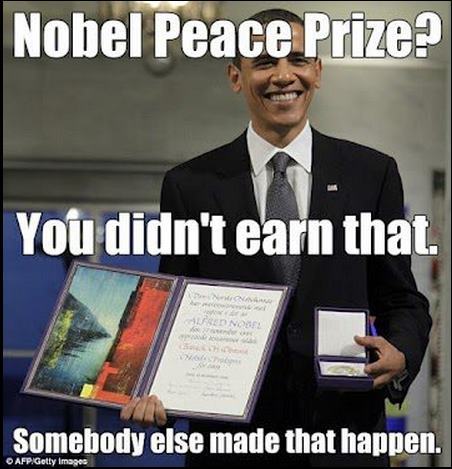
"If you’ve got a business — you didn’t build that. Somebody else [government] made that happen.”  - Barack Obama

From Ayn Rand, Atlas Shrugged (HT Carpe Diem)
“He didn’t invent iron ore and blast furnaces, did he?”
“Who?” 
“Rearden. He didn’t invent smelting and chemistry and air compression. He couldn’t have invented his Metal but for thousands and thousands of other people. His Metal! Why does he think it’s his? Why does he think it’s his invention? Everybody uses the work of everybody else. Nobody ever invents anything.” 
She said, puzzled, “But the iron ore and all those other things were there all the time. Why didn’t anybody else make that Metal, but Mr. Rearden did?” 
From FA Hayek, The Counter-Revolution of Science  (HT Cafe Hayek)
We flatter ourselves undeservedly if we represent human civilization as entirely the product of conscious reason or as the product of human design, or when we assume that it is necessarily in our power deliberately to re-create or to maintain what we have built without knowing what we are doing.  Though our civilization is the result of a cumulation of individual knowledge, it is not by the explicit or conscious combination of all this knowledge in any individual brain, but by its embodiment in symbols which we use without understanding them, in habits and institutions, tools and concepts, that man in society is constantly able to profit from a body of knowledge neither he nor any other man completely possesses.  Many of the greatest things that man has achieved are the result not of consciously directed thought, and still less the product of a deliberately coordinated effort of many individuals, but of a process in which the individual plays a part which he can never fully understand.  They are greater than any individual precisely because they result from the combination of knowledge more extensive than a single mind can master.
Removing Joe Paterno's Statue: A Critical Opinion

As a writer, I really can't predict how readers will respond to my work. I've written some high-quality essays in this blog which have attracted few, if any, pageviews. And then there have been unexpected hits. I did not get individual blog post statistics until I upgraded my blog design a few months back, so I don't have lifetime statistics on the posts, but my George Zinkhan post is still one of my most popular entries.

For those who are unfamiliar with MBA degree plans, students take a number of core classes in finance, organizational behavior, production and logistics management, accounting, etc., including marketing. Zinkhan, relatively new to the UH faculty, taught my marketing class. I believe that he was Dutch American and like many Dutch people very tall (6'3" according to one news account). Like many academics, he came across as well-mannered, disciplined, quiet, almost aloof. I did well in the class but as an MIS major didn't take additional marketing classes. The next and last time I saw him, I was a PhD student with a shared office on an upper floor at one end of McElhinney Hall; the marketing department office anchored the other end of the floor. Zinkhan and I crossed paths on a rare occasion in the hall one day, and he flagged me down  (I remember being impressed that he recognized me by name from a few semesters back). He told me (unknown to me) that he had submitted a copy of my class paper along with about 26 or so other projects, and some external authority had reviewed the papers and ranked mine the best. Zinkhan then hastily added that he thought so, too. To be honest, it made my day: it was an unexpected blessing.

I was visiting my folks in Texas; my maternal uncle was a diocesan priest in the Fall River area but preferred his milestone ordination anniversary to be a quiet, simple family affair with my mom, his only, younger sibling. I was staying at a local hotel and remember scanning the headlines, only to discover from national news alerts that my former marketing professor, now with the University of Georgia, was on the run and wanted as the chief suspect in a multiple homicide involving his wife and others. At first authorities thought that he would attempt to flee to Holland where I think he had relatives, but then they found his body a few days later, having attempted to disguise his suicide (Why? So law enforcement would spin their wheels trying to find him?)

I've never known someone whom has murdered another human being; it was a surreal feeling. Zinkhan didn't seem that much different from scores of academics I have met over the years. He had published over 100 peer-reviewed articles and served as an editor and  reviewer for major marketing journals; he served for several years as chairman of his department at the University of George and had held an endowed chair for years leading up to the tragedy.

The point is, after a horrific crime like Zinkhan's, and I want to ensure readers know I'm not whitewashing his crime, I hate the idea that's the only thing people will remember him for. He was a very good professor over almost 3 decades (to which, I'm sure, hundreds of students besides me will attest) and had a first-class mind. I understand why people are upset over the murder-suicide; nothing can ever justify or excuse what he did during those last few days of his life. He destroyed his hard-earned legacy of decades as a distinguished scholar and teacher. As I wrote the above, I read a relevant webpage (freerepublic.com) and saw virulent attacks by people whom never met the man.

(For those unfamiliar with the story, Zinkhan apparently had a secret recording of his wife's affair with one of the two other murder victims, Tom Tanner. He was planning a divorce but hoped to reconcile with his wife, lawyer Marie Bruce. Zinkhan drove in a car with his 10-year-old daughter and 8-year-old son, confronting Bruce and Tanner at a theater reunion picnic, resulting in an angry argument between Zinkhan and his wife. Zinkhan reportedly then returned to his vehicle for a pair of handguns. Tanner was the first victim; Teague became a victim while trying to calm the situation. Zinkhan left the scene, dropped off his children and then fled the area.)

Other examples come to mind. As familiar readers know, I enjoy the spectacle of scripted pro wrestling. Chris Benoit, at an average 5'9", was an unlikely competitor in a sport where big men up to a foot or more taller and over 100 or more pounds heavier dominate. Other than the obvious David vs. Goliath storyline, it's simply not credible than an average-sized man can compete at the same level without diminishing the bigger characters. What Benoit lacked in size, he made up with technical wrestling expertise, agility and high-flying maneuvers. Then in June 2007 over a weekend with a Sunday PPV where ironically he had been booked to win a now defunct championship title, Benoit killed his wife and their young son, whom many suspect had Fragile X syndrome, before hanging himself in the proximity of a weight machine. When WWE chairman Vince McMahon, Benoit's  boss, learned of the murder-suicide, he immediately distanced himself and WWE from Benoit, and 5 years later, I don't think I've seen or heard a single reference to Benoit on any broadcast. Again, I understand the nature of Benoit's unforgivable crimes, but it doesn't change the fact that for several years, he was an entertaining, skilled wrestler, one of the best I've ever seen.

Pete Rose remains one of the greatest MLB players of all time, the all-time hits leader, but to this day, MLB has banned Rose from its prestigious Hall of Fame. Rose was a manager at the time and had a gambling problem. From my understanding, the gambling did not involve betting against his own team in which one would have an obvious conflict of interest. Now I don't approve of gambling, but to what extent does a Hall of Fame maintain its integrity by pretending his entire stellar playing career before the gambling problem never existed? What if a current Hall of Famer got accused of domestic violence or worse? Would the Hall expunge his election, pretend it didn't happen? Everyone knows if Pete's gambling problem hadn't surfaced before his eligibility for election, he would be in the Hall. I understand MLB's sensitivity to the gambling problem in the aftermath of the Black Sox scandal, but there are ways to sanction Rose without denying an honor he earned.

So let's get to the topic of Penn State's legendary late football coach, Joe Paterno. A prominent statue of Joe Paterno was removed from the proximity of the stadium over the weekend (see video below), and the NCAA is set to issue strong sanctions, short of a football program "death penalty" on Monday, in the aftermath of the trial and conviction of former assistant coach Sandusky on dozens of sexual abuse charges.

Let me be very clear: this blog has not been favorably disposed towards Jerry Sandusky; I heard enough during Bob Costas' remarkable interview with him that I would never leave the former coach alone with my kids (if I had any). [I find it remarkable that Sandusky's lawyer let him do the interview.] Still, I was uncomfortable by how many people (including Sandusky's own adopted son) were coming out of the woodwork as soon as it was clear that Sandusky was in serious legal jeopardy, and political correctness was running amok: everybody or everything associated with Jerry Sandusky, especially Penn State and head coach Joe Paterno.

Joe Paterno was in his 80's; I suspected that his main motivation for continuing with coaching as he had was an ambition to set the all-time win record for college football coaches. And there is no doubt that exposure of questionable Sandusky allegations would been scandalous.

The connection is somewhat tenuous. There was an allegation that Sandusky showered with a boy at a Penn State facility in 1998. The district attorney declines to press charges, but word gets back to Paterno, whom tells Sandusky that he'll never succeed him at Penn State.  Sandusky retired in 1999 but with emeritus status, giving him access to Penn State facilities on an ongoing basis; the university dismisses speculation that Sandusky's retirement was related to the 1998 allegation. [I certainly don't understand how or why Sandusky was allowed continued access to facilities given the nature of the allegation.] A temp janitor Jim Calhoun reportedly observed Sandusky performing oral sex on a boy in 2000. It's not clear that the complaint goes beyond Calhoun's supervisor; there are concerns by the janitors about political reprisals if they came forward.  Then in 2002 we have the infamous event of McQueary whom reportedly catches Sandusky engaging in anal intercourse with a boy. McQueary reports to Paterno, whom contacts the athletic director Curley whom in term contacts the VP of Finance Schultz (to whom campus police report). Curley reportedly interviewed Sandusky, whom denied any wrongdoing. Neither Schultz nor Curley allegedly report the allegations to authorities, and McQueary himself never does.

From where I'm sitting, Paterno (1) effectively told Sandusky to retire after the 1998 allegation,  (2) escalated the 2002 issue to the athletic director, and (3) was not a target of the prosecution. Even after the scandal breaks near the end of the football season, Paterno proposes a face-saving retirement at the end of the football season. Not good enough for the university which summarily throws a legendary coach under the bus and terminates him.

Even though I think it was imprudent for the university to grant Sandusky access to Penn State facilities after he retired, it is clear that the 2000 and 2002 incidents occurred without knowledge or consent of Penn State administrators or Paterno. I think Calhoun and McQueary, who claim to have observed crimes, should have gone to authorities, although it's not clear whether they knew the identities of the victims, especially if Sandusky chose to deny the incidents ever happened.

Could Paterno have done better under the circumstances? Yes. No doubt he was aware that the Sandusky allegations were scandalous and could taint his own legacy simply because they occurred on his watch. But I think this political grandstanding by Penn State at Paterno's expense is overdone and petty.


Political Humor

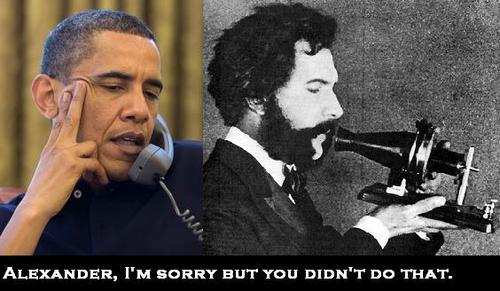
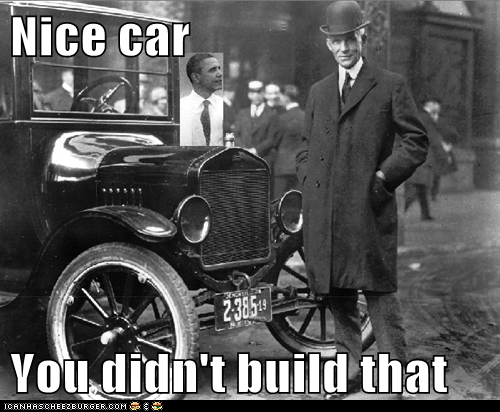
Inspired by Obama's famous Roanoke speech gaffe:

Some favorites from http://didntbuildthat.com/
Boom! From big Jon Lovitz.
Courtesy AFP Getty Images / HT didntbuildthat.com

From Mark.
HT didntbuildthat.com

Hey Mr. Edison, don’t get such a big head. It’s almost as big as that light bulb. Which you didn’t build. Somebody else made that happen.
The great Tom Edison    HT didntbuildthat.com

Henry Ford, you think you’re so smart. You didn’t build that. Somebody else made that happen.
Barack Obama: You didn't save THAT(Ford Motor Company)
HT didntbuildthat.com
Musical Interlude: My Favorite Groups

The Baby's, "Head First"

Friday, June 22, 2012

Miscellany: 6/22/12

Quote of the Day 
Men of genius do not excel in any profession because they labor in it, 
but they labor in it because they excel.
William Hazlitt

The Fed Prints On
The Fed Prints On  

Bums once cried "hey buddy, have you got a dime"
Obama says the economy is doing fine
Now bums ask "do you have a dollar?"
Economists study facts from ivory towers

The Fed prints on, the Fed prints on
Marshall keeps pounding his fist on the door
Serves notice you don't live here anymore
La de da de de, la de da de da

Crony bankers make money hand over fist
The dollars chasing goods economists miss
The Dems keep spending faster all the time
Helicopter Ben still hands out the same old line


"Instead of opting for a full-blow QE3 package, the Fed decided that it would instead extend Operation Twist. The extension, which will take place through the end of the year, will result in another $267 billion of purchases in the 6 to 30 year bond range."


Jerry Sandusky Found Guilty on 45 of 48 Counts
of Sex Abuse of Minors

The 68-year-old former defensive coordinator for the Penn State Nittany Lions under the late legendary football coach Joe Paterno was found guilty tonight. I deliberately did not comment, because I believe that he is entitled to a fair trial. The recent revelation that his own adopted son Matt swerved his strong support into accusations of his own during the trial was particularly troubling.
Jerry Sandusky has the American legal system's right to a presumption of innocence. Not a single voice rose up against what I regard literally as lynch mob mentality against Sandusky--and the Penn State football program. I mean literally a lynch mob mentality: Sarah Palin said on Greta van Susteren's On the Record program this evening that if the charges turned out to be true, she would personally furnish the rope to hang him. Like 3 or 4 times. 
I have heard and read enough (including the bizarre Costas interview) to know I would never trust Jerry Sandusky with my own kids if I ever had any. However creepy this guy is--and hearing him talking about showering with boys (not his own sons) and touching them on their thighs truly nauseated me--Sandusky deserves his day in court. 
On a sad day where a Philadelphia monsignor, a former aide to Cardinal Cardinal Anthony J. Bevilacqua, was found guilty covering up sexual abuses by priests under his supervision:


we must never forget that children are gifts from God, and abusing a child violently, sexually or verbally , through negligence or violation of trust, is a heinous crime in the eyes of God and a crime against humanity. Whereas nobody else is guilty of Sandusky's convicted crimes, there are a number of people whom could have, should have, and did not come forward for whatever reason--fear of institutional scandal, getting involved, possible retaliation, whatever: how can one sleep at night knowing because of his or her moral cowardice, yet another unsuspecting child became a victim?


Isn't It Time We Scale Back Our Wars
(on Drug, Terror, Unauthorized Immigrants,...)

I started this discussion in last Saturday's post when I was discussing the huge amount of resources this economy loses just in terms of the TSA, wasting personnel and other resources on checking over 99% of passengers whom pose absolutely no threat to air safety. (It's also not only a deadweight loss to the economy but not very effective, with TSA employers detecting only a minority of prohibited items in various testing.) I brought up a concept almost any business or economics student learns early in their courses of study: the Pareto principle. Here's a relevant extract from my post:

There's been a topic I've been meaning to discuss: the concept of risk. Social liberals have a problem with this discussion. Almost anyone who has ever studied economics and/or has a business degree has encountered what Joseph Juran called the Pareto principle (the 80/20 rule, aka the law of the vital few and the principle of factor sparsity ). Pareto, the Italian economist, discovered that 80% of the land was owned by 20% of the people. Similar proportions have been found across a wide variety of phenomenon (50%<=K<=100%, where K tends to cluster around 80%, to 100%-K%*), e.g.,  20% of the pea pods in a garden contained 80% of the peas, a past United Nations Development Program Report revealed the richest 20% of the world's population controlling 82.7% of the world's income,  Microsoft noted that by fixing the top 20% of the most reported bugs, 80% of the errors and crashes would be eliminated, 20% of the hazards that cause 80% of the injuries or accidents,  20% of customers contribute 80% of the income, 20% of patients have been found to use 80% of health care resources, and 80% of crimes are committed by 20% of criminals.
There are some nuances about specific distributions and additivity (see the above cited source);  for instance, there is a certain reflexive nature to the principle. For example, if you look at the top 20% of income/wealth, it has its own Pareto ratio: for example, 4% (20% of 20%) of the population owns 64%  (80% of 80%) of the wealth, and so on.
The basic thing I'm trying to get across is that when we look at things like social policy, airport safety, etc., we have to start from the fact that we have a finite amount of public resources (i.e., tax revenue).
Mark Perry of Carpe Diem recently noted that Nixon's war on drugs started over 40 years ago. In a time where government is finding our expensive jails and prisons overly crowded and lacking resources to buy new ones (see the first table below), we need to seriously overhaul our laws and legal system: we are imprisoning at the highest level in the world--an ironic fact for the "land of the free", nearly 5 times the rate of our closest allies (second table) and over 4 times our own percentage in the early 1970's (third table).

If we look at the distribution of our prisoners by crime category, almost two thirds are accounted for by immigration and drug (see the last two html tables below). It would seem that we need serious policy solutions for these two categories of crimes, and it's clear that the war on drugs is failing and correlated with the rise in prison population. Marijuana, a more innocuous drug than the others cited, has the highest rate of convictions. It's not just the clogged courts and prisons, but in a recent WSJ article cited below, the prices of harder drugs (i.e., not marijuana) have continued to drop, which one would expect to increase demand. (Discussion continued after the tables.)

Data courtesy of prisonstudies.org

CountryUNITED STATES OF AMERICA
Prison population total
(including pre-trial detainees / remand prisoners)
2,266,832
at 31.12.2010 (U.S. Bureau of Justice Statistics)
Prison population rate
(per 100,000 of national population)
730
based on an estimated national population of 310.64 million at end of 2010 (U.S. Census Bureau)
Official capacity of prison systemc.2,134,000
(866,782 in local jails at 30.6.2010, c. 1,140,500 in state prisons at 31.12.2010, 126,863 in federal prisons at 31.12.2010)
Occupancy level (based on official
capacity)
c.106%
(86.4% in local jails at 30.6.2010, c. 115% in state prisons at 31.12.2010, 136.0% in federal prisons at 31.12.2010)

Prison Population Rates per 100,000 of the national population

1United States of America730
6Russian Federation516
7Cuba510
29Iran333
92United Kingdom: England & Wales155
115Australia129
124China121
145France101
175Sweden70

Courtesy of  Carpe Diem

US FY2011
Primary
Offense
Category
Percentage
Offenders
Overall
Immigration 34.9
Drugs 29.1
White Collar
Fraud
9.8
Firearms 9.2
White Collar
Other *
3.6
Child
Pornography
2.2
Larceny 1.8
Other 9.4

Unauthorized
Drug
Category
Percentage
Offenders
Overall
Marijuana 27.9
Cocaine, Powdered 23.9
Methamphetamine 18.1
Cocaine, Crack 16.8
Heroin 7.1
Other 6.2

*  embezzlement, forgery/counterfeiting, bribery, money laundering, and tax
SOURCE:  U.S. Sentencing Commission, 2011 Datafile, USSCFY11.

The standard response from libertarians is to legalize drugs: most of these crimes are victimless, competition of the free market would drive down the high margins attracting drug cartels and other organized crime. We would be able to get  (say, sales or income) tax revenues from suppliers and consumers, and we could regulate distribution, purity, etc.

Mark Kleiman, Jonathan Caulkins and Angela Hawken have an interesting WSJ commentary, Rethinking the War on Drugs. They try steering a middle ground between prohibition and legalization. They point out, for instance, that alcohol, a legal drug, is a worse problem:
In the U.S., alcohol kills more people than all of the illicit drugs combined (85,000 deaths versus 17,000 in 2000, according to a study in the Journal of the American Medical Association). Alcohol also has far more addicted users. Any form of legal availability that could actually displace the illicit markets in cocaine, heroin and methamphetamine would make those drugs far cheaper and more available. If these "hard" drugs were sold on more or less the same terms as alcohol, there is every reason to think that free enterprise would work its magic of expanding the customer base, and specifically the number of problem users, producing an alcohol-like toll in disease, accident and crime.
I have had similar concerns and have usually phrased my approach as decriminalization much as the authors are suggesting here, also using the Pareto principle. For example, special attention could be paid to recidivists, and police could target transactions in public areas or over a certain amount. The authors also suggest innovative sentencing procedures (e.g., some variation of an ankle bracelet, surprise testing in probationary arrangements) and point out that low risk of detection and lengthy time between arrest and sentence weaken the law's effectiveness.


Musical Interlude: My Favorite Groups

Tom Petty & the Heartbreakers, "Rebels"

Friday, November 18, 2011

Miscellany: 11/18/11

Quote of the Day
I desire so to conduct the affairs of this administration that 
if at the end I have lost every other friend on earth, 
I shall at least have one friend left, 
and that friend shall be down inside of me.
Abraham Lincoln

Unconscionable Quote of the Day
"To have something on the table that does not ask the wealthiest people in the country to share (the burden) ... is unconscionable." - Sen. John Kerry (D-MA)
The fact of income inequality does not, of and by itself, mean unfairness. For example, in some cases, one is making a trade-off for long-term success or other investment in the future. My oldest sister, a registered nurse, didn't work during her daughters' preschool years, and the family lived off my enlisted serviceman brother-in-law's earnings.

After earning my MBA, I spent the next 3 years as a full-time PhD resident student paying for all school and living expenses (room, board, car, insurance, etc.) on a graduate stipend for teaching a couple of classes a semester: I was earning a few hundred dollars a month,  just a fraction of what most college graduates were making (despite my then 3 degrees). And then I started making a decent income. After living on a tight budget for years, even after high taxes in Wisconsin and the fact I wasn't making that much as an MIS professor (I found some of my fellow graduates elsewhere were making 15-20% or more), I had enough to start saving towards retirement and spend more.

Did I make more than, say, a checkout cashier? Yes. It wouldn't have taken me years of study to operate a cash register, and after my shift, my life was my own. But I had chosen a field at the time where there was a strong demand and little supply for accredited PhD's for junior faculty positions. It took years of sacrifice and hard work to get to that point; even after my coursework was done, I had to prepare for multiple written and oral comprehensive exams, not to mention defending my dissertation proposal and the dissertation itself.  Even though I got the degree, as a university professor I now had to worry about tenure, which at many colleges is not a formality. In many universities, you have a renewable 3-year contract;  near the end of the second contract, you are going up for tenure, which requires solid teaching, research and service. (My first two positions were tenure-track; I left these positions due to unusual academic/office politics.)  Others may spend less time, but I was routinely putting in over 70 hours a week.

I eventually earned a decent income (which only lasted 5 years when a bad job market in academia forced me to start over in a third career), I had earned my opportunity. That's part of the American way. The same things go into starting a business; you put together a business plan, you have to find a way of financing it; you may go through years of living of juggling bills and endless hours. You have to worry about the competition, with staffing and payroll issues, government paperwork, etc.

So, yes, making your way is the American dream. And if one day you find it paying off, good. Why? Because maybe if you see that hard work pays off like it did for, say, Steve Jobs or Bill Gates, you'll be inspired to make your own way to building a successful business. Hinderaker notes that income inequality is a good thing. Households aren't static, i.e., stay in the same quintile of income every year; in fact, during tough economic times, income inequality tends to shrink. I'll be reporting in a lower quintile this year, despite being one of the most talented professionals and academics around. (There are various reasons why these anomalies occur. For instance, for the first 5 years after I left academics, professional recruiters worried I was just biding my time for the academic market to recover and I would take any company "investment" in my skills with me.)

In 2007, the top 1% started at about $347,000 in income. But whereas CS Monitor and progressives talk about the top 1% nearly quadrupling their income since 1979, their share of total income doubled from 8% to 17%; however, the percentage of total tax burden (including payroll or excise tax burden) went from 15.4%  to 28.1%. In contrast, the total tax burden for the bottom two quintiles went from about 9.3% to 5.2%.

From 2007 to 2009, the percentage of adjusted income for the top 1% decreased by 6 points, while the percentage of tax burden decreased by 4 points. In contrast, whereas the bottom 50% earns 13.5%  of income, they have an average income tax rate of 1.85%. So, yes, the top 1% earns more than the bottom 50%, it's roughly 3.4 points, while the income tax share is 22.16 points more.

In the meanwhile, we've seen federal spending escalate from just under 20% of GDP to (more recently) 24% GDP. We're not talking about the 20% of the budget that goes towards the defense spending. When are the Democrats going to put REAL CUTS on the table--not just phony cuts in the growth rate of spending. Not that I'm from Missouri, but SHOW ME SHORT-TERM real cuts in base budgets (i.e., eliminating programs and personnel, limiting program eligibility, consolidating operations).

Let's cut the crap about asking sacrifice only from one income class, the same group that already pays a disproportionate amount of taxes from their income. The Democrats are the same ones whom reneged on deals with Reagan and Bush Sr. to match multiple dollars in spending cuts for each new dollar in tax hikes (almost all from upper-income taxpayers, of course). These are the same guys whom seem to be budget-conscious when it comes to only the quarter of cuts that go to upper-income taxpayers whom pay the most taxes and not a word about the other three-fourths (which contribute three times as much to the deficit). These are the same guys whom hypocritically complain about the abandonment of "pay as you go", when they made a mockery of emergency exceptions under pay go to finance a 24% increase in domestic expenditures, over and beyond a $862B stimulus bill.

Yeah, the Democrats talk about "tax cuts for the rich" as if there was no economic benefit and tax revenue benefit to the upper-income taxpayers'comparable  more efficacious spending and investing of their own income. These are the same guys whom talk about "spending cuts" which are no more than REDUCTIONS IN FUTURE SPENDING INCREASES.  That's like someone currently brown-bagging his lunch saying he'll save money on next year's budget by doing fast food next year but ordering combo meals instead of a la carte  (or, while making minimum payments on your existing credit card balance, promising to add to your credit card balance by shopping only on sales days at the local department store!): in either case, you are still spending more money that you don't have. The Democrats' idea of spending cuts? Disingenuous gimmicks like treating Iraq/Afghanistan spending like ongoing federal programs and treating expiring expenditures as occupation activities wind down as "spending cuts" to offset increases in domestic expenditures.

Former Penn State Assistant Coach Jerry Sandusky 
and the Dr. Phil Show

First of all, I've made it very clear in multiple posts my judgment on this case. if and when you witness a crime, you have a moral, if not legal obligation to do what you can safely do under the circumstances to demand the aggressor to cease and desist, at minimum promptly alerting authorities to the scene of an alleged crime.

At the same time, I realize that everybody deserves fair treatment under the law, and there is understandably a strong social stigma against perpetrators of child sex abuse. In the 2002 incident witnessed by assistant coach McQueary, currently on leave, there are differing accounts of what McQueary has said about the incident. Reportedly in recent sworn testimony, McQueary reported he saw anal penetration by Sandusky on a 10-year-old boy.  McQueary reported the incident to Paterno, whom in turned reported it to the athletic director, one of two Penn State managers whom have been indicted for failure to report the incident to law enforcement. Joe Paterno has indicated that McQueary told him that that the encounter was suspicious but not definitive.

What disturbed me was how many in the media immediately assumed guilt, even though there are disputed elements in McQueary's story: what was said to Paterno  and whether McQueary reported the incident to the campus police. Paterno has not been charged for failing to report the incident to police, and Sandusky recently said that he talked to the athletic director about the incident and gave (or offered to give) contact information for the youth in question. (I don't know if the athletic director contacted the boy and/or if McQueary confirmed the boy Sandusky named was the same boy he saw.)

The point is, we know, especially after the Kern County child abuse scandals, that people's lives can be ruined by false accusations. My gut feeling is that Paterno heard something differently than the grand jury did. Paterno's responsibility was to escalate the issue, and he had nothing to gain by changing the story. Presumably the police would be in contact with McQueary.

We are already seeing a Penn State backlash; other than their facility being used, the big issue is whether they promptly reported the incident to authorities. Franco Harris, a prominent alumnus and pro running back best known for the "Immaculate Reception", is a high-profile supporter of Coach Paterno; he was suspended from his recent job at a casino over his Paterno comments over the weekend (which many regard as an attempt to bury the allegations).

On Dr. Phil's show today, he had some experts analyzing the recent Sandusky/Costas interview with the general conclusion being that Sandusky was being deceptive. But there were other elements to the story I hadn't heard. There was a prior instance of something happening also in a 1998 incident between then active Coach Sandusky and a different boy; supposedly a janitor (now suffering from dementia) observed an oral sex act. The case was reported to the police, but the District Attorney failed to prosecute. The gist is that Penn State behind the scene forced Sandusky into a face-saving retirement the following year. (If this is true, I am at a loss to see how Sandusky was given access to the facilities without escort.) I do not know that Paterno and the university knew out of the 1998 incident, but if Paterno had heard about a second boy in 4 years in a Penn State shower with Sandusky: well, fool me once, shame on you; fool me twice shame on me. You act first and apologize later. Your program's reputation and your own legacy are at risk (not to mention, of course, justice for the victim himself).

Political Humor

"President Obama quit smoking this year. It wasn't easy. He had to ask the Republicans for permission first." - Craig Ferguson

[It was bad enough when his progressive staffers decided that the President shouldn't smoke and cut him off. But when Obama finally had to go out to buy his own cigarettes, he suddenly discovered that the 2009 SCHIP bill he signed  increased federal excise taxes on cigarettes.] 

"The government took action and introduced a bill to classify pizza as a vegetable in schools. Mark this down: November 17, 2011: The day America gave up. "- Jimmy Kimmel

[Now we know what that mystery meat on the pizza really is....


Herman Cain, former Godfather's Pizza CEO, said, "We have FINALLY come to a debate topic on which I'm the undisputed expert in the field..."]

Minor factual correction: existing policy already let pizza with a limited amount of tomato paste [note: tomatoes are a fruit, not a vegetable] to count as a vegetable. The new rule would have required MORE tomato paste on the pizza to be counted as vegetable.

An original:
  • I'm not saying that Ron Paul is feeling confident, but he's got the home field advantage: he's running against a former member of the Fed (Herman Cain), the person whom designed the precursor to ObamaCare (Mitt Romney), the candidate who championed renewal of the Patriot Act and regards torture waterboarding as highly effective (Michele Bachmann), the former Speaker whom picked up over $1M in consulting fees from Freddie Mac (Newt Gingrich), and the guy whom had a high-profile role pushing Al Gore to be President running against Reagan's tax policies in 1988 (Rick Perry).
Musical Interlude: My Favorite Groups

Boston, "Peace of Mind"

Tuesday, November 15, 2011

Miscellany: 11/15/11

Quote of the Day
There are always a lot of people so afraid of rocking the boat 
that they stop rowing. 
We can never get ahead that way.
Harry S. Truman

Congratulations, Coach K!

Over the past week in which the NCAA Division 1 football all-time winning Coach Joe Paterno of Penn State was terminated over the emerging Sandusky scandal, we now have a new NCAA Division 1 basketball all-time winning coach Mike Krzyzewski of Duke University notched the 903rd win of his career, eclipsing the record of his mercurial mentor, the legendary Indiana University Coach Bob Knight.

Incidentally, I want to reprint Bob Knight's statement on Coach K's surpassing his mark, because I think it is truly classy and sportsmanlike:
After reading about Roger Banister and the four-minute mile, I thought it would be neat to be the first coach to win 900 games. Once I reached that, I was hoping Mike would be the first person to surpass it. I also think it is neat for a coach and his former player to have the opportunity to win this many games while each one was coaching at nearly the same time.


He made great contributions to our Army team as a player, and has been a great example as a coach of how to do things the right way. There is no one I respect more for the way he went about coaching and following the rules than Mike. The history of college basketball has had no better coach than Mike Krzyzewski.
Mayor Bloomberg's Evacuation of Zuccotti Park: 
Thumbs UP!

Only the arrogance of self-entitled progressives can see equal access and maintenance of a safe, healthy environment at a public park and obeying the same laws as everyone else as a violation of the First Amendment. The fact that some progressive Democrats are attempting to align themselves in sympathy with the Politics of Envy against the Politics of Individual Responsibility; they are playing with fire, and they will be held accountable. As a libertarian-conservative, I have a great deal of tolerance for opposing viewpoints, and for the most part, although I personally disagree with almost  everything they do, say, or stand for, I've barely touched on the Occupy movement. I've sat by silently while I've seen disturbing scenes from Oakland; I worked on an Oracle Consulting project for the City of Oakland for 6 months in 1998. What I saw on the streets recently was not legitimate dissent; it was lawlessness. That undermines any moral standing the movement has.

USPS Looking at Restructuring: Thumbs UP!
(But Privatization Is Better And Necessary...)

A $14B loss this fiscal year? The Postmaster can't make  balloon payment to fund retiree health care benefits this Friday. Zero cash less than a year from now. 80% of USPS' costs are personnel (versus 60% of unionized UPS and 40% of Fed Ex). I've written a number of commentaries on the USPS; I pointed out that the postal unions were griping about the post office being required to fund a retiree health benefit, but I'm worried that the taxpayer, not the postal ratepayer, is going to get stuck with the retirement bills they did not oversee. USPS can't balance without cutting spending  and increasing prices. Cutting spending means taking on unsustainable union contracts; raising prices means accelerating the decline of first-class mail, its major cash cow. We are not going to be able to nickel-and-dime our way to balance here: union concessions of a pay freeze are almost laughable in terms of cost controls when three-quarters of post offices are losing money.

Super Committee: Go DEEP!
Mayor Bloomberg: Let ALL the Bush Tax Cuts Expire: 
Thumbs UP!

Any faithful reader of this blog knows one of my favorite statistics to recite is the fact that three-quarters of the Bush tax cuts went to middle-class (vs. upper-class) taxpayers. Obama has been trying to do everything in his power to separate out the middle-class tax cuts because, by some mystical revelation known only to Obama, they have "earned" to keep their cuts, despite trillion dollar deficits as far as the eye can see. I am well aware that restoration of the Clinton tax brackets will have a dampening effect on growth, but I'm far more worried about the compounding effect of trillion dollar deficits, and any uptick in interest rates will not only result in interest payments crowding out necessary expenditures but will accelerate businesses' cost of doing business, leading to even more layoffs.

We need to resurrect Bowles-Simpson and other bipartisan efforts out there (e.g., the 'Gang of 6').

How do I sell this to my fellow conservatives? Well, first of all, I want to argue that if we're going to have short-term tax increases, we need to have short-term spending cuts, across the board, the end of automatic budget increases or transfer payment increass, etc. No sacred cows, including Medicare and social security cuts. I would like to see more of a shift towards consumption taxes, But bottom line, business leaders know that a declining dollar makes it more difficult to control their costs and government deficits raise their cost of capital. Yes, I want to review tax simplification and a number of other proposals out there. But EVERYBODY must have skin in the game, and we need to end trillion dollar deficits sooner than later.

How Is It Possible For News Media 
To Get the Penn State Scandal Wrong?

I've  heard ABC This Week panelists and Fox News America's Newsroom (this morning a jointly contemptuous discussion between a guest host for Bill Hemmer and Martha Maccallum) both discuss Draconian measures against the Penn State football program. Christiane Amanpour phrased the incident in provocative, presumptuous, judgmental terms that seemed to blur the line of journalistic ethics. Here is Maccallum's Tweet: "Should Penn State shut down the football program? if so for how long?"

First of all, I've strongly condemned in posts over the past week the circumstances involving the 2002 alleged sodomization of a 10-year-old boy in a Penn State facility shower by a FORMER coach, Jerry Sandusky. Whatever wide receiver coach McQueary, then a graduate assistant, saw and what he mentioned to Head Coach Joe Paterno is not clear. Sandusky has denied the accusation (he says that the boy and he were engaged in "horse play"; he has admitted to showering with boys after workouts and nonsexual contact) , and Paterno has said that McQueary told him that what he witnessed was suggestive of inappropriate behavior, not sexual behavior.

Coach Sandusky retired in 1999, three years before the shower incident. Sandusky's behavior occurred without the knowledge or consent of Penn State management. The issue here has to deal with the timely reporting of suspicious behavior to law enforcement. When people start talking about suspending a football problem 9 years after a single incident (to the best of my knowledge) because the athletic director and/or another administrator failed (versus the witness to the event whom himself failed to report it--see below) to contact authorities seems unfair to the student athletes and/or other coaching staff whom were in no way part of an alleged university coverup of the incident.

[McQueary in a recent email to a friend a week ago reportedly claims that he did report the incident to campus security and police and tried to stop the behavior. This is more confusing than ever if true: why wouldn't authorities have acted sooner to investigate Sandusky? Why would the authorities be pursuing Penn State administrators presumably for not reporting the incident if the police knew about the incident 7 years ago? And how is it possible that the adjacent county school district didn't know about volunteer coach Sandusky before a victim's mother came forward in 2009?]

You would think there would be enough lawyers hired by these networks (God knows how many lawyers Fox News hires as contributors: Megyn Kelly, Judge Andrew, Judge Judy, Lis Wiehl, etc.)  You would think someone would discuss to what extent Penn State is implicated to the extent a suspect event allegedly occurred on campus.

I'm not a lawyer (thank God!) But there seem to be a number of salient issues that I have not even heard raised (I have not listened to Fox News 24 hours a day, so I can't be sure whether Ms. Kelly or others referenced these topics explicitly, but...)

For one thing, what legal obligation is there to report a crime?  Second, assuming there is a crime, if the victim does not have legal status with the university, what responsibility does the university have to report a crime? Even if states which require reporting suspected abuse, it's usually based on some relationship between a professional and a victim, e.g., a teacher or doctor. McQueary was a graduate assistant; he was not a coach to the boy; the boy certainly wasn't a Penn State student. As far as I know, the boy was on campus without college knowledge or permission. Clearly Sandusky, as a retired coach, had access to that facility; I would assume that he had guest privileges and subject to relevant policies about other guests (especially those not part of his immediate family).

Did McQueary report the incident to campus security, which would then, I assume, have points of contact with local law enforcement? [See above note.] (Incidentally, McQueary reportedly has emailed friends, arguing that he didn't simply leave but insisted that Sandushy cease and desist.) We do know that Paterno sent McQueary's complaint up the chain (e.g., to the athletic director).  Now we have a different question: if Paterno is correct, that McQueary did not report the incident as sodomization of the boy but merely deemed the behavior suspicious, does the university have a legal obligation to report a rumor of suspected activity? What if they made an allegation and then Sandusky sued them for damaging his reputation?

There's also a legal distinction between negligence and misprision (assuming statutory rape is a felony): was Penn State merely negligent in not exercising any legally mandated reporting of a suspicious incident or did it actually attempt to stonewall disclosure of the incident from the public (e.g., maybe up to the point of threatening McQueary's status with the university if he went to the police). Again, I don't have any other information beyond what has been circulated to the press. My guess is that the state of Pennsylvania is upset with the fact that Penn State knew about a suspicious incident but did not report it, for whatever reason.

And finally, the big issue I think deals more with a big loophole in Pennsylvania law about reporting an incident. (According to MSNBC, it is not one of the 18 states requiring adults to report relevant instances.) I would think if anyone had a legal obligation to contact law enforcement, it's the key witness. McQueary has not been indicted for failing to report the incident: only high-ups in the university.

The idea of sanctioning the current football team because an alleged crime occurred on campus years earlier and someone didn't report it promptly seems to be grossly unfair. We don't even know for sure what happened and what was discussed with campus highers-up. Jerry Sandusky has the American legal system's right to a presumption of innocence. Sandusky's lawyer Joe Amendola claims that they believe they know the identity of the boy, now in his twenties, and Sandusky gave the the athetic director Tim Curley contact information for the boy shortly after Paterno had spoken to Curley; the young man allegedly currently denies sexual activity took place.

[I will say one other detail I recently read about from the grand jury disturbs me: reportedly a prior boy's mother claimed in 1998 that Sandusky had showered with her young son, reported to Penn State police, but the District Attorney declined to press charges. If true, I would have expected higher scrutiny of Sandusky's behavior and a Penn State discussion with Sandusky about the use of the school's facilities.]

I have heard and read enough (including the bizarre Costas interview) to know I would never trust Jerry Sandusky with my own kids if I ever had any. I'm not sure what to make of Coach McQueary's statements. My personal opinion is that McQueary is engaging in self-serving, defensive rhetoric. There are other things I don't know--if McQueary did tell the police in 2002, what happened? Is it possible the District Attorney didn't think there was enough evidence to prosecute Sandusky? What if, say, the purported victim did deny McQueary's account? What does the prosecution think of its chief prosecution witness saying he did talk to police? Doesn't that mitigate the charges against Curley and Schultz? If what he's saying is false, doesn't that undermine his credibility as a witness?

I started off this commentary talking about two television programs where not a single voice rose up against what I regard literally as lynch mob mentality against Sandusky--and the Penn State football program. I mean literally a lynch mob mentality: Sarah Palin said on Greta van Susteren's On the Record program this evening that if the charges turned out to be true, she would personally furnish the rope to hang him. Like 3 or 4 times. However creepy this guy is--and hearing him talking about showering with boys (not his own sons) and touching them on their thighs truly nauseated me--Sandusky deserves his day in court. I think news programs need to stick to reporting the facts and leave the moralizing to op-ed columnists like myself; all that Amanpour and Maccaullum succeeded in doing is making it harder for Sandusky to get a fair trial.

Musical Interlude: My Favorite Groups

Boston, "More Than a Feeling". I'm following my Foreigner series with my other favorite group from the 1970's. I mentioned in an earlier post how I had a strong disagreement with my once closest cousin Jacquie (actually, Jackie, but as a young woman, she preferred the Franco-American spelling; my late uncle was an immigrant) over the Grammy for new artist going to the Starland Vocal Band, which I correctly predicted was a one-hit wonder. My aunt and uncle had passed before my two cousins graduated from college. Jacquie is probably the closest cousin in age.

Jacquie was lead female singer for a 3-person band which did soft rock covers (e.g., the Carpenters) at various gigs (e.g., weddings) in southern Massachusetts when we were young adults. (Good pipes run in the family; I have a couple of nieces whom also have good voices. I won't mention their names, because one is/was an Obama follower and the other has personally told me she doesn't want to be in my blog. I know one of my nephews was in a garage band, and I know another has done some songwriting. I've offered to do some joint projects with some of them, but no takers.) Jacquie had a falling out with me, not over my championing Boston (like my first girlfriend, Jacquie came under the influence of a religious movement/cult, and they dropped contact with those perceived as not supportive of their choice). I would dedicate this performance to Jacquie, but it would probably tick her off. I still love you and miss you, Jacquie!

My favorite rock single from the 1970's; glorious songwriting and performance. How did they not hit #1 with this signature song? (Their only #1 was a power ballad in the mid 1980's, "Amanda".)