Analytics

Showing posts with label political essay. Show all posts

Saturday, June 16, 2018

Post #3706 M: Success Without a College Degree, Trump's "Negotiating Tactics", and More

Quote of the Day

In the end, we will remember 
not the words of our enemies, 
but the silence of our friends.
Martin Luther King  

A Mini-Rant Over Trump's "Negotiation Tactics"

I had seen an email float by while I was writing my latest Trump rant today about how he sees stripping children from their parents at the border as a tactic to force Democrats to the table in negotiating his xenophobic version of immigration "reform".  I intended to comment about it then, but it slipped my mind at the time I published the post, so I'll address it now. Whereas the practice predated the outlaw Trump Administration, it has gone on steroids under Trump: nearly 2000 legalized kidnapping over the six weeks preceding June, a number which had exceeded the cumulative number over several months in prior periods. Trump says that he "regrets" using the tactic, which is about as sincere as an apology where the other party says they regret you feel bad over what they did (but they stand behind what they did). The Democrats are not the surrogates for asylum seeking immigrants. This is a travesty of individual rights and unconstitutional in principle. For the "family values" GOP Congress to not resist the Trump regime doing this is unforgivable.

The perverse xenophobic GOP has oddly enough almost radicalized me on the topic of immigration. The fears of the xenophobes are totally without foundation. Violent crime among the unauthorized is lower than the proportion of the American-born population. Even legal immigrants are ineligible for welfare for the first several years. The idea that we would find ourselves overrun with migrants is contradicted by our early history of open immigration. I know in part because I once had a Brazilian girlfriend and wanted her to come to the US, but she didn't want to leave her home country, family, culture, etc. None of the Brazilians I met wanted to emigrate; some wanted to visit, but they didn't want to stay here.  And this was during the economic boom of the Clinton years. If you have modest resources, are unfamiliar with our country, our principal language and culture, and you aren't confident about your work prospects (never mind the prospects of dealing with xenophobic Americans or their hostile government), how likely are you to make that decision?

In part, toughening the border has been counterproductive; it's locked people into place who would probably leave on their own if they were guaranteed a right to return. We could issue temporary work papers, widen unreasonably narrow legal immigration quotas that can delay family reunions for years This idea that somehow you have a "right" to interfere in other people's lives beyond your own property lines is evil: that you have a "right" to decide who an employer can/can't hire, whether you can keep your neighbor's family from living with him, etc.

How To Find a Job Without a Degree


Facebook Corner

[responding to a meme suggesting if Domino's fixes potholes, Chick-Fil-a handle traffic lights. "Muh roads" is probably the most famous libertarian parody of Statists , i.e., "without government, who would build the roads?"]

We gotta protect the chickens crossing the street, regardless of their reason. But..but... muh roads!

[Another case of a xenophobe "immigration laws are laws" trolling on a libertarian portal]:

You anti-liberty bastards have no say beyond the borders of your property. So fuck off imposing your economically illiterate views on the natural rights of others.

[separate, my own response to the Cato Institute thread]

We need to restore our traditional heritage of open immigration; the xenophobic bastards, led by the economically illiterate Trump, think they have a majoritarian "right" to veto beyond their property line ends: who a farmer (or other businesses) can hire, whether their neighbor's wife and children can live with him, whether an entrepreneur can have a chance to build his business. It is a fundamental abomination against liberty and un-American at its core.

[I'm responding to some purported liberty portal waxing anxiety over uncontrolled Big Tech power]

Oh, Jesus, economically illiterate anti-trust bullshit. Does anyone even remember Nokia, American Online, Netscape, MySpace or Blackberries? WalMart's profits dwarf Amazon's.


Choose Life: Adoption Is a Beautiful Choice


Choose Life: You're a Daddy!


Political Cartoon

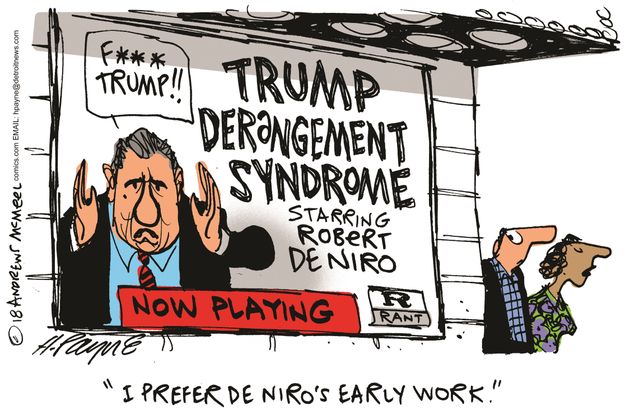
Courtesy of Henry Payne via Townhall

Musical Interlude: My Favorite Vocalists

Elton John, "Bennie and the Jets". His second #1.

Friday, November 24, 2017

Reflections on America's Second Revolution

There were two major revolutions of note against monarchies before the end of the eighteenth century, the American and the French. One (the American) was conservative, based on the concept of a limited central government with little appetite for international meddling. The French revolution,  at the risk of oversimplification, involved an expanded conceptualization of equality beyond equality of opportunity or equality under the rule of law, less safeguards for individual rights due process protections against tyranny of the majority, and more nationalistic in terms of spreading its revolutionary ideals of liberty, equality and fraternity beyond its borders. (For a good essay on how the French Revolution resulted in the catastrophic anti-liberty notions of nationalism and socialism, see here).

To be sure, there were issues and abuses preceding French Revolution; France's legislature had been abandoned for nearly two centuries under an autocratic monarchy, and peasants hadn't fared well under a parasitic feudalism. But it turned out they had replaced one form of autocracy for an even crueler version, one which had no qualms about eliminating its potential royal predecessor rival for power or its opposition. It reminds me of a favorite Arabic proverb: "He left us and we rejoiced; then an even more unbearable person came." The FEE article cites how the government imposed price controls resulting in shortages and then stole crops from the farmers (not in power) to accommodate their urban constituents. (So much for property rights under the new constitution/declaration of rights.).

[As aside: writing this essay is a classic example of the difficulties faced by my work ethic, perfectionism, and professionalism, whether I'm preparing to give a college lecture, writing an academic article--or a simple blog post. I ridiculously over-prepare. Although being extraordinarily articulate, I never went to class without detailed lecture notes (some students even wanted to make copies of my notes, no doubt for their convenience). And sometimes I get distracted by some odd thought and go with it. In this case, even titling this essay, which is not really different from other one-off essays in the history in the blog (I often start with a more general title like "Some Thoughts on xxx".) So I had an idea for this essay and started with the title; at this point, it triggered a memory that the famous Whig/Father of Conservatism Edmund Burke's similarly-titled, perhaps most well-known work was "Reflections on the French Revolution".  So I ended up spending hours on Burke's work, others' criticisms of that work, and literally dozens of pieces on French history, political theory on French Revolutionary constructs, comparisons and contrasts of the two revolutions, American reflections on the French Revolution, etc. All this for an essay which was not intended to be a history on the French Revolution but a take on current politics. I've written academic papers with literally hundreds of citations, not to impress others but to acknowledge contributions made by others.]

For those of us who are classical liberal (conservative in the American tradition), a good conceptual model is the distinction between negative and positive rights. Whatever legitimate mandate government has, it's for guaranteeing individual rights and market access, the enforcement of contracts, and for purposes of common defense/safety/security and public health. Negative rights are things that the State cannot use force, without due process, to restrict. such as our inalienable rights, e.g., to choose our own livelihood, to relocate, for political speech, etc. Positive rights are things that government must provide or guarantee, e.g., food, shelter, free basic education, an old-age pension, healthcare, legal assistance in criminal proceedings, etc. These latter "rights" are potentially limitless, based on one's operational definition of "equality", the redistribution funding of which is a fundamental restriction on the property and liberty of others.

We (classical) liberals believe that there is no such thing as positive rights. Some egalitarians, e.g., Thomas Paine, think equality of opportunity is vacuous without government providing some kind of level playing field; for instance, he championed a capital grant by government when a citizen became of age. Jefferson championed basic public education and founded the University of Virginia (although he would have been concerned about federal involvement in education, which he considered a state/local issue.

So when do I think this second revolution happened?  It probably wouldn't surprise readers, given numerous recent posts about the Civil War and Lincoln that it had a lot to do with that, although massive financing for public spending and interventionist wars really required direct taxation, made possible by the sixteenth amendment during the Wilson era and the Progressive Era in general, for example, the direct election of US Senators, which essentially dissolved a balancing constraint on the US Senate from state legislatures.

Lincoln's refusal to accept secession from the South and willingness to use force to regain control over "rebellious" states made a mockery of the principle of federalism, of decentralized government. We also saw some shadows of the future: issuance of greenbacks, conscription, suppression of civil liberties, the imperial Presidency, direct taxes (income tax), etc.

Nationalism and economic fascism, a softer variation of socialist/government control of the economy, basically persists to today's politics. Economic intervention was FDR's failed playbook during the Depression. SCOTUS, in response to FDR's threat to pack the court, basically surrendered the cause of economic freedom in Carolene Products and Footnote 4, opening the door to Big Government. FDR started social security, whose trust fund (making up the difference from in-flows to out-flows) will be exhausted in 16 years, and attempted to pass a second Bill of (Positive) Rights.  LBJ would build on that social agenda with Medicaid, Medicare, and a feckless War on Poverty. Obviously ObamaCare is an expansion of the healthcare positive right. Even Trump's embrace of nationalism and hands off entitlement reforms is a logical extension of the second revolution.

There are so many similar patterns of comparison, it's ridiculous. Let me close this essay by pointing out some obvious ones:
  • the politically correct war against Southern statues and flags, even churches removing plaques honoring (former) slaveowners George Washington and Robert E. Lee. This is analogous to some of the excesses during the French Revolution Reign of Terror.
  • the Democrats' constant rejection of minority rights (the filibuster, especially during the 111th Congress) and attacks on the federalist electoral college, attempting to de-legitimize the elections of Bush 43 and Trump. ("[The Founding Fathers] even considered direct election of the president, as many today propose, but rejected that idea.  It was brought up for a vote twice at the Convention and was rejected by a 9-1 vote on July 17 and by a 9-2 vote on August 24 (each state got one vote.")

Sunday, November 12, 2017

Thoughts on a Political Taxonomy

An Internet-based taxonomy via libertarian FB group

Let me start by saying I disagree with this diagram. I intended to republish it in last night's post but couldn't find a copy of the image. Here was my brief critique:
This is a rather simplistic approach which doesn't do a reasonable job reflecting political differences; the Old Right didn't buy into FDR's policies.or international intervention. This diagram implies there are no major policy differences between progressives and conservatives except healthcare, and that's a departure from reality. I see a distinction between right-wing authoritarians and conservatives, who in this country are more classical liberals. We need to see more of a federalist construct and the size and extent of regulation in play.
"Conservative" is probably best described in context. Among the conceptual aspects (this is not meant to be comprehensive, but a conspectus of key elements):

  • Tradition. For example, I consider myself a conservative, traditional Catholic. I was one of the rare altar boys who served during the entire transition of the Mass, from Latin to local language (English). I still remember the first Mass I served, as a cross-bearer leading the procession into church. I loved votive candles, holy water, Gregorian chants, the sung liturgy, burning incense, sermons based on spiritual vs. pedestrian issues), majestic cathedrals, various disciplines (eating fish on Fridays, sacrifices during Lent, fasting before communion, etc.) I had basically memorized the entire liturgy and know enough Latin by reading the English translations as a young boy; it seemed impossible that people older than me couldn't keep up; I also felt connected to the Catholic community globally sharing in the liturgy. I wouldn't say I was resistant to change (for example, I am quietly in favor of relaxing the priestly vow of celibacy and encouraging married clergy plus a more inclusive role for women through the hierarchy and the liturgy (not based on ideological feminism)) The nature and extent of Vatican II, especially on the paternalistic shoving of the liturgical changes down our throats, not even as an option, deeply troubled us traditionalists. Nuns or sisters started dressing to blend in, traditional hymns were replaced with folk/rock arrangements, and homilies transitioned from moral/spiritual development to secular humanistic topics where Jesus or spiritual themes were incidental to the discussion. Does that mean that as a conservative, the standard notion being resistance to change, I would oppose change such restoring a centuries-old liturgy? No. I simply want my fellow Catholics to have the alternative.
I do cherish our traditional American holidays, celebration, customs and culture. It is somewhat nuanced; for example, I'll honor the flag, stand up, hand over heart, during the national anthem. On the other hand, I respect the right of political dissent. The issue I've had with the anthem protest is the fact that the players signed a contract acknowledging league policies. But I've opposed the government (in particular, Donald Trump) intervening in the dispute. 
  •  Locus of Control/Principle of Subsidiary/Decentralization. Government should be limited and more decentralized in favor of local autonomy and enforcement. In particular, we have social norms, civic virtue, religious institutions, voluntary associations/charities/philanthropies, open markets, and the private institutions of marriage and family.
We conservatives are wary of the unintended consequences of the government intervening against institutions of faith or public morality and morally hazardous public policy, such as the social welfare state.
  • Egalitarianism/Law and Order/Public Safety.  The guarantee of individual and free associative rights (including life, liberty and property) against government, the tyranny of majority or lawless individuals and groups, equally enforced, under the rule of law.
  • A Limited Central Government. This includes reconciliation of conflicts among local, state or regional groups, including, but not restricted, to violations of open markets among the states, majoritarian restrictions on individual/group rights (e.g., discriminatory acts against a political minority or migration among states). In addition, a commensurate national defense provides scaleable resistance against external adversaries who would exert force to trespass and occupy or otherwise violate the unalienable rights of Americans. A limited government costs less and imposes less fiscal and regulatory burden on citizens and their voluntary associations.
No doubt that some conservatives would disagree with aspects of this discussion; in the context of America, our tradition is an economic liberal one with equal rights for all people, including the rule of law (no double standards in application). In Europe or elsewhere, you might see a traditional hierarchical class system (e.g., royal, aristocracy, bourgeois, worker class/proletariat, etc.) There might be economic nationalists (e.g., paleoconservatives) who subordinate individual rights to State economic interests with politically favored (crony) businesses or industries. The New Right expanded a more proactive anti-Communist foreign policy and military build-up. 

I do distinguish between American conservatives and right-wing authoritarians and/or populists. Quite often they emphasize law-and-order and/or perceived economic security at the expense of the individual. They may feel vested in social welfare programs and tend to scapegoat certain groups, particularly immigrants, which they feel exacerbate program costs at their expense.

Modern (social) liberals expand on the negative rights under classical liberalism (American conservatives), i.e., things that government cannot coerce of the individual without due process of law. Egalitarianism does beyond equal treatment under the law; they argue because of differing circumstances, there is no real equal opportunity and government must provide related rights, e.g., the right to free education, unemployment subsidies, healthcare access guarantees, a social welfare net, and financial security for old age. (There is no real limit to how much government must spend in pursuit of this equality of opportunity, and social liberals are willing to spend whatever it takes from the pockets they feel are well off enough to pay the resulting burden.) They distrust the market and its perceived failures, including alleged externalities (e.g., pollution, where they see businesses socializing relevant costs) and hence justify regulatory intervention. They will subjugate individuals rights to higher-standing sociopolitical interests.

The Internet meme above totally ignores these nuances. Conservatives (at least American ones) have rebelled against the social welfare state, the expanding scope of federal programs. There is talk about decentralizing health programs to the states in terms of block grants, there's talk of abolishing cabinet level departments (e.g., energy, commerce, education), of narrowing criteria and limiting duration of eligibility for social programs (including food stamps), of imposing beneficiary cost-sharing (e.g., work mandates). There is still a social stigma for participating in government programs.

Let me point out that conservatives don't oppose helping neighbors in need. We know that the State is an ineffective and inefficient way of resolving these issues, at probably twice (or more) the cost with an overly expensive bureaucracy cutting its cut before beneficiaries see a penny. Not to mention State intervention impedes private sector initiatives to address these issues. Immigrants in the nineteenth century did not have a social welfare net. Before senior entitlements, elderly parents often stayed with families and got discounts for medical services. Fraternal societies, soup kitchens and mutual aid societies helped those down on their luck.

Left-wing and right-wing authoritarians tend to subordinate the rights of the individual to the State, which in the contemporary world is a form of fascism. We at the opposite side of the spectrum want to subordinate the State to individual rights, i.e., the consent of the governed. I tend to be minarchist, almost borderline AnCap (which the meme above identifies as volunteerism).

I may expand on these constructs in a future post.

Monday, September 11, 2017

Post #3358 M

Quote of the Day

The only sense that is common in the long run, is 
the sense of change-and we all instinctively avoid it.
E. B. White  

Tweet of the Day


Where Were You 16 Years Ago?


I was working feverishly on an ERP upgrade project at a Milwaukee suburb county courthouse. (I came in 2 to 3 months into a fixed-bid 6-month project. The project DBA had left the project weeks earlier; the project was probably 6 weeks behind schedule when I took over, and we were heading down the home stretch on schedule, in all honesty mostly on my efforts.) The company had wanted me to move to WI, but this was their only client there, so I compromised and moved to the northwest suburbs of Chicago. It was still an 83 mile commute one way, and basically my company forced me to be on site at 7:30 AM because the county DBAs, in charge of backups. couldn't be trusted with restarting application background processes. Even worse, I wasn't allowed to start any patching until 7 PM. This meant I often didn't eat dinner or get home until 11 PM or even midnight. (No bonus or extra pay.) The clients were sometimes jerks; for instance, I was required to walk both of the DBA's through the upgrade process. We had scheduled a time to meet, and she no-showed. It turns out that she had decided to go get her dog's nails clipped. The end result was I had to work late that evening. Never mind I was working on site at least 11 hours a day, allowing for a lunch break, plus another 3 on the road.

So I was doing my 101 things in the morning, when my Indian developer colleague, who lived locally, came in, babbling about some aircraft crashing into a World Trade Tower. I didn't know what to make of this: was it some Cessna where some pilot lost control of the aircraft? I thought it was curious, but I like to mind my own business, and I hate drivers slowing down to rubberneck an accident. I got back to work; there was a lot of buzz, especially among the county workers. And then at least one county worker in a nearby cubicle brought in a portable TV, and it was like everyone converged around his cube. And my honest first impression was "Damn! I'm like the only guy working here; how are we going to get anything done today?"

I eventually became aware of what had happened at the Towers, but I found the Pentagon attack astounding. How is it, with the world's greatest air force, some rogue aircraft made a direct hit on the Pentagon? I knew by now, these were no coincidences and I recall listening along to reports about Flight 93 in process.

Of course, when I got home that evening. I surfed the Internet for the latest news. I could only dread possible follow-up attacks, like packed Union Station during morning or evening rush.

There are a few things that stand out, like members of the Congress standing defiantly together on the steps of the Capitol. Coming into work at the courthouse I found an assembly of people praying for the victims and survivors, and I joined in.

No, I will never forget.


Behavioral Economics


Ron Paul On the Minimum Wage and Government


Political Cartoon


Courtesy of Henry Payne via Townhall


Musical Interlude: My Favorite Vocalists


Michael Bolton, "Love Is a Wonderful Thing". This is another of a number of #1's from 1989 through the 90's on the A/C chart.

Saturday, September 9, 2017

Post #3355 J

The Left's Ongoing Obsession With Wealth

A recent Gray Lady piece on how the noveaux rich (more diverse, meritorious vs. hereditary) cope with social stigmas on wealth and conspicuous spending is an interesting read. Many of them, in fact, are politically liberal (what I refer to as modern/social liberal, vs. my being a classical liberal, in the context of low government footprint).

We have seen some stories of a related nature with Warren Buffett, who had been known to drive nondescript cars for years and living in an ordinary 2-story house he bought in 1958 for $32K.(he's probably added on to the original structure). Although he once owned a beach-front vacation property in California, he considers it absurd to collect homes around the world like postage stamps; there's a lot of overhead to doing that: you need to employ people to maintain the properties, make sure that tax payments and utilities are paid on a timely basis, etc., and Buffett just doesn't see the marginal benefit of  a home portfolio worth his time and effort. He sees a home in functional vs. investment terms. Warren, who drives maybe 3500 miles a year, doesn't see the need to buy the latest and greatest cars, he'll go down to McDonald's to grab a quick, cheap breakfast, and if a friend, like fellow billionaire Bill Gates comes to visit, Buffett often personally goes to the airport himself to pick him up.

In fact, Ms. Sherman's op-ed is hardly original in its theme. For instance, in this book there are similar observations, e.g., how fewer than 1 in 4 millionaires buy a new car within every 2 years, that Amazon's Bezos had driven the same Volvo station wagon for years, the "new rich" are likely to prefer a Bud to an exotic microbrewery offering, chips and dip over fancy fondus. Bloomberg liked to show being like everyone else taking the subway in NYC.

As for me, my income has been up and down with the business cycle. (I've never been offered stock incentives, etc.) I've often been in an industry where you can find yourself laid off after the end of an expiring contract. But if the challenging work is steady, you can make a decent income. I certainly could have afforded a better car, and to eat out more often than I have (and for the most part order whatever I liked on the menu), maybe like my brothers, or go on annual vacations, cruises. I pay off credit card balances, am never late on paying rent or utilities, etc.

My being frugal goes beyond driving cars for 10 years or more (I've driven my current one since 2000), Internet price checking and coupon savings (I even used a coupon on my Lasik surgery years back). I've been frugal with my company/client's money as well, e.g.,

  • I worked for an IT software company headquartered in Malvern, PA; generally speaking, we did most work remotely or at colleges (our clients) on the road. So occasionally we had to do training at Malvern, and we could expense our travel expenses up to per diem limits (hotels were sometimes a challenge). But I remember one night a group of us went to a sports bar, and this one guy literally looked for and ordered the most expensive item on the menu (a ribeye steak).  Sometimes the clients would stipulate, for example, that I have to make use of the college cafeteria for lunch. But my eyes almost popped out: this one client's cafeteria was in a different universe than when I earned my undergraduate and first Master's as a resident student: this place had a breads and dessert island, a fast food like island (like burgers, pizza, and fried chicken), multiple buffet lines (one of which focused on organic and/or veggie cuisine) and the usual beverage and salad islands. One client was a NYC area community college; I think the state limit on dinner was something like $28-32.  And I ended up going to Boston Market with roughly a $12 tab. 
  • I worked initially as a subcontractor at a computer memory testing equipment subsidiary in Santa Clara, CA. I was commuting from Chicago. The CEO's secretary asked to meet me and told me I was authorized to bill them for hotel bills up to $199/night. I just couldn't do that. I found a Morgan Hill (outside San Jose) Extended Stay for about $43/night, even though I had to fight traffic on infamous Route 101. I found a budget airline from Chicago to SFO for seats at roughly half the cost of a major airline. I would book subcompacts rentals for as low as $19/day. Rather than eating out, I submitted (much cheaper) grocery tapes. It's not just a matter of being frugal: I hate waiting for a table, waiting for a waiter to take my order, waiting for a coffee refill, and waiting for the bill. [On at least 2 occasions, I've walked out a restaurant because of unreasonable waits  (> 15 minutes) for waiters to take my order.] To me it's just easier and faster to throw something into a crock pot or onto my Foreman grill; I don't have to worry about whether restaurants carry my preferred salad dressing, the limited menu suggestions, how many carb grams are in the meal.  I don't have to get dressed up, etc.
  • Probably one of my more interesting experiences dealt with a small DC-based consulting company I jointed after leaving Oracle in 1998. A technical manager (I never met) hired by the company had negotiated a lease for his use of a Mercedes. The scuttlebutt is the CEO discovered that the manager was hanging his own shingle at Oracle OpenWorld (which, by the way, I've never personally attended). So the manager was fired, but the company was stuck with the lease. I think my boss' intent was to use me on a prospective Philip Morris project in NYC, but there were delays in the project and then a company DBA got walked off a project in Glen Burnie (a south Baltimore suburb). So I was staffed into the duty-free shop subsidiary and quickly got the project back on course. The CEO's assistant called me into a personal meeting to discuss the company's decision to scotch my plan to rent a subcompact for my next Chicago round trip. It turned out they wanted me to use the Mercedes. I don't think to that point of my life I had even driven a Cadillac, never mind a Mercedes. What I first noticed was the smooth drive; it felt like I was driving on a cloud; and the soundproofing was also quite impressive. One of the clients saw me driving in one morning and enviously asked, "Does everyone in your company drives Mercedes?" I eventually had to return the Mercedes as I was subsequently assigned to projects at Virginia Beach and Chicago. I enjoyed the experience but I didn't want a prospective girlfriend to judge me by the car I was driving (or prospective car thieves).
  • Just before last Labor Day I was working for a well-known defense contractor. I had to do training in the Ft. Walton, FL area (along the panhandle). I went through the company's travel vendor to look at available hotels. I found rooms further away from hotels with beachfront views were significantly (like 30-40%) cheaper and booked one of those; none of the other trainees checked into the same hotel. Multiple people (including the trainer) asked, "Why are you staying there? So what if these other hotels are more expensive? It's not even your money!" They don't get it. I don't need to pay for a beach view using other people's money. I have a decent bed, I've got Internet, I have a lot of restaurants to eat at within a 2-mile radius.
So Sherman talks about how some new rich have sought to obfuscate say, designer labels so any household staff might not realize how well off they are, have denied conspicuous wealth as in flying in private aircraft, they aren't like THOSE 1%. etc.  There are some sudden realizations like, "How the hell did we spend $600K last year? They are seen as defensive, almost apologetic over their relatively outsized income or wealth, how to reconcile their material well-being with their generally egalitarian perspective.


The Sherman post quickly trended on Twitter, with of course most people not even bothering to read the article. Of course, people who live paycheck to paycheck are going to say "Cry me a river!" You spent $600,000 in one year? That's like the income of some 10 or more households! I don't think the fact that you are a mere multi-millionaire vs a multi-billionaire isn't going to wash under a morally corrosive Politics of Envy.

Let's be clear: the poor of today enjoy arguably a better standard of living than the most wealthy of 100-200 years ago; they often own cellphones and computers along with the massive learning and other resources available on the Internet, live in homes furnished with indoor plumbing, major appliances and air conditioning, have access to meds and vaccines and medical treatments and innovations, access to a wide variety of cheap food and household goods, etc. Whatever economies of scale exist mostly benefit the lower 99%. Global poverty has decreased to less than 10% for the first time in human history. We need to stop obsessing over whether our neighbors own a flashy car, a bigger house, or whatever. We need to stop focusing over the conspicuous spending highlighted by Sherman and focus on their investments in the future economy which ultimately benefit consumers and future job seekers.

I Posted a Product Review on WalMart.com


https://www.walmart.com/reviews/product/21667828

Antartica Guarana is worth the price!
 9/7/2017

Customer review by RAGPerspective

5.0 stars by RAGPerspective
Antartica is the brand of guarana I drank and enjoyed during 2 business trips in Brazil. I wish Walmart or Sam's Club would stock it; I would buy it regularly. It's hard to describe the taste--like a fruity ginger ale. It's a little pricey at roughly $3.50/2 liter bottle, but this is seriously good soda, and I would choose it over any soft drink you can think of.

Let's me note, first of all, I don't have a financial interest in either the producer or vendor. I will point out that when I searched on Google for vendors selling 6-packs of 2-liter bottles, the other 2 vendors were selling for over $30, over 50% more; do your due diligence.

I vaguely recall Sam's Club carrying it briefly maybe 5-6 years back and I remember buying it every time I saw it. That wasn't the first or last time Sam's Club suddenly discontinued something on my regular shopping lists. (I would gather they weren't big-selling items, but this is something perfectly suited to the practice of product sampling.)

I've mentioned multiple times on past posts I made two business trips to Sao Paulo, Brazil in 1995. My employer at the time, a privately-held marketing research company later acquired by Equifax, had a contract with the largest credit card company in South America, a subsidiary of Citibank. I had to ramp up on my rudimentary vocabulary on Brazilian Portuguese, because although Citibank required its employees speak English (which wasn't really enforced, but I knew more Portuguese than the clients thought I knew, which has its advantages), most restaurants, taxi drivers, etc., I frequented rarely spoke English (and seemed proud of that fact). I must have had some success because I put on almost 20 lbs during my first stay which spanned several weeks. I learned to love feijoada and churrasqueiras, and it was not long before I was introduced to Brazil's favorite, distinctive flavor soda pop; from the first sip, it became a steady beverage choice with my meals.

I've radically cut soda pop from my regular diet for health reasons, but even when it was more regularly part of my diet, I rarely drank more than one serving a day. I mostly drink pop while on travel or moving. I generally prefer to drink iced tea. This won't necessarily by a subscription-style purchase, but it is a legitimate purchase I made with WalMart, and I'll likely reorder every 4 months or so (assuming the price is comparable or better).

Saturday, August 26, 2017

If I Were Trump

Well, this essay would be if I simply put my libertarian views into Trump's mouth and actions. Among other things, I would be looking to:

  •  privatize parts of the federal government, including the USPS, FDA and the TSA
  • privatize senior entitlements and service elderly poor in existing poverty programs 
  • consolidate welfare programs  and use the principle of Subsidiarity (i.e., state/local to distribute social welfare net  resources
  • largely privatize most of the federal workforce
  • decentralize federal authority over states
  • downsize our military footprint overseas by 85%
  • pay down the federal debt
  • unilaterally declare free trade and open migration
  • repeal 1913: the Federal Reserve and the income tax
  • reduce regulatory overhead by 85%
  • break up the Department of Homeland Security and eliminate all but a half dozen federal departments
Okay, I know that's never going to happen, and I will have the AnCaps on my right saying I'm still leaving too much on the table for the Statists. That's really not the point  I'm looking for a paradigm shift in American politics. If we don't start conceptualizing goals and specifics in terms of how to regain lost liberty, we're screwed playing defense against corrupt Statists who have built their unsustainable government by bribing the electorate. We need to fight the beneficiaries, the bureaucrats and the special interests who benefit from such corruption. I don't see that happening but under extraordinary circumstances like an economic meltdown.

So then: what I'm referring to?

  • Trump should have exited Afghanistan and Iraq, declared victory, calling an end to the Bush/Clinton era
  • Trump won the Presidency with one of the lowest non-leading percentages since Harrison and John Quincy Adams and in a change election year. He should have shown more humility and not expected some sort of mandate for a largely unspecified agenda.
  • Trump's mishandling of Charlottesville was an unforced error, one that largely dogged him during the primary fight over David Duke. Trump is stubborn to the point of being counterproductive, fighting tooth and nail before (in the past) conceding the Obama birther issue (and in some bizarre way trying to claim credit for resolving it). There was no reason in the world why Trump shouldn't have said something like, "Look, what these radical groups on the left and the right teach do not reflect my values or those of my administration. I won the election largely based on Republican and independent votes, not on the votes of fringe groups, which I don't seek and repudiate unconditionally. I don't seek the votes of fringe groups who oppose equality under the law and won't abide by the rule of law. As President, I support the right of people to express their thoughts, even disagreeable ones, under our Constitution. As for Confederate statues and flags, let me point out that Gov. Nikki Haley, who took down Confederate flags in SC is part of my administration.
  • Trump needs to exercise more self-discipline. His threats against GOP Congressional leaders, Senators, Comey, Mueller, North Korea, and more (not to mention his infamous tweets) have badly backfired. He's roiled international stock markets with rogue comments
  • On healthcare, Trump needs to focus on how to restore competition in the health care sector and this means radically removing barriers to entry within and across states, lower financially ruinous mandates (like community rating, business and individual).
  • Trump needs to not sweat the small stuff.  He needs to cut his losses faster. He needs to stop this insane policy of threatening his own GOP allies; Dick Morris recalls that when FDR went after allegedly disloyal senators following the failure of his court packing scheme, he miserably failed, and his domestic initiatives were largely stymied for the remainder of his Presidency.
  • Trump needs to negotiate with Congress, not attempt to impose his will. He needs to build a record of win-win successes to build momentum for bigger policies.
  • I do not know exactly how to reverse his slumping 34-35% public approval rating. He thinks any publicity is better than no publicity, and he's wrong. I know his faithful love him calling out the mainstream media and take shots at the Establishment. But I don't think he's helping himself with the voters on the margin. They need to feel better off after 16 years of mediocre economic growth under Bush and Obama.
Can Trump survive the mid-terms and get reelected? Just a reminder that an unpopular IL Gov. Blagojevich managed to win reelection in 2006 by making his opponent radioactive. A lot depends on who the Democrats nominate, the state of the economy, etc. But I am surprised that despite his expertise with the media that he hasn't been able to maintain his job approval ratings.

On paper, Trump's abysmal ratings should  lay the prospect of a 2006 wave election. But it's possible if not likely that the GOP will pick up Senate seats since most seats up involve Democrat incumbents, many in red-leaning states, and the latest I've seen, the GOP seems to be favored in about 230 House seats, enough to remain in control. But a lot can happen over the coming year.

But even if Trump turns out to be a one-term President, his Presidency is likely to be consequential for at least 2 positive reasons:
  • Trump is likely to mitigate the damage caused by Obama's court appointments over the last 8 years
  • Trump is the first POTUS to seriously tackle the GDP-choking costs of over-regulation.

Sunday, August 20, 2017

Post #3331 J

Reflections on the Confederate Statue Kerfuffle

I feel that I finally have to write some comments on this topic. I've tried to fight the good fight on Twitter (with some reasonable success: for example, my anti-New York Times tweets often get hundreds of impressions/readers). I don't think I get as many discussions in my Facebook feeds; Reason definitely comes down in favor of free expression, but there are also a number of libertarians who suggest that these statues were established in the post-reunified South with the intent of intimidating blacks, who argue against the evil anti-liberty rationales behind secession and suggest that we need to side with those who want no part with those who fought to maintain the perpetuation of slavery in the South.

I think I've made my position clear in numerous blog post comments and tweets, but let me summarize the key points here:

  • I agree that the institution of slavery is an unconscionable violation of natural rights. However, slavery did not have a European genesis; for example, it was an issue for the Jewish exodus from Egypt. I understand that slaveowners would come up with their own (often paternalistic) rationalizations for violating the rights of thousands, if not millions, of people. That some would even use the Bible (e.g., Paul's epistles) to justify their ongoing behavior is an abomination.
  • The institution of slavery was slowly dying out across Europe and the New World. My belief, and the belief of other libertarians, including DiLorenzo, was that this would also have happened in the South eventually. (Note that Brazil, a top post-Confederacy emigration destination, peacefully ended slavery a generation after the end of our Civil War.)  Why? Because an independent North would have repealed the Fugitive Slave Law. This would have increased the costs of maintaining slaves. The South was facing increasing pressure from its cotton export customers for non-slavery supplies. Free labor was unhappy with wage-dampening effects of competing against slave labor, never mind being taxed to subsidize crony, corrupt Big Plantation owners. I feel that the Confederacy trying to become more competitive with its more populated, affluent Northern neighbor would have abandoned slavery sooner than later and likely rejoined the US voluntarily. In fact, even without slave labor, the South regained its spot as the world's leading cotton producer just a few years after the end of the war. 
  • For me and other pro-liberty folks, the Southern secession was a logical consequence of the guaranteed right of free association. Lincoln made it clear at his inauguration that slavery was negotiable, that what was not negotiable was the collection of tariffs in the South. The Emancipation Proclamation, which did not free slaves in the Union slave states like MD, was more of a diplomatic maneuver to persuade anti-slavery Europeans (England, France) from recognizing the Confederacy. We also see the war as principally one of Northern aggression; the North was much more populous and economically diverse, not to mention with an existing military, supply sources and infrastructure. In fact, Lincoln's election came without the necessity of even a single Southern electoral vote. To a number of Southerners, this reflected basically a tyranny of the majority in a remote government, not unlike something they rejected 4 generations earlier, and exacerbated secession.
We could go on and further describe the post-Reconstruction period in the South, the rise of Jim Crow, etc.  In part, this reflected a bad court system that failed to enforce Civil War era amendments, explicitly rejecting government-sponsored discrimination, protecting individual rights equally under the rule of law.

Now what do I think of Confederacy-era statues, the Confederate flag, etc.? I and other pro-liberty people are not nationalists. If there is government, we want it to be minimal and decentralized. We don't want the government to hinder the human right to migrate or to exchange goods and services. I do cherish America and its Constitution and heritage; I do see a right to self-defense.

That being said, I see government taxation and regulation as excessive and at the expense of our liberty and free market. I'm not particularly fond of government-subsidized and/or maintained art, but what do I make of arguments that Confederate statues "glorify" racism, slavery, treason and so on?

Not much. For one thing, they don't change the reality of the outcome of the War of Northern Aggression. I personally think they reflect a recognition that Americans served on each side of the war, and there were elements of honor, gallantry, and heroism in these soldiers. There is honor in protecting one's homeland, heritage and distinctive culture, which cannot simply be reduced to the institutional evil of slavery.

In a similar way, I have not been a fan of a leftist movement to banish the Confederate flag from public display (including, apparently, at Six Flags Over Texas!) Did I see the Confederate flag as being somehow a state of denial over the war outcome, a symbol of defiance, a subversive symbol in favor of reinstating the slavery-dominated South? No. I think in part it reflects a shared regional identity, heritage, culture and pride; I also believe there's a conservative heritage in favor of limited central government, a more open market, a more religious, social conservative populace.

Now when Gov. Haley (R-SC) called for ending flying the Confederate in the aftermath of the racist massacre in a Charleston church, I wasn't crazy about the implicit identification of the Confederacy with racist extremism (there was also a lot of racism in the North), but at least this was a more local response.

To a large extent, I saw things like memorials and statues on both sides as a form of national reconciliation after a cruel war costing the lives of over 600K, an implicit warning of the outcome of bad public policy. Pretending that the past did not occur by wiping our past clean only sets the stage for a future war, even more catastrophic, because we won't have learned from history. This is not about a few crackpot white supremacy groups, who are literally a rounding error in a nation of 323M and have no support nationally, including the inarticulate Trump Administration (note also that the Justice Department is also looking at the Charlottesville murder)

So what led to this rant? A note in today's newspaper reveals Madison, WI Mayor Soglin is removing Confederate monuments IN THE LOCAL CEMETERY because he thinks they glorify INSURRECTION when conciliatory language notes their valor in combat. (Apparently Confederate soldiers, even though they were American, are "less equal".)  I'm not making this up; check out the link. Political correctness has reached a new low.

A Mini-Rant on Paywalls

I just saw a note from the Gray Lady saying that I was bumping into their upper limit of monthly "free webpage views" and got a sales pitch for an unlimited use monthly rate. Um, no: I'm mostly reviewing op-ed pieces and have written a number of tweets implicitly advertising their content. If you think I'm paying for the privilege of promoting your material, you're delusional.

Of course, the Wall Street Journal is the granddaddy of paywalls. I used to subscribe when they were charging something in the range of $49-79/year. But when they kept on escalating prices even beyond the competition, I simply wasn't using the portal to make it worthwhile (in addition, in checking out stories, I look at a variety of sources, most of which are free/ad-supported.

I would have figured by now we would have more metered subscription services, e.g., micro-payments (say, a few pennies for a story), reduced alert-link, national news subscriptions, etc. I'm particularly appalled when they charge for op-eds. I've never made a penny on my blogs. So if they want my business, they need to come up with a reasonable business model. WSJ loses out because I've rarely cited them for years now on the blog.

Tuesday, July 25, 2017

Post #3299 J

OK, ONE MORE TIME: OBAMACARE IS NOT "INSURANCE"

I had a "progressive" troll respond to my pro-liberty response against government-sponsored healthcare argue I was saying (paraphrased), "Screw poor people and old people; let them die and decrease the surplus population."  I probably didn't win friends and influence people with a "you idiot" response, but this was not a case of my trolling her and saying something provocative, which I occasionally do with left-fascists. I refuse to let myself be judged by someone who doesn't know me--I've done acts of charity, less than some, more than others. For crying out loud, when I started college, I was convinced I had a vocation for the Roman Catholic priesthood which meant serving the people of God and living a simple life. I have made countless sacrifices for students, clients and employers over the years, most of which were unacknowledged and unrewarded. But we who are Catholic Christians were taught not to publicize our sacrifices for personal honor. There are a couple of times I defended the honor of women who were being chased down by abusive men, screaming for help. In one case I blocked the man where the lady made her escape; he did not take it well and threatened to kill me. In the other case, she had a purplish eye swollen shut and I stood with her until police arrived on the scene and arrested him. My nephew wasn't so lucky; he got beaten up defending a lady's honor.

But I honestly believe that the worst thing we could do to resolve the issues of the economically disadvantaged is to support a self-sustaining government monopoly on healthcare. The government's slide into healthcare intervention has existed for a long time, including caps on doctors/training, certificate of need, scope of practice, tax-privileged basis for employer-provided welfare, Medicare/Medicaid, bottlenecks in drug approval, etc. The government has exacerbated an inflation-bounded sector and has discouraged competition and innovation..

Let's be clear: insurance is about risks. In auto insurance, we aren't covered for gasoline purchases, road tolls, auto registration or traffic fines, parking, wiper, battery or tire replacements, oil changes or tune-ups; those aren't risks--they are ordinary expenses, part of what one expects to pay as part of the price of car ownership. There might be much to be said for bundled transportation services, but these expenses are expected, normal. What is not expected or normal are low-probability events, like a fatal collision (maybe a brake line snaps as you approach an intersection or you skid over a patch of black ice). Few of us have the immediate resources to handle car and hospital bills resulting from what we caused. I've never been in a serious accident and hope that I will never be in one (in fact, I've almost never had any tickets (while I was in grad school, I had to attend a lawyers' meeting in downtown Houston, ironically with my insurance company settling a claim resulting from a guy who rammed his car into my left fender while I was at a stop in a T-intersection; I wasn't familiar with Houston's maze of one-way streets. I turned the wrong way out of the parking garage (no traffic signs)--and suddenly realized traffic was coming in my direction. I quickly darted down a side street, but there had been a police car at the intersection. Yeah, one of the few times I ever saw a cop in Houston, and he happened to be there.). So I've paid more into insurance than I've ever collected, but I'm fine because it's a trade-off I'm willing to make against the unlikely prospect of a catastrophic accident.

When it comes to health insurance, we aren't talking about treating a cold or the flu, Janie's allergies, paying for birth control or even Junior's birth (many, if not most married couples have children; it's a predictable consequence of sexual activity); I don't need an insurance company or the government to explain the importance of a periodic checkup to me. I'm also not saying that health expenses, just like car expenses, aren't real or significant. But there are catastrophic expenses, e.g., heart disease, sepsis, cancer, etc., which could vaporize any savings I have, e.g., for retirement. Other than my weight, I've generally enjoyed good health, rarely taking a sick day over my job history. There have been consecutive years I've never seen a doctor, despite having employer-sponsored heath insurance (which I paid for, directly and indirectly). Me, I don't need insurance to pay for the occasional medical test, but the bills associated with being in the ICU for several days would more than offset any savings I've accumulated since year 2000.

We have a competition problem; we could and should have more doctors, more utilization of nurse practitioners, more hospitals and clinics; government has rigged the game against health care consumers by artificially limiting doctors (e.g., fewer medical schools, not recognizing internationally-trained doctors, restricting nurse practitioners from handling routine medical matters, etc.) Government put special-interest benefits and/or policies (community rating and guaranteed issue) into health policies, an indirect form of redistribution tax which technically doesn't show up on the government's books. Government raises the bar on new drug competition. Government has even restricted price competition by disallowing disclosure of pricing for self-serving, so-called "moral reasons". Government has restricted voluntary, self-insuring groups across states, not allowed competition of catastrophic plans. There are free-market groups (e.g., at a prominent surgery clinic in Oklahoma) which provide highly cost-competitive flat-fee services (but refuse any government-money-with-strings-attached).

Whereas many conservatives and libertarians want to spread the idea of tax-advantaged savings accounts, etc., I don't want government granting special deals in specific industries, whether we are talking real estate or health care. I want consumers to make decisions based on the intrinsic value of those goods and services, not with government's thumb on the scale.

On the Politics of Pit Bulls

As a teenage paperboy, I've encountered more than my share of relatively hostile animals and have never respected those who failed to control their aggressive animals. Do I believe in banning breeds like pit bulls? No. My middle brother owned one, which, to the best of my knowledge, never had a bad episode and eventually died from some health condition. But the other day one without provocation attacked my mom taking her beloved, sweet Miniature Schnauzer on a walk, killing it. My mom also reportedly suffered assorted scratches and bites. The aggressive dog was put down by police or animal control people; I have zero tolerance for violation of the non-aggression principle. I don't know if my mom will sue the dog's owner (it won't bring back her own dog), but even libertarians will hold you responsible for your property's damage to other people and things.


Christmas In July Is Over

I have sort of a love/hate affair with Hallmark's holiday movies. There are multiple commentaries over the life of the blog pointing out some of my favorites. Hallmark seems to like Santa Claus fantasies and the royalty theme (commoners marrying princes), along with its innumerable romantic comedies/dramas. (They also have a movies and mysteries companion channel which hasn't been on some cable packages I've had over the last 2 years--which does play more "classics".) There are a couple of fantasies I like (e.g., a female elf who is sent to cure a family's sagging Christmas spirit, and an old man who has been his town's Santa Clause for 50 years), but for the most part their recent 2-3 years of romantic comedies that played during their one-week break bore me: cookie competitions, etc. (I do like the one about the news reporter who gave a jaded disc jockey 12 gifts for Christmas; they had initially met over a holiday break when he was Mr. Christmas.)  For those who missed it, they'll probably start again around Halloween through the end of the year. I already bought a copy of the one I like best: "Angels and Ornaments". This one is about a grandfather composer angel, killed during a world war, who unknowingly has been sent to help his granddaughter Corinne, an aspiring singer, find her one true love (she's working for him, the owner of a small music shop). It's not exactly clear why Gramps is still roaming the earth decades after his death wanting to reunite with his beloved wife, but I like the story.

Congratulations to the AL All-Stars Once Again


As an American League fan who repeatedly saw the all-star team lose serially to the National League for year on end in my youth, it was good to see the AL finally even up its win-loss record and continue its current run, even with the home team advantage no longer at stake (which I think sucks).

Thursday, July 20, 2017

Post #3293 J

I Feel A Rant Coming On

I've posted profusely on Twitter and/or Facebook. I used to be much more visible on Facebook, but part of the problem was I would write these long beautiful comments no one would read and/or I would find trolls just crapping all over it with ad hominem attacks. It's not that I have a thin skin--I really don't really need or want the approval of these trolls. I once posted a sweet photo of my beautiful redhead niece hugging me. What people didn't know was this photo was taken by my middle brother at the post-funeral reception in honor of my father. I really didn't feel well, over and beyond the recent loss of my Dad. I did have something to eat but my stomach was churning. My grandniece noticed me sitting alone and spontaneously came over to me and give me a gentle sweet hug, a bright ray of sunshine on a very bad day.

So a lot of trolls were speaking nonsensical trash, like how she better watch out, or I would eat her, too, or speculating she was my daughter (not in a complimentary way). I didn't mind it when they were calling me fat, but lay off the little girl with a heart of gold, who is not responsible for her uncle's "crackpot views". I pulled the photo from my profile.

And I've had my share of battles with fellow libertarians. Many libertarian portals, like Reason and Cato Institute, were positively giddy over the legalization of "gay marriage"; I was appalled by a central court trumping traditionally locally enforced marriage law, which violates the localization principle. I felt the more principled position was one of privatizing marriage.

And if and when Cato Institute posts pro-immigration pieces, the Trumpkins and alt-rightist trolls crawl out of the woodwork to hit and run anyone posting a favorable comment. As a libertarian, I'm rather used to being a lone wolf, but few of us apparently have the stomach for taking them on. Well, I do, but I don't have the time or patience to ward off hundreds of brain-dead alt-righters.

Twitter is a different platform. It's very difficult to get your message across in 140 characters or less. Still some of my tweets have done spectacularly well. For example, over the past month, I've had 7 tweets with over 1000 impressions (2 of them yesterday) and probably dozens of others over 100. I still struggle with maintaining civility when I deal with "progressives" or alt-righters; I still want to lash out with "retard", "idiot", "fascist", etc. I really don't want to obfuscate my message with crude name calling. I'm not trying to defend that use of language, and I don't doubt I've lost Twitter followers over it. But usually I'm pairing it with a point I'm trying to get across. Why use the terms, then? I liken it to something like Cher's slap across the face in "Moonstruck": "Snap out of it!" Also, I get a huge amount of satisfaction when leftists are totally confused over the application to "fascists" to themselves. They consider it a popular pejorative to hurl at right-wingers, think it's self-evident that the Germans and Italians were right-wingers. But if you look at them, they subordinated the individual to the State--and the business/industry to the State. They favored social welfare; consider, for instance, this Wikipedia extract on Mussolini:
By 1925 the Fascist government had “embarked upon an elaborate program” that included food supplementary assistance, infant care, maternity assistance, general healthcare, wage supplements, paid vacations, unemployment benefits, illness insurance, occupational disease insurance, general family assistance, public housing, and old age and disability insurance.[14] As for public works, “the Mussolini’s administration “devoted 400 million lire of public monies” for school construction between 1922 and 1942, compared to only 60 million lire between 1862 and 1922.[15]
It's difficult to argue xenophobia/immigration restrictions are distinctively right-wing; recall that Bernie Sanders claimed that "open borders" was Koch brothers' conspiracy. And government controls of the economy can come from the left or the right in the counterproductive pursuit of economic security or social justice, whether we are talking trade or monetary manipulation, infrastructure investment, etc.

There were a couple of topics yesterday that set me off: (1) voter fraud and (2) people "losing" their healthcare on an ObamaCare repeal. I need to discuss these matters in more than a soundbite. (Yes, I am aware that I could write a passage and then attach it as an image to a tweet.)

I ran into an exchange with a bleeding-heart progressive furious over the Trump Administration's attempts to address voter fraud at the federal level. which he regarded as intentionally discriminatory towards lower-income people, perhaps homeless, not owning a registered car, the whole discussion of disparate impact. Disparate impact is different than disparate treatment. Disparate treatment is what most of us would regard as intrinsically discriminatory, e.g.,  a black child living in the same apartment building as a similar-age white child cannot attend the same public school because of a government-based segregation policy.

Now suppose the same white child attends a private school costing $10,000/year. The school is willing to accept the black child, but his lower middle-income parents don't have $10,000. Is it fair that the black child might be stuck at a lower-rated public school? Perhaps not.  But then life can be "unfair". When luxury car dealers raise prices, they price me out of the market. Trump could probably buy a fleet in different colors without breaking a sweat. I work as hard or harder than Trump. Why is it fair he can buy a fleet and I can't even afford one? The prices have a disparate effect based on one's income. It's not really that the dealer is deliberately trying to prevent me from buying a car; for one thing, he's accruing costs for unsold vehicles on his lot. It's insane for him to sell me the car below his costs just because it's easier for me to finance.

As Chief Justice Roberts pointed out, the answer to discrimination is not to discriminate. For example, most engineers are male. (Let me point out that I have a niece-in-law who is an engineer.) This is not necessarily evidence of discrimination against prospective female engineers. Women are not assigned by the State into professions. There may be gender-based differences in preferences. I know my middle brother had his sights on becoming a chemical engineer because he could make a lot of money. And he was right. I set my sights on being a professor. I could make a comfortable living as a professor, but I had students who would make more 3 years after graduation. So my brother and his wife have always lived in the biggest, best house in the family, they take annual vacations and own a timeshare in Mexico. I think he's vested in two pension systems if and when he decides to retire. Am I jealous? Hell NO! I remember how hard he had to work as an undergrad at Texas. He owned a house in east Texas while I could barely make my rent payments as a UH graduate student. My attitude has always been, good for him! If anyone deserves success, he does; I'm proud of and happy for him. I despise the Politics of Envy. My engineer brother and (our) nephews can't figure out why I didn't do the same; I certainly had the aptitude. The answer is that I had non-financial career goals and preferences. I loved being a professor, despite all the petty politics; I loved lecturing, researching, and service; I was very good at those activities, not that university evaluation schemes recognized my efforts.

The problem here is that statistics are basically sliced and diced to fit the leftists' agenda, and any difference is seen as the result of intentional or subconscious discrimination. Nonsense! If women are disproportionately attracted to lower primary school education, why would it be fair to implement a policy of minimal male representation? It may well be we would shut out more talented women just to enforce an arbitrary quota. It's not up for us to say, "You silly women, instead of going into this low-paying profession, you could make far more as engineers." That's elitist and condescending.

We should have serious safeguards against fraud. And yes, the progressive troll rolled out his predictable tired argument that all these studies "prove" the actual incidents of fraud are negligible. That's just nonsense from an even casual reflection on disputed elections in American history. These purported studies simply don't obtain sufficient data, never mind control for variations in voting laws. Even comparisons before/after voter ID laws shouldn't assume that any difference is due to the voter ID law; for example, blacks didn't turn out as much as when Obama headed the ballot.  And it doesn't make sense that we require more evidence of identity in cashing a check than in ensuring the integrity of our elections.

So the progressive troll is afraid that ensuring the integrity of our elections with more rigorous rules will deprive more marginal residents of their right to vote. It would be one thing, for example, if the homeless were not allowed to vote, but there are ways for the homeless to register. I think these numbers (of missing voters) are grossly exaggerated, not unlike the numbers of people with preexisting conditions denied insurance. Early ObamaCare was actually a test case where those who could document they couldn't get insurance locally qualified for the PCIP program: max enrollment? Less than 115K. In a country of 320M. And THIS is what the Dems are using to try to blackmail the country into this unaffordable monstrosity of ObamaCare?

Which leads us to the final part of my rant. Moderate Republicans are freaking out that voters will punish them if they are seen as throwing people out of healthcare policies. Let's point out that there are already exceptions to the mandate for financial hardship and skyrocketing premiums under ObamaCare. Hospitals already couldn't turn away patients on ability to pay for emergency care (not that turning dying people away is that great for publicity). Catastrophic care would cost a lot less, if it was an option, and people would quickly take to more frugal spending of  (say,) health security account money for goods and services. We could liberalize cross-state insurance pools, self-insuring entities, allow for a more transparent market in terms of prices, etc. The point is if we allowed a more cafeteria style approach than an overengineered plan that confounds insurance with normal expenses, we could see more people insuring or getting health benefits. What the GOP needs to do is improve competition among providers, and there are a ton of ways to get there, including occupational licensing reform, elimination of certificate of need, interstate providers of catastrophic-like health plans. If you free the market, the healthcare providers will come.
Friday, August 26, 2016

Journal: 8/26/16

The Failure of Authentic Health Care Reform (8/24/16)

The hubris that federal government bureaucrats can micromanage the health care industry is beyond a fatal conceit. The real issue that most of us have is the idea that in a split second we could be forced into filing bankruptcy by a low-probability event. That's the real purpose of insurance. I've paid far more into auto insurance over my lifetime than I've gotten back (and I hope that remains true for the rest of my life).

Somehow the government feels that it has to intervene to "save" us from the free market. The basic idea is if the government gets stuck with the costs, it feels it needs to manage the industry, hence it thinks by mandating certain preventive measures in conjunction with purported economies of scale, it can minimize aggregate costs. It furthermore ensures the efficiency by ensuring standardization of procedures, qualifications of personnel, etc.

I will simply point out that the monopoly State doesn't enable creative destruction and innovation in the competitive marketplace; there are vested interests with stakes in the status quo (including the bureaucracy). Michael Cannon pointed out in a recent Cato Institute podcast, for instance, that insurers had introduced policies that would insure young people against the risk of preexisting conditions--at a fifth or so of the cost of carrying full-fledged insurance policies, which would allow younger people with fewer resources to get the benefits of true insurance. (One would then be allowed to purchase a policy at regular rates if a relevant hardship surfaced.) There were also policies written to be guaranteed renewable (e.g., vs. vendors who might drop you if you developed a costly condition). Cannon pointed out that many of the points that reformers were promising were already available in much of the marketplace already because the market was addressing the underlying consumer preferences; this is much like the fact that purported labor laws (say, child labor  or union policies were mostly reinforcing ongoing trends and market realities sparked by the competitive, innovative policies of Ford and other entrepreneurial capitalists). It is not the intent of this segment to outline a free market reform alternative to the status quo, but the interested reader can start with this policy analysis by Cannon.

I recently met a highly competent, personable corporate trainer, a mother and grandmother, maybe a decade short of retirement. (As is my current blog policy, I do not specify names of personal contacts without their knowledge and permission. It is not my intent to violate their privacy or to imply that they share my political view; I'm simply referencing a real-world example relevant to discussion.) Her husband and she were looking forward to a comfortable, well-deserved retirement having raised a family with multiple incomes. Over the past year, their world turned upside down. On a vacation in Texas, her then healthy husband suddenly came down with acute pancreatitis, an often fatal condition. Her husband has since had multiple stays in the ICU (including sepsis, a condition that my own father died from) and surgeries, including removal of a pancreatic cyst and parts of his intestines and colon. (There is a likely future surgery as well; apparently local Florida surgeons are wary of doing it, and the wife has basically exhausted company leave time; she may need to take unpaid leave, not to mention foot the likely hotel bills in TX, etc., to accompany him.)

The company has a decent health care insurer, but she got bad news this week that her husband's doctors, unsatisfied with what the insurer had reimbursed for their services rendered, sent her an invoice for an additional $25K. She's already paying off another medically-related loan. She's openly speculating since they don't have the resources, they might need to consider declaring bankruptcy. Don't get me wrong; she realizes that if her husband had not receive the quality care he got in Texas, she would likely be a widow today. But few people, beyond perhaps the wealthy, have the resources to write a check for $25K; I know I can't. There are also a few things, though, that irked her about the invoice over and beyond the aggregate amount; for example, she noted that the doctors were charging about $500 a shot just for brief casual post-operative visits to look in on him, maybe listening to him cough.

Let me point out that there are complications if one has to file for bankruptcy. For example, if you have a government clearance, financial issues are considered to be a potential vulnerability for foreign adversaries to exploit.

The point I am raising here is how the Democrats have failed at the fundamental job of healthcare reform; it's not just that you have major insurers withdrawing from ObamaCare (there just aren't enough profitable health care risks to offset below-cost insurance for others), but people not only have to pay sky-high prices for insurance but high deductibles and co-pays. In this case, high out of pocket expenses are faced by a household which has paid into insurance and high taxes for decades, and they could face uncertain golden years wiped out by these bills they thought would be covered by insurance.

The Republicans had floated a catastrophic healthcare alternative to HillaryCare some 25 years back. Government policies have often been morally corrupt and unproductive, e.g., the destruction of urban black families. I may have mentioned one of my best friends from UH back in the early 80s. Dr. Tim is an accounting professor in Southern California. (I actually had a campus visit where he teaches, but they declined to make an offer.) He was seriously dating a Latina in the 1990's when she got into an horrific auto accident, leaving her in a wheelchair permanently. They could never get married, because if they did, the state would bleed his assets dry before paying anything for her care. This is just wrong. They could live together without getting married, and the state would pay.

There is something fundamentally wrong with progressive policies that work against traditional marriage and family. We need to liberalize the health care industry from the grasp of the State.

Spoonerisms 8/26/16

While on my current business trip to Florida, I've adjusted to the Jeep SUV I've been driving surprisingly well. But I still find myself plopping down my left foot to set the emergency brake when I leave the vehicle when in fact the brake is set with my right hand to the side. I just know when I get back home to my 15-year GM car, I'll find myself applying Jeep nuances, whether it has to do with operating power windows or my windshield wipers. (In Florida, the weather can change on the dime. It was sunny when I started to drive back from lunch, when all of a sudden the rain pelted down, and my trigger response didn't work on the Jeep. It just took a split second to adjust.)

This process of reversing things is amusing when I catch myself doing them. One time, for example, I caught myself throwing tea bags in the trash vs. tea bag envelopes; I've even retained egg shells, while tossing the egg whites/yolks in the trash. People also sometimes mangle speech in a similar fashion (e.g., fighting a liar vs lighting a fire),