Analytics

Showing posts with label Piketty. Show all posts

Monday, June 9, 2014

Miscellany: 6/09/14

Quote of the Day

O'Toole's commentary on Murphy's Law: 
Murphy was an optimist.

Image of the Day: Free Market vs. Minimum Wage

In Williston, ND (Bakken Shale Oil Hub): 0.9% unemployment
via Carpe Diem
Chart of the Day


NBER 2004 via Bob Murphy
Piketty--evidence of top wealth accumulation?
Tom Wood Takes Madariaga to the Woodshed: Thumbs UP!

Over the past week, I've been stewing over an unconscionable seminar at the Catholic University of America, “Erroneous Autonomy: The Catholic Case Against Libertarianism", with a keynote address by a Pope Francis surrogate,  Cardinal Oscar Rodríguez Maradiaga, the archbishop of Tegucigalpa, Honduras. Think that this was a balanced presentation and/or a genuine dialogue/debate? Think again. One of the mostly prominent Catholic libertarian-leaning organizations/spokespersons,  Rev. Robert A. Sirico, of the Michigan-based Acton Institute, was only welcomed as a member of the audience. Other prominent Catholic libertarians: Woods, Napolitano, Tucker, Rockwell, etc., weren't invited either.

As I mention in my FB Corner segment below, the one thing the Catholic catechism focuses on (and regular readers will recognize my frequent reference to it over the past several weeks), is the principle of subsidiarity, which is the polar opposite of government centralization. I think that American Catholic bishops are being played by "progressives" using high-sounding titles for legislative acts and pushing disingenuous talking points. I think they don't appreciate how conservatives/libertarians could oppose federal legislation on grounds of moral hazard and/or at least counter to the principle of Subsidiarity, how government can impede the functioning of voluntary institutions (take, for instance, the recent birth control mandate under ObamaCare, even for Church-affiliated institutions of hospitals and schools, or regulations on charitable donations), how excess tax revenues have opportunity costs in the private sector (impeding growth, which would add new jobs, goods and services to the economy), how easy money policies by central bankers come at the expense of the poor and those on fixed-income, how protectionist policies limit low-cost product and service alternatives, etc.  The pope and Madariaga don't understand or trust the concept of spontaneous order or the invisible hand and confuse the concepts income or wealth inequality with consumer inequality. For example, during the Gilded Age, we saw a few had accumulated large fortunes, but we also saw rising wages and a higher standard of living--a win-win situation. Just because you live in a house vs. a mansion does not mean you live in poverty--and envy and/or theft of another person's possessions are a focus of the Judaic-Christian Ten Commandments.

Madariaga, who doesn't understand the convenient datasets and nuances of the likes of Krugman and Piketty, thinks that we libertarians have been devastated by the latest "progressive" flavored cotton candy fad, Piketty's Capitalism tome. Woods has had a couple of podcasts on the topic and dismisses it concisely: "Cardinal Maradiaga says we libertarians are trembling before Thomas Piketty’s fashionable book Capital in the 21st Century. You know what? Not really. Let’s see: Piketty invented a tax history of the U.S. that suits his narrative but has no connection to reality; he invented a history of the minimum wage in the U.S. that suits his narrative but has no connection to reality; how he deals with depreciation is at the very least unconvincing (see here and here) yet central to his argument; and his view of the relationship between capital and interest was exploded 100 years ago."

Some other interesting Woods' stats: "In 1820, 85 percent of the world’s population was living in “extreme poverty.That had fallen to 50 percent by 1950, 33 percent by the early 1980s, and 18 percent by the beginning of the twenty-first century...this is the natural outcome of the extension of the market economy and the division of labor...When we look at the figures from 2011, the American poor—not the American public in general, but the American poor—97.8 percent had refrigerators, 96.6 percent had gas or electric stoves, 96.1 percent had televisions, 93.2 percent had microwave ovens, 83 percent had DVR capability, 80.9 percent had cell phones in addition to land lines, and 58.2 percent had computers."

I wish that Woods had tied libertarianism more directly to the catechism's explicit focus on the principle of Subsidiarity, voluntary associations and institutions, the emphasis on free will, personal liberty and responsibility, and Rothbard's reference to Spanish scholastics as proto-Austrians. But Woods' review is up to the task of providing a compelling rebuttal to the disingenuous rhetoric of an intellectually vapid and insipid left-wing cardinal.

Interesting Tidbits

From certain financial investment emails (1,2):
  • "According to a new study published in the Financial Analysts Journal, investors (that's both individual investors and institutional investors) currently have the lowest percentage of their portfolios invested in stocks since they began collecting data in 1959. Just 37.7% of portfolios are stock positions at last count." We're talking about a $90.6 trillion pool of investable assets worldwide. And $56.4 trillion of it is in (mostly) cash and bonds. There's not much of it in gold right now, that's for sure...Nor is that survey the only evidence out there: As of last month, the American Association of Individual Investors survey found cash allocations at an eight-month high and stock allocations at a six-month low.
  • As for Friday's numbers, don't forget the good ol' birth-death model. That's a practice with which the wonks at the Bureau of Labor Statistics guess at the number of jobs "birthed" by owners of startups, who are too busy to respond to BLS surveys. Using the birth-death model, the statisticians imputed 205,000 new jobs last month. In other words, nearly 95% of the total was a statistical invention
  • The bureaucrats running government agencies are not encouraged to produce profits. They are not rewarded for improving the long-term value of a business. Bureaucrats are motivated to spend their entire budgets and grow larger. This allows them to acquire more power… and bigger budgets for next year… which allows them to acquire more power and bigger budgets for the year after that.
  • Tom Woods on the Gilded Age: "Andrew Carnegie, for instance, almost single-handedly reduced the price of steel rails from $160 per ton in 1875 to $17 per ton nearly a quarter century later. John D. Rockefeller pushed the price of refined petroleum down from more than 30¢ per gallon to 5.9¢ in 1897. Cornelius Vanderbilt, operating earlier in the century, reduced fares on steamboat transit by 90, 95, and even 100 percent. (On trips for which a fare was not charged, Vanderbilt earned his money by selling concessions on board.)...Economist Thomas DiLorenzo, in an important article in the International Review of Law and Economics, actually bothered to look [at behavior evident in the industries where monopoly was most frequently alleged to have existed]. During the 1880s, when real GDP rose 24 percent, output in the industries alleged to have been monopolized for which data were available rose 175 percent in real terms. Prices in those industries, meanwhile, were generally falling, and much faster than the 7 percent decline for the economy as a whole. We’ve already discussed steel rails, which fell from $68 to $32 per ton during the 1880s; we might also note the price of zinc, which fell from $5.51 to $4.40 per pound (a 20 percent decline) and refined sugar, which fell from 9¢ to 7¢ per pound (22 percent). In fact, this pattern held true for all 17 supposedly monopolized industries, with the trivial exceptions of castor oil and matches."
Facebook Corner

(Cato Institute). "The leaders of the world’s most hierarchical, centralized faith don’t much care for the philosophy most closely aligned with individual liberty. Huh."
As a Catholic libertarian who has been critical of the pope and Madariaga, I found this essay disappointing. One would think from the author's characterization that the Church is a prototype of central planning. If an author writing on Catholicism did due diligence, he would know that the catechism explicitly espouses the principle of subsidiarity, promotes voluntary associations and institutions, and insists on personal freedom and initiative. There are several prominent Catholic libertarians (Lew Rockwell, Tom Woods, Andrew Napolitano, and Jeffrey Tucker immediately come to mind); do not confuse the structure of an organization with a political perspective.

It is astonishing that the commentary on the Post piece doesn't take issue with the opening statement: "For years, American Catholics have been under pressure to vote Republican." In fact, this is the kind of rubbish JFK had to address in the 1960 campaign. Nancy Pelosi, Mario Cuomo, John Kerry, Joe Biden and the late Ted Kennedy are Catholics, whom have taken political positions (e.g., elective abortion), which have been against Catholic moral teachings (not to mention opposed to the principle of subsidiarity in federal policy). The Post article neglects to mention Catholic prelates all but endorse nearly all "progressive" social policies, sending a nuanced message to voters.
The Catholic Church is opposed to all forms of collectivism. That's right out of the catechism. The current Pope is from Argentina where there is crony capitalism. That's not free enterprise either. He also has pretty bad translators.
If you think that the pope was simply attacking crony capitalism, you're delusional and knowingly quoting him out of context. His exhortation explicitly attacked the invisible hand, raised the bogeyman of social darwinism, and praised the political vocation. He explicitly realized that his discussion would spark controversy--certainly not from the "progressives" whose talking points that he had copied and pasted.

You are somewhat misstating what catechism says. "The teaching of the Church has elaborated the principle of subsidiarity, according to which "a community of a higher order should not interfere in the internal life of a community of a lower order, depriving the latter of its functions, but rather should support it in case of need and help to co- ordinate its activity with the activities of the rest of society, always with a view to the common good." "The principle of subsidiarity is opposed to all forms of collectivism. It sets limits for state intervention. It aims at harmonizing the relationships between individuals and societies. It tends toward the establishment of true international order." " In accordance with the principle of subsidiarity, neither the state nor any larger society should substitute itself for the initiative and responsibility of individuals and intermediary bodies."

(Mercatus Center at George Mason University). See Chart of the Day
Let's point out that until the 1980's or so, two-income households were less common, i.e., a lower labor force participation rate. I thought that the more salient point is that the rate is much lower than the overall rate at about 63%--and worse--the proportion is leveling off or even declining--perhaps involuntary retirement?

(a "progressive" troll in an IPI thread).

Government, by its very nature, is self-serving and ineffective; the market alone anticipates and fulfills consumer wants and needs. Government is monopoly and has no competition or managerial incentives to radically reduce costs and prices.

Proposal Encore


Political Cartoon
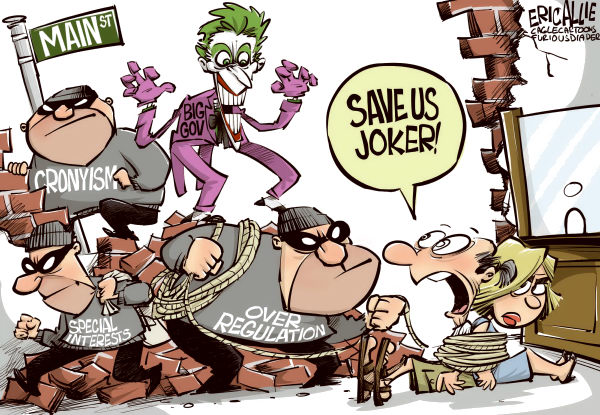

Courtesy of Eric Allie via IPI
Musical Interlude: My iPod Shuffle Series

Neil Diamond, "America"


Saturday, May 31, 2014

Miscellany: 5/31/14

Quote of the Day

I can’t write a book commensurate with Shakespeare, 
but I can write a book by me.
Sir Walter Raleigh

Pro-Liberty Thought of the Day


Don Boudreaux's Barrons Review of Piketty: Thumbs UP!
Flaws aplenty mar Piketty's telling of the capitalist saga, flaws that spring mainly from his disregard for basic economic principles. None looms larger than his mistaken notion of wealth...No principle of economics is more essential than the realization that, ultimately, wealth isn't money or financial assets but, rather, ready access to real goods and services...Yet, to the extent that inequalities are at all relevant, the only ones that really matter are inequalities in access to real goods and services for consumption...This shrinking gap between the real economic fortunes of the rich and the rest of us should calm concerns about the political dangers of the expanding inequality of monetary fortunes.
Flaws in the author's stratospheric viewpoint are also on display when we try to think in human terms about the inevitability of the return on capital, at 4% to 5%, exceeding the growth rate of economy, at 1% to 1.5%...Sooner or later, the entry of competitors and of changing consumer tastes curbs their growth, when not reducing their size absolutely or even bankrupting them. In 2013 alone, 33,000 businesses in the U.S. filed for bankruptcy, a typical figure for a year of economic expansion. Second, and more importantly, successful capitalists rarely spawn children and grandchildren who match their elders' success; there is regression toward the mean.
If Piketty really believes in a "perfect" capital market yielding capitalists reliable and steady income, he might wonder why the bankrupt book-selling giant Borders is no longer around to sell his books, while Amazon.com has grown up to challenge all manner of bricks-and-mortar retailers. In his world, capitalism is a system of profits; in the real world, it's a system of profit and loss.
Piketty's disregard for basic economic reasoning blinds him to the all-important market forces at work on the ground—market forces that, if left unencumbered by government, produce growing prosperity for all.
I'm a mark for just about anything Boudreaux writes; my favorite daily email is a digest from Cafe Hayek. If I would make a criticism, I might have wanted a brief summary of some of the more technical objections to Piketty, e.g., the summarization and/or valuation of capital, whether Piketty's findings are unduly influenced by the analomous 2008 economic tsunami, the use of summary statistics vs. longitudinal designs which might obfuscate income mobility, etc. I know that he is aware of them via links published at Cafe Hayek. I might have wanted him to expand more on the opportunity costs of Piketty's "and then some magic happens" suggestions of public policy tools to correct inequalities. If, as I believe, that wealth taxes and/or high income tax brackets are inversely related to economic growth (did Piketty exhaustively review public policy? I haven't heard a reviewer mention it), wouldn't that adversely affect job opportunities and net worth for the lower-income households? What about the morally hazardous consequences of welfare net programs on lower-income savings accumulation? I don't believe for a second Piketty's view about wars or revolutions being wealth accumulation resets.

Boudreaux has a marvelously readable, pithy writing style I admire. I particularly like the second highlighted sentence--this is very similar to a point Cowen recently made: "Another pre-existing empirical problem is that 19th century data seem to indicate that a “Piketty world,” even if we take it on its own terms, far from being a disaster, would likely be accompanied by rising real wages and declining consumption inequality, albeit rising wealth inequality." Conveniences like televisions, music players, PC's, and cellphones, were barely conceivable less than a century ago, unavailable at any cost. Whereas the well-off may have been early adoptees of emerging technologies, it was production economies of scale which made the technology affordable for even lower-income Americans. So what if companies like Apple and WalMart made themselves wealthy in the process of providing low-cost, usable technologies for the masses? Competition is intense; for instance, a number of smartphone competitors (including Google and Microsoft) challenge Apple's dominance, and Amazon has transformed itself from its early roots as a dominant online bookseller to a serious competitor to WalMart.

Shinseki Resigns: Thumbs UP!

This was inevitable; the fact that the Obama Administration had been caught red-handed keeping vets off the official wait lists to manipulate performance statistics, it was necessary for Shinseki to fall on his sword. I knew just as soon as I heard him issue a public apology, he was done. Nervous Dem incumbents, up for reelection this fall, were increasingly on the record for throwing him under the bus. I think I was mostly intrigued that Speaker Boehner had held off calling for Shinseki's resignation.

The big issue remains, of course. As an aside, I myself, as a former Navy officer, had received a mailing from the VA, hyping eligibility for the program. No, thanks; the VA has been hyped by the Administration as the successful prototype for "superior" single-payer solutions. The real solution is to privitize VA hospital operations.

Guest Post Comment

Every once in a while I'll  comment in another blog (e.g., occasionally I'll do it on Cafe Hayek). As I've explained in past posts, I don't do it often, because in the past I've found myself subjected to wolf pack attacks (e.g., Atkins diet fanatics); it's not that I don't enjoy the give and take of a debate (after all, I'm a former academic), but they are a sinkhole of my time, and typically the other party resorts to ad hominem attacks, which is never fun.

In this case, the House of Representatives passed an historic bipartisan amendment 219-189 to defund related DEA raids in nearly half the states decriminalizing medical marijuana/products (e.g., medicinal oils). Granted, this is a baby step forward; we also need federal sentencing reform, etc., and it's an open question whether the Senate might go along, although I would expect senators from the nearly half of states which have decriminalized pot for medical or recreational use would support it, and I think there are enough libertarian-leaning GOP senators (Paul, Cruz, Flake, Rubio, etc.) to push it through (although frankly I've not looked at individual senator policy positions on this issue).

I myself have never indulged and have never been tempted by either cigarettes or marijuana. One story from my undergraduate days: my best friend Ramon and I had taken a city bus down to watch the Spurs play. (At the time, the Spurs offered OLL student a cheap ticket bundle--I think it cost more for the bus rides than the games.) Some of our dorm friends spotted us and offered us a free ride back to campus. Ramon didn't want to go but didn't explain his reluctance; I didn't see the harm in saving bus fare. I then understood; soon as we got on the road, our dorm friends started smoking weed, and the smoke filled the car. They rolled down the windows and shouted, "Oink! Oink!" as we passed by a San Antonio cop directing traffic. All of a sudden, I could see my life pass in front of my eyes, worrying I might get busted with my fellow students, even though I had nothing to do with it. I then told the others that the smoke was making me queasy, and if they didn't stop, I might puke all over the car. It worked, although there was discussion of kicking me out of the car and stranding me in the middle of San Antonio...

It was difficult not to notice in the dorms where it seemed every other room was burning incense. It got to the point I even misinterpreted an act of kindness. One of my best coed friends had a younger, taller sister also attending the university; I didn't know the sister that well, but late one semester she had some issue with her typewriter (yes, I'm ancient...) with some end-of-semester term papers coming due; without really thinking about it, I offered to loan her mine. The next semester I started getting notes from a secret admirer, and one of the guys in the dorm was helping her out. I don't think at the time I had even gone out on a date (I graduated from high school at 16, I lived on an Air Force base miles from campus and had no car), never mind having a secret admirer (I have to admit that initially it was very flattering). Then one day the intermediary knocked on my door bearing a pan of brownies. At this point, I started getting paranoid: everyone knows what some people do with brownies: was this some sort of hoax to get me high? (I eventually did eat the brownies--which were ordinary brownies.) I thought the attention I was getting had crossed the line into stalker territory, and I told the intermediary in no uncertain terms this had to stop. I got one tearful response from the mystery coed writing it was never her intent to get me upset; she wanted me to be happy, and she would respect my wishes and leave me alone... It stopped and had mostly been forgotten until some time later when I was talking to my coed friend whom I think was graduating. She made a puzzling comment that her kid sister was dating someone else now. I didn't immediately understand why she was discussing her sister's dating life with me--when it finally dawned on me later that the little sister was my secret admirer and big sister thought I knew. Story of my dating life: once women get to know me... (It would have been awkward anyway; I was attracted to big sister, whom had a boyfriend; I would have asked her out in a heartbeat. Who knows? Maybe big sister encouraged her sister's interest; I don't know how she forgave me for hurting her sister's feelings--I would have never done that if I had known whom it was. I would have probably have asked out the little sister if her approach had been more direct, and my life might have changed for the better.)

In any event, the Libertarian Republican blog published a relevant post on the medical marijuana vote. (I have my differences with the blog, which is more interventionist, immigration-restrictionist, and partisan political than I am; they regard some of my widely cited sources like Reason as "left-libertarian". As I mentioned in yesterday's post, I see left-libertarianism as more anti-big, including business, not in terms of foreign meddling, which the Old Right, like Robert Taft, also opposed.) I have mostly steered my blog away from partisan bickering and have posted multiple times my differences with the GOP, even coined a term 'Free Federalist' for a new party name. (I use the term to reflect less of a nationalistic, mercantilistic brand which transitioned from Hamilton's party to the Whigs and eventually GOP, more reflective of the principle of Subsidiarity with a minarchist perspective.) That being said, I find the conservative wing of the GOP closer to my classical liberal (free market) views, while there no longer is such a thing as a conservative Democrat [the last real conservative of note was Grover Cleveland]. But still, the one talking point that irritates me to sniping back on Facebook and elsewhere is the LP talking point that Democrats and Republicans are essentially the same. I think the George W. Bush Administration was anomalous; keep in mind Bush had been elected in part on rejecting Clinton-style nation-building, he had created the world's biggest bureaucracy in DHS, and his version of "compassionate conservatism" was a smokescreen for accelerated domestic spending and a radical expansion in federal education intervention--a generation after Reagan wanted to eliminate it. I think likewise the Congress had lost its way--the most prominent example being a late Alaskan senator whom threatened to resign his seat over any attempt to scratch funding for the Bridge to Nowhere. This was a different GOP than the one whom kept President Zipper in a fiscal straitjacket during his last 6 years in office.

Here's the Dem troll:
FTR, 91% of democrats supported this while 22% of republicans did. Party of freedom and liberty indeed. 
As to the Democrat troll in this thread, tell me, where was the Democratic leadership on this issue when they controlled both chambers of Congress from 2007-2010, plus the Presidency in the second? And where has The One been, other than the Justice Department will look the other way for states that decriminalize, an abuse of discretion? The fact of the matter is that 100% of the Dems couldn't have carried the day without sizable GOP support. And let's not forget: "Progressives" were full in on the original Prohibition and to the present day have no problem telling other people what to do, to eat, etc.

Facebook Corner

(Drudge Report). D'Souza's 'AMERICA' warns Hillary will 'finish off' country.
I think 2016 will be a change election year, and an aging Hillary is part of the Bush-Clinton legacy that will have dominated national politics over the past 3 decades. We will be well into the first decade of the Baby Boomer tsunami, with probably $80T in unfunded liabilities, nearly $20T in national debt and probably 16 years of tepid economic/job growth, if not a global recession. If and when interest rates pick up, federal interest expenses on that $20T will explode. Even if Ms. President Zipper is elected, she will likely be fending off problems that have been kicked down the road for years, hardly expanding the Statist empire.

(Economic Freedom). See Thought of the Day.
Hairdressers should be licensed. I am a licensed barber, at the time I needed 15OO hrs of schooling (took out a loan) then had to pass state of fla. board. There is a lot to know especially when dealing with chemicals & sanitation. So I believe in licensing for certain jobs
Spoken like a self-serving crony hairdresser; why do you feel threatened by women whom have a talent for hairbraiding? If you can markup your services commensurate with your qualifications, do so.

 Who would hire a unlicensed plumber? How about a unlicensed doctor?
Licensing need not be bear the imprimateur of Statist bureaucracy. Speaking as an IT consultant and former MIS professor, I've met many talented people in the profession without a relevant degree or certification. I know a lot of people whom pick a service professional based on favorable word of mouth and/or have selection criteria beyond any licensing criteria, e.g., bedside manner, responsiveness, availability, experience. (For example, when I had my Lasik procedure done, it was done by someone with 800 procedures under his belt.)

More Proposals


Political Cartoon

Courtesy of the original artist via IPI
Musical Interlude: My iPod Shuffle Series

BJ Thomas, "Whatever Happened to Old-Fashioned Love?"

Sunday, May 25, 2014

Miscellany: 5/25/14

Quote of the Day

Scitum est inter caecos luscum regnare posse. 
(It is well known, that among the blind the one-eyed man is king.)
Gerard Didier Erasmus

Pro-Liberty Thought of the Day


Via Independent Institute
Via LFC
Via LFD

Image of the Day

via Eddie DaDog on FB
Courtesy of Natalie Fawn Danelishen via LFC
Still More on Piketty

Stan Veuger of US News & World Report points out an overlooked issue in Piketty's polemical analysis of  the Forbes' list of the wealthiest people. Familiar readers know my usual response to comparing snapshots of income summaries--they usually are not longitudinal in nature (I think Mark Perry has published multiple posts on this topic, e.g., here). In other words, you miss dynamics of mobility over time. For example, I know at one time Ted Turner was worth about $10B on paper; several years later, his net worth collapsed by over two-thirds. This is particularly salient because Piketty espouses a patriarchal theory of capitalism. Veuger looks at the top 10 in Forbes in 1987 and how they are today. Adjusted for inflation, they collectively have increased their net worth only by about 0.5%--not the 7% Piketty suggests: and if you take outlying WalMart out of the mix, the rest of the group lost about half their cumulative wealth.

I'll probably add the Marginal Revolution blog, with major contributors Tyler Cowen (whom I've featured in embedded videos from LearnLiberty) and Alex Tabarrok, to my blogroll in the near future. Tabarrok looks at an asset pricing problem (which, to a certain extent was covered in one of Holcombe's post--recall Piketty's example of rents on a French apartment--he argues that rents will inevitably rise to accommodate a certain return on the apartment's value. Holcombe implies effectively the initial purchase price is irrelevant and a better estimate reflects the market price reflecting apartment rents: in other words, it's not a case of rents rising to meet some return on investment, but the market price correcting to meet the NPV of expected rents. Tabarrok points out that if we look at rent divided by say, interest, the price increases as interest rate decreases. So, for $100 in income, we are willing to pay $1000 if the interest rate is 10%, $2000 if the interest is 5%. Notice that we need 2 income-producing assets producing $100/month if the interest rate is 10% to have the same market priced of assets at half the interest rate. Tabarrok notes that Piketty ignores this salient nuance. Importantly, 4 French economists have demonstrated that Piketty's findings of an increase in capital stock are distorted by the anomaly of the housing bubble, and if you adjust for the disparity of rents from asset prices, capital in the US and France hasn't increased at all.

Cowen considers the asset pricing problem one of the key issue; he is less impressed with the Financial Times spreadsheet issues I discussed yesterday, he is also interested in pointing out nineteenth century data are consistent with rising inflation-adjusted wages and declining consumption inequality. He also discusses a couple of other serious criticisms of Piketty's work: if you adjust for distribution of Europe's population, Piketty's thesis of growing inequality is not confirmed; he also argues that Piketty's focus on inheritance is not supported by the data.

As an aside, the Ryan Avent commentary on the spreadsheet issues cited above has an interesting side discussion of the Reinhart-Rogoff kerfuffle I also discussed in yesterday's post:
In that way, and in many others, this does look quite a lot like the Reinhart-Rogoff contretemps, to which Mr Giles draws a parallel. The errors identified in their spreadsheet turned out to be far more embarrassing to the authors than a threat to their work. The attack on the Reinhart-Rogoff analysis showed that the authors had made a mistake in the figures that led them to identify a "discontinuity" in growth rates when public debt reaches a 90% of GDP threshold. But the analysis by economists at the University of Massachusetts, Amherst actually reinforced the finding that growth rates tended to be slower when debt levels were higher. The UMass work did nothing to undermine the broad dataset that rested beneath the 90% work (and beneath their book, and many other pieces of research). Subsequent analyses have turned up a discontinuity at various thresholds (though other papers have not).
Facebook Corner 

(National Review). The VA scandal is a reminder that government-run single-payer health care does not work
The point of massive bureaucracies is so valid. VA, FEMA, HSS, the list will go on. Yet, I know the benefits of ACA. The number of uninsured has gone done quite a lot. the ACA , blueprinted from Mass. and Heritage Foundation, did not go single payer route which was cheered on by the liberal\progressive wing. It is keeping the private sector in the loop (insurance companies). The downside, too many top down regulations as to how / when / who on policies. Medical Profession acceptance (see Medicare\Medicaid).
Wrong. The Heritage Foundation never advocated the idea of bundled health services which is not true insurance or risk-sharing. Keep in mind Taxachusetts implemented guaranteed issue and community rating long before RomneyCare, never mind gold-plated benefit mandates that had families paying far more than, say, those in Utah. What Heritage did was propose the concept of catastrophic coverage as an alternative to single-payer or the current fascist model where nominally insurance remains in the private sector but the government controls it. Effectively the insurance industry serves as Statists' useful idiots and whipping boys at public discontent over hiked premiums.

(IPI). Illinois Sen. Ira Silverstein wants to ban Illinois drivers from using Google Glass, even before complaints about drivers using it have become an issue. Silverstein has been pushing a Google Glass ban for some time, even before it became available for the general public to buy, and last week representatives from Google went to the General Assembly to demonstrate how Glass works.
Never underestimate the Nanny State

(Reason). Whatever you may think of Keynesian economics, you have to give it credit for one thing: its staying power.
Self-serving political whores always love a philosophy that morally justifies their propensity to overspend.

Via LFC
Real democracy is the marketplace. Unlike the government, capitalists can't use force to compel you to buy their goods or services, and they remain subject to the forces of competition, innovation and creative destruction.
I agree with your sentiment, but replace the word "democracy" with "liberty". Democracy is acrimonious to liberty. Democracy is mob rule; it means 51% get to dominate and control the 49%. Democracy is a terrible idea.
I wasn't referring to "vulgar" democracy or the modern form of republican democracy. Capitalism has done to raise people out of poverty than politicians and religions put together; it increases the people's standard of living, and it brings a variety of goods and services to all even the most wealthy just decades ago could barely imagine, never mind procure, like a smartphone.

(National Review). Rep. Adam Kinzinger says the two-year backlog at the VA was a sign of incompetent bureaucracy, but that the fake waiting list showed "criminal negligence.” Read NR’s coverage of the Sunday talk shows: natl.re/1nIOUcW
No, the case of hidden waiting lists is a de facto form of rationing, which is an artifact of a single-payer system (and a predictable one at that). The problem with the healthcare system is domination by government, which is too rigid to deal with the dynamism and complexity of the markets. What we should be hearing is a call to privatize the system and rollback government programs, regulations and tax policies which have served to consolidate competition and exacerbate sector inflation.

Do I believe that what happened in Arizona was a matter of negligence and incompetent management and there should be accountability? Of course. The free market operates to serve the consumer, and feedback is a way of correcting course or gaining market share. Consumers would not willingly choose a provider given bad reviews from existing customers. There's no way this would have happened given, say, an ombudsman that vets or their families could come to and/or if the agency was independently sampling current/former patients about quality, timeliness, professionalism, etc., of current providers

(Independent Institute). Senior Fellow William Shughart: " No one hates the U.S. shale revolution more than Russian President Vladimir Putin. Surging U.S. oil and gas production is a nightmare he can’t escape. Already, U.S. gas production and the promise of U.S. liquefied natural gas exports have Russia’s European customers demanding cheaper prices for gas, and the Russians are reluctantly agreeing.."
Man, this guy drinking the kool aid or what!? Russia, and the Soviet Union before it, were very reliable suppliers of gas to Europe. Even at the height of the cold war. Second, it is Ukraine not paying it's bills and siphoning (to put it polity) Gas intended for paying customers. That is why the North stream pipeline direct to Germany was built and now the South stream is being built as well. To by pass your newest fascist pets in the Ukraine. Next, shipped gas from the US is no way even close to being cheaper. Did this guy do research or simply a stooge!? Lastly, Russia and China just signed a massive gas trade agreement that will develop the Siberian regions and enable investment in high technologies, meaning diversification, and with Russia's mineral wealth, oh by golly! Also, all the benefits of fracking in the US like polluted water and god knows what else. Lastly, the gas supplies from the fracking are not really panning out to be very productive. Quite a few wells are a failure, but, the area has been polluted. So Mr. Shughart, you need to actually do some journalism instead of just being a mouthpiece.
Hypocritical talk of a country led by corrupt, lawless politicians whom have failed to diversify their country's economy from overreliance on commodities which ultimately rely on international economic growth. Everyone knows that the referenced negotiation with China broke down several times over price, and in part that had to do with global supply/demand referencing new export supplies from the US. Someone from Russia parrotting US environmentalist crackpots on fracking, when Russia has some of the worst air and water pollution on the planet? Russia is ugily extorting Ukraine and has periodically threatened cutoffs to Europe to gain concessions; the fact is, supply from the US is undermining Russia's pricing power to Europe.
Via LFC
Technically socialism is the assumption that human nature is good. Think about it, the aim of socialism is for everyone to share, and for there to be no class distinction. Unfortunately mans nature is evil. That is why socialism and communism fail so horribly. It looks good on paper, but it can't work on earth due to the fall of man. Our sinful nature prevents us from a perfect world.

Capitalism is the best fit for a healthy economy. America started as a free market capitalist nation, we exponentially warped into a mixed market capitalist society that ignorantly moves towards socialism. 

It's this countries' overwhelming ignorance that will be the downfall. Americans today are too consumed with their own self worth to bother with the future of our nation.

Sad sad truth...
"America started as a free market capitalist nation"--I don't think so. Alexander Hamilton from the first Washington Administration wanted to use tariffs and dutieson imported goods to go beyond funding the government to protect the US fledging manufacturing sector. Hamilton's ideas were inherited by Clay's American System based on central planning through tariffs, a central bank, and infrastructure: the Whigs and then the GOP developed similar themes. The Democrats saw protectionist policies as favoring the Northeast at their expense and a threat to their exports (e.g., cotton)--not to mention that high tariffs contracted the import tax base. I'm not necessarily arguing that nationalist policies carried the day, but to argue that we were free market ignores much of our history--plus pre-Constitution protectionist taxes on interstate commerce ("In the 1783–89 period, each state set up its own trade rules, often imposing tariffs or restrictions on neighboring states").

(Bastiat Institute). Is Murray Rothbard the most influential Austrian Economist ever? http://liberty.me/authors/murray-n-rothbard/
No. It's hard to overestimate Mises' impact, particularly his devastating early 1920's critique of socialism. I consider Rothbard to be a superb historian and certainly the most influential American in the tradition, and obviously Hayek's Nobel Prize speaks for itself--certainly the most accessible of the three. I do wish Hayek had done more to undermine Keynes' masterwork.

Proposals With a Twist

I really love this one and the backing song... I think I may be the only person on the planet never to have heard the song before, because Youtube shows 174M  plays for Christina Perri...


Now I never thought about a flash mob on a flight... Very creative...


OK, I like the serenade aspect of the same old same old Bruno Mars tune, but does anyone else have the itch to give this dude a buzz cut?


Political Cartoon
Courtesy of Gary Varvel via Townhall
Musical Interlude: My iPod Shuffle Series

Olivia Newton John, "Don't Stop Believin'"

Saturday, May 24, 2014

Miscellany: 5/24/14

Quote of the Day

Never anger a heathen, a snake, or a pupil.
Talmud

Pro-Liberty Thought of the Day


Iraq Vet Blows Up Over Inappropriate Flag Display

I caught this courtesy of a Drudge Report feed. Being brought up as an Air Force brat and having served as a Navy officer, I have always had pride in the flag; one moment I'll never forget was marching as the flagbearer of my Scout troop marching in the annually televised South Texas George Washington birthday parade. But I've become more critical of politicians rallying behind the flag to justify international meddling, how matter how noble the high-sounding objectives. Politicians who abuse the trust of voters spending a trillion or more dollars in American treasure we didn't have to begin with and responsible for thousands of casualties, American and others, are unconscionable.

I understand the indignation of the vet here, but a professional soldier must never let his emotions cloud his judgment. Freedom to express dissent, including of the government, through symbolic abuse of the flag, is part of what the original American Revolution was all about. What other people do or say are not within your locus of control; you need to model the civic virtues that are part of our heritage. Don't let uncivil protesters jerk your chain; these jerks were filming in the hope that some conservative would fall into their trap and overreact, showing conservatives to be alleged unprincipled hypocrites. What matters is how you yourself treat your own flag.


More on Piketty (French Socialist Income-Inquality Guru)

Chris Giles of the Financial Times has uncovered a number of anomalies with Piketty's spreadsheet data, not unlike some of the infamous Reinhart-Rogoff issues (HT Valuewalk).  (Reinhart and Rogoff published an influential study noting when national debt approaches a high percentile of GDP, the nation's economic growth rate takes a hit. This study has confirmed what we fiscal conservatives have argued during the post-2008 politics involving fiscally irresponsible government overspending and trillion-dollar deficits, and other studies using different measures and statistical approaches have supported related conclusions. For a Reinhart-Rogoff response to their critics, see here; in brief, they point out they used median values, less vulnerable to data outliers, they left out even more compelling datapoints, and they had not necessarily bought into short-term austerity policies.) I'm not going to paraphrase all of Giles' critique here of Piketty except to point out British wealth share of the upper 1% is significantly overstated, there are some typos in spreadsheet data from source data, and Piketty had made several unexplained adjustments to spreadsheet factors.

Holcombe has published the fourth post of his critique of Piketty. (I summarized his first 3 posts here.) In this essay, Holcombe argues that morally hazardous welfare state policies have contributed to the observed inequality because instead of saving for a rainy day, the down payment for a house, for retirement, etc., lower-income people tend to spend all their income. Since program benefits like social security, which is really an income transfer scheme, do not leave descendents with residual assets, and since one of Piketty's Politics of Envy obsessions deals with inherited wealth, the expansion of social welfare programs over the past 3 decades, government policy has exacerbated differences in household wealth.

I think I paraphrased Bob Murphy's objections in the first commentary on Piketty (see my Piketty tag), but Murphy also notes that Piketty's description of American tax policy is incompetent. In part, Piketty has bought into the myth that Hoover was some laissez-faire President. It is true that Hoover recoiled from FDR's more ideological government intervention and joined forces with former Democratic nominee Al Smith and the Old Right in opposing FDR's "progressive" empirebuilding, but his Presidential record was different: he raised income taxes in his attempt to balance the budget (FDR would later on increase taxes even more), he raised protectionist tariffs, he invested in public infrastructure projects, he jawboned companies against cutting wages and other spending, etc. So here is Piketty, whom confuses calendar years with tax years (e.g., Hoover signed the 1932 Revenue Act, effective with 1932 personal income but formally assessed on Tax Day 1933), not to mention confounding the effects of fiscal with monetary policy (which Murphy doesn't discuss here):
[T]he Great Depression of the 1930s struck the United States with extreme force, and many people blamed the economic and financial elites for having enriched themselves while leading the country to ruin. (Bear in mind that the share of top incomes in US national income peaked in the late 1920s, largely due to enormous capital gains on stocks.) Roosevelt came to power in 1933, when the crisis was already three years old and one-quarter of the country was unemployed. He immediately decided on a sharp increase in the top income tax rate, which had been decreased to 25 percent in the late 1920s and again under Hoover’s disastrous presidency. The top rate rose to 63 percent in 1933 and then to 79 percent in 1937, surpassing the previous record of 1919. [Piketty pp. 506-507]
Martin Feldstein penned a WSJ op-ed  where he argues that Piketty's numbers don't add up. For example, he points out increases in income and wealth, adjusted for inflation, since 1960 has been roughly 3.2%. (He points out the dilutive effects of heirs and other beneficiaries, not to mention the death tax.) Then there are nuances of personal and business income; for example, before Reagan's tax reforms, corporations were taxed at below top income tax brackets, which provided an incentive for owners to shift income at the corporate level and minimize highly-taxed salaries; on the other hand, when the personal income tax rate went below corporate tax, it provided more incentive for owners to shift distribution of income to the personal level. This didn't really result in a higher income, just its allocation, and Pinketty's assessment only looks at the income distributions at the personal level. (In other words, Pinketty is comparing apples to oranges.) Second, a tax cut provides an increased incentive to invest because of the risk-reward tradeoff. For example, municipal bonds generally pay a tax-free, low interest rate. At lower tax rates, there are more private-sector opportunities to obtain a higher post-tax yield than municipal bonds.

Leef's Forbes critique is from first principles, the morally corrupt solution of Politics of Envy redistribution schemes. He echoed a variation of some themes I've repeated repeatedly: the Statist Dems are far from their party's founder, Thomas Jefferson, whom obsessed about the growth of the federal government at the expense of the States and was worried about corrupt bankers and mercantilism protecting Northeast business interests, Jackson, whom shut down a central bank and paid down the national debt, and Grover Cleveland, whom supported sound money and free trade. Today's Dems are interested in growing the State bureaucracy, which takes its cut before the pretense of lipstick-on-a-pig high-sounding rhetoric versus the reality which misallocates whatever remains to politically favored constituencies. We had the Keynesian pipedream that wasteful spending somehow propped up the economy, that infrastructure, particularly earmarked boondoggles like money-losing supertrains in the People's Republic of California, had a multiplier effect on the economy, that if you threw more money at teachers and Big Green subsidies, it was better than growing the business tax base by reducing uncompetitive higher tax brackets.

There is a struggle, but not between the rich and the poor, but between the economically successful and the parasitic governing class. Principled legislation becomes corroded with corrupt political bargains with a maze of exemptions, guarantees, and handouts providing a bragsheet for each legislator's next reelection effort. It is the odious sausage making in Congress, far worse than anything Upton Sinclair could have imagined. Maybe economically illiterate voters are confused, whom mistake the lipstick-on-a-pig name of a bill with the reality of 2000 page bills that you have to vote for, before you know what's inside, according to the Wicked Witch of the West Coast.

Leef notes, spot on:
What would [the economically successful] have done with the money that the taxman confiscates? They would have spent some (and that spending is one reason why the rich don’t keep getting geometrically richer), they would have donated some to charities (ditto), and they would have invested some in whatever ways they thought best. Nothing harmful in any of that. On occasion, rich people make poor decisions in the use of their money, but they usually make far better use of it than politicians do. 
Exactly. They have a vested interest because it's their own money. And there's an opportunity cost of what the private sector would do if its resources were not squandered to "invest" in wasteful spending, to bribe voters with unsustainable programs..

He then points out the point I've made about baseless leftist conspiracy theories about crony capitalists. The way to get rid of government corruption is by designing it out: limit government's resources and authority, which attract parasitic businesses (like Big Green companies whom pick government turkeys clean, whom otherwise can't win in the real democracy, the marketplace). Who doesn't understand what Warren Buffett means when he says his wind farm operations wouldn't make sense without government giveaways, all but ensuring a profit?
Piketty frets that unless we have national, and indeed global wealth redistribution, the rich will become excessively powerful. Now, it’s true that wealthy people sometimes try to buy themselves governmental favors and often succeed. The solution to that problem, however, is not to tax away everyone’s wealth, most of which is used, as I argued above, for beneficial things. The solution is to get rid of those features of government that allow people (rich or not) to obtain favors from the state.
Facebook Corner

(Reason). Why would anyone need a permit to cook a meal in their own home?
http://reason.com/blog/2014/05/24/cheeseburger-with-fries-and-a-permit
Don't give the fascists any ideas: soon the health gestapo will be doing health inspections in any residence with a kitchen or microwave... You'll have to register every time you host a dinner party or have relatives over for the holidays....

The cultural Marxists think the whole thing of accepting cash to help defray expenses is intrinsically dirty. If your kid gives away the lemonade she made at her own cost, it's fine (no doubt because it is a teaching moment for redistribution...), but if she sells it in a stand on your front lawn, heaven forbid: is your neighborhood zoned for "business", have you procured necessary permits and licenses, does your glass of lemonade come with an ingredient label, has the health department inspected the operation, the handling of ice, etc.?


Many of the pro-Big Nanny commentators below don't understand the sharing economy or the nuances of operations. In this case, the cooks/hosts actually eat with the guests; they typically don't have economies of scales associated with brick restaurants, and you are not going to clear much, if any profit, when you factor in the overhead of shopping, cleanup. It's also a way of getting to know new people in the area and fulfilling social needs. I see the business model as an incubator of sorts (like food trucks) for prospective new restaurants without covering the initial high costs of procuring a lease, outfitting the restaurant, hiring staff, etc. Only parasitic, greedy government would devour the entrepreneurs of the future economy.
So you make food for strangers and charge them. How is that not a business?
So a public school charges students for lunch, or the local church has a pancake breakfast as a fundraiser, how are they not businesses? /sarcasm

This thread is rather pathetic; it's like people don't realize the distinction between a hobby or a business. There are tax implications. This is from the IRS:

The Internal Revenue Service reminds taxpayers to follow appropriate guidelines when determining whether an activity is a business or a hobby, an activity not engaged in for profit.

Generally, an activity qualifies as a business if it is carried on with the reasonable expectation of earning a profit.

In order to make this determination, taxpayers should consider the following factors:

Does the time and effort put into the activity indicate an intention to make a profit?
Does the taxpayer depend on income from the activity?
If there are losses, are they due to circumstances beyond the taxpayer’s control or did they occur in the start-up phase of the business?
Has the taxpayer changed methods of operation to improve profitability?
Does the taxpayer or his/her advisors have the knowledge needed to carry on the activity as a successful business?
Has the taxpayer made a profit in similar activities in the past?
Does the activity make a profit in some years?
Can the taxpayer expect to make a profit in the future from the appreciation of assets used in the activity?

The IRS presumes that an activity is carried on for profit if it makes a profit during at least three of the last five tax years, including the current year
These people are running a restaurant out of their kitchen. Get a permit! But these people are doing it on a regular schedule, for pay, and not just chipping in. If the cook and server make a profit, it is a business. And it needs an inspection and permit just like anuy other food business. Either all restaurants should be exempt from permits and inspections [bad idea!], or these people need to get a permit to serve paid dinners in their house. Simple as that. These people seem to think they are above the law.
I don't think if someone slips and falls or gets food poisoning in someone else's home, he doesn't have cause for possible legal action, whether or not money changed hands. But the main point in this thread confuses a hobby (hopefully a profitable one) with a business. The slippery slope argument is patently absurd. It's like saying if I sell an occasional book or CD on Half.com, I'm running a business.

More Innovative Proposals

(although I think I've had my fill of Bruno Mars...)


Political Cartoon

Courtesy of Gary Varvel and Townhall
Musical Interlude: My iPod Shuffle Series

England Dan and John Ford Coley, "Nights Are Forever Without You"

Sunday, May 18, 2014

Miscellany: 5/18/14

Quote of the Day
For I am a Bear of Very Little Brain, 
and big words Bother me.
Winnie the Pooh

Chart of the Day
Courtesy of the Gray Lady via Tucker
The services that are rising the fastest in price are those most afflicted by government intervention and control: college, health care, (overregulated) child care. Every single good or service that has fallen in price and thereby become more available is mostly or entirely a product of free-market production and distribution. And remember that this has happened despite the attempt by the Federal Reserve to increase prices on everything.
Image of the Day

Via Drudge Report
Pro-Liberty Thought of the Day


Still More on Piketty

In recent posts, I've discussed the best-selling French socialist Politics of Envy tome,  reflecting on reviews by Austrian School economist Bob Murphy and free-market economist Don Boudreaux. This  commentary reflects a 4-part series by Austrian School economist Randall Holcombe for the Independent Institute. (The fourth post has not been published as of this date.)

In Holcombe's first post, he gives an overview of the book, which does a comprehensive review of  economic history of income inequality across countries and that has increased over the past 3 decades. (Piketty essentially argues that this unsustainable trend will inevitably trigger social unrest and prescribes a wealth tax to mitigate unrest.) Holcombe takes issue with Piketty's conceptual framework for extrapolating the trend over the coming decades: "His framework misrepresents the nature of capital, how it is valued, and how owners of capital earn their returns." Capital is not some intrinsically return-yielding simplistic conceptual blob; it must be productively deployed to earn a return. Piketty does play lip service to this distinction, but this nuance is not reflected in his empirical framework.

In his second post: "Piketty says “the first fundamental law of capitalism” is that the share of income going to capital, α, is equal to the return on capital, r, times the capital/income ratio, β, or in equation form, α=rxβ." Holcombe has two issues here: (1) the dubious measurement of  β as an aggregate monetary value, and (2) he argues Piketty's equation has it absolutely backwards, i.e., β=α/r. Think, for instance, of a bankrupt company: regardless of what shareholders invested in the company, the company has not generated a return: the worth of their investment is zero  Holcombe uses Piketty's example of a 1-million euro Paris apartment that reaps 30,000 euros in rent. If r=4%, Piketty argues that an increase in rent to 40,000 euros is inevitable. Nonsense, Holcombe replies: the value of the apartment is only as good as its market-clearing rent. If indeed r=4%, the market value of the apartment is really only 30000/.04=750,000 euros. Holcombe ends his essay with this seminal insight: "Piketty laments the increase in inequality since 1980, but setting aside inequality for the moment, anyone who has lived in a capitalist economy since that time can see the increase in the standard of living that everybody — not just the economic elite — has enjoyed. That increase in the general standard of living has been due to the employment of capital in productive uses by its owners, but this economic function of the owners of capital plays no role in Piketty’s analysis."

In his third post, Holcombe further reflects on his transformed version of Piketty's equation, this time reflecting on values of r. As anyone knowledgeable of basic arithmetic knows, holding α steady, β increases as r decreases, and β decreases as r increases. Consider how r is impacted by interest rates. In general, we would pay more for a bond as the risk decreases: for example, there is no meaningful risk that the federal government will default on its notes, so we are willing to pay more for the bond. On the other hand, if a company or local/state government runs into revenue/cash flow problems; bondholders would bid the price of the bond security down to reflect the increased risk they're taking. Second, let's consider the effects of monetary policy. As the Fed manipulates interest rates downward to near-zero, this suggests that r decreases, which suggests that the market is willing to pay more for an asset. (HINT: what does this suggest happens to stock and bond prices if and when the Fed raises interest rates?) Why is an Austrian School economist pointing this out in response to Piketty? Note that Austrian School economists despise activist monetary policy; they tend to believe this stimulates artificial bubbles and inevitable busts. Holcombe is basically arguing that the inequity that Piketty has observed is largely an artifact of loose monetary policy and it's gone about as far as it can go, because you can't push nominal rates below zero. In essence, the trend behind Piketty's observed trend over the past 3 decades is temporary/unsustainable and is not an artifact of capitalism but rather of dysfunctional government policy.

Facebook Corner
Via IPI
During that whole 20 years we've had a flat income tax and for most of that time it was at 3%, a much lower tax rate than most states. It didn't lead to job creation and anyone who tells you it will is full of it.
The resident troll also is looking at only part of the state resident tax burden. According to the Tax Foundation, in 2010 (note: before the tax hikes) only 2 states west of NY had state/local tax burdens exceeding 11%, the other being the People's Republic of California. If the troll was a legitimate businessman, he would know the government cost burden must be taken into account when it comes to establishing or expanding local operations. Texas, on the other hand, was one of a handful of states with a cumulative tax burden under 8%. Checkmate, tax-and-spender.
If Illinois was sitting on oil it would be the same story. A vast sum of jobs in Texas are low skilled minimum wage earned jobs. And that is only happening because the cost of living is so low. Throw in a several months of cold weather and it would be the same as here. States are going to continue to cut each other's throats with tax rebates, no taxes. That worked for the NFL for a few years.
The troll also is neglecting to point out that per capita income in Illinois has dropped from rank #12 in 2007 to #16 in 2012 while Texas has been a stable #25 and closing the income gap. Texas has a diversified economy with about 16% based on the energy sector. It leads the nation in production of cattle and cotton, is a major producer of fruits and lumber and has the largest farming acreage in the nation. It is a major trade hub (exporting more than California and New York combined) and has several deepwater ports. It is home to 51 of the Fortune 500, including 6 of the top 50.

(IPI). Property tax hike for pensions? Chicago voters say, "No can do."
Why should today's taxpayers bail out decades of failed union-supported political leadership which made the corrupt bargain for and paid lip service to unsustainable pension plans but did not "invest" the city's fair share? Taxpayers have been paying their fair share all along through already high property taxes; pensioners and future retirees need to adjust to the reality of what has been actually invested on their behalf and not expect taxpayers, many if not most whom don't have any pension plan of their own and need to fund their own retirement, to make up the difference.

(Cato Institute). "The federal Highway Trust Fund is expected to run out of money in a few months, and unless Congress replenishes it, state highway projects will supposedly grind to a halt."
It is unconscionable that a regressive fuel tax is used as a political slush fund to fund boondoggles and money-losing mass transit. It's time we move to more of a mileage-based/user fee system and privatize operations.

More Creative Proposals


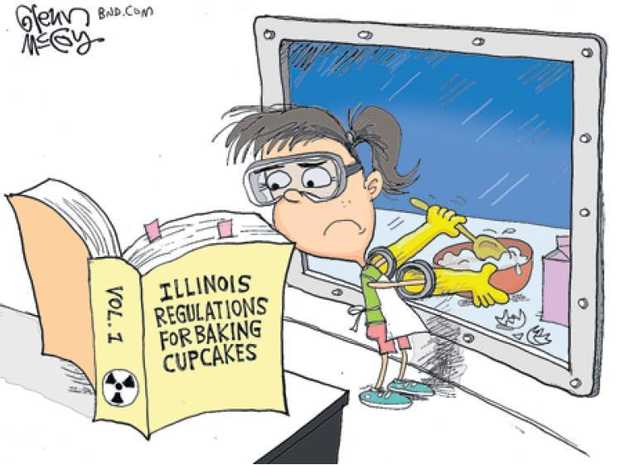
Political Cartoon

Courtesy of Glenn McCoy via IPI
Musical Interlude: My iPod Shuffle Series

ABBA, "Knowing Me, Knowing You"

Friday, May 16, 2014

Miscellany: 5/16/14

Quote of the Day
If I had my life to live over again, 
I'd be a plumber.
Albert Einstein

Image of the Day

Via Drudge Report

Via Citizens Against Government Waste
Rules
Courtesy of the original artist via Carpe Diem

Persnickety Piketty

A few posts back I did an initial comment on the French socialist's income-inequality tome, the latest rage of the "progressive" cocktail circuit, quoting or paraphrasing Don Boudreaux of Cafe Hayek. This follow-up focuses on Bob Murphy, an Austrian School economist recently interviewed on Tom Woods' May 16 podcast.

I'll simply provide a summary of posts Murphy made about a relevant comment from economy PhD student Matt Rognlie and critiques from sympathetic critics Brad Delong and Larry Summers. I don't want to get into the economic weeds of this discussion, but Rognlie points out that Piketty does a bit of "some magic happens" in arguing this escalating rate of return to capitalists, requiring the government intervention of a confiscatory wealth tax. In particular, Piketty seems to be confounding a gross production function with a net production function. This is significant because depreciation, an issue in net income determination, is nontrivial. Basically, there are diminishing returns to capital accumulation, just as we would expect the labor rate to fall if the labor pool increases. Piketty wants to argue that the rate decrease is small enough to ensure the share of income attributable to capital is still increasing at the expense of income allocated to labor.  But this demands an elasticity of substitution (capital relative to labor) > 1. Piketty wants to argue the economics literature talks about elasticities of as high as 1.25. The depreciation factor really means we need to see twice the elasticity Piketty is using to make his point; under more realistic models, we would expect to see labor's share of income to increase considering the fact of depreciation/diminishing rates of return of capital, which is inconsistent with Piketty's income-inequality thesis.

I myself have never understood how Piketty's model is consistent with the increasing standard of living with the fact of our economy, say, during the Gilded Age, with rising incomes and economic growth without government intervention, or, for example, the recent decades of an exploding middle class in China and India under more liberalized economies....

Facebook Corner

(Cato Institute). "The United States can have a smaller government and freer immigration."
Note that we real pro-liberty conservatives support liberalized immigration of all types of workers, from all the nations of the earth, of all cultures and creeds. We celebrate the same dreams that motivated our forefathers to migrate to this land of freedom and opportunity (in my ancestors' case, emigration from French Canada, attracted by opportunites in New England like textile mills and lumber).

We reject the toxic legacy of the Know Nothings and KKK, the xenophobes and racists, the economically-illiterate labor protectionists, the government intervention in labor markets. We reject the toxic angry rhetoric of those unprincipled populists and their nefarious pledges, whom have all but killed the cause of liberalized economies and market-friendly politics in the People's Republic of California and are attempting to extend by default the cause of "progressive" policies. Keep in mind the same dysfunctional government which has led to Food Stamp Nation, decades of failing public schools and unconscionable debt and other liabilities for future generations is no better at regulating immigration policy. We need a pro-growth liberalized immigration policy; we need to reject the past century of shameful restrictions which have harmed our economy..

(National Review). Would you be in favor of a drone strike on Boko Haram? 
No! This would be unconstitutional, unauthorized by Congress. This does not directly involve our own national security. We are not the world's policeman. Not to mention that we would be morally responsible for the collateral damage to innocent civilians whom had nothing to do with this atrocity.

(National Review). Charles Cooke writes that if Harry Reid wants to restrict freedom of speech beyond recognition, he’s welcome to try.
Money is not Speech. Corporations are not people. Not every issue is a partisan issue.
I am so tired of crackpot "progressive" trolls uttering that corporations are not people, that money is not speech, etc. Corporations are voluntary associations of people; these people do not lose their right to speak, just because they lack a "progressive" sugar daddy like George Soros backing their smug, self-superior fascist policies. They imagine crackpot business conspiracies, while backing legalized plunder and redistribution, mandatory Ponzi schemes, promoting individual dependency on Leviathan.


A constitutional amendment to restrict political speech will never reach the necessary super-majority in either chamber of Congress. It is dead on arrival.

(Reason). Hello fetus, goodbye civil liberties
No one is arguing that pregnant women should not be fully advised of the potential effects of their behavior on the unborn child. But nothing is more morally reprehensible than for a mother to terminate her child's life to avert State prosecution.

(The Independent Institute). Research Fellow Vicki Alger: "For the nation, this family’s saga serves as refresher course on the true origins of our fundamental rights. We are endowed by our Creator — not government — with certain unalienable rights, including the right of parents to educate their children as they see fit. An administration that would deport a family for doing just that should leave all Americans unsettled." [This involves a German immigrant family wanting to home-school their kids, not allowed under the German government; the family seems to have lost its battle to stay here.]
Apparently educational choice is not a priority of The One's core special interest teacher union constituency. Shameful departure from the principles of our pro-immigrant principled foundation.

(Cato Institute). "The H-2A visa is stymied by regulations promulgated and “enforced” by four different federal agencies."
This reinforces the fact that "pro-immigrant" Dems like The One are not principled but trying to split the difference between their civil rights Latino constituency and their Big Labor protectionist constituency. Artificially low temporary worker caps are an unconscionable infringement on the small business owner to engage in pro-growth win-win contracts. Quotas are economically vacuous policies, whether we are talking for temporary workers or those seeking permanent status. We need to stop counterproductive government interference in the economy, and that includes immigration policy.

(CAGW). The Federal Communications Commission (FCC) continues its attempts to impose more restrictions and regulations on the Internet. Instead of focusing on real problems that the Internet is facing, the FCC is pushing for policies that have already failed twice. http://ccagw.org/media/press-releases/ccagw-frustrated-fcc%E2%80%99s-ruling-net-neutrality-proposal. SHARE if you agree: The government should not control the Internet!
Big corporations aren't any better than govt control.
Big corporations are vulnerable to innovation, creative destruction. Look at how the USPS' monopoly over first-class mail has been undermined by advances in high tech.

(Reason). Stricter new requirements may sound reasonable, but they're not reasonable for everyone—or reasonable for democracy.
It is amazing to me that anyone would trust the integrity of our elections on the mere assertion of government, which unlike the private sector, is not vested in fraud protection--there's not only Medicare fraud, but all sorts of misconduct at lower levels of government. I've worked at locations which operated on biometrics, like fingerprint readers and iris scans. Most jobs require at least one form of photo ID.

Just because some urban populations may have large percentages of non-drivers and hence may feel a disparate effect, I am not convinced. You have to provide ID when you start a job, get medications, cash a check, pick up mail at the post office, etc. Presumably an eligible voter, to establish citizenship requirements for voting, must present a birth certificate, naturalization papers, etc. An ID could be provided free of charge on a needs basis at the time of registration. Let's not confound the issue of registration with identification.

There are a number of things inconvenient about voting. I've often been on the road at election time, so yes, I've had to vote absentee, not to mention I've had to get drivers licenses in each state I've lived (including 4 times in TX). But waiting until the last minute to vote should be a red flag; prospective voters have months or years to register for an election. Inconvenience is an excuse.
Because voting is a RIGHT. Every American has the right to vote. There is NO proof that voting under another person's name is a "huge problem." It is nothing more than one party trying to fix the elections in their favor. If your tribalism is so entrenched that you actually support taking away Constitutional rights so "your side" can win, then you should move to a dictatorship. It is patently un-American.
First of all, let us all agree that no political whore is worthy of or can be elected by one marginal vote. 

Second, as a former professor, I personally caught several students engaging in academic dishonesty, more than all my colleagues put together--yet I was convinced for everyone I caught, many more went uncaught. There were all sorts of obstacles: there was a time limit for me to file a charge, there were due process rules that blatantly favored the student (e.g., one student claimed that I had orally contradicted my specific written policy and claimed she had "witnesses"), universities would fail to enforce written policy, and I became the target of certain powerful faculty and administrators claiming I was "sabotaging" their recruitment processes, a problem especially if you are a junior, untenured faculty member. And the reactions of the students whom got caught were not contrite; they wanted to know how I caught them so they could get away with it next time. (In one case, I happened to remember a passage from a book I read years earlier.) The point is if you lower the barrier to fraud, you will get more fraud. I had to spend an ungodly amount of time; if you are accepting statistics based on assuming all acts of voter fraud are detected, you are in a state of denial. We've all heard anecdotal accounts of precincts with more votes than voters, of votes cast in alphabetic order, notorious cases of dead people voting: those are simply the most incontrovertible types of fraud, of precincts showing a highly improbable case of unanimous votes against a candidate, unlike historical vote patterns. 

Just a casual observation here: my former MBA finance professor gave killer multiple choice exams. I had aced my course and was trying to help an officemate whom was an MBA student taking the same professor. I felt bad for the guy; he couldn't compute the simplest NPV problems. But apparently the prof would recycle past exams, and some students acquired past copies and sold them--not enough to tip off the class or the professor. So when I asked my friend how he did on the exam, he mentioned buying a past exam, how he finished his in 5 minutes and purposefully missed a couple of questions and waited a half hour before turning in his exam so as not to tip off the professor. Some time later I ran into my former prof and told him that there were rumors some of his old exams were being sold, he had a reputation of reusing exams, and the correct answers were memorized. He initially shrugged his shoulders and said, "How industrious of them!" I was shocked because I had earned my mark the hard way and asked him if he ever thought of having his whiz bang students show their work in front of the class how they solved the problem....

There was a notorious attempt in 2000 for the losing Presidential candidate whom had lost two machine counts of Florida votes to seek enough rejected votes in Democrat-controlled precincts to reverse the election results. There were two prominent Washington and Minnesota statewide elections where suspicious last-minute ballot boxes favoring the Democrats swerved election results.

There is no moral justification for requiring less identification to cast a ballot than to cash a check at your bank or to satisfy I-9 requirements for payroll processing. Fraud goes beyond voting multiple times at one precinct; there have been cases of students double-dipping, voting from their home and their college addresses, etc.

The bottom line is that fraud, especially in a close election, undermines the integrity of our democracy. Since our Constitution already outlaws a poll tax, states maintaining a more robust voting regimen must provide alternative free identification certification for those not having an acceptable form of picture ID like a driver's license.

(Judge Napolitano). Why is POTUS allowing immigrants convicted of serious crimes to go free? I discuss w/ Fox & Friends at 6:45a!
I think the story confounds criminal status with immigration status. The story doesn't explain how a criminal who has served his time hasn't had his immigration case adjudicated by the time he's released. We don't know from the story how many releases were at ICE's discretion vs. judicial order, and we should have rule of law. We do know that ICE's rationalization for prioritization for deportation was to focus on those whom were breaking the law, so certainly we have a credibility issue here. And we do know there was a cluster of releases around the time of the sequester. I'm more concerned about the perception of the rule of man vs. the rule of law, i.e., the Obama Administration's apparent abuse of discretion.
Because he and the Democrats need their votes and cheap, slave labor.
Do not blame immigration for economically illiterate wage controls. Not to mention voter registration requires proof of citizenship.

(Reason). This  is what's wrong with the collectivist logic of "public health" [talking about alleged e-cigarette experimentation on our kids].
What about the effects of spendthrift governments and government-style Ponzi schemes (you "invest" at the point of a gun on past wasteful spending) on newer generations? Ah, the slippery slopes and domino theories of paternalistic government... Next thing you know, they'll be requiring you to be licensed to have a family..
You said collectivist logic. 
Oxymoron

(IPI) Mandating that employers pay more not only dampens future job growth, it also throws the lowest-skilled workers into the ranks of the unemployed or shuts them out of the labor market altogether. In fact, a recent government report estimates that 500,000 to up to 1 million could be thrown into the ranks of the unemployed as a direct result of increasing the minimum wage.
A wage increase creates more spending power. And the wage increase is passed on to the consumer not the company. However when wages go up at the bottom they go up at the top. If this was true wouldn't dropping pay to $1 an hour increase job growth? No why no buying power with huge poverty. Cost of living has risen over the last 10 years pay hasn't. However poverty has do u see the conection?
A wage increase not justified by increased productivity (as in the 98% of above-minimum wage jobs) does not make for a viable business model. Wage controls are economic folly, period. This megalomaniac economic policy is a vain attempt to punitively tax lower-skilled labor. Employers certainly won't be tempted to hire the surplus of low-skilled workers, priced out of the market, counterproductive in this weak economy with a high unemployment rate in certain socioeconomic groups. Employers are likely to trim lower-income hiring, increase their production expectations for existing lower-wage workers, reduce work hours, shift funds from other compensation categories, etc.

The only legitimate public policy is for government to get out of the way of employers, workers and their right to contract without some political whore picking a wage floor out of his incompetent ass.

Still More Love and Marriage

Every once in a while I get fixated on a theme; I love creativity and often wonder how I would approach asking the question.


Oh, my goodness... The worst version anywhere of "My Girl"....


Political Cartoon

Courtesy of Lisa Benson via Townhall
Musical Interlude: My iPod Shuffle Series

Dexys Midnight Runners, "Come On, Eileen"