Analytics

Showing posts with label financial reform. Show all posts

Thursday, July 11, 2013

Miscellany: 7/11/13

Quote of the Day
Let no man pull you low enough to hate him.
Martin Luther King Jr.

Factually-Challenged Krugman Invents Government Spending Cut Bogeyman

I am making an inference here that Bastiat has never appeared in a Krugman class reading list because I have never heard him discuss the broken-window fallacy or opportunity costs of government stealing spending money from private sector expansion. Krugman clings to the absurd belief that bureaucratic toll collectors and government-raised white elephants create national "wealth".


House Farm Bill  Passes 216-208 Thumbs DOWN!

Let me be clear: I'm very much for what every House Democrat voted against--breaking up the unholy bargain between Big Farm and food stamps, the union of farmer welfare and social welfare "progressives". What I object to here is a failure of the House to commit to a phaseout of government intervention in the agriculture sector. As I write here, Justin Amash, who voted against an inadequately reformed farm bill, has not updated his Facebook page; in looking at all the little amendment votes leading to this result, Justin provides a good running commentary of what's going on, and you see how even modest reforms, not just major reforms, are like pulling teeth. I'll paraphrase just one of the votes: he wrote something to the effect that government should not be in the crop insurance business, but at least under this proposal the farmers have to pay premiums versus the taxpayers footing all the risk." Amash is rapidly becoming my favorite Congressman; I would trade all of Maryland's Congressional delegation except Harris to Michigan for him. I'll throw in our good-for-nothing governor and lieutenant governor for free.


Whatever Happened to the Rule of Law? Continuation of Egyptian Aid Is Illegal: Another Ground for Obama's Impeachment

Let me make clear that I don't object to the removal of Morsi, whom had become increasingly autocratic. But the Egyptian military, by executing a coup violated the terms of the US aid, knew the consequences of its actions:
The United States is forbidden by law to give aid to countries where a military overthrow of a democratically elected government has occurred. The administration has maintained, however, that the events in Egypt do not constitute a coup.
Whereas it goes without saying I support Sen. Paul's (R-KY) legislation to strip military aid to Egypt and the Obama Administration once again illegally ignores enforcement of laws it disagrees with, I think there should a lawsuit from the Congress against our lawless President. This is yet another example of Obama bringing people together--who would have ever thought McCain and Paul would find common ground on foreign policy?

"Cherokee Lizzie" and McCain Try to Resurrect Glass-Steagall: Thumbs DOWN!

Let's be clear here: the big failures at the start of the 2008 economic tsunami were investment banks, not commercial banks and/or fused banks where investment banks were gambling with government-guaranteed assets. Trying to scapegoat the private sector, instead of government regulatory failure and the moral hazard caused by liberally-granted government guarantees, fits in with analytically-deficient progressive talking points and McCain neo-Teddy Roosevelt style populist progressivism but true reform is to scale back government incompetent intervention, not to expand the government footprint. Make it clear we'll let big banks fail, no more taxpayer bailouts of crony institutions.

I have to say this is yet another in a series of unprincipled stands, like his defense of restricted corporate speech double standards and his relentless neo-con foreign policy that makes me look forward to his retirement; is there a second Jeff Flake in Arizona? One can only hope.....

The Obama Administration's War on Coal


Courtesy of Gary Varvel and Townhall
Musical Interlude: My Favorite Groups Redux

The Beatles, "Help". One of my all-time favorites--it sounds like no other pop song. The frenetic pacing, the mad lead vocals, the distinctive harmonies and falsettos, the overwrought lyrics (they were young men singing about being so much older and wiser now), etc.

Thursday, April 4, 2013

Miscellany: 4/04/13

Quote of the Day
A man on the street is pointing up to the sky.
"Look, an angel!" he yells. 
Passersby laugh. 
"You fool, that is only a cloud.
"How wonderful it would be 
to see angels where there are only clouds. 
How sad it would be 
to see only clouds where there are angels.
Anonymous

Those who do not remember the past are condemned to repeat it. - George Santayana: Obama must have failed history in school

I'm all but speechless at the sheer incompetence and insanity of this; I think it may constitute grounds for impeachment by Obama's intention to replicate the same factors that exacerbated the housing bubble. I'm quoting salient material from a Washpo news item published earlier this week:
  • Administration officials say they are working to get banks to lend to a wider range of borrowers by taking advantage of taxpayer-backed programs — including those offered by the Federal Housing Administration — that insure home loans against default.
  • Housing officials are urging the Justice Department to provide assurances to banks, which have become increasingly cautious, that they will not face legal or financial recriminations if they make loans to riskier borrowers who meet government standards but later default.
  • Officials are also encouraging lenders to use more subjective judgment in determining whether to offer a loan and are seeking to make it easier for people who owe more than their properties are worth to refinance at today’s low interest rates, among other steps.
  • Deciding which borrowers get loans might seem like something that should be left up to the private market. But since the financial crisis in 2008, the government has shaped most of the housing market, insuring between 80 percent and 90 percent of all new loans. It has done so primarily through the Federal Housing Administration, which is part of the executive branch, and taxpayer-backed mortgage giants Fannie Mae and Freddie Mac, run by an independent regulator. If borrowers with FHA loans default on their payments, taxpayers are on the line
Commentator ld59 remarks, "It's too bad we don't have any real life experience to determine how this may work out. Oh. Wait." Or, as Don Boudreaux might say, "Plus ça change, plus c'est la même chose."

Let's be clear: the lesson Obama got from nearly half the loans of the loans bought by the GSE's of high-risk homeowners before the GSE's went bankrupt at taxpayer expense is to back lower-risk borrowers in a stagnant economy as private equity companies have bid up prices in an unsustainable way (see below)? And this crap about "subjective factors" is a violation of transparency and the rule of law. This reeks of socializing losses from bad loans and cronyism. No more exploitation of the taxpayer by predatory borrowers! Boehner needs to stop the madness now.


Bernanke Print Money Fever Contagion Spreading the Globe

I feel very badly by what's going on in Japan. If you had invested in YCS, a short-the-yen vehicle, you would be up 21% YTD, almost 7% today. DXJ, a currency-hedged Japanese equity fund, closely follows behind. (I do not hold Japanese investment positions.) This is because the Japanese are doubling the money supply and government bonds over the coming 2 years.  This will not end well; this is a desperation tactic by an aging population nation which has tried every Keynesian trick in the book over the past 2 decades, including massive public boondoggles, such as Obama's beloved high speed rail. The "new" Japanese prime minister is hoping to jump-start the economy by making Japanese exports cheaper. The problem is "beggar thy neighbor" by competitive devaluation is a race to the bottom in a global recessionary spiral.

They aren't alone. China, which lectures the US over monetary and fiscal policy, has increased its money supply by nearly $10T. Given a slowing economy Putin is not replacing his central bank chair with an inflation hawk. Whereas England and Europe seem to be holding off in the short term, easy money options are on the table.

What would I do in Japan's place? As a start, embrace a strong currency; adopt free market principles; expand trade; and encourage immigration and pass family-friendly policies. I would not flirt with easy money  policy  I think the Fed, Japanese and other central banks are painting themselves into a corner because what happens when they take the foot off the gas pedal? I think when you play with fire, you get burned. You may have to resort to tough policy tools to break the back of inflation, which could trigger a tough recession.

A Brief Sequester Note: Did You Notice?

One of the points I made while Obama was like the boy crying wolf one too many times, was the numerous ways companies often cut back during tough times, e.g., defer training, minimize travel, postpone projects and purchases, etc. US Airways and Delta are attributing revenue misses on lower than expected federal employee traffic. Good to hear the government is finally taking some obvious steps to cost savings

One Word: RoboPresident


You Read It Here First

In my March 28 post, I have a commentary entitled "A New Kind of Housing Bubble" I openly fret about "fickle speculators" propping up the market and confounding the appearance of a recovery. Banks are also sitting on inventory. (Why? If and when they sell, they will likely have to book a loss, eroding equity. Like many inexperienced stock investors, they seem to  hope the current rally will eventually make them whole.) I would never say other people didn't express similar opinions somewhere else on the Web, but I felt a little like the boy observing the emperor is wearing no clothes. I could understand why others might be skeptical:  I've never worked in the mortgage or real estate industries; I'm not an economist; I'm not even a homeowner! (However, I have lived in the Chicago and DC suburbs and Silicon Valley where I think homes start in the mid six-figures...)

Shah Gilani, a Wall Street veteran and former hedge fund trader, has recently penned a relevant piece, Are "Wall Street Buyers" Like Blackstone Group Creating Another Housing Bubble? (If I was going to summarize his message, it's a variation of 'don't fight the Fed', only in this case private equity companies. There's a reason why the Fed has been pushing out the end date to ZIRP and its bond-buying binges. Everybody knows bond prices will plunge once the principal buyer leaves the stage, so they think they'll have divested before the crowd has. Sound familiar? Everybody else was sure they could time the peak of the housing bubble, the Nasdaq bubble, etc. How many of these geniuses actually pulled it off? Invest at your own risk.)

I just want to point out a few insights:
  • Is the trend sustainable? No
  • Price increases have been across the huge inventory of existing homes, mostly those in foreclosure and in other "distressed" circumstances, not new homes.
  • New home prices averaged $246,800 in January. That's up only 3% from a year ago. And sales of new homes in February were down 5% from January.
  • That means investors are behind the rapidly rising prices for pre-owned homes, not your average investors. They are big institutional buyers.
  • Just because institutional investors are thought to be long-term investors and can theoretically wait out any further bumps in the housing market,  it doesn't mean they won't head for the exit doors all at the same time like they did with the mortgage-backed-securities they all speculated in.
  • Everything is "tradable" now-even the houses in your neighborhood
The Right To Be Left Alone

Karl Borden has an interesting essay on this subject, where an elderly gentleman at a restaurant, whom had recently had surgery, mentioned he wasn't feeling well, found himself dealing with EMT's, etc., unable to enjoy his now cold dinner in peace, and he himself had to fly on a business trip while passing kidney stones and found himself in a similar situation. (I remember a few years back I had an outpatient surgery early in the morning;  I was hungry afterwards because I didn't have breakfast, although I didn't feel all that well. I wasn't in pain: it was discomfort. I can't relate to Borden, but I do recall on my second trip to Brazil (it was one of those overnight flights from Miami) I was stuck in a middle seat in coach and woke up nauseated, my hair completely soaked in sweat, like I just came out of a shower. I made my way to an airplane bathroom and sat on the toilet for maybe 15 minutes with my head between my legs; my sleeping fellow passengers didn't hassle me. I know even though I would have been appreciative of the concern of others, if I had wanted help I would have asked for it; otherwise, MYOB. (Obviously it's different if you find someone whom is unconscious.)


I Call It "Iceberg Accounting"

This is an "oldie but goodie" video from Cato Institute. Progressives talk a good game about transparency, but what you often see is an elaborate shell game, the bureaucratic version of money laundering. Take, for example, the social security program--do costs really include true personnel costs, including supplemental/contract personnel, prefunded retirement liabilities and other benefits, training and travel, overhead (including facilities, computing, banking-related, etc.)?

Why do progressives purposefully understate true government program costs? There's an ideological anti-profit/private sector obsession. There are apples to oranges comparisons all over the place: I've mentioned before, for example, healthcare administration costs compared on a proportional vs. per-user basis. The government doesn't use the same accounting standards as the private sector (consider the accounting for infrastructure, for example).Progressives compare salary versus total compensation. Pension and entitlement contributions are grossly understated by private-sector standards. The net effect is to rig comparisons by using artificially low prices to promote statist "solutions".


Political Humor

Public Policy Polling asked a group of 1,200 registered voters, and 13 percent said they believe Obama is the Antichrist and another 13 percent were not sure. I feel if he were the Antichrist, he would be getting more legislation passed. - Jimmy Kimmel

[...ObamaCare would actually lower the deficit and policy premiums...]

The White House has now put together a website for kids. It's a website to teach kids how to manage a budget responsibly. The website is called "Irony.gov." - David Letterman

[Here are the tax revenues and expenditures; balance them. PS Don't forget to factor in debt service for all your money we spent before you had the chance to vote.]

Political Cartoon

Courtesy of Chuck Asay and Townhall
Musical Interlude: My Favorite Groups

U2, "Beautiful Day". One of my favorite 2000's tracks, with its upbeat message and musical arrangement.


Monday, April 1, 2013

Miscellany: 4/01/13

Quote of the Day
I know God will not give me anything I can't handle. 
I just wish that He didn't trust me so much.
Mother Teresa

Sowell on Multiculturism


Existentialist Economics -- Love This Video


Discussion of Wallison's Review of the Economic Tsunami

John Allison, a highly successful former CEO to the North Carolina-based  BB&T bank, is the successor to CEO Ed Crane; the familiar reader may recall the bitter dispute between Crane and billionaire Charles Koch, another founder and generous sponsor. I found Allison's introduction engrossing and actually makes me want to read each man's book on the crisis. Allison's remarks reflect my opinion on Fed performance. I have found this well-written dissent of Walison from the FCIC majority report on the economic tsunami on the AEI website, Wallison makes a compelling case that the majority commission lacked basic transparency. I agree that Glass-Steagall was a red herring, that what was different about this bubble bust was the federal government's subsidies and policies promoting high-risk mortgage lending (not to mention predatory borrowing--underqualified people with little or no collateral  exploiting lax underwriting standards  borrowing gambling on the backs of taxpayers they could sell into a rising market before interest rates reset.) The double standards of bailouts (Bear Stearns vs. Lehman Brothers) exacerbated issues.


More Bad News for the Dollar

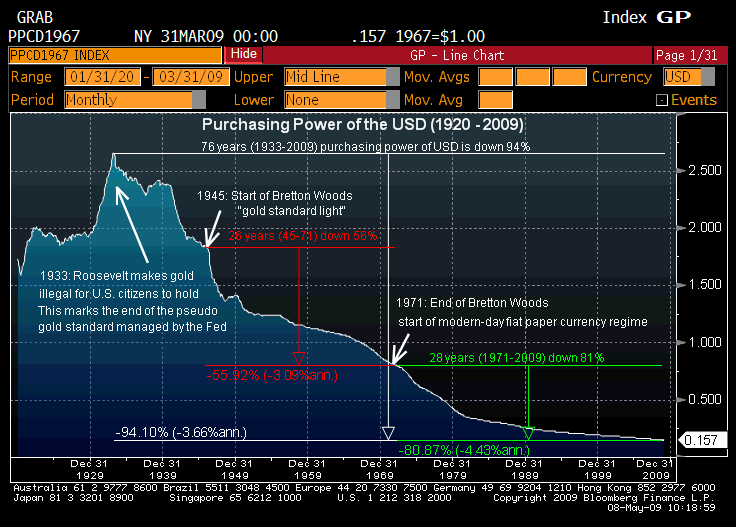
I think most Americans are underestimating what having the world's reserve currency means. One analogy I might make is of a token system (think of, for example, Chuck E Cheese where tokens, not coins, are used to operate games). There are certain transactions, like oil, where transactions are typically priced in dollars. This artificially creates demand for dollars. The US basically is an implicit middleman. Of course, we also have goods and services for sale in dollars. Before Nixon in 1971 took the US off the gold standard (other countries were concerned the US was trying to print its way out of deficits and wanted to convert their dollars into gold), gold was in theory or fact the world's common currency. In fact, the Fed's attempts to defend the dollar by raising interest rates (lessening demand for gold conversion) is thought by monetarist critics to have exacerbated the Depression; higher interest raised the cost of doing business in a weak economy and hurt bank margins and loan demand. Notice the purchasing power of the dollar began to weaken after FDR outlawed gold ownership and the dollar was devalued by raising the price of gold in dollars for international trade settlement.

Courtesy of Seeking Alpha

The rest of the world is not fooled by the Fed's easy money policies; even if the Fed allows 2% inflation a year, that means losing nearly half the value in a dollar over the coming generation. It is important not to be distracted by the even worse prospects of the euro and yen over the near term. Anything that slackens demand for dollars, like direct currency exchanges, is not good for its purchasing power. Iran has been seeking alternative barters with its trading partners, India and Japan directly exchange, and China has announced a number of arrangements including Russia, Brazil, and most recently Australia. I've also mentioned how several central banks have been building up their gold reserves (an alternative to holding dollars).

Musical Interlude: My Favorite Groups

Earth, Wind & Fire (with The Emotions), "Boogie Wonderland"

Sunday, September 30, 2012

Miscellany; 09/30/12

Quote of the Day
The real voyage of discovery consists 
not in seeking new landscapes 
but in having new eyes.
Marcel Proust

Regulation and Moral Hazard

I've embedded the below New Zealand-based video before contrasting traffic flow at the same time of day, the one on the left after a power failure. Consider the following example from  Niels Jensen:
Maybe we should learn from the lessons learned in the Dutch town of Drachten. A number of years ago the local council took the seemingly drastic step of removing all traffic lights, most road signs, lane markers and other devices designed to control the traffic flow through the city centre.
The result? The local residents complained at first because they felt less safe, which was exactly the objective of the exercise. When you feel less safe, you slow down and you seek eye contact with your fellow drivers and pedestrians. The experiment has since been repeated elsewhere and the result is the same – a dramatic reduction in the number of accidents everywhere the ‘naked street’ approach (as they call it) has been introduced.
What if we didn't know the government guaranteed our deposits, a loan, or mortgage-based security? As a consumer I would do due diligence, for example, I would want to ensure an MBS was geographically diversified with a preponderance of conventional collateral backed loans.  For other things, I might look at things like ownership stakes and tenure of operations and management, independent audits,  membership in industry or business groups (e.g., Better Business Bureau), prominent customers, depositors, vendors, etc.


Wednesday Night

On Sunday talk soup (e.g., MTP), there was the typical political posturing before this week's first Presidential debate, e.g., the Obama side trying to play down expectations by praising Romney as an experienced debater whom has been preparing 6 years for this debate while Obama has been busy running the country, pointing out incumbent challengers have generally done well (e.g., Mondale and Kerry).

Let's cut through the spin. Obama is trying to play out the clock. he's going into prevent defense; he has 2 major objectives: (1) avoid a Gerald Ford-like gaffe and let his mainstream media allies come away with the takeaway Obama held his own and Romney didn't land a punch, and (2) Obama will try to provoke an un-Presidential reaction, e.g., Gore's disrespectful sighs and in-his-face approach of George W. Bush. Romney has shown a tendency at times of letting his opponents getting under his skin, e.g., his notorious bet with Gov. Perry, and I remember a 2008 debate when McCain made a comment about Romney cutting jobs while with Bain, and provoked a reaction. So i fully expect for Obama to try to land some parting jabs, several are predictable--his notorious flip-flops, his jobs record in Massachusetts as governor, his  Bain experience, trying to buy the Presidency, etc, I wouldn't be surprised to see Obama try to score points on the Akin and Libya 9/11 memo PR debacles, etc. Romney can try to preempt these moves,what he can't afford is to come across as overreacting, defensive and distracted; This would be a good time to have a good "there he goes again" line (might I suggest "we're in the new TV season and Obama is already in negative summer ad reruns")

In addition, Romney should be able to exploit Obama's inaccessible,  rambling rhetoric.and Romney should preempt Obama's cherry-picking predictable nonsense. e.g., 29 months of underwhelming private sector job gains, the slowest job recovery in decades: xx straight months months of 8-plus unemployment., labor force participation rate, anemic GDP growth,  etc.

Don Boudreaux, "Deflating arguments for inflation": 
THUMBS UP

Wages are often sticky downward. think, for example, of teacher unions where longer-tenured, more expensive teachers in a seniority-based system would rather throw junior teachers under the layoff bus rather than to share in compensation an/or work rule austerity measures.

But Keynesians often prefer a little inflation in a challenged economy. Why? Because unlike compensation adjustments, inflation is more of a stealth wage cutter. in the long run, in an inflation-bound economy. workers will demand catch-up adjustments.The real (inflation adjusted) cost of labor falls providing employers with an incentive to hire. As more workers are employed and expand spending, we have a virtuous cycle driving the economy.

Now let's look at the Fed which exercises a government-sanctioned monopoly control over the money supply, presumably in the public interest. it has the power to debase currency.
Boudreaux offers some key takeaways
  • "History offers powerful evidence that this trust [in the virtuous Fed]is misplaced. Since the Fed was created in 1913, the dollar has lost 96 percent of its value. By comparison, during the 123 years prior to 1913, the dollar’s value fell by a mere 8 percent."
  • "Another problem with using inflation as a “countercyclical tool” is that it initially transfers wealth from creditors to debtors. Debtors repay their loans with dollars worth less than the ones that they earlier borrowed."
  • "In addition, because rates of inflation are impossible to predict with any precision, an inflationary policy introduces unnecessary uncertainty into the economy. Households, businesses and investors have to do more guesswork about the future. This added uncertainty is extra drag on the economy."
Don doesn't even mention the non-virtuous transfer of wealth from savers or the distorting effects  on future consumption. for example, during the Internet bubble,  customers accelerated IT purchases from the early Bush years,placing market-distorting redundant orders to ensure fulfillment. During the late 1990's, we had unsustainable asset prices, capital gains and relevant tax revenues.

There's also the Fed's dual mandate of price stability and full employment (particularly the latter); given the preference of incumbent politicians for easy money policies (consider the recent announcement of QE3 by Bernanke during the general election campaign even as Romney warned against it and said he wouldn't reappoint Helicopter Ben Bernanke) .

 "Throughout its history, even up until the current times, the Federal Reserve has continuously succumbed to political and special interest group pressures, and often at the most inopportune times. Existing empirical evidence on the independence of the Federal Reserve, while suggestive of a compromised Federal Reserve, fails to adequately capture the extent of influence of political and special interest groups (Boettke and Smith 2012)."

Reflections on Dodd N. Frankenstein
Why the Dems Forgot the GSE's
Barney "let's roll the dice" Frank vs "Safety and Soundness". 
In a House Financial Services Committee hearing on Sept. 25, 2003, Frank told the committee,” I do think I do not want the same kind of focus on safety and soundness that we have in OCC [Office of the Comptroller of the Currency] and OTS [Office of Thrift Supervision]. I want to roll the dice a little bit more in this situation towards subsidized housing …”
Who failed worse: the crony bankers or House Dems? Maybe if MD Governor O'Malley wins his crony-casino expansion Question 7, Frank will open the new casino by rolling the honorary first dice....

Listen closely to the moderator Anthony Randazzo at the end when he distinguishes between regulation and government-run regulation (which is intrinsically incompetent and ineffective).


Entertainment Potpourri

I seriously doubt that entertainment moguls read a political blog .

Since I'm endorsing Linda McMahon to succeed Lieberman, I thought I would say something about pro wrestling/sports entertainment with prearranged outcomes. I never cared for a number  of Vince  McMahon decisions, e.g., he botched the acquisition of WCW; he booked the talent into jobbing to WWE regulars which undermined the promotion, I would have revamped Nitro and maintained the key PPV''s.  Right now the John Cena character is a stale babyface character but McMahon refuses to turn him heel because his merchandise sells. Current plans seem to be to have Punk job to occasional wrestler/actor The Rock early next year and have Rock job back the title at Wreslemania, maybe in a triple threat match with Punk and Cena.  I don't know how many times they can rerun CM Punk-Cena. Punk and Daniel Bryan are both great characters and technicians, a natural tag team. I would also pair the similarly condescending  Cesaro and Sandow characters ("the Elitists"). The "AJ as GM" angle is annoying; her roles as  a wrestler romantic interest and as a slightly deranged petite female wrestler are more entertaining.  For  the competing TNA promotion Bobby Roode is the best heel character I've seen in years; it was a mistake to take the title off him.

I haven't reviewed new series on CBS, NBC or Fox yet, although I have found new NBC comedies "Animal Practice" and "Guys with Kids" amusing so far.  I disdain abstract art, so seeing a snob paying $300 for a monkey's original was hilarious.

"Revolution" is interesting. The storyline is something has caused all electrical sources (including car batteries) to fail simultaneously. the de facto authority is a roving militia and American flags are seen as part of an outlawed resistance. It seems mysterious amulets can revive some devices like secret  communication terminals.

The CW is reviving one of my favorite series from the late 80's "Beauty and the Beast". In the original series , Catherine, an attorney, is viciously attacked and Vincent, a man with feline characteristics, saves her from further attack and brings her to recuperate from her injuries at his secret shared home under the metropolis streets   I have only seen the excerpt tease below.


Musical Interlude: My Favorite Groups

ZZ Top,"Gimme All Your Lovin"

Thursday, August 2, 2012

Miscellany: 8/02/12

Quote of the Day
Nothing in the world can take the place of persistence. 
Talent will not; nothing is more common than unsuccessful men with talent. 
Genius will not; unrewarded genius is almost a proverb. 
Education will not; the world is full of educated derelicts. 
Persistence and determination alone are omnipotent.
Calvin Coolidge

Out of the Mouths of Babes...

Obama seems to be in an oddly obsessive competition with George W. Bush; it took Bush 8 years to almost double the national debt; it took Obama less than 4 years to double the public-held debt. At this point of the 2004 campaign, Bush had 79 fundraisers; Obama has had 160.

The President tells a joke (from IBD, my edits):
This young couple was at a campaign event with their adorable four-year-old son and pointed at a picture of the President. "They said, 'Sammy, who’s that?' And he said, 'That's Barack Obama.'  'And what does Barack Obama do?' And the boy thinks for a second and he says, 'He approves this message.'"
If only Obama spent as much time and effort exercising leadership as he does working on his reelection, his fundraisers, his vacations, his golf games, his polarizing boring speeches, etc....

I Don't Claim Credit But....

I independently coined a term for the Democratic Financial Reform Law, i.e., Dodd N. Frankenstein, which I have repeatedly used for several months now. I realize that with 2319 pages of regulations and  a Congressman named Barney Frank, it doesn't require that much imagination to come up with 'Frankenstein', but the first time I ever heard another party use a similar term was IBD on a recent podcast: Dodd-Frankenstein Strangling Economy On Second Anniversary.

A Pet Peeve: Disingenuous Progressive Rhetoric,
The Freeloader/Free Rider and Mandatory Insurance

Okay, I'm officially annoyed. Democrats, who in general tend to be grossly incompetent on matters of business and economics, have gleefully drafted off Romney's defending tax/penalties for insurance mandates as a strategy for dealing with freeloaders/free riders and thus reinforcing individual responsibility.

Romney and Gingrich trace their support for the mandate concept to a 1989 Heritage Foundation piece. (The Heritage Foundation is a conservative think-tank which I have often referenced during the history of the blog.) The Heritage Foundation had advocated a mandate in crafting a market-based alternative to Democratic attempts to nationalize health care.

[Heritage has responded to opportunistic (unprincipled) attacks by progressives in the wake of the emerging consensus against purchase mandates by saying, among other things, RomneyCare/ObamaCare differ significantly from their proposals (e.g., comprehensive vs. major medical (i.e., catastrophic)), the use of an incentive, not a penalty; etc.) and there have been developments in behavioral economics and risk adjustment over the past 2 decades.]

Why would a conservative organization suggest a mandate? Because of dysfunctional regulatory policies which effectively enable some policyholders to insure below their costs and restrict pricing/underwriting flexibility; these costs get passed along to other policyholders, including healthy people whom rarely use medical services. As price increases, demand shrinks (e.g., more profitable healthy policyholders elect to self-insure). The insurance business becomes a vicious circle of poorer risks and insurance companies can't cover their costs.

The insurance industry has a come-to-Jesus moment with a clueless, regulation-happy, "you're stuck with the unsustainable cost burden of our policies" progressive government:

"Look, your absurd regulatory policies make for an unsustainable business model. You have one of three options:"
  1. repeal the unsustainable, dysfunctional policies (e.g., community rating, guaranteed issue, comprehensive benefit mandates, etc.) [our preference]
  2. reimburse us directly for the additional costs of high risk policyholders
  3. reimburse us indirectly through your coercive powers, i.e., a purchase mandate requiring self-insuring individuals to purchase insurance above their own costs 
There is NO INDUSTRY REASON for pursuing a mandate if the self-insuring/uninsured people are unprofitable under existing regulations.

That's why Milton Friedman (below) and other rational people, including myself, HAVE CALLED FOR REPEALING TAX EXPENDITURE POLICIES (i.e., TAX-EXEMPT BASIS) FOR HEALTH INSURANCE. Granting people tax exemptions for health care is sort of like giving everybody entering a race a blue ribbon: who do you think you're fooling? If everybody has a tax break, nobody has a tax break, because government has to make up the revenue elsewhere. While people have been focusing on the tax/penalty (i.e., Chief Justice Roberts' opinion), the fact is that people get charged either directly (e.g., the tax penalty) or indirectly (through above-cost insurance, probably with after-tax dollars)

I point this out because:
  • from an equal protection basis, the self-insured are entitled to their fair share of government subsidies.
  • it's patently absurd to scapegoat the (before RomneyCare) 7% (Massachusetts) - 16% of the population uninsured for the health care cost bubble. Catastrophic health conditions are spread across the population.
  • a considerable portion of the uninsured are eligible for existing government programs (e.g., Medicaid) and/or are low-risk young adults whom rarely use medical services and if and when they do, pay them out of pocket. 
  • self-insured people do assume some of the relevant system costs (including makeup costs for government program participants) through out-of-pocket transactions for medical services, just like every customer of a retail store indirectly shares some of the costs of merchandise theft, etc.
Do an Internet search on 'Heritage' and 'freeloader' and you'll see entries like "GOP: Defenders of the Freeloaders". Let me quote former Speaker Nancy Pelosi from a month ago on MTP:
It's not a tax on the American people -- a tax, it's a penalty for free riders.  Those who want to be free riders have to pay their -- they either have to take responsibility and buy insurance, and there are many ways for them to do it, or they get, they get a penalty.  And the penalty, yes, it is charged under the tax code. The penalty is on people who have the wherewithal but refuse to buy health insurance, figuring they won't be sick and if they do, other people will have to cover it.  So these free riders, as they were identified by Governor Romney himself, he said people have the ability to pay and don't -- can't expect to be free riders. And I think that he termed it exactly right.  These free riders make health insurance for those who are taking responsibility, making it more expensive.  Personal responsibility is a principle of our country. 
Oh, yeah: the Democratic Party, responsible for up to 2 years of morally hazardous generous unemployment payments, welfare transfer payments, food stamps, public housing, low/no collateral for home mortgage loans, and 1001 other government freebies, is all about individual responsibility. So let us summarize here:
  • the Democrats, whose Medicare/Medicaid program payments are generally below market costs and subsidized by private-sector plans, are talking about "freeloaders"
  • the Democrats subsidize those whom are covered under employer or government plans at the expense of other taxpayers, and yet they have the audacity to talk about "freeloaders"
  • the Democrats exacerbate costs through third party systems, competition-killing regulation, gold-plated benefit mandates (each creating their own set of freeloaders) and pass along their costs to captive taxpayers having to pay for their own medical costs out of after-tax money:  these are "freeloaders"?
  • the Democrats have an income tax system where half the workers do not pay a single penny towards ordinary government expenses. Not a dime for national defense or any other operational government service--but these aren't "freeloaders"?
As for Governor Romney: let's be honest. He's putting lipstick on a pig. He was facing an 85% Democrat Massachusetts state legislature which could and often did override his veto: including several on RomeyCare itself. Governor Romney faced two big problems: (1) he successfully blocked more Draconian statist solutions; (2) he was dealing with a Bush Administration threat to cut off hundreds of millions in Medicaid, which would have blown his budget wide open.

Romney wants credit for fashioning a popular bipartisan achievement, which he can rightly contrast to the highly unpopular ObamaCare law which passed without a single Republican vote; he rightfully deserves kudos for basically driving a market-based alternative, certainly not a Democratic plan. From a standpoint of political strategy, it was a brilliant masterstroke.

I am highly amused by Democrats, without a single, creative thought on their own, deciding to imitate, on the surface level, a more statist alternative to RomneyCare, think that they have boxed in Romney. If I was Mitt Romney, I would say something to effect: "The Democrats like to talk about RomneyCare. Well, I know RomneyCare well:  I was in my office alone when it came to designing RomneyCare, and I got RomneyCare passed. And I can tell you this: ObamaCare is NOT RomneyCare. Why should voters reelect a man whom wants to be like Romney, when they can elect the REAL Mitt Romney instead?"

But let's be clear: RomneyCare is not a panacea. Massachusetts has among the highest health insurance policy costs in the country. It's harder to find doctors. Costs have blown past projections; Governor Patrick has resorted to various schemes (like denying eligibility to new immigrants) to cut down costs.

In my view, RomneyCare is a failure because it fails to address the real issues: it distorts the free market in health care by perpetuating unsustainable regulations and benefit mandates. All RomneyCare and ObamaCare do is advance in a more stealth fashion a statist government takeover of the sector. The real solution is to restore the free market to the health care sector. Romney failed to do that, but I do not underestimate the difficulties of implementing legitimate free market reforms in progressive groupthink states like Massachusetts.

This week, given Milton Friedman's centennial birthday, I hadn't seen a piece that he wrote for the Hoover Institution back in 2001 on How to Cure Health Care until now, but he raises some of the same issues I've repeatedly mentioned: policyholders not vested in purchase decisions (third party), government subsidies through pretax basis, ordinary vs. risk-based expenses, catastrophic (not comprehensive or what I call "gold-plated" insurance):
We generally rely on insurance to protect us against events that are highly unlikely to occur but that involve large losses if they do occur—major catastrophes, not minor, regularly recurring expenses. We insure our houses against loss from fire, not against the cost of having to cut the lawn. We insure our cars against liability to others or major damage, not against having to pay for gasoline. Yet in medicine, it has become common to rely on insurance to pay for regular medical examinations and often for prescriptions.
A cure requires reversing course, reprivatizing medical care by eliminating most third-party payment, and restoring the role of insurance to providing protection against major medical catastrophes. The ideal way to do that would be to reverse past actions: repeal the tax exemption of employer-provided medical care; terminate Medicare and Medicaid; deregulate most insurance; and restrict the role of the government, preferably state and local rather than federal, to financing care for the hard cases. 
Be still, my beating heart. If a woman I dated said such things... I've been REPEATEDLY saying the same things independently of Friedman or others.

Interesting Pro-Romney Blog Comparison
of ObamaCare / Romney Care

NB: This blog OPPOSES both RomneyCare and ObamaCare.

Courtesy of Virginia Virtucon
Musical Interlude: My Favorite Groups

The Four Seasons, "Big Girls Don't Cry"

Friday, July 27, 2012

Miscellany: 7/27/12

Quote of the Day
This is the worst pain a man can suffer: 
to have insight into much and power over nothing.
Herodotus

Reflection on Today's Quote

Plus ça change, plus c'est la même chose.

I don't mean to borrow fellow Franco-American Don Boudreaux's (Cafe Hayek) signature tagline, but it's so true. I've had to battle office politics in academia and in the private sector to do the right thing; I've rarely had formal authority, within an organization or with a client, to compel others to my point of view. 

I'm an optimist by nature, but there are a few things that are fairly clear:
  • We will never close $40+T in unfunded senior entitlement liabilities; the GOP never will have the stomach for the kinds of politically tough decisions necessary because the Dems will argue to seniors that they are for "saving" the unsustainable programs.
  • We will never pay off the national debt. It's difficult to see economic growth robust enough given the ongoing regulatory regime. I don't see the political will to impose across the board spending cuts, strip out tax preferences and expenditures. I suspect that the Fed Reserve will try to monetize the debt and destroy the dollar in the process.
  • The government spending bubble, the college cost bubble, and the health care bubble are unsustainable. 
  • Individual liberty is permanently impaired
I won't go into a long explanation here, but let me point out a few examples to make my points:
  • Even Paul Ryan's more "Draconian" approaches phase e.g., in entitlements, phase in serious cuts over time. 
  • Mitt Romney is talking about increasing, not decreasing, the 20% or so of federal spending for DoD. Furthermore, he's not talking about cuts in senior entitlements. When 80% of the budget is off-limits, it's difficult to see where the cuts are coming from.
  • Fear-mongering continues to drive us down the road to serfdom. If you look at recent votes on the Patriot Act and cybersecurity, pro-liberty Congressmen votes run to maybe a dozen or two out of hundreds.
Is there a way to turn things around? Yes. But it would require new leadership that is less preachy, more optimistic and more pragmatic, able to build a winning coalition, sort of a new age libertarian-conservative Ronald Reagan.  (I mourn the fact of President Reagan's handlers and what might have been given Reagan's professed libertarian/conservative principles.)

I think just like Obama's personality soft-sells his dubious progressive philosophy, Reagan's charisma, optimism and trademark humor soft-sold the conservative message better than his ideological predecessor, the dour Barry Goldwater. But there are flaws to Obama's selling of progressive philosophy: he initially made his sale on his optimism ("Yes, we can!") but then he had--and continues to have--a blindside to the toxic, unattractive aspects of his personality, e.g., the unprecedented attacks on his predecessor and the Supreme Court, his condescending attitude towards people whom disagree with him (e.g., the "cling to their guns and Bibles" moment), his ultra-defensiveness and unwillingness to accept responsibility (except for killing UBL),  etc.

Gary Johnson comes across as this generation's Barry Goldwater--good on principle and performance, but rather judgmental and not inspirational. There are some things that Ron Paul and/or Gary Johnson have said that have been unduly provocative and divisive (e.g., foreign policy in the lead up to the 9/11 tragedies).  I think it's enough to simply note that foreign meddling is expensive, is unsustainable, and has unintended consequences, not unlike counter-productive government invention in the economy. Speculation about specific events is unnecessary and unhelpful.

What does a new libertarian leadership need to have? A gifted orator with unfailing optimism, speaking of the possibilities of individual liberty, freed from the tyranny of meddlesome self-sustaining stealth empire-building crony government.

What is Wrong With Mitt Romney?

On paper, Mitt Romney may well be the smartest guy to run for President over the past 60 years. Very few people hold both a Harvard Law degree (with honors) and a Harvard Business School MBA (graduating in the top 5% of his class). 

In fact, I would say right now, despite what many polls say (with Romney behind in almost every electoral projection I've seen and slipping a bit in battleground state polls after saturation anti-Romney ads), the Presidency is Romney's to lose. Why? We've seen 3 incumbent Presidents defeated for reelection over the past 4 decades: Gerald Ford, Jimmy Carter, and G.H.W. Bush. In each case, we saw a recession within a year or so of the election.

We aren't in a recession technically: we have had, as any Dem talking head will dubiously remind you, an unbroken string of private sector job gains (since September 2010: see below). (You want to see a Democrat sweat? All it takes is a single month to break that streak--and many months in that streak have been below growth in the labor force.) Looking at the data, we see a familiar pattern--a trio of reasonably strong months--March through May 2010,  February though April 2011, and December through February 2012--only to see job growth slump to slump to 3 or more consecutive months of sub-100K job growth. It's almost like a sputtering engine with a weak battery; the engine strains to turn over but eventually stalls; you repeat and the same result. You know the battery is dying and maybe the next time you turn the key, all you'll hear is the dreaded click, click, click.

BLS Total nonfarm
YearJanFebMarAprMayJunJulAugSepOctNovDecAnnual
2002-129-146-24-84-947-100-11-551218-163
200395-159-213-49-9025-4510919714119
200416244337249310814612216134863134
20051372401413601702433741936680334160
20062833162831811476209183157-9204171
2007236931907213975-40-18737911289
200841-84-95-208-190-198-210-274-432-489-803-661
2009-818-724-799-692-361-482-339-231-199-202-42-171
2010-40-35189239516-167-58-51-27220121120
201111022024625154849685202112157223
20122752591436877(P)80(P)
P : preliminary
I think under ordinary circumstances that the power of the incumbency would be almost impossible to overcome, particularly with a personally popular incumbent, like Obama. But the other side of the coin is the unemployment rate, and Bush's worst month prior to Obama's election in 2008 (which I hold is the relevant point because at that point employers were factoring an Obama Presidency) was 6.5%. Obama's best month since he took office is 8.1%--and that was achieved only through a statistical gimmick, because a large number of discouraged job seekers left the official labor force. During all this time, Obama has set a record for government expenditures, and the Federal Reserve has maintained an unprecedented stretch of near-zero interest rates--during the ENTIRE stretch of the Obama Presidency. Even the most ardent Obama fan has to wonder: what is Obama going to do in a second term that he hasn't already done? Certainly he would have implemented relevant policies, especially when he carried almost unprecedented majorities in both chambers of Congress. What is he going to argue? He has a "secret plan" for the economy that he's been waiting to implement after the election? His only plans have been to spend and regulate more and more...

YearJanFebMarAprMayJunJulAugSepOctNovDecAnnual
20014.24.24.34.44.34.54.64.95.05.35.55.7
20025.75.75.75.95.85.85.85.75.75.75.96.0
20035.85.95.96.06.16.36.26.16.16.05.85.7
20045.75.65.85.65.65.65.55.45.45.55.45.4
20055.35.45.25.25.15.05.04.95.05.05.04.9
20064.74.84.74.74.64.64.74.74.54.44.54.4
20074.64.54.44.54.44.64.74.64.74.74.75.0
20085.04.95.15.05.45.65.86.16.16.56.87.3
20097.88.38.78.99.49.59.59.69.810.09.99.9
20109.79.89.89.99.69.49.59.69.59.59.89.4
20119.19.08.99.09.09.19.19.19.08.98.78.5
20128.38.38.28.18.28.2
So I think that Romney has a powerful story to tell as a highly successful businessman whose company was involved in a number of different areas of the economy, whom has dealt with struggling businesses and a struggling state. The Obama campaign is desperately trying to impeach that story, attempting to cast doubt on Romney's job creation credentials at Bain Capital or Massachusetts (where Gov. Romney had to deal with an 85% Democratic state legislature and a high tech state which was particularly affected by the Nasdaq stock collapse in 2000-2002.). However, the fact of the matter is that Obama didn't have ANY private or public sector administrative experience--and the economy has struggled over the entirety of his term.

The point is: the 2010 elections didn't go far enough: the Democrats are playing defense in the Senate and White House. The country knows that the stimulus didn't work as claimed; is the electorate really going to blame the GOP when their policies have been stymied by the opposition? I think it all boils down to whether they think Obama will do something different in a second term than a first term; in the meanwhile, long-term unemployment hasn't improved; our national debt now exceeds the size of our economy for the only time since WWII; the credit rating bureaus have already started downgrading our debt for the first time ever; the retirement tsunami of Baby Boomers has already started, and already we have scores of cities and states dealing with chronic pension problems.

I think every voter out there knows that if they have to watch their budget during tough times, so must the government. The budgets submitted by the President and the Senate Democrats have been a joke. They haven't even proposed something as simple as a 3% spending cut across the board. We are paying hundreds of billions in interest payments--with record low interest rates.

Will voters really reelect Obama because of an executive order here, another empty promise there or attack ads on Romney? In fact, despite Obama's waves of negative ads, Romney has continued to split national head-to-head polls, with a large number of Americans whom really don't know much about him. This will change over the next 4 months.

But I've been absolutely baffled by Romney's campaign, political posturing, gaffes and stumbles. Let me be specific:
  • Romney has been utterly clueless in symbolism and unforced political errors. For example, he was recently quoted questioning London's preparations for the Olympic games and in the process started a kerfuffle. I have no idea why he would even go there. Next, Romney knows that the Obama campaign is trying to stereotype him as having been born into wealth and privilege: why in the world would you have photo opps on jet skis? Multiple homes, cars, elevators for cars, etc.? Jokes about plant closings? Now, granted, Obama has stepped into it himself with the "you didn't build that" sound bite, the "spread some wealth around" moment of the 2012 campaign.  (I haven't reviewed Romney's response, but I would have had a Lloyd Bentsen moment like, "Mr. President, I was there when we started Bain Capital from an initial seed investment of $X million and YY employees and no clients--and I built the business to XXX clients, YYY employees, and ZZZ millions of dollars of business; the government didn't do that: I did it with the assistance of a number of other professionals.") You should never have a contradictory message coming out of the SCOTUS ObamaCare decision, given the fact the Dems are trying to link ObamaCare to RomneyCare. A lot of this is just plain common sense--and I'm not even a politician. If you're going to get your picture taken, do it at a state fair, throw out the first pitch of a baseball game (but, for God's sake, don't let the Dems catch you singing "God Bless America" during the seventh-inning stretch), go to a Boy Scout jamboree, go deer hunting, etc.
  • Romney has failed to posture himself effectively. Romney is a successful businessman, a capitalist. From a first principles perspective, he should be similar to me: a commitment to free trade and free markets, against crony relationships between business and government, for immigration. Instead, he's out there bashing China and taking a hardline on immigration which is absolutely lethal in terms of outreach to Latinos.(You would have figured that he's seen what has happened to the GOP in California over since Pete Wilson's scorched earth policy on immigration...) There are ways to criticize Obama on the issue (I've outlined some steps) without making it seem like the GOP wants to crack down on nannies, maids and gardeners or split families apart. Romney could talk about American universities training young professionals to compete against us, because they can't stay in the country after they graduate. Romney could talk about farmers unable to get migrant worker labor they need because unions block visiting worker programs.
But it goes beyond that. For instance, Romney could position himself against Obama by arguing for a more restrained foreign policy, he should contrast himself from the Bush/Obama legacy of low economic growth, government interventionist policies, foreign meddling and nation building, etc. Romney could take a position critical of the Fed--recall, Obama renominated Ben Bernanke. Romney had to notice how Ron Paul drew strong, almost fanatical support; he should trying to forge a coalition with Ron Paul supporters rather than to maneuver to the right of Rick Santorum populism.
  • Romney needs a simpler, consistent message.  Romney had a hard time putting away a fairly weak field in the primaries (his strongest competitors were a senator whom lost reelection by a landslide in a purple state and a former Speaker reprimanded by the Congress and with ties to the GSE's) and comes across as unprincipled. Voters' eyes are going to glaze over when he talks about a 59-point plan. He needs to wrap himself around themes like: individual responsibility, not government responsibility; Obama talks bipartisan--I deliver bipartisan; simplify taxes; the government should think before it spends; stop taxing the next generation with deficits; no more government deals for businesses and unions; etc.
Maria Bartiromo v. Barney Frank: 
Democrats and Half-Baked Policies

I think one of the most amusing consumer product categories out there are half-baked goods (pizza, pies, etc.) (as if baking for several minutes in your own oven makes it your own!) What is utterly amazing is how the 111th Congress managed to pass two bills with thousands of pages between them (ObamaCare and Dodd N. Frankenstein) and you STILL have bureaucrats pumping out regulations not in them. "Let the HHS Secretary decide this, that, and the other thing." Simply OUTRAGEOUS! Congress shouldn't be delegating SQUAT!

I have to say: does life get any better than watching a beautiful, smart woman like Maria Bartiromo put Barney Frank in his place? Be still, my beating heart...  Barney probably went home crying on the shoulder of his newlywed husband...

So here's Russ Roberts of Cafe Hayek on the situation:
The entertaining part is the arguments they get into. The illuminating part is that TWO YEARS after Dodd-Frank passed, its provisions are not completely specified. Frank resents the claim that it’s not even half done, but that’s quibbling. The point is that two years after this legislation passed, its provisions remain incompletely unspecified. What the heck is that about? There is no way to measure the impact of this kind of uncertainty on the economy in the middle of a recession with any precision, but it’s not a good thing. We’re not talking about the uncertainty of what the consequences are of the legislation. We’re talking about the uncertainty over what’s in the legislation.
So we wait a while to see, along with Nancy Pelosi, what's in the legislation. The key question is: how can a politician ethically vote for blank check legislation?


Political Humor 

"President Obama hasn't met with his jobs council in over six months. You know the reason? They're all out looking for jobs." –Jay Leno


[They still haven't found anything for him to do after the election this November.]

 Germany has opened a new hotline that lets people call in and yell curse words at strangers on the other end. We have something similar in America. It's called Time Warner customer service.  - Jimmy Fallon


[So THAT'S why all those Germans have been calling and screaming at me in the middle of the night... I should have known better than to criticize Chancellor Merkel in my blog.]

Musical Interlude: My Favorite Groups

Blondie, "Dreaming". I can still remember driving on a San Antonio freeway at night, playing this tune full volume with the windows down.... Brilliant vocal and I love the driving percussion in the arrangement. One of my two favorite Blondie tunes (the other being "Atomic")