Analytics

Saturday, September 6, 2014

Miscellany: 9/06/14

Quote of the Day
There are two types of people in this world, good and bad. 
The good sleep better, 
but the bad seem to enjoy the waking hours much more.
Woody Allen

Chart of the Day

Exhibit 1
National Health Expenditures (NHE), Amounts And Annual Growth From Previous Year Shown, By Spending Category, Selected Calendar Years 2008–23
Spending category 2008a 2012 2013 2014 2015 2019 2023
Expenditure, billions
NHE $2,411.7 $2,793.4 $2,894.7 $3,056.6 $3,207.3 $4,042.5 $5,158.8
 Health consumption expenditures 2,257.3 2,633.4 2,735.1 2,893.3 3,040.8 3,834.0 4,891.3
  Personal health care 2,017.1 2,360.4 2,448.3 2,579.3 2,706.0 3,413.1 4,359.7
  Hospital care 729.0 882.3 918.8 959.9 1,008.5 1,276.1 1,637.7
  Professional services 652.8 752.3 776.7 822.7 856.8 1,077.4 1,369.1
   Physician and clinical services 486.5 565.0 583.9 618.5 641.9 805.2 1,023.8
   Other professional services 64.0 76.4 79.8 87.6 92.3 119.3 153.4
   Dental services 102.4 110.9 113.0 116.6 122.7 153.0 191.8
  Other health, residential, and personal care 113.5 138.2 145.6 153.1 161.5 206.9 267.1
  Home health care 62.3 77.8 81.5 86.2 91.7 121.5 162.3
  Nursing care facilities and continuing care retirement communities 132.6 151.5 156.4 162.3 170.2 215.6 271.4
  Retail outlet sales of medical products 326.9 358.3 369.2 395.2 417.3 515.6 652.3
   Prescription drugs 242.6 263.3 272.1 290.7 309.3 381.8 482.8
   Durable medical equipment 34.9 41.3 42.3 44.0 45.8 56.0 71.3
   Other nondurable medical products 49.5 53.7 54.8 60.5 62.2 77.8 98.2
  Government administration 29.4 33.6 35.1 36.3 37.8 50.1 66.7
  Net cost of health insurance 139.2 164.3 174.5 196.7 212.5 268.7 341.0
  Government public health activities 71.5 75.0 77.2 81.1 84.5 102.1 123.9
 Investment 154.4 160.0 159.7 163.3 166.5 208.5 267.4
  Noncommercial research 44.0 48.1 47.1 47.2 46.4 55.8 69.5
  Structures and equipment 110.4 111.9 112.6 116.2 120.1 152.7 197.9
Annual growth
NHE 7.1% 3.7% 3.6% 5.6% 4.9% 6.0% 6.3%
 Health consumption expenditures 7.0 3.9 3.9 5.8 5.1 6.0 6.3
  Personal health care 6.9 4.0 3.7 5.3 4.9 6.0 6.3
  Hospital care 7.2 4.9 4.1 4.5 5.1 6.1 6.4
  Professional services 6.4 3.6 3.2 5.9 4.2 5.9 6.2
   Physician and clinical services 6.4 3.8 3.3 5.9 3.8 5.8 6.2
   Other professional services 6.7 4.5 4.5 9.8 5.3 6.6 6.5
   Dental services 6.1 2.0 1.9 3.1 5.3 5.7 5.8
  Other health, residential, and personal care 7.0 5.0 5.3 5.1 5.5 6.4 6.6
  Home health care 8.8 5.7 4.8 5.7 6.4 7.3 7.5
  Nursing care facilities and continuing care retirement communities 5.6 3.4 3.2 3.7 4.9 6.1 5.9
  Retail outlet sales of medical products 7.6 2.3 3.1 7.0 5.6 5.4 6.1
   Prescription drugs 8.3 2.1 3.3 6.8 6.4 5.4 6.0
   Durable medical equipment 4.8 4.3 2.5 4.0 4.1 5.2 6.2
   Other nondurable medical products 6.3 2.1 2.1 10.4 2.7 5.8 6.0
  Government administration 6.4 3.4 4.3 3.4 4.3 7.3 7.4
  Net cost of health insurance 10.1 4.2 6.2 12.7 8.1 6.0 6.1
  Government public health activities 6.2 1.2 2.9 5.1 4.2 4.8 5.0
 Investment 7.8 0.9 −0.2 2.3 1.9 5.8 6.4
  Noncommercial research 6.4 2.2 −2.1 0.1 −1.7 4.7 5.7
  Structures and equipment 8.4 0.3 0.6 3.2 3.4 6.2 6.7
Image of the Day

Via LFC
Via Libertarian Republic
Via Joseph Dunlap
Tell Me Again Why the US is Intervening Against ISIS?
This group is perhaps 20,000 fighters possessing some artillery and armor but no air force. It is an island of tenuously occupied territory in a sea of hostile regimes — those of Saudi Arabia, Jordan, Syria, Iran, Iraq, and Iraq’s Kurdish region, which has its own regime. These command approximately 2 million troops who, with ample air power, can pulverize the Islamic State whenever the regimes summon the will to do so. - George Will
Remy Goes Live From Freedom Fest


Examples of Public Pension Exploitation at Taxpayer Expense
No other large municipal pension fund in the state is in such dire financial shape as the Jacksonville Police and Fire Pension Fund, which is $1.65 billion in debt and is so underfunded that the city’s bond ratings have suffered. Today, the average soon-to-be retiree is 48 and has put in 21 years; they are signing up younger and after fewer years worked. Out-of-control pension costs [are] currently costing taxpayers $153 million this year with an anticipated pledge of another $40 million a year for more than a decade  A guaranteed 3 percent cost-of-living increase annually and the ability to bankroll a separate pension — funds from his Deferred Retirement Option Plan account potentially paid by taxpayers — will allow Deal [Sheriff's office recent retiree; Deal’s top income earned when working was $109,221] one day to bring home twice as much money per year as a retiree as he did when he worked. A retiree’s DROP account is guaranteed to earn 8.4 percent interest each year [with the taxpayers making up any downside market offset: during the worst of the recession between late 2007 and late 2008, when taxpayers saw their 401(k) funds and stock portfolios obliterated, the Jacksonville Police and Fire Pension Fund had market returns of negative 16.12 percent.]. The DROP program allows police officers and firefighters with just 20 years of service the chance to put five years of future pension checks into what amounts to a secondary, high-interest retirement account while they continue to work and draw their regular pay. Deal is among a group of 16 July retirees who are guaranteed to turn $4 million in DROP benefits into $11 million in additional pension benefits. On top of his regular pension, Deal will draw more than $52,000 a year from his DROP account. As a senior-level employee, Deal was entitled to a pension of 80 percent of his average monthly salary of the previous two years. For 2015, Deal will have earned $153,045 in pension benefits between his regular $100,701 pension and $52,344 from his DROP account.
Ray Dean, police chief of the 2.9-square-mile village of Westhampton Beach, is getting $403,714 for 15 years’ worth — or 531 days — of unused sick, vacation and personal time. Dean, who is only 53, will collect an estimated pension of $142,000 a year. Dean was already a millionaire. He bought a house in Quogue for $1.3 million in 2005, owns a 32-foot boat, and his pay last year came to $226,236 — more than NYPD Commissioner Bill Bratton makes. But while Bratton oversees a force of 34,500 uniformed officers, Dean presided over 11 in a resort town of 1,700 permanent residents.
Some Healthcare Notes
Because health spending is projected to grow 1.1 percentage points faster than the average economic growth during 2013–23, the health share of the gross domestic product is expected to rise from 17.2 percent in 2012 to 19.3 percent in 2023... Supporters of centralized federal control of health care tout its supposed efficiencies. For that to happen, the costs of administration would have to grow at a slower rate than spending on actual health care. The opposite is happening. Government control of health care has grown well beyond its optimal span and scope.
 Goodman points out that while one anti-competitive restriction on economic freedom, i.e., unions, has lessened to just under 7% today, a fraction from the 1950's, another obstacle, occupational licensing, has expanded, correspondingly from 5% to about 30%. He notes that the stagnation in today's job market largely reflects 2 factors: the adverse effect of government tax/regulatory burden on small businesses and occupational licensing. Goodman traces how the AMA since its birth in the mid-nineteenth century has promoted public policies creating artificial shortages in physicians, including closure of for-profit medical schools and licensing. He points out workarounds to these constraints, including for-profit medical schools in the Caribbean countries, with highly qualified graduates who are accepted for rotations and residencies in the states. He argues instead of licensing, we should consider the alternative of certifications and let the market decide their relevance and importance.
Facebook Corner

(Being Classically Liberal).It seems as though most libertarians on social media adhere to Austrian economics, they're favorite economists are von Mises and Rothbard, their living hero is Ron Paul, and they consider themselves anarcho-capitalists based on their adherence to the non-aggression principle. Am I wrong, or do you think this is an accurate assessment?
Some subtle differences. I thinks most libertarians, including minarchists, accept the NAP. I think only Rothbard is in the AnCap category; many have put Friedman, Hayek and Mises in the fusion libertarian conservative category, including Ron Paul. I do think Ron Paul is seen as the most likewise principled libertarian politician, although a few active ones also enjoy a following, like Justin Amash, Mike Lee and Rand Paul. Tom Woods is probably the closest to what you describe; the historian, an AnCap, recently hosted "Ron Paul week" on his daily podcast.

(Independent Institute). This summer, twenty graduate students at the University of Virginia who participated in a cross-disciplinary course on the national debt created a 10-minute YouTube video to help their fellow Millennials better understand where it comes from and also the consequences of the national debt. Check out the video!
The video has a define "progressive" edge, particularly in the later aspects. It doesn't really discuss where to cut spending, it buys into "progressive" talking points on healthcare (e.g., administrative costs and international cost comparisons) and after pointing out nearly 60% of the budget is mandated individual benefits, argues there's not enough spending in certain areas because those nefarious corporations "buy" votes and youths don't get their fair share of the loot because they don't turn out to vote enough. Almost no discussion of rampant government waste, redundancy, and failed programs, that government spending and regulation is a drag on the rest of the economy, etc.

(We the Individuals). Never did I think I'd live to see the day where even "libertarians" were using the ol' "We gotta attack [enter terrorist group X ] over there so we don't have to fight [enter terrorist group X] over here" line as a justification for further war.
Rand Paul had a junior moment: he forgot what his dad taught him.

More Proposals


Musical Interlude: My Favorite Vocalists

Petula Clark, "Happy Heart". This is the end of my Petula Clark series; I'll start my Barry Manilow retrospective with my next post.

Friday, September 5, 2014

Miscellany: 9/05/14

Quote of the Day
To reach a great height a person needs to have great depth.
Source Unknown

Earlier One-Off Post: Top 10 Pet Peeves for Professors (My Edition)

Chart of the Day

gdpjobs

Tweet of the Day
Image of the Day

Via Being Classically Liberal


Kudos to the Cincinnati Bengals

 From Yahoo Sports:
The Cincinnati Bengals appeared to have moved on from former second-round defensive tackle Devon Still when they cut him this preseason. However, Still has had much bigger and better things on his mind than football. His 4-year-old daughter, Leah, was diagnosed with stage 4 pediatric cancer back in June. The Bengals re-signed him to their practice squad, and the $6,300 weekly salary and medical insurance will go a long way to help Leah.  As a member of the practice squad, Still will practice with the team but not travel. That means he has more time to spend by Leah's side.
Sweetie, you're a beautiful gift from God; my thought and prayers are with you. I hope that you feel better soon.

Eric Dondero and the Libertarian Republican Blog

Dondero is an interesting story, an ex-staffer for Ron Paul, who himself refers to Dondero as a fired, disgruntled staffer. (I read a lot on this kerfuffle; I will say that it doesn't take years for performance issues to surface.) You may recall during the Ron Paul campaign there was a kerfuffle over Ron Paul's involvement with newsletters bearing his name with some politically incorrect op-eds (which Ron claimed no knowledge of). Dondero came out with a piece on his former boss, suggesting Ron was uncomfortable with Spanish or gays. There were exchanges with a Paul spokesman Jesse Benton, and at one point around 2008 Dondero, who despises Paul's non-interventionist policies, wanted to run against Paul for his congressional seat. If Benton sounds familiar, it's because he had a high-profile in the McConnell reelection campaign and abruptly left the campaign in a shakeup around April. I only knew about the kerfuffle when Dondero made gleeful references to Benton's demise.

I will say that I am not comfortable with the blog's hawkish and nativist perspectives, but there is a kerfuffle on another libertarian blog critical of Dondero,  who responds and makes a compelling case of involvement with the Libertarian Party and standard libertarian positions on most domestic policies. Dondero is not a GOP shill; for example, Dondero will often vote for a Libertarian Party candidate if a GOP victory is expected (I believe he lives in the Houston area). One of the reasons I follow the blog is it does a lot on various tight domestic political races, and it often covers European and Australia/New Zealand politics.

Facebook Corner

(Being Classically Liberal). (F) "Unregulated Corporate Greed"
"Unregulated....."
This is what Progressives actually believe. They want greedy politicians to protect us from greedy businessmen. So adorable and humorous, but this is unfortunately why we can't have nice things.
The stupid hurts so hard...government can be bought..so make more government to fix it!
I call it the "vicious circle of corruption".

(Being Classically Liberal). (F) I'm not sure why this is so hard for Progressives and Democrats to understand. Politicians are in the business of dealing favors and making promises they can't keep.
BCL: Governments invade countries, kill innocents, and mess things up. So we need more government invasions.
The troll doesn't understand the concept of regulatory capture. Never mind the poster boy of regulation-banks--have never been unregulated. There were restrictions against banking that made US banks more volatile than Canadian ones without similar restrictions (unit banking, asset reserves).

As for the imbecilic reductionist argument, he doesn't understand that a leading cause of war is dysfunctional trade policies. Countries generally don't want to go to war with their trading partners. Usually war is divisive and decreases a nation's wealth. In a free market, corporations cannot rely on the government's monopoly of force to compete. Moreover, there are more potent weapons than incompetent regulators, i.e., transparency. He doesn't understand the concept of a vicious circle of corruption.


(Reason). We asked some prominent libertarian writers what they thought about Rand Paul's hawkish turn on ISIL. Here's what they said.
When I read Rand Paul's piece on Time, I went to Tom Woods' FB portal and commented "Rand Paul just f*d up." This is incoherent nonsense and no self-respecting libertarian buys into the gross flip flop. I would like to be there when Ron Paul takes Rand to the woodshed. I think just like George W took a lesson from his Dad's flip-flop on taxes, Rand doesn't want to the pinata of neocons in 2016, so I read this as a preemptive move on the imbecilic isolationist smear. He's running the risk of losing his core supporters, including me, with this nonsense.

More Proposals


Musical Interlude: My Favorite Vocalists

Petula Clark, "Don't Sleep in the Subway"

Top 10 Pet Peeves for Professors (My Edition)

Mark Perry of Carpe Diem spotlighted Dr. Wade's list ; I encourage readers to read the essay, but let me summarize her list for reader convenience:
  • Don’t use unprofessional correspondence
  • Don’t ask the professor if you “missed anything important” during an absence.
  • Don’t pack up your things as the class is ending.
  • Don’t ask a question about the readings or assignments until checking the syllabus first.
  • Don’t get mad if you receive critical feedback.
  • Don’t grade grub.
  • Don’t futz with paper formatting.
  • Don’t pad your introductions and conclusions with fluff.
  • Don’t misrepresent facts as opinions and opinions as facts.
  • Don’t be too cool for school.
Personally, I find these annoying behaviors but not necessarily my own pet peeves. I probably might tweak the following list if I thought about them longer, but this is a good start:
  • Eliminate "Is this going to be on the test?" from your list of questions. You are responsible for anything I present in class or assign, including the textbook, supplemental readings, and assignments.
  • Do not repeat another ask-and-answered question. You would be surprised how many times I've answered the same question just 5 minutes earlier.
  • Don't be overly familiar. As long as I'm your instructor, I prefer Dr. or Professor Guillemette. Unless a professor specifies otherwise, do the same for others; do not generalize any exceptions. This is not a Barbara Boxer moment; it's professionalism. In any professional gig or interview I've ever done, the first thing other professionals routinely ask is how I prefer to be addressed. I am not a fellow student or your drinking buddy; I'm your professor/mentor: be respectful.
  • Don't be obsequious. It's usually transparent and comes across as desperate and manipulative; in my case, it's counterproductive. For example, what flatters me as a researcher is hearing from a fellow doctoral consortium fellow from Wisconsin-Madison say that he raised my name with a fellow Illinois Institute of Technology professor and asked if he had ever heard of me; that tech communication professor described my articles on technical communication as "classics". On the other hand, when I was on a UWM PhD exam committee, the relevant candidate started out an office visit by telling me how he had read all my articles (as if I would vainly write an exam question over my own work!)
  • Don't say 'Professor X doesn't require such-and-such work in his course'. You would think I'm a parent fielding complaints from my teens over "unreasonable" dating/curfew/other family policies... First of all, it's not relevant to my requirements, which reflect my professional judgment. Second, I will not discuss Professor X in an unprofessional manner behind his back; if I have issues with Professor X, I'll address those differences directly and in private.
  • Don't ask me to intervene in a disagreement among students. This is particularly true in group projects; I've gotten complaints from students over others not pulling their weight, one student locking out another from their collaborative account, etc. Guess what, folks? Petty behavior often exists in the real workplace; learn to cope, sooner than later.
  • Don't make excuses. I don't want to hear how your hard drive crashed just as you were putting final touches on your paper. Most professors are flexible, e.g., with medical problems, weather anomalies, etc. One example: I had a final due date, just before finals, for computer assignments in the fall of my second year at UWM; there was a freak snowstorm on that day.  I personally walked to campus in knee-deep snow and fielded calls from students in a panic: I posted a 3-day extension on my office door.
  • Follow instructions. Some students seem to have a death wish in defying a teacher's instructions. An actual case in point: I once assigned a 2-page paper, double-spaced, inch margins. One student (no lie) turned in a 5-page, single-spaced, no margin paper. If I don't outright fail the paper, I would probably have the student redo it with a minimum one letter grade penalty. 
  • Don't procrastinate. In a programming class, I would try to spread say 4 or 5 computing assignments evenly through a semester, each handed out a full 3 weeks or so before the due date. During that 3 week period, I would regularly ask at the beginning or end of lecture if there were any questions about the current assignment. I would estimate maybe 80% would wait until the last 3 days before an exam or assignment due date before starting work and then panic and/or gripe over how "unrealistic" the assignment is.
  • Do your own work. Unless you are in a group project, I expect you to turn in your own effort; I personally caught several students at UWM and UTEP who had plagiarized, copy-and-pasting from the familiar unattributed published works of others and/or from each other. In many cases, we often recognize work inconsistent with prior work or exam performance; in other cases, it may be some recurring odd answer, say, for instance, a uniquely misspelled word.
Some Bonus Guidance:
  • Don't use me as a reference without my knowledge or consent.  In my first semester at UTEP, an MIS senior, who was taking her first class from me, listed me as a reference on her job applications. I later caught her and a fellow student in a clear-cut violation of my published academic honesty policy. She was in a state of panic, worried what I might say to any interested employer and then (under the theory the best defense is a good offense) filed a libelous claim with the gullible, unprofessional Dean of Students Office, irrationally and falsely alleging that I had threatened to blacklist her on the job market (in fact, I've never threatened a student; I had no local and few national recruiter contacts; I don't think in 3 years at UWM any student asked me to serve as a reference). I only knew about this when I got a cold call from the Dean himself, warning me "not to do it". What the hell are you talking about? "You know what you did; don't play innocent!" It was like being in the doghouse without conjugal benefits... He finally admitted the student's smear. I think I ended up getting one relevant employer postcard, which I reported to the Dean's office and sent back a generic response. Now personally I'm not out to get anybody; I also believe in redemption, that one mistake is not fatal. [As I recall, assignments were around 10% of the grade, and I probably dropped the lowest one.]  However, the way the student handled it (including throwing tantrums in class (I had simply drawn attention to my published syllabus guidelines and identified no student directly) and in my office) was unacceptable; if I had been her boss in professional IT, she would have been fired for cause. If she had simply calmly discussed her concern with me in private from the get-go, we could have come to an understanding without all the drama. I don't know what happened to her, but karma is a bitch, and the student had a self-destructive personality.
  • You're not in high school anymore. I would occasionally get complaints like "I made A's and B's in all my high school classes; I'm not even sure I can pass your course"; "I'm acing all my other courses like history, but I'm spending more time working on your classwork"; "If you were doing your job right, this wouldn't be so hard"; "I learned more in Dr. Guillemette's class than any other class, but he doesn't deserve any credit, because I had to do it all myself". Let me note before continuing, many of these complaints were from students who entered my class before writing their first computer program on their own, and there is a learning curve to any new skill; it never ceases to amaze me that the same students who might spend months training to run a marathon would approach classwork with lesser discipline and higher expectations. In one class, I even had a male student reduced to tears because he saw computer science majors doing my assignment in 30 minutes while he had spent 12 hours without success. It was a blow to his self-esteem that while in high school he was one of the better students, in the more competitive world of college, he was merely average. In college, you no longer have Mommy dragging you out of bed in the morning or badgering you daily about doing your homework. We assume you come to class prepared, that you attend all your classes, do your assigned work and your readings, and know the material; you are competing against equally or more capable students and against higher standards.  I learned that in freshman calculus, when I lost full exam credit on a correct proof of a theorem; my professor noted that I could have proved it in 6 vs. 10 steps. I had a philosophy professor who graded every answer on a 4-point scale and applied more stringent grading criteria to more able students like me. The point is, you need to be self-motivated and develop a hard work/study ethic, not just for academic purposes, but for your own subsequent professional career.

Thursday, September 4, 2014

Miscellany: 9/04/14

Quote of the Day
Murphy's First Law: Nothing is as easy as it looks.

Chart of the Day: The Dysfunctional Centralization of Lower Education
Courtesy of Mercatus Center
Image of the Day

Via Libertarian Catholic
Via Being Classically Liberal

Rand Paul: Wrong Call on ISIS Intervention

I think it's totally political, aimed at defusing the isolationist smear. But I think first of all, it does very little to defuse the neocon claims against Rand; second, it alienates his base, including people like myself who have been defending Rand against his libertarian detractors whom still haven't forgiven Rand for endorsing Romney in 2012 after Ron Paul was mathematically eliminated.

I won't repeat here what I say below in FB Corner; I simply see his policy as incoherent. He seems to link crushing ISIS to protecting an embassy in northern Iraq and on humanitarian grounds. We have embassies and consulates in almost every nation, not to mention almost every country has in some sense violated some form of human rights; this seems to be a prescription for perpetual meddling; is he serious about getting DoD costs under control?

Even as a supporter of Rand Paul, I see this as an unprincipled flip-flop, and I would like to be a fly on the wall when Rand Paul tries to explain this essay to his dad. And so I reluctantly put Rand Paul on my short list for this year's mock award, Bad Elephant of the Year.

The Free Market and Hong Kong


Wasserman-Schultz Wins JOTY Nomination

Using domestic violence terminology to describe your political opponent? Utterly pathetic, desperate and unconscionable. From the Milwaukee Journal-Sentinel:
The Florida congresswoman said: "Scott Walker has given women the back of his hand. I know that is stark. I know that is direct. But that is reality."
Wasserman Schultz added: "What Republican tea party extremists like Scott Walker are doing is they are grabbing us by the hair and pulling us back. It is not going to happen on our watch."
On Challenging Pelosi: Just Follow the Yellow-Brick Road


The Police On Official Business Have No Reasonable Expectation of Privacy


Facebook Corner

(Reason). "Gone for good are the days when Miss America could be dethroned for old nude shots coming to light, as happened to Vanessa Williams in 1984 (Williams is now even listed as a winner at the pageant’s official site)."

Of course, many celebrities have done nude scenes, probably the most controversial was Ms. Mary Poppins, Julie Andrews, who went topless in her own husband's feature movie (S.O.B.) However, particularly in the case of Kate Upton, she had decided for career purposes not to do a potentially lucrative pictorial in Playboy, at least in the near future, and no doubt it could have effects on her professional opportunities (say, endorsements, etc.)

In an Internet reality where hundreds (if not thousands) have knowingly gone nude or partially nude in front of a camera, a few more celebrities may not seem a big deal. Certainly most computer-literate people know that there are security risks to whatever connected device on which you have stored data, images, etc.

Still, I would have hoped that Gillespie had focused more on privacy rights. I also worry about the coarsening of our culture where social norms erode, with unintended consequences.

(Reason). "Hacked celebrity pics should not be an excuse to throttle our free and open Internet." -Nick Gillespie in TIME
Agreed, but at the same time I believe that there is a claim to be made against parties which steal, profit or do damage from unauthorized private images.

(Drudge Report). RAND PAUL: OBAMA HAS CREATED 'JIHADIST WONDERLAND'...
Rand Paul is materially violating a key principle of non-interventionism; as a fellow fusion libertarian-conservative, I'm appalled by Paul's inconsistency; he has just contradicted his case against the unconscionable Obama/Clinton activist extension of Bush interventionism and is a slippery slope away from the world's overextended policeman. Why? Just to refute imbecilic claims of isolationism? No, we free marketers welcome global trade....

(Mercatus Center).  Federal outlays for elementary and secondary education in 2010 were more than 15 times higher than comparable outlays in 1960. During that same time period, average reading and math scores remained stagnant. See chart above.
Progressive trolls need to comment elsewhere. Standardized testing is absolutely necessary for benchmarking student/teacher performance. The idea that public monopolies are not dysfunctional is a state of denial. I am not sold even in the case of testing, it is necessary to federalize education; local administration/control need benchmarks to assess educational performance.

Via We the Individuals


Come on! Who has lived long and prospered under socialism?

(Cato Institute). "A radical fringe has hijacked the conversation in an attempt to undo two decades of bipartisan consensus against heavy-handed government control of the Internet.”
Should we be surprised that Big Content Providers would want to engage in regulatory capture? I'm read the typical economically illiterate trolls below whom first of all don't understand the nature of IT and second, are utterly lacking knowledge of how regulation has been used in the history of economics to handicap up-and-coming competitors. There are well-known critics on the myth of natural monopolies (e.g., see DiLorenzo and Woods).

Cato Institute is, as usual, spot on; the lightly regulated Internet has provided equality of opportunity to consumers and suppliers everywhere. The road to hell is paved with good intentions. We all need to reject the sham rationalization of pushing-on-a-string net neutrality forwarded by the fascists.

Pretty sure only big telecom business would agree w you. The VAST majority of small online business would be destroyed without net neutrality
"Progressive" hogwash as usual. We have seen small retailers multiply in presence and sales, all without fascists inventing a rationale to intervene.
total garbage. Advocating for a pay to play system when the tax payers paid for the start up and infrastructure is a joke.
Is this yet another imbecilic claim that government invented the Internet? It wasn't until government got out of the way that the Internet boomed...
Sorry CATO, this is garbage. Every now and then, regulation is necessary: this is one of those cases.

The state of the telecom industry in this country is abhorrent. We're a first-world nation with third-world Internet speeds, because of a limp-wristed, crony-infested FCC that caters to the interests of people more interested in squeezing consumers than keeping America competitive.

Pushing-on-a-string regulation is the reason we have a $1.8T drag on the economy. It's shooting the crown jewel of our economy in the foot.Pushing-on-a-string regulation is the reason we have a $1.8T drag on the economy. It's shooting the crown jewel of our economy in the foot.

Proposals


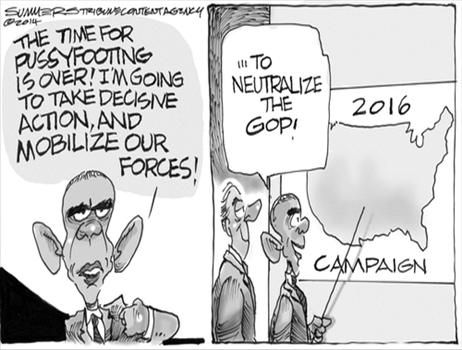
Political Cartoon

Courtesy of Dana Summers via Townhall
Musical Interlude: My Favorite Vocalists

Petula Clark, "This Is My Song". A Charlie Chaplin remake...

Wednesday, September 3, 2014

Miscellany: 9/03/14

Quote of the Day
I would prefer even to fail with honor than win by cheating.
Sophocles

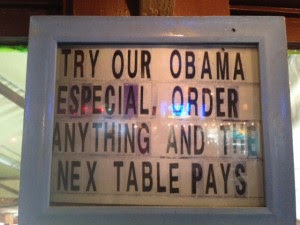
Sign of the Day

photo
HT Cafe Hayek
How Many Federal Regulations Are There?


Image of the Day

Via We the Individuals

Reflections on College Teaching

My elementary school teacher niece posted a videos of teachers writing letters to themselves as newbies. It's an interesting topic: what had academia not prepared me for in the teaching experience? I could write an essay which I haven't done to date about the academic version of office politics and the need for junior professors to be low-profile. I could talk about the difficulties of new preps and changing textbooks, the political problems of having higher standards than one's colleagues. For my second year at UWM, I gave up a cherished graduate course to teach an undergraduate service course, probably the worst decision I've ever made. I never should have accepted UTEP's job offer (at the time of the offer they had not achieved AACSB accreditation and wanted my vita/resume to add to the application).

But there were little things I picked up, even as a teaching fellow in Houston. For example (and I think I've mentioned this incident in the past), the last  year I taught the undergraduate service course (I would teach DSS, an upper-division class, the next year), I decided just to go around to the student computer labs where some of my students were working on their COBOL programs; there were work-study lab student majors who often helped the students with routine errors. I did hold office hours and debugged dozens, if not hundreds of program errors the lab majors couldn't handle. But a lot of students never came to ask for help. There was a middle-aged woman of color in one of my sections who was stumped why her assignment output wasn't showing the expected field values. Not to go too much into the intricacies of computer programming, but there are ways of padding a field to the left or right with spaces, zeroes, or other characters; what was happening in this lady's program was she was displaying the space padding for the field in her output (she erred in specifying her output line). I instantly knew the solution, what to fix, etc., but I decided instead was to try to lead her in a Socratic fashion to diagnosing the problem herself. She got the hard part of the program right; she just had a minor error in displaying the program's output. She did figure it out, and I'll never forget her smiling, appreciative response: "You're a great teacher!" Unfortunately, I would never hear that again in my remaining years of teaching.

The lesson I got from that incident is sometimes you have to go outside your comfort zone as a teacher. I noticed a similar incident involving playing teen baseball. As a southpaw, players normally play outfield, pitch or play first base. I usually played outfield before settling into first base my last year of baseball. This one game I was trying to field like a major league player, stretching from the bag, but my colleagues were throwing wildly at first--feet over my outstretched glove or several feet past the bag. I was demoralized and the crowd was booing ME. We had no reserve that day, and my angry coach threatened to pull me, which would have meant forfeiting the game. I snapped back maybe he should, when he did the smartest thing I've ever seen a coach do--he suggested that I play first base off the bag like an outfielder and simply outrun the base runner to first base. It was a paradigm shift in playing the position, and it worked like a charm. I couldn't improve my fellow players' bad throws, but I did have the power to adjust my playing style; it was unconventional, but it worked for this team.

In a similar way, I had no control over the heterogeneous nature of my students, their uneven preparedness, work habits or different skills and experience, but I did have control in how I approached the class. I'm not sure I had the same degree of success, but e.g., when I discovered my UTEP database students didn't know data structures, despite an explicit course prerequisite, I spent the next week or two teaching data structures.

I am a perfectionist. What I remember after teaching my first college classes is how I would have done so many things differently if I had to do it over again. I was at a department store buying a men's suit when one of my former students recognized me. I started to apologize for his being one of the guinea pigs of my first classes teaching. He stopped me and said, "You know, while I was taking your class, I hated your guts." (Okay, I thought to myself: this is really not going as well as I hoped...) He then continued, "I later discovered I learned more in your class than in any other class I had at UH. In fact, I was just talking about you at lunch the other day... I wouldn't change a thing." Then I remember suggesting that my advanced student majors seek opportunities with a management consulting company, like Accenture and Deloitte; to be honest, I thought the students just blew it off. We had an MIS research center at UH, and after one presentation, a sharply dressed young man hurried over to talk to me. "Do you remember me from DSS class? I took your advice, and I'm with Accenture..." I was amazed; something I said in class actually impacted someone's life decisions. Now granted I've taught hundreds of students, and few if any have ever been in touch. But the little feedback I got helped me stay the course.
Blacks: What Happened After the Civil Rights Battles Were Won


Facebook Corner

(IPI).  NBC Chicago: "Chicago Mayor Rahm Emanuel plans to sign an executive order that requires city contractors and subcontractors to pay employees a $13-an-hour minimum wage."
Someone needs to get rid of these demagogues. The last time I heard, Chicago's finances were a mess. To whatever extent any subcontractors are making under the new minimum (given only about 2% of jobs overall are minimum wage), you can be sure that any incremental costs will be passed along to the Chicago taxpayer, but I would also expect contractors to do what most employers do, e.g., hire fewer workers or cut hours, shift dollars from benefits to wages, etc. The idea that city contractors will drive up wages for other employees is sheer fantasy.

(Jeffrey Tucker). I once met a libertarian who turned out to be kind of annoying. Should I write a bit splashy article for Salon? http://www.salon.com/2014/09/03/confessions_of_a_recovering_libertarian_how_i_escaped_a_world_of_ron_paul_hero_worship/#comments

He probably thought he could score points with progressive chicks. Anyone want to break the news to him?

Proposals


Musical Interlude: My Favorite Vocalists

Petula Clark, "I Couldn't Live Without Your Love"

Tuesday, September 2, 2014

Miscellany: 9/02/14

Quote of the Day
Appreciation can make a day, even change a life. 
Your willingness to put it into words is all that is necessary.
Margaret Cousins

Image of the Day


Feminism and the Decline of American Nuns

The Jo Piazza Time post The Great Nunquisition: Why the Vatican Is Cracking Down on Sisters is yet another clueless, analytically vacuous op-ed piece on Catholic topics by the secular press; there are other excellent reflections on the post (e.g., see here).  Let's first of all concede that the numbers of nuns/religious sisters has indeed gone down by nearly three-quarters; I made the same observation just a few weeks ago in the blog when I suggested that Pope Francis  seemed to be focused more on symbolism than substantive reform, not unlike "all hat, no cattle" Obama. Second, it is true that some radically feminist religious sister groups are getting increased scrutiny by the Vatican. But then "some magic happens" and Piazza, citing a single anecdotal case of a potential candidate, thinking the Church doesn't value her social justice agenda, backing out, suggests that the male-dominated hierarchy needs to capitulate to secular progressive ideology if she expects to attract membership.

A brief response. First, the vocation issue is across the board, including the priesthood. There has been a sharp decline since Vatican II; why it's so is open to debate. I and others have argued that Vatican II reforms as implemented went too far, and the Church has not responded or led strongly enough to a sexually obsessed, hedonistic culture. I personally loved the Latin mass and the rich tradition of rituals; I thrived on the old disciplines, relaxed in the post-Vatican era. My maternal uncle, a retired pastor, not exactly a progressive, disagrees, feeling a lot of people were going to Church under fear of damnation but were not really participating in a liturgy under a foreign tongue.

Second, the Vatican has cracked down on other groups, including traditionalists and liberation theology. There has been a propagation of faculty or invited speakers at Catholic universities openly contradicting Church dogma or moral teachings. That the Vatican might question a feminist agenda that ignores the abomination of elective abortion or a gay agenda that fails to recognize the Church's teaching of traditional marriage and an active extramarital lifestyle hardly surprises me.

One of my favorite former professors whom I deeply respect is one of the feminist sisters; a while back she wrote an autobiographical piece for a feminist volume which I found fascinating because she had never opened up like that to me personally. Among other things, I learned that she had left OLL to teach philosophy at some seminary, and apparently she had issues with an old-fashioned administrator. (She didn't go into specifics but implied his approach was sexist.) I think she might have also taught a course on liberation theology or social justice that I would probably have taken a pass on; I do not like the politicization of academia, including multicultural or feminist studies.

I also knew a small feminist group of the inner circle at UH Catholic Newman; in fact, I tried to ask out one of them, and the very next week she and others announced their intention to become Dominican sisters. (This, of course, was a blow to my male ego; a life of chastity was preferable to dating me.) I have written before where this group really ticked me off; normally, we had mixed-gender lector pairs for readings. One Sunday just before Mass, a coordinator asked me to substitute for the missing (female-undisclosed) lector. I agreed. This group pitched a temper tantrum over two male lectors at Mass; I was simply helping out and had not solicited the opportunity. I thought the kerfuffle was anti-Christian at its core.

But I want to counter the perception that ideological feminism is the key to driving vocations. I have seen notices from more traditional orders and congregations attracting some of their largest formation groups in decades (also noted in this post). I also see similar things about more conservative young priest recruits. They are attracting them in a number of ways, e.g., social services, education, retreats/gatherings, campus ministry, the Internet, etc.  Me, I always remember my late paternal Aunt Grace, an educator. She left her original community but later joined a lay Franciscan order. One of the finest women I've ever known. Not an ideologue, except for her devout Catholic faith.

Follow-Up Odds and Ends
What Is It About Cops Killing Pets, Even Chickens?

Let You Without Sin Caste the First Stone...

It turns out that all municipalities go after kids running lemonade stands--mostly notably, after a Dunedin Floridian, Doug Wilkey,  went after his next-door neighbor. But guess what? Wilkey has been operating a home business without the necessary license. Now personally, I don't like petty anti-business regulations of any type, but you think Wilkey would have thought twice about going after the kid next door and drawing attention to himself.


Proposals


Facebook  Corner

(IPI). "If the Illinois Teachers Retirement Service (TRS) had to pay out all of its pensions today, it could only afford to give its members 40 cents on the dollar."
Government unions are not the problem. The politicians in Springfield are!
And what corrupt unions put them there?
 Cut off the public funds for the crony unionist parasites!
That statement assumes that, every member of the system, retires on the same day, which is impossible.
Is this troll for real? The funding percentage is the worst in the country; in the 2012 Pew only 2 states had under 50 cents on the dollar. "A pension plan that is 100 percent funded at the end of a business expansion will likely lose 20 percent of its value in an average recession, so 80 percent is the bare-minimum "healthy" funding level at the bottom of a recession — and only then. " You take into account IL's bottom bond ratings, this is a serious problem.

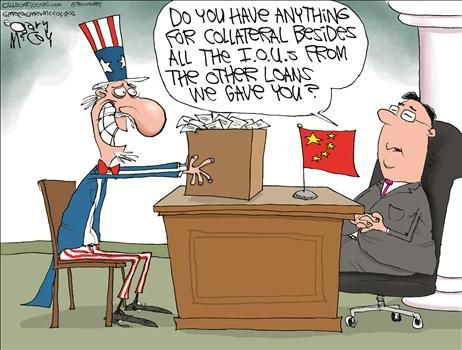
Political Cartoon

Courtesy of Gary McCoy and Townhall
Musical Interlude: My Favorite Vocalists

Petula Clark, "A Sign of the Times"

Monday, September 1, 2014

Miscellany: 9/01/14

Quote of the Day
One never notices what has been done; 
one can only see what remains to be done.
Marie Curie

Happy Labor & Capital Day!


On the Prohibition of Productive Work By Fascists


Image of the Day

Via EconLib
Rant of the Day: Jeffrey Tucker
About a century ago, when the intellectuals, politicians, and professional bureaucrats starting building Leviathan, they said it was all about us. There were things we wanted that we just couldn’t do for ourselves....They would provide schools, keep our meat and hospitals safe, stabilize the money, bring about fairness, and professionalize philanthropy. There would of course be a cost to getting these great benefits. There would have to be a tax...The whole bargain really was a poison apple.  The birth of leviathan coincided with history’s first world war, which was financed all around the world through the new magic money machine called central banking. There were price controls, wage controls, speech controls, conscription, labor camps, shutdowns of financial markets, censorship of the press, and all-round planning. the whole of life. The wartime bureaucracies did not go away in peacetime. A new class of bureaucrats had been born, people who held their jobs and powers regardless of public will or elections.  There was prohibition in the U.S. followed by the Great Depression and the fascistic experiment in national planning called the New Deal.  [The] second war world gave birth to another layer of state control. Massive welfare states were born that control health care, work hours, cartelized corporate establishments, provide security to old age, stamp out drug use, end invidious discrimination, redistribute income domestically and internationally, and so on. There was a time when people dreamed of a limited state, one that was checked by constitutions, representative democracy, courts that complied with laws passed by legislatures beholden to the people. This dream fully died 100 years ago.
There was a time when it was seemingly plausible to imagine the state as a helper, a benefactor, an agent of charity, a force for justice, a bringer of fairness, a planner more far-seeing and wise than the decentralized, diverse, and dispersed population over which it ruled. Those days are really over. The state does not love us. We should have known all along. How and why? Because the state brings to the social matrix only one unique thing: the legal use of compulsion. What awaits is a new awareness, one that reclaims the old liberal insight, that society can manage itself without a monopolist of power and coercion. 
David Gregory Is Done with MTP!

I know this news is somewhat dated, but I didn't realize it because of a mid-August family emergency; I was working through a backlog of podcasts today and discoverered the fact that David Gregory will be replaced by political analyst/NBC pollster Chuck Todd; according to industry sources, he was paid a $4M severance to go away from MTP and NBC News with a speak-no-evil clause. Not bad if you can get it; I don't know if he has a no-compete clause or what his options are. In his early 40's, he could probably start a second career say in academia as a journalist; I expect him to write a book or two, maybe dabble in new media like Katie Couric. Given his ratings record, I don't expect to see him land a related gig at a major network, at least in the near future. I have no idea, but I would have thought Jay Leno, who retired at the top of his game, might have attracted a major deal by now (I have not checked recently). Yes, different line of work, but it's the ratings game. I would not be surprised to see Gregory covering the 2016 election in some format.

I would like to think Gregory's ouster was related to his patently one-sided interviews which I have sometimes reviewed in transcript commentaries of Sunday talk soup, my principal target over life of the blog. Of course, MRC details the excesses of mainstream media on a more universal basis. But, and I have not reviewed the show's ratings, apparently the ratings, not Gregory's biased performances, were the culprit. But don't think Chuck Todd will be a major difference; he is also blatantly left-center in his perspective (MRC has a top 10 retrospective here).


Tom Woods and His Digs at Romney

Several days back Tom Woods had a thread on Facebook congratulating Ron Paul on his birthday. For reasons I don't understand, Tom Woods felt a need to describe Paul as a man of conviction and principle in a profession of phonies: he specifically singled out Mitt Romney as a man of no discernible principle. This struck me as an unnecessary cheap shot, and a protest comment led to a thread where Woods himself and several Woods acolytes posted comments, including an exasperated sarcastic shot when I suggested that Woods had not done due diligence on Romney's governing philosophy.

As a result, I have since unsubscribed to his podcasts and removed relevant links to my blogroll. I get contradicted all the time, but I felt Woods was being a jerk. In fact, Ron Paul is closer to my views than Romney, I understand the bitterness against Romney during the last 2 Presidential elections by Paul supporters, including Woods, and in fact I have written a number of critical posts on Romney, including his neocon views.

Actually, Woods' lecture here is reasonably good; I've made similar observations before, e.g., the Washington Monument issue during sequester. But my prime reason for including this video is because he takes another not-so-subtle swipe at Romney early in the presentation. The real talking point is not what Woods is pointing out--i.e., about the failure of central planning without an authentic market, but the fact that running more efficiently something better handled in the private sector is not so virtuous, e.g., why focus on running the Dept. of Education more efficiently, when there should be no such federal agency? Granted, Woods does make a passing reference to privatization in his comments.

But I do think government can be made more efficient and effective; in the past, I've pointed to Mitch Daniels' DMV reforms as a case in point. And there's no doubt Romney's executive skills would be well-suited for the Oval Office. We are not going to shrink the $3.7T budget by a third or more overnight (it's difficult to get past a Senate filibuster), and a business executive knows to make tough decisions. Coolidge is another example of a superb administrator. It's hard to argue against an executive willing to pull the trigger on failing projects, veto spending bills, etc. Now you need to have a chief executive who is more than Greenshades-in-Chief, but if there is anything worse than taxing the people's money, it's wasting the people's money.


Facebook Corner

(Cato Institute). "Oh, the humanity! Companies might sell 'poorly performing vacuum cleaners' to an unsuspecting public! And only legislation can save the day!
Or – and I know this might sound crazy to some people – we could just rely on consumers to evaluate the vacuum cleaners, buying the better ones and leaving the 'poorly performing”' ones on the shelf."
I wonder if the Roomba would have survived the maid union...

Should Schools Be Privatized? YES.... Dream Team: Buckley, Friedman, Sowell


Proposals


I'm old-fashioned... I think you should ask in-person.


Political Cartoon

Courtesy of Gary Varvel via PatriotPost
Musical Interlude: My Favorite Vocalists

Petula Clark, "My Love". An all-time favorite, a pop classic.