Analytics

Monday, December 7, 2009

Miscellany: 12/7/09

Republican Candidate Litmus Tests?


The GOP leaders have reportedly come up with a list of 10 positions, for which agreement on at least 8 would be necessary to receive RNC backing and/or funding:

(1) We support smaller government, smaller national debt, lower deficits and lower taxes by opposing bills like Obama’s “stimulus” bill;
(2) We support market-based health care reform and oppose Obama-style government run health care;
(3) We support market-based energy reforms by opposing cap and trade legislation;
(4) We support workers’ right to secret ballot by opposing card check;
(5) We support legal immigration and assimilation into American society by opposing amnesty for illegal immigrants;
(6) We support victory in Iraq and Afghanistan by supporting military-recommended troop surges;
(7) We support containment of Iran and North Korea, particularly effective action to eliminate their nuclear weapons threat;
(8) We support retention of the Defense of Marriage Act;
(9) We support protecting the lives of vulnerable persons by opposing health care rationing and denial of health care and government funding of abortion; and
(10) We support the right to keep and bear arms by opposing government restrictions on gun ownership.
Quite frankly, I find this whole list poorly written. For instance, the first point  confounds a number of different issues: the budget and aggregate deficit, taxes, and size of government. A fiscal conservative could rightly insist that some tax modifications may be necessary to close the operational and aggregate debts, but that the burden should be spread in an equitable way (e.g.,  a small value-added tax).

Second, I find that the RECORDS/PERFORMANCE of the candidates need to be considered in addition to POSITIONS. The fact of the matter is that under the last Republican President and Republican Congress, we expanded the operational and aggregate deficits, Medicare entitlements, and discretionary spending (including earmarks). I have been critical of Obama's rhetoric not reflected in his performance; the same kind of criticism can be applied to Republican incumbents. Talk is cheap.

Third, I want to see more of a commitment towards resolving significant problems versus kicking the can down the road for future generations, including solving reserve problems for social security and Medicare and repairing the nation's infrastructure.

Fourth, we need to see more of a pro-business growth agenda, including globally competitive business taxes,  incentives for savings and investment, immigration reform,  and moderating the tax and regulatory burden, particularly on small business.

Fifth,  we should emphasis support for a strong dollar and inflation hawks in the Federal Reserve.

Sixth, we need to halt the erosion in traditional American values, including hard work, civility, personal responsibility, self-reliance, and frugality. Enough of Democratic scope creep and moral hazard of socializing personal expenses of lower-income Americans. This also applies to government subsidies to businesses.

I would also like to see less of an emphasis on what I consider bumper stick issues like guns, abortion, and illegal immigration and more emphasis on pragmatic, good faith negotiations with the opposition. Take, for instance, the statement of supporting immigration reform by denying amnesty for illegal immigration. First of all, the immigration debate is  more than illegal entry via the US/Mexico border, and the proposals I've seen to date are not "amnesty" but require the payments of fines, a return to their home countries, background screening, and being placed at the end of the existing immigration wait list.

Pro-immigration conservatives, like myself, argue that we need to attack the fundamental causes for illegal entry, principally including an inadequate infrastructure  for orderly visiting worker flow and a viable legal temporary foreign worker program (opposed, of course, by unions). The immigration compromise of 2007 also included more emphasis on merit-based criteria (e.g., education, professional or entrepreneurial skills and English fluency), an end to existing chained immigration (where relatives, regardless of merit-based qualifications, qualify for eventual citizenship, their relatives in turn qualify, etc.), and a long-overdue revision of dysfunctional national quotas, unfairly restricting applicants from more populous nations.

However, I think we also need to speak to and honor the tremendous contributions and sacrifices made by Latinos, their patriotism, hard work ethic, traditional moral values and deep Christian faith. We must reject narrow-minded, reductionist, dishonorable characterizations that question the motivations and undermine the dignity and respect of Americans and foreign visitors

Abortion and gun rights mostly deal with Constitutional issues and hence indirectly factor into confirmation hearings for federal jurists (but for the most part, nominees generally refuse to respond to hypothetical questions on these issues); I do think it might be appropriate to recommend the confirmation of judges whom respect the separation of powers (i.e., the primacy of the legislative branch to enact laws) and have a core commitment to the Bill of Rights .

In short, the problem I have deals with the arbitrary nature of the questionnaire and the relative scoring of various issues.  I can't help but wonder if this is motivated by the recent disastrous nomination of Dede Scozzafava in NY-23, clearly out of step with the mainstream Republican Party, but I do realize strident media conservatives like Ann Coulter for years have been trying to purge the Republican Party of more pragmatic conservatives, like Colin Powell, John McCain and Rudy Giuliani.  The ability of Republicans to compromise is a virtue, not a betrayal of principle.

How do we avoid nominations like Scozzafava's  in the future? Let the Republican voters make the decision in primaries.  If desired, administer questionnaires to announced candidates and publish them for the benefit of primary voters. But the last thing we need is some codified version of media conservative groupthink; that does not help the GOP attract independent and moderate voters that they need to win  in purple and blue states. Have we learned nothing from the Democrats, whom retook both houses of Congress in 2006? They didn't do it by running progressive candidates in purple or red districts and states; they did it by running Blue Pups Dogs and, in one case, a pro-life Democrat (Bob Casey). Next year, in order to regain the NY Senate seat now held by Kirsten Gillibrand, the GOP may need to run a more pragmatic candidate like former Governor George Pataki or former Mayor Rudy Giuliani.


Democratic Governors Express Concern Over Health Care "Reform"


Keep in mind a point I just raised in the prior segment: Democratic-sponsored federal government scope creep: in particular, the states and the federal government have generally split costs associated with Medicaid, the government-run health care program for poor or lower-income Americans. Whereas much attention has been paid to so-called competition of the public option plan, there is a stealth type of government takeover of the health insurance sector, namely by raising the eligibility income (or other expansions) for Medicaid and other government programs. The Democratic governors have two principal concerns: first, they are worried about covering their share of any Medicaid expansion forced on them by federal fiat; second, they clearly wish that the federal Democrats were putting a higher priority on jobs-related legislation.

I think they lose either way. Democratic make-work legislation is a grossly inefficient, corrupt way to set up a job lottery system, benefiting the select few, not the many. Progressives will never be able to understand what drives job creation in the private sector; labor, taxes and indirect taxes (e.g., regulatory costs) are significant costs (among others, including infrastructure). Job creators don't like uncertainty in their environment--things like the government suddenly changing the rules in the middle of the game and saddling them with unexpected new costs.


Political Cartoon

Cartoonist Steve Kelley points out that Obama has let the insurgents know (so they can plan their activities accordingly) the limit of his commitment to the "real" war on terror.


Christmas Musical Interlude: Bob Dylan's "Must Be Santa"

Well, most of the material I've picked to date has been previously released. This single is from an American music legend whom has just released his first ever holiday album. As a Franco-American, I'm delighted that Bob Dylan has chosen a Cajun-style performance for the album's single, and the video is probably the funnest Christmas one I've ever seen; Bob Dylan never ceases to amaze me with his creativity. Dylan's US royalties for album "Christmas in the Heart" go to the charity Feeding America. I intend to purchase a copy of this album.

Sunday, December 6, 2009

Miscellany: 12/6/09

Republicans in a Dilemma over Afghanistan


One of the things that surprised me was the generally positive remarks I heard from Senate Republicans in the aftermath of Obama's announced decision for a 30,000 troop surge; in fact, that number was less than most the estimates I had seen in print, of 34,000 or more. I suspect that this was motivated more by a belief that half a loaf is better than none. I also think they were making a stand on principle, consistent with their 2007 position backing the Iraq surge against Democratic calls for unilateral withdrawal, reacting not in defense of Obama personally, but out of respect for the position of Commander in Chief.

Obama has attempted to rationalize his dithering on Afghanistan, claiming no harm was done. This is wrong on many levels; first, regardless of specific surge tactics, the fact is that McCrystal was responding to actual conditions in Afghanistan, not some projected problem next summer. Second, Obama's unduly extended decision process and the impression that his judgment is influenced by external, political considerations can be perceived as a sign of weakness by adversaries. Third, the mixed message Obama is sending, by announcing a timetable for withdrawal in advance of the surge, implies his indifference to whatever transpires during the surge itself.

If I had to articulate a common position by conservatives on the Afghanistan issue, it's this: if you are going to send in ground troops, make sure you send enough troops to complete the mission, to stabilize the situation; you do not play politics with the lives and mission of the troops hanging in the balance. Obama, after repeatedly claiming that the Afghanistan war was the "right" war, now decides on a higher-risk strategy for a surge; I don't think Obama's actions have matched his rhetoric.


My Favorite Holiday Flicks. There are the classics, of course, like "Miracle on 34th Street", "It's a Wonderful Life", "Holiday Inn" and multiple versions of  "A Christmas Carol". I love watching those movies, but the truth is, there are more recent films that I love watching time and again:


Scrooge (1970). Starring Albert Finney, this musical version of Dickens' "A Christmas Carol" is my favorite. (I love movie musicals, and the tunes in this movie are catchy; a sample track, "Thank You Very Much",  is the bonus music video below.)

The Homecoming: A Christmas Story (1971). I haven't seen this movie, the pilot for the 1970's iconic The Waltons television series, in years. There is edginess to the pilot, with solid performances, especially by Patricia Neal as mother Olivia Walton, set in the Depression; the father, John, has been forced to look for work far from home to make ends meet; first-born John-Boy aspires to be a writer, a profession to which his blue-collar parents can't relate. John Walton is expected home Christmas Eve, but a storm hits, and Olivia sends John-Boy out to search for him. The core strength of family comes shining through, and John-Boy gets closure on what his parents think about his interest in writing. [I think one of the reasons I relate so strongly to this story is that I share John-Boy's love of writing. I once told my younger brother Philip one of the things I liked getting as a kid was a blank sheet of paper; there are just so many different ways to express oneself. Philip thought that was hilarious and told my folks instead of buying me toys, they should have bought me a ream of copy paper!]

A Boyfriend for Christmas (2004). This is a Hallmark Channel original focusing on social worker Holly and a prickly encounter with a young lawyer whom shows up too late at a crucial court hearing for his pro bono representation of one of Holly's clients (trying to reunite with her kids, now in foster care, in time for Christmas). What does this have to do with 13-year-old Holly's encouragement of a timid, unrelated little girl's visit with a shopping mall Santa (the girl's big brother hadn't been able to convince her to approach Santa), her own Christmas wish for a boyfriend (just like her friends have) and a subsequent mysteriously inscribed gift from Santa? A romantic conflict breaks out between Holly's long-term romantic interest, wary of commitment, and the reluctant lawyer Ryan, whom finds himself gifted to Holly for a day by a Santa selling Christmas trees on a lot. I find the story/fantasy utterly charming and well-told; you find yourself cheering Holly on as the clock approaches midnight.

One Magic Christmas (1985). This is probably my favorite Disney film, a variation on the storyline behind the classic "It's a Wonderful Life". Mary Steenburgen stars as Ginny Grainger, a struggling lower middle-class mother whom works as a grocery checkout clerk. She has little patience for husband Jack's impractical dream of starting his own business, a bike shop. Lost in the daily struggles of suburban life, she no longer remembers the true meaning of Christmas. Cowboy angel Gideon arrives on the scene; unknown to Ginny, he gives her that rare opportunity to see what the future will bring if she continues her tunnel-visioned approach to life, when the lives of her beloved family can be turned upside-down in the blink of an eye. This is a moving film which reminds us of the importance of helping others realize their dreams and random acts of kindness.

A Christmas Visitor (2002). This is another Hallmark original story/fantasy. William Devane and Meredith Baxter star as grieving parents, facing a Christmas without their only son, an Army medic killed during service in the Gulf region. Their surviving child, a younger daughter, has just received a devastating medical diagnosis. The father's vehicle becomes stuck in mud on his way home, and this young Gulf War veteran approaches the vehicle and offers to help him get the vehicle back on the road. The father subsequently invites the stranger to celebrate Christmas with his family; the stranger doesn't know the man's son, but agrees to go along with the father's suggestion of comforting the grieving wife and daughter, telling them that he had, in fact, briefly met the medic during his own service in the region. The dad finds himself startled as the visitor seems to go off script at times; just who is this mysterious stranger? This is another well-written movie. I generally don't like to watch the same movies (other than musicals) over again, but I admire the craft of storytelling in these films.

The Family Man. (2000) This Nicolas Cage movie inverts a basic story concept in Dickens' "A Christmas Carol". Recall how the Ghost of Christmas Past forces Scrooge to address his biggest mistake: putting his overwhelming drive for professional success above his relationship with beloved fiancée Belle, whom responds by breaking their engagement. In this variation, successful investment banker Jack Campbell (Cage) gets an unexpected phone message from an old flame, Kate. That evening he finds himself in an alternate universe where he's a tire salesman in a struggling middle-class existence, with wife Kate and their children. A lifelong bachelor, he finds himself warily stumbling in this unexpected new role as husband and father. When karma later once again provides him the opportunity to become an investment banker, he is astounded to discover his priorities have changed. When Jack awakes from his dream (like Scrooge), he feels that he's been given a second opportunity (to win Kate's heart). I bought a copy of the DVD after viewing the movie for the first time via Netflix.

Angel in the Family (2004). The third Hallmark movie in my brief countdown (and second Meredith Baxter film), this fantasy co-stars Ronny Cox as Meredith's very ill widower. There's a conflict between the older daughter, played by Tracey Needham, as the struggling sibling attempting to take care of her ill father and somewhat resentful of her younger sister's freedom, and the younger daughter, played by Natasha Wagner, whom, despite a successful professional career, has her own issues, finding herself unwed and pregnant. The dad insists on having one final family Christmas which his late wife would have wanted. The girls think that their dad has lost it when they overhear him talking out loud to their late mother. This movie explores the theme of what would happen if you had one day to spend with a loved one whom has passed on.

Bonus Christmas Music Video: "Thank You Very Much" from "Scrooge"


Today's Cartoon

Brian Fairrington invites us to remember the reason for the season.


Christmas Musical Interlude: Jewel's "Hands (Live-Christmas Version)"

The achingly beautiful Jewel (Ty Murray won something far better than any of his rodeo trophies--the heart of a wonderful woman) makes a re-entry in my musical interlude segment with a live Christmas version of the same song.

Saturday, December 5, 2009

Miscellany: 12/5/09

Obama Spinning Job Numbers, but His Economic Agenda is on a Slippery Slope


Who does Obama think he's fooling by ludicrously claiming that his deft handling of the economy prevented a second Great Depression and a nearly $1T so-called stimulus plan is stabilizing the economy? Hasn't his credibility on the stimulus plan already been settled when official unemployment eclipsed 8% months ago, a cap that was used to rationalize a spending spree that our grandchildren will have to pay off (never mind cover their own national budget)?

Never mind the fact that Bernanke (see my recent critical posts on Fed Reserve Chairman Bernanke), who Obama has previously (and dubiously) credited with saving the country from a second Depression, was a Bush appointee back in 2006; Obama's renomination of him is for a term starting next year. When Obama and Treasury Secretary Geithner keep griping about the poor hand they were dealt by the Bush Administration, the biggest appointment a President makes relevant to economic policy is the choice of Fed Reserve chairman. So if Obama truly believes that Bush's economic policies are responsible for the bubble and Bernanke was asleep at the switch, why in the world is he renominating the man? Even if we grant for the sake of argument (and I think the jury is still out on that point) that Bernanke has been effective during and after last year's economic tsunami, what about all the rhetoric that Obama has been hyping in the health care "reform" about the wisdom of preventive policies? Doesn't it also apply in the economic arena? The best way to control fires is to ensure they don't happen in the first place; hiring the best firefighters is important, but if you don't address the root causes of the fires, you are always going to putting out fires by the seat of your pants.

When the Democrats hype the Keynesian elixir of infrastructure multipliers (and I've made my position on infrastructure very clear--I support a broad-based, long-term investment, but I distinguish legitimate economic investment from political pork-barrel projects), there's a huge difference between, say, building the Hoover Dam, which is yielding cheap, green electrical power decades after its construction, and Senator Reid's passionate embrace of a multi-billion dollar high-speed train link between Los Angeles and Las Vegas. I mean, really; if you need to get faster access to gambling with the nation's future, why not install moving walkways to Congressional Democratic back offices?

Obama's Government Motors job engine just keeps stalling out, and despite Obama's efforts to field the best economists he could find to diagnose and fix the problems (Larry Summers, Geithner, etc.), he just can't keep his economy vehicle out of the shop; it only seems to get as far as the nearest unemployment office.

The Congress Continues to Play Trivial Pursuit

Ever since Obama found himself behind the curve in discovering preexisting executive retention bonuses intact after last fall's economic bailouts, he is determined not to let anyone question his commitment to the Politics of Envy again; so what if hiring better managers, at a market-competitive salary, can pay for themselves many times over and get these companies off the federal teat sooner rather than later?

Senator Blanche Lincoln (D-AR), facing an unnecessary $1T health care initiative in the US Senate, certainly knows how to pick her moments: while paying lip service to a commitment to private-sector solutions, what better way to undermine the private sector than to scapegoat health insurer executives and target their salaries, leaving only mediocre talent to fend off a growing government monopoly? Never mind the fact that executive pay is an issue which should be addressed by a company's stakeholders, not an obtrusive federal bureaucracy. I wish Mike Huckabee or other viable Republican candidate will run against her next fall; I even have a winning slogan for them: "I'm not Blanche Lincoln".

And just to prove I'm a bipartisan critic, my home state Democratic US Senator Barbara Mikulski joined with Republican Senator Vitter in an amendment setting aside recently revised mammography guidelines for 40-year-old women, despite compelling evidence that mammograms, over the general (versus at-risk) population of women, results in a significant relative number of false positives, the expensive, devastating treatment of which does more harm to women than saving lives.

If, indeed, we are going to debate health care reform, let's have meaningful debate over conservative proposals to strengthen state/regional risk pools, provide medical malpractice tort reform, open up the health insurance market across state lines, or provide equal protection of tax savings for those whom purchase health insurance on their own...not these trivial sideshows and soap operas.


Political Cartoon

Cartoonist Nate Beeler takes a well-grounded look at the Fools on the (Capitol) Hill.


Christmas Musical Interlude: "The Chipmunk Song"

This brings back fond memories of my childhood and our often-played red Christmas album...

Friday, December 4, 2009

Miscellany: 12/4/09

Bernanke Wants Reappointment


For Americans confused by the arcane economics of money supply, a few things are obvious: Obama has renominated George W. Bush's choice to replace Alan Greenspan. You have to wonder, when Obama also chose to hold over Bush's Defense Secretary (Robert Gates), whether the fact of Obama's actions contradicts his constant Bush bashing.

What motive would Obama have in nominating a conservative inflation-fighting economist? After all, Obama's arguments in selling the so-called stimulus bill channeled John Keynes, not Milton Friedman. Obama's whole economic policy is an attempt to micromanage the economy in favor of things like green energy, and he is attempting to use fiscal policy to jump start the economy, just like FDR fruitlessly attempted to do during the Great Depression. Was "Helicopter Ben" an inflation-fighting profile of courage during the Democrats' mad spending spree earlier this? In fact, even though Bernanke claims to be a student of the Depression, his endorsement of the so-called stimulus bill shows no lessons learned from Keynesian economics during the 1930's.

Methinks that Bernanke doth protesteth short-term motives of his critics on both sides of the aisle too much. There is a grain of truth, of course; raising rates is never politically popular. But, in fact, Bernanke has been maintaining artificially low interest rates for extended periods of time, which is consistent with most progressives' objectives of loose, easy money, motivated by the Phillips curve, etc. There are multiple reasons I object to Bernanke's policies. First of all, I don't think maintaining artificially low interest rates fools the market; sooner or later, you eventually have to raise rates to deal with inflation (never popular), and (as Greenspan knows) one rate rise too many can result in an asset crash. Second, I don't think maintaining low interest rates and high corporate taxes helps grow the U.S. economy; it results in investment flight, exactly the kind of thing you want to avoid if you're trying to grow the economy. Let me point out--when you are dealing with near zero interest rates, you're pushing on a string.

I think Bernanke needs to explain why the Fed's record over the past decade warrant his reappointment and the Fed's continued or expanded responsibilities. Aren't the failures in financial service industry, over which the Fed has much regulatory authority, also a reflection of the Fed's deficient efforts making short-shrift of risk? Why, after a stock market crash, a housing bust, and corporate scandals, do we really believe that Bernanke and the Fed got its act together just in time to deftly handle last year's economic tsunami and aftermath? I believe that the Fed's current policy is penny-wise, pound-foolish, and Bernanke will face his own day of reckoning.

The only reason I'm holding off opposing Bernanke's renomination or stripping the Fed of some of its portfolio of  responsibilities is because I'm concerned what Obama and his Congressional allies will do in response--e.g., appointing even more liberal economists or creating a new progressive-dominated regulatory agency. Let's just say I remain a skeptic, and I have no problem with the Congress holding the feet of Bernanke and the Fed to the fire. But I'm not clueless about Congressman Ron Paul's real objectives (Paul opposes the very concept of the Federal Reserve on Constitutional grounds) and his measure's co-sponsor, über-partisan pro-health care "reformer" Alan "My Congressman is Nuts" Grayson.

Obama's Job Summit: Too Little, Too Late


Speaker Nancy Pelosi never ceases to amaze me with her ability to do and say ever more more irresponsible things: her desire to use the TARP funds beyond their original intent, as sort of a slush fund for economically inefficient government job "creation". "Green jobs?" Give me a break! As if the government knows where to invest better than the private sector...  More and more money to fiscally irresponsible states? No way...  You want to create jobs? Get government out of the way of the private sector;stop competing (through massive spending) with small business for capital, reform Sarbanes-Oxley, quit threatening companies with cap-and-trade or heath care taxes and penalties and raising tax rates on job creators, cut employer payroll taxes, reduce government mandates and reporting requirements, make corporate tax rates more globally competitive, and negotiate free trade pacts, opening markets to American goods and services.

Political Cartoon


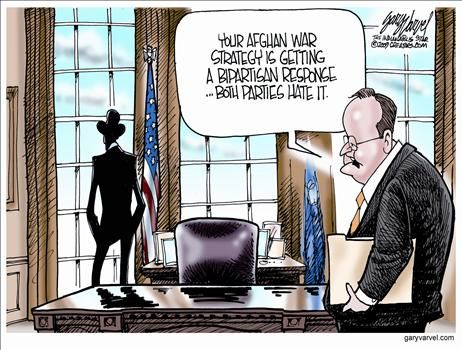
Cartoonist Gary Varvel explains how Barack Obama has finally achieved his goal of bringing a divided America together:


Christmas Musical Interlude: Newsong: "The Christmas Shoes"

I think this song is one of those that I remember what exactly I was doing when I first heard it--I was doing a DBA gig in the Los Angeles area and had stopped by a gas station to fill up the rental car's tank when the song came on the radio--and I just sat there, listening to the song. This is the touching song of a young boy desperately wanting to buy his dying mother a cherished Christmas present and the kindness of a stranger. (This is also one of the few songs for which I've myself written a sequel.) I also think the producers of this Youtube video did a superlative job retelling the story behind the song.

Thursday, December 3, 2009

Miscellany: 12/3/09

NY Senate Rejects Gay "Marriage"


The Senate rejected the measure 38-24 as 8 Democrats joined Republicans in voting down the measure. What I found particularly obnoxious were the advocates of these nontraditional legal rights self-righteously proclaiming their morally-superior stand against "discrimination" and accusing their opponents of moral cowardice. We believers in the traditional institution of marriage spanning millennia do not take issue with gays maintaining their own historical traditions and institutions. Marriage has been the traditional foundation for procreation, something physically impossible with same-gender relationships. I'm really not interested (unlike the courts in Massachusetts and California) in comparing the concept of marriage with domestic partnership along some arbitrary criterion. There are intrinsic differences in the nature of the relationships and hence their comparative institutions.

It's rather like the fact that some manufacturers don't make clothes in my (overweight) size. I don't consider that "discrimination"; it could simply be a reflection that I am bigger than most people my height. The fact that I have to pay more reflects more on the limited market economies of scale for someone my size. (I'm sure that women over 6 feet tall face similar issues.) The issue of fairness is not based on an absolute equality of price but relative to the focused market.

Incidentally, this is a concept most progressives can't grasp. For instance, take the often cited comparison of gender pay or gender health care costs. Quite often there are intrinsic factors that explain most observed differences. Let's say, for the sake of argument, that women spend more time with personal physicians than men do. You would expect the doctor to charge in accordance with his or her relative time and effort. For ideological feminists to argue that doctors discriminate against women by charging more makes no more sense than arguing someone whom buys a large cup of popcorn should pay no more than someone whom buys a small cup.


7 Stories that Obama Doesn't Want Told

Politico has a new column pointing out 7 basic political problems, which I'll paraphrase:
  • "Spend first, apologize later." I don't agree with the authors here in saying most people believe that the scope and nature of the Democratic spending spree was optimal. For example, bailing out fiscally irresponsible states was not "stimulus"--it was creating a moral hazard (why should progressive state governments live within their means if Uncle Sam has their back?) merely postponing a day of reckoning for state governments. Money is fungible. The federal government dedicating the money to cops and teachers simply enables the state government to shift money elsewhere. I could go on and on. Why did the federal government pay off the full value of Goldman Sach's credit default swaps from AIG? Why did we throw taxpayer's money at GM and Chrysler, only to have them declare bankruptcy? 
  • "His professorial style doesn't connect." Whereas Obama makes a conscious effort to bring personal stories into his addresses, he'll often lapse into excessively abstract discussions and lose his audience, and he'll sometimes make decisions that are hard to reconcile with his principles. A classic example is his reversal on releasing controversial photos of prisoners based out of Iraq or Afghanistan (which I support for precisely the reason he gave, namely safety of the troops).
  • "Mr. Obama Goes to Washington." The Obama White House is not adverse to Chicago-style back room deals (e.g., with Big Pharma), political arm-twisting, and trashing the opposition (Rush Limbaugh, Fox News, et al.)
  • "Obama is a paper tiger." Remember when health care "reform" was due in August? Even my own former students never got these kinds of extensions.... Remember when he said in the Presidential debates he wouldn't sign earmarks into law? Then came the first omnibudget bill...
  • "American Unexceptionalism" Is it possible for Barack Obama to deliver a speech in a foreign country where he doesn't bash apologize for George W. Bush, another predecessor or various sins of the past (including slavery, dropping the first atomic bomb, etc.)? Obama seems much more interested in appeasing and imitating the politics of European socialists than promoting America's global leadership.
  • "Co-Presidents Pelosi and Reid." Instead of Obama quarterbacking the Democrats down the field, he often has lapsed into the passive role of a cheerleader on the sidelines willing to sign whatever bill that Pelosi and Reid push through Congress. Take, for instance, health care "reform"; Obama reportedly liked the idea of a compromise public option trigger floated by a liberal GOP Maine senator and seemed ready to concede medical malpractice reform, but these are not in proposals at present.
  • "He's So Vain". I bet Obama thinks Carly Simon's song is about him. Whatever happened to the sense that "less is more", that there was a certain mystique fitting of the Presidency? More mystery to the man? Instead, we see saturated airwaves, all Obama, all of the time, almost daily speeches or remarks.
Political Cartoon


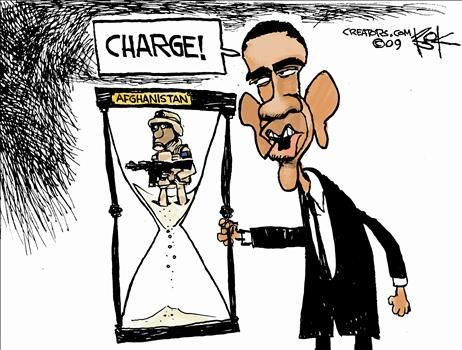
Chip Bok reminds us like sands through an hourglass, so are the days of our soldiers' lives in their quest to complete their mission.


Christmas Musical Interlude: Andrea Bocelli & Celine Dion: "The Prayer"

How can a Franco-American have a Christmas music countdown without including the second single from Celine's memorable Christmas album a decade ago? With all due respect to Josh Groban, I prefer this original duet version.


I pray you'll be our eyes, and watch us where we go.
And help us to be wise in times when we don't know.
Let this be our prayer, when we lose our way.
Lead us to a place, guide us with your grace
To a place where we'll be safe.
La luce che tu dai
Nel cuore restera
A ricordarci che
L'eterna stella sei.
I pray we'll find your light,
And hold it in our hearts
When stars go out each night,
Remind us where you are..
Nella mia preghiera
Quanta fede c'e.
Lead us to a place ?
Let this be our prayer
When shadows fill our day
Guide us with your grace
Give us faith so we'll be safe.
Sogniamo un mondo senza piu violenza,
Un mondo di giustizia e di speranza.
Ognuno dia una mano al suo vicino,
Simbolo di pace...di fraternita.
La forza che ci dai
E desiderio te
Ognuno trovi amor
Intorno e dentro se.
Let this be our prayer,
Just like every child.
We ask that life be kind
And watch us from above.
We hope each soul will find
Another soul to love.
Let this be our prayer,
Just like every child.
Needs to find a place, guide us with your grace
Give us faith so we'll be safe
E la fede che hai acceso in noi
Sento che ci salverai...

Wednesday, December 2, 2009

Miscellany: 12/2/09

Obama Listens to Kenny Loggins Songs

In a lifetime
Made of memories
I believe
In destiny

Every moment returns again in time
When I've got the future on my mind
Know that you'll be the only one

Meet me halfway
Across the sky
Out where the world belongs
to only you and I

Meet me halfway
Across the sky
Make this a new beginning of another life.


That's how I imagine a conversation went between Barack "The One" Obama with General  Stanley McChrystal. McChrystal is believed to have outlined three options to the President: 80,000 additional in a low-risk, 40 to 45,000 in a medium-risk, and 20,000 for a high-risk operation to stabilize Afghanistan in the face of the Taliban insurgency. Obama has reportedly settled for 30,000 (halfway between the high and medium-risk options from his own trusted military advisor) and is simultaneously pushing for a 3-year exit strategy in leaving Afghanistan, ironically wrapping things up around election day.

To a certain extent, Obama may have boxed himself in because of his own push for a unilateral withdrawal from Iraq in early 2007 and his awkward dependence on Republican support for any meaningful surge. (But do you think that Obama, needing that support, would have brought the GOP into the conversation? Of course not! Was Obama's post-partisan rhetoric, in the words of another pop song, "More Than Words"?) He has put himself in a tough spot for his reelection battle: if the war goes badly, the Republicans can argue that he should have sent McChrystal's low-risk numbers. What does he do--leave Afghanistan in a state of chaos, with the Taliban in a position of regaining power? What will become of the "real war" then? What of the American lives that are sacrificed in vain for Obama's war? Bush never pushed for a big enough footprint to stabilize Iraq until after the 2006 election; are we seeing Obama replicating Bush's earlier mistake?

Judge Spinner: We Need to Cram Down on Activist Judges

Judge Jeffrey Spinner, a New York judge canceling a $525K mortgage loan,  is spinning his own Alice in Wonderland interpretation of the Fifth Amendment in his unconscionable, unethical, ill-tempered, irresponsible, ill-reasoned decision to cancel a mortgage loan just because he didn't like the lender's behavior. This guy is so eager to cram down mortgage loans--which the US Congress has wisely refused to enable--he gave the ultimate cram down. About the only thing he didn't cram down on was studying the US Constitution before rendering his decision.

If this kind of nonsense was played out consistently, it would wipe out the US banking industry which lent out money in good faith. There are two parties to a mortgage contract. If the judge's abuse of power is left to stand, you will find very few parties willing to make loans; not just that, but what about the homeowners whom continue to pay their loans in good faith? The judge makes a big deal about the fact that the value of the house has gone down in the aftermath of the housing bubble burst; apparently when someone sells a house for a gain, without the original lender getting a cut, that's okay, but the judge thinks that he has the right to  write down a loan during adverse market conditions because a homeowner doesn't live up to the terms of his loan. That's judicial theft of property. The judge's actions are shameful, disgraceful and reflect badly on his profession.

There are a lot of misguided populists going around saying, "Great that the little guy won..."; what a great Thanksgiving gift! No, this was not the "little guy"; we are talking about a college professor and his wife whom bought the house over a decade ago and then decided to take a subprime loan for roughly 3 times the original mortgage. It's unfortunate that the professor made a bad, costly decision that cost him his home. The lender when it made the loan didn't know that he wouldn't be able to live up to the terms of his loan; they are exercising their legal rights to secure the collateral to the loan under terms of nonpayment.

Political Cartoon

Jim Morin of the Miami Herald addresses the elephant in the room:


Christmas Musical Interlude: Bing Crosby/David Bowie: "Peace on Earth/Little Drummer Boy"


I mentioned in an earlier post I loved the annual holiday specials, in particularly those featuring the Crosby and Williams' families growing up. I remember seeing the clip below during the original late 1970's show airing and instantly loved it; it remains what I think is the best cross-generational duet and mix of different singing styles I've ever heard. I think the "Peace on Earth" ditty was created especially for this performance. I was so happy to see copies of the performance available the next holiday season, which, of course, I purchased.

Tuesday, December 1, 2009

Miscellany: 12/1/09

Bernanke, Reappointment, and the Ron Paul Audit-the-Fed Kerfuffle


I have to admit that I have mixed feelings over Obama's renomination of Bernanke as Fed Reserve Chairman. Anna Schwartz, one of the great Milton Friedman's co-authors, points out what she regards as errors of commission (i.e., failing to act as bad cop to ward off inflation). She points out maintaining an artificially low interest rate for prolonged periods, as the Fed has been doing, sets the stage for recession-causing asset bubbles. She also points to what she regards acts of omission, e.g., the Fed failed to address valuation issues of mortgage-backed securities or derivatives, known well before the economic tsunami, and a convoluted plan of action (or was it simply seat of the pants?) during the economic tsunami, as it was unclear to the market why some companies were saved and others were allowed to fail.

"Helicopter Ben" Bernanke wrote a guest editorial in Sunday's Washington Post, entitled "The Right Reform for the Fed". (The nickname came from his reference to a famous Milton Friedman metaphor, that the government if necessary should drop currency from helicopters to avoid money supply contraction.)

Let me point out some points of agreement:
  • "Our ability to take such actions without engendering sharp increases in inflation depends heavily on our credibility and independence from short-term political pressures. "
  • "Looking to the future, we strongly support measures...to ensure that ad hoc interventions of the type we were forced to use last fall never happen again,,,,that the costs of failure are borne by owners, managers, creditors and the financial services industry, not by taxpayers."
  • "The Federal Reserve...did not do all that it could have to constrain excessive risk-taking in the financial sector in the period leading up to the crisis. "
On the other hand, I'm less convinced, despite Bernanke's insistence otherwise, that existing audits for the Fed are a sufficient quid pro quo for Ron Paul's GAO audit, given vague descriptions of how nearly $500B in loans (especially to foreign central banks) ended up on the Fed's books. I think Chairman Bernanke is being a little disingenuous about his vision of regulatory empire-building, he has not convinced me or the market that the bewildering, seemingly arbitrary bailouts were principled (versus seat of the pants), I don't like the fact that he has remained largely remained silent during extraordinary, ineffectual federal spending (with inevitable inflationary consequences), I would like hear the Fed explain why, for the second extensive period over the past decade, it has maintained an artificially low interest rate, and why, after the S&L and Long Term Capital Management fiascoes, we didn't see more proactive steps by the Fed to explicitly control risk (and why we should believe they are controlling it better now), why the Fed did not anticipate liquidity issues with mortgage-based securities or diagnose the nature of artificial homeowner demand in propping up unsustainable housing prices, and I have yet to be convinced (despite Bernanke's spin) the nature and scale of last year's massive intervention was necessary to prevent a "second Depression".

Bottom line: no sale; pass the GAO audit.

Surcharges for the War?

Wisconsin progressive Democrat David Obey (wan-Kenobi) has devised yet another "soak-the-rich" tax; let's add a 1% surcharge to pay for Obama's mismanaged war on Afghanistan, to fight the "real war" against international terrorism. I have a counter-proposal: let's require anyone whom voted for Obey, other national Democrats and/or Obama to pay for their unprecedented spending spree and highest deficits in US history, which dwarf our outlays for the War on Terror... Our first priority in the federal budget is national defense, not in promoting the moral hazards inherent in progressive domestic policies.

Political Cartoon


No, Chuck Asay. I suspect that the White House Propaganda New Media Office has come up with suitable spin to explain the bows: Obama felt honor-bound to take a bow after a glowing introduction and wildly enthusiastic reception by the crowds...


Christmas Musical Interlude: Kenny Rogers & Wynonna Judd  "Mary, Did You Know?"


The second of two Kenny Roger duets in my Christmas song countdown... Besides the strong vocal performance (Wynonna Judd has great pipes), what I particularly like about this song (brilliantly conceived and written by Buddy Greene and Mark Lowry) is how it blends every parent's concern with the future of his or her child with the Christian beliefs of salvation through the life, teachings and works of Jesus Christ. (As an unpublished songwriter, I have always been intrigued by the greater cultural emphasis on Christmas versus Easter, despite the primacy of the Easter event in Christian faith; how many Easter albums have been released? I love a good swerve; if I had had the talent to perform (beyond my high school choir), I always thought I would first release an Easter album,,,)


Mary, did you know
that your baby boy will one day walk on water?

Mary, did you know
that your baby boy will save our sons and daughters?

Did you know,
that your baby boy has come to make you new?
This child that you've delivered,
will soon deliver you.


Mary, did you know
that your baby boy will give sight to a blind man?

Mary, did you know
your baby boy will calm a storm with his hand?

Did you know,
that your baby boy has walked where angels trod?
When you kiss your little baby,
you've kissed the face of God.

The blind will see
The deaf will hear
The dead will live again.
The lame will leap
The dumb will speak
The praises of The Lamb.

Mary, did you know
that your baby boy is Lord of all creation?

Mary, did you know
that your baby boy will one day rule the nations?

Did you know,
that your baby boy is heaven's perfect lamb?
This sleeping child you're holding, is the great I AM.