Analytics

Wednesday, January 23, 2013

Miscellany: 1/23/13

Quote of the Day
The greatest challenge to any thinker is 
stating the problem in a way that will allow a solution.
Bertrand Russell

A Beautiful Sweetheart Victim 
of the Aurora, CO Movie Theater Shooting
Is Back to Playing High School Basketball 
and Going to Movies


On Hillary Clinton's Leadership Failure: 
The Benghazi Scandal

According to The Hill, Clinton accepted responsibility  and said the following, leading to Rand Paul's sharp response (below):
But even as she accepted blame for the security lapses in Benghazi, Clinton made an effort to protect her legacy at State — and potentially her chances at a presidential run in 2016 — by denying any wrongdoing herself.
A bipartisan board that investigated the Libya attack “made very clear that the level of responsibility for the failures that they outlined was set at the Assistant Secretary of State level and below,” Clinton said. “These requests don't ordinarily come in to the secretary of State.”
She pays lip service to taking responsibility but actually plays a poor imitation of Hogan Heroes' Sgt. Schultz, hiding behind the skirts of a bipartisan investigatory commission. For God's sake, she's an executive; if her underlings were not communicating to her, that's problematic. As a DBA I've had to be proactive and diagnose and fix many (user-defined) "database" problems; in several, if not most, cases they really involved hardware, code, or network issues not under my control. Now Clinton is NOT a DBA (not the point). But for her NOT to know Libya is not a stable place, that there are hostile elements in Libya, that 9/11 is a significant date for hostile forces and not to require an extra degree of precaution is, in my judgment, gross negligence; her #1 responsibility is the safety of Americans (including diplomats) involved. Not getting information from a deputy is a bureaucratic excuse: it was her professional responsibility to exercise due diligence. Is it possible that the ambassador could have been targeted even in a "safe area"? Yes, but it doesn't look like the Administration made safety and prudence a priority, totally unacceptable--and for the Administration try to scapegoat a Youtube video, knowing first of all, the Cairo protest over the video was nonviolent, is utterly pathetic and disingenuous.

This is as nonsensical as the Bush Administration in the aftermath of Katrina, all but oblivious to what was playing out on televisions. Most of us were aware this was a military-style of attack from the circumstances of the late ambassador's death.

The Obama Administration, including Obama and Clinton, knowingly deceived the American people by trying to scapegoat a video--as if they think Americans are unaware that each year since 9/11 of potential attacks on the anniversary by hostile forces. They seem to think because there was a nonviolent protest hours earlier... It's not like America conducted military actions against Libya over the recent past: why not blame a stupid film? It's all those attacks during the Oscars by the critics or viewers, don't you know? The American people are like Mikey of Life Cereal; they'll believe anything.

How did Clinton not know about her ambassador's unauthorized visit to a dangerous part of Libya? That's part of due diligence.

The last thing I want to hear from Clinton is a pale imitation of Bill's "I feel their pain." What difference does it make over how they died? Are you kidding me? And this pathetic women had and/or still has Presidential ambitions?


Santa Monica and Anti-(Fitness) Business Policy

No doubt in sunny Southern California, spectacular Pacific Ocean scenery, warm weather, and fresh air provide a delightful alternative to stuffy, smelly, bland fitness centers. But what happens when you have groups crowding the park?
Faced with fitness crowds, Redondo Beach allows only city-sponsored classes in public parks and beaches. Beverly Hills prohibits groups larger than two from its parks, and the city of Los Angeles charges boot camp operators $60 per hour.  But there is talk [in Santa Monica] of a tax of up to 15% on the gross receipts of trainers as well as restricted hours and new rules for equipment use. 
When I read about Redondo Beach, I have to groan. This is a fairly typical liberal solution: eliminate the private sector alternatives to a government monopoly? Note that several operators comply with the existing permit requirement. Instead of cracking down on unlicensed operators or, say, opening exercise areas to a first-come, first-served/reservation basis or competitive bidding process, never underestimate the ability of government to provide barriers to entry for residents to group-exercise (operators have to pass on their new government costs and restrictions to their clients). Some might argue that government might have an interest in promoting citizen healthy lifestyles rather than taxing and regulating operators out of business.


Rand Nails It in Hillary Clinton Critique: A Preview of 2016?

 I'm generally not fond of politicians grandstanding in committee hearings: quite often, these things can be a public flogging.   I called for Clinton's termination months ago. I would have also made the point that America had no legitimate self-defense reason for intervening in Libya.

 
The Johnson-Clinton Exchange on Benghazi


Protectionism and the "Buggy Whip" Speech

Remember all those plants and unions in a state of denial about failing business models. Have you looked at the stock charts of  high tech superstar stocks like Microsoft, Intel, HP, and Dell over the past decade? I'm not predicting their demise, but clearly they need to reinvent a growth story in a mature PC industry.


Entertainment Potpourri

American Idol New Season: Thumbs DOWN!

I have muted my criticism of the show during the off season: I welcomed the departure of celebrity singer judges Steven Tyler and Jennifer Lopez. I'm not saying the singer judges were always fawning critics (plus, I would expect well-rehearsed performances over a week between shows not to be disastrous), but it's not immediately clear why singers are better judges, any more than actors in judging movies or performances of other actors. I just don't get from the nature and extent of the judges' comments that these are like judges in, say, gymnastics and diving with scoring on technical factors. We hear trite, predictable feedback or repetitive admonishments about needing to find a distinct performance style and unnecessary references to personal appearance (especially by a singer in his 60's flirting with ladies young enough to be his granddaughter).

 I think from the point of scoring,  the viewer voting process needs reform: the current process (with multiple votes per viewer allowed) can be more of a popularity contest; and the judges have little relevance after the final cut except for an occasional gimmick like being able to save one eliminated contestant during the season. I would like to see judging widened to include a remote panel of maybe 2-3 dozen experts, including record or musical theater producers, media music critics, choir directors and voice coaches, with some parity between viewer and judge assessment. Quite often we see a viewer sympathy backlash when a judge gives a candid but unpopular assessment.

 But the show has, in my opinion, started to go stale. To give an example I was working on the blog during last week's show and this week's and barely watched the screen. Now to understand the following observation, you need to understand American Idol during its earlier runs has had multiple shows in opening weeks to maximize tatings; I did know about  last week's kickoff show, which was highly promoted. But I didn't even check to see if there was a second show last week.

And the elimination shows are torturous, mostly filler material, and host Ryan Seacrest is trying 101 ways to swerve results and, as always, cutting to a commercial before announcing the decision. In fact, last year comparable ratings for the premiere were down nearly a quarter, and this year went down another fifth--to the point a CBS drama show the prior evening found more viewers. Reality singing contest fatigue?

To be honest, I'm not favorably impressed by the replacement judges, Mariah Carey, Nicki Minaj and Keith Urban, particularly Minaj. There was a lot of buzz in the hiatus of a rift between Carey and Minaj. They showed a few sparks around the judging of a successful country-style blond contestant. Mariah is probably the most successful female vocalist ever with over 200 million sales and 18 #1 hits. Minaj has released 2 studio albums and has had 2 top 10 hits to date (although she had at one point 7 singles concurrently on the Hot 100, which is impressive). I found the disagreements among the judges to be trivial, annoying,  and boring.

AI is still good at telling human interest stories, but it's too predictable. They usually close the show with an upbeat success story, and they had to know the black mother whom brought in her young daughter, an avid Minaj fan, was going to move on, because it would have been cruel to have the little girl there to see her mom fail.

I usually watch the first shows especially to see the train wreck auditions; I haven't seen a good one in a while: some tone-deaf singer in a state of denial about his or her lack of talent.

Musical Interlude: My Favorite Groups

The Cars, "Shake It Up"

Tuesday, January 22, 2013

Miscellany: 1/22/13

Quote of the Day
I will charge thee nothing but the promise 
that thee will help the next man thee finds in trouble.
Mennonite proverb

Bureaucratic Moment of the Day

I'm hesitant to write about these incidents because (if you aren't aware of them), you might think that I'm making this stuff up. Yes, I understand threats of violence should be taken serious, particularly in the aftermath of the Newtown Massacre, but when you're dealing with kids, you have to look at context and apply some common sense. Small children play games; what little boys at that age don't  play cowboys and Indians with toy guns (and cap guns)? It is highly unlikely that parents would leave weapons accessible to their young children, and I don't remember kids at that age physically threatening other kids. (I'm not saying it's impossible, but you have to look at the context of the alleged threat, e.g., is it consistent with the child's patttern of behavior.)

The first incident is a 5-year-old Pennsylvania kindergarten girl, proud owner of a pink bubble gun. Someone overheard a conversation between the girl and her friend at the bus stop where the first girl playfully suggested that she would first shoot the friend with her bubble gun (not with her) and then herself.  The school got wind of the incident and questioned her without parents present, labeled her a terrorist threat, suspended her for 10 days, and required that she see a psychiatrist. Are you kidding me? Reportedly the school has reduced her sentence to 2 days, and the parents are trying to to get the terrorist smear expunged from the record. The real terrorists in this story are the incompetent administrative thugs questioning an intimidated, harmless little confused sweetheart without her parents or lawyer present; talk about a lack of due process (and common sense).

If it was in my power, I would terminate the principal and all the other school personnel involved. I'm sure that they wouldn't have trouble finding jobs with the TSA, patting down kindergartners and scrutinizing babies' poopy diapers for explosives.

The second incident involved two Baltimore area 6-year-old boys, caught playing cops and robbers during recess using their index fingers as play gun barrels and being subsequently suspended. Isn't it time we start demanding standardized exams in common sense for public school employees and management? This reminds me: a travel tip--don't do your impression of pro wrestler Cactus Jack (Mick Foley), aka "Mr. Bang-Bang", while standing in the security line at the airport.

40 Years, 55 Million Dead: 
A Date Which Will Live in Infamy: 1/22/73

I realize the issue is controversial; I've known conservatives and libertarians whom are pro-abortion choice. as well as two of my best friends. For me, it's a matter of conscience, based on science. Whereas I am Catholic, and the Church's stand has been consistently against abortion (what confuses people is a minor theological disagreement over the seriousness of the sin based on obsolete Aristotelian science on child development), I remember learning about the issue not from Church, but my mom. I had seen the term in a newspaper and asked my mom what it meant. My mom gave a very clinical description, avoiding judgmental references. I remember my first reaction, stark disbelief any woman would even consider the notion: "But, Mom, that's MURDER. What does the Church have to say? They have got to be against it!"

Among libertarians, pro-lifers are probably a strong minority, including Fox Business News personality Judge   Andrew Napolitano and former Presidential candidate Ron Paul:
 Libertarians believe, along with the Founding Fathers, that every individual has inalienable rights, among which are the rights to life, liberty, and the pursuit of happiness. Neither the State, nor any other person, can violate those rights without committing an injustice. But, just as important as the power claimed by the State to decide what rights we have, is the power to decide which of us has rights.
Today, we are seeing a piecemeal destruction of individual freedom. And in abortion, the statists have found a most effective method of obliterating freedom: obliterating the individual. Abortion on demand is the ultimate State tyranny; the State simply declares that certain classes of human beings are not persons, and therefore not entitled to the protection of the law. The State protects the "right" of some people to kill others, just as the courts protected the "property rights" of slave masters in their slaves. Moreover, by this method the State achieves a goal common to all totalitarian regimes: it sets us against each other, so that our energies are spent in the struggle between State-created classes, rather than in freeing all individuals from the State. 
And as for the canard that abortion is merely a religious value preference, the founder and guiding member of Libertarians for Life, Doris Gordon, is a Jewish atheist.  LFL believes:
  • Human offspring are human beings, persons from conception
  • Abortion is homicide.
  • One's right to control one's own body does not allow violating the obligation not to aggress. There is never a right to kill an innocent person. Prenatally, we are all innocent persons.
  • A prenatal child has the right to be in the mother's body. Parents have no right to evict their children from the crib or from the womb and let them die. Instead both parents, the father as well as the mother, owe them support and protection from harm.
  • No government, nor any individual, has a just power to legally "de-person" any one of us, born or preborn.
  • The proper purpose of the law is to side with the innocent, not against them


The Dream Of This Child
Music & Lyrics ©Cheri DeGruccio

She will be beautiful, long golden hair
a heart that finds hope through the darkest despair
She'll be a mother, gentle and wise
they will see love when they look in her eyes
That is the dream of this child
that she can believe for a while

But she'll never fall in love
She'll never see a sunrise
Look in her mothers eyes
From her her life has been torn
This day will be her last
She'll never get past
Being unborn

He will be handsome, tall dark and strong
Someone to turn to when life's going wrong
Hell be a father, stand proud and tall
Gentle protector, leader of all
That is the dream of this child
That he can believe for a while

But he'll never fall in love
He'll never see a sunrise
Look in his mothers eyes
From him his life has been torn
This day will be his last
He'll never get past
Being unborn

Unless we open up their eyes
And let them hear our voice
It's a child not a choice

They'll never fall in love
They'll never see a sunrise
Look in each other's eyes
From them their life has been torn
This day will be their last

Will this day be their last
Will they get past
Being unborn

Why Do Special- Interest Groups Succeed?

This is an interesting video in part for who's delivering it--Mike Munger, a veteran of the Reagan Administration, is a former Libertarian gubernatorial candidate in North Carolina in 2008. I haven't seen an article on him discussing gun control (which may be an artifact of my search), but the Libertarian Party is quite clear on the issue (against). I think Munger is simply using the NRA as a teaching point because it's probably most well-known, powerful special-interest group. Still, it's a bit unnerving to hear him discuss the free rider problem of alleged benefits from gun control. One might argue that neighbors may benefit from the fact that a prospective home invader may encounter a gun owner willing to use lethal force to protect his home and family.

Munger has (or has had) a couple of issues that I find eclectic for a Libertarian particularly from today's perspective: collective bargaining for public school teachers and shifting the income tax burden more progressive. Yes, Libertarians recognize voluntary groups, but usually in the context of a competitive marketplace, which doesn't apply to the public school system. (This may have been a better discussion for Munger: how taxpayers are too diffuse to mobilize against teacher unions which gain at taxpayer expense, re: Wisconsin public sector collective bargaining reform.)

The second point is the progressive income tax, which manifestly is punitive and violates principles of uniformity and equal protection. I would normally expect a Libertarian to argue traditional low tariffs/excise  taxes (I prefer a more uniform consumption/sales/VAT) revenues are sufficient enough to fund legitimate government and we need to starve the beast. I find it counterproductive to penalize workers and businesses for maximizing their productivity.

The arguments for progressive taxation boil down to "tax him: he won't feel it: he doesn't need it", said with all the moral certitude of the self-justifying common thief. It may well be I won't eat all the apples from my apple tree, but the apple tree and its fruit are not the yield of  the thief's own efforts. It is to my discretion whether to market or donate my apples. If I do not market my apples, others may pay more for their fruit.

Folsom has a readable essay on the progressive income tax (my edits):
America’s founders rejected the income tax entirely, but when they spoke of taxes they recognized the need for uniformity and equal protection to all citizens. The principle behind the progressive income tax—the more you earn, the larger the percentage of tax you must pay—would have been appalling to the founders. They recognized that, in James Madison’s words, “the spirit of party and faction” would prevail if Congress could tax one group of citizens and confer the benefits on another group.
During the 1800s economic thinking in the United States usually conformed to the founders’ guiding principles of uniformity and equal protection. One exception was during the Civil War, when a progressive income tax was first enacted. Interestingly, the tax had a maximum rate of 10 percent, and it was repealed in 1872. As Representative Justin Morrill of Vermont observed, “in this country we neither create nor tolerate any distinction of rank, race, or color, and should not tolerate anything else than entire equality in our taxes.”
When Congress passed another income tax in 1894—one that only hit the top 2 percent of wealth holders—the Supreme Court declared it unconstitutional. Stephen Field, a veteran of 30 years on the Court, was outraged that Congress would pass a bill to tax a small voting bloc and exempt the larger group of voters. At age 77, Field not only repudiated Congress’s actions, he also penned a prophecy. A small progressive tax, he predicted, “will be but the stepping stone to others, larger and more sweeping, till our political contests will become a war of the poor against the rich.”
Stephen Field was a REAL judge, not today's morally bankrupt, sophistic progressive judges whom decide ex post facto how to rationalize imposing their political/cultural preferences on others. Tell me what is fundamentally different between what the Congress unlawfully did in 1894 and what Barack Obama and his Congressional cronies did last month in deciding outnumbered upper income earners whom already pay a disproportionately higher share of their income deserved a tax hike but the more numerous middle class voter didn't.  It's fundamentally unconstitutional. Putting aside the fact that government has morphed into a grossly inefficient, ineffective, economic growth-crippling resource sinkhole which rewards enablers and punishes critics, the unpleasant task of levying general taxes should be done minimally and uniformly--either everybody shares the worthy burden, or nobody.

Everybody must have skin in the tax game. I don't care what Warren Buffett does with his fortune (except to note that I find it curious and philosophically inconsistent that he's not leaving his estate to Barack Obama to fritter away on things like bribing liberal California yuppies to buy electric cars), but if he lets his great-grandkids to play ball in his house, it doesn't give him the right to tell other rich people what to do with their property. Progressive politicians are little more than glorified common thieves.

Note that a low flat rate system still has people whom earn or consume more to pay more taxes: if you make ten times more income, you pay 10 times more taxes. Very simple system.


Musical Interlude: My Favorite Groups

The Cars, "Good Times Roll".  I have a nagging suspicion that I covered the Cars earlier in the blog; I did a blog search earlier which came up empty. I do intend to reprise my earlier Beatles retrospective in a more comprehensive format like I've done over the recent past.

Monday, January 21, 2013

Miscellany: 1/21/13

Quote of the Day
He who smiles rather than rages 
is always the stronger.
Japanese proverb

Sometimes Words Are Just That: Words


New JOTY Nominee

The First Lady is caught rolling her eyes on tape clip (9 s) as Speaker Boehner engages in small talk with the President.


Obama Scorecard: First Term: 
An Abridged Summary

Courtesy of Gallup
The only 2 Presidents with lower mean ratings, both one-term'ers:: Ford and Carter. The Bushes finished just over 60%, most likely a rally-behind-the-Chief, the first Gulf War and 9/11 respectively. What about Obama's bounce last year? In my opinion, a few things. First, the rising stock market, improving housing and auto sectors, and declining official unemployment rate provided the facade of a more robust economy. Second, a lot of that was late in the year as a couple of widely publicized tragedies, Hurricane Sandy and the Newtown Massacre provided Obama to showcase a key strength as Consoler-in-Chief. Third, I think Obama has considerable political skills: he was able to exploit differences between GOP factions, attribute the economic malaise to his predecessor's policies and fear-monger over the GOP (GWB v. 2, "extremist"  candidates, intolerant policies, and politicians of and from the wealthy elite); the President also tried to co-opt a couple of traditional GOP strengths, tax cuts and small businesses.

Other accomplishments (via CBS, others or me*):
Sasha Obama yawning at yet another of her Dad's speeches:
His second Inaugural Address
  • highest average unemployment since the 1930's * (recent improvements in unemployment have more to do with people dropping out of the official labor force than new jobs: recent gains have barely kept up with new labor market entrants/population growth)
  • highest long-term unemployment * (one source I recently saw cited a Fed Reserve study that claims employers have been routinely trashing resumes with a current 6 month or longer gap)
  • lowest labor rate participation rate in decades *
  • declines in household income and net worth (2010 Fed 3-year study, did not improve in 2011, 2012 data not yet available, but unlikely much better in an employer's market)
  • largest accumulated national debt ($5.8T--Obama disingenuously argues that Bush owns the FY2009 deficit, which covers the first 8 months of his Presidency: this ignores the fact a Democratic-controlled Congress did not pass Bush's budget and instead passed continuing resolutions to bridge Bush's final months in office)
  • most overexposed President in history: number of speeches, remarks and comments: 1,852  (with teleprompter: 699, bashing Slurpee-drinking (do-nothing) Republicans: 35), days with no public or press appearances: 93, media interviews: 591 (major TV networks, 104 )
  • number of blue or purple states not visited: 0, red states 6, foreign nations visited at least once: 35
  • vacations: 13 (spanning all or part of 83 days); golf outings: 113; evening outings (dinner, theater, shows): 57
Number of Americans whom wished they could forget the last 4 years? 310 million
Number of people whom will end up paying Obama's overdue bills, may never see the money they put into senior entitlements or US Treasury obligations  paid off? Too many.

Housing Recovery? A Note of Caution

There are a flurry of news reports showing housing starts improving, prices up all over the country year over year, ETFs in home builders or builders and construction registering strong gains for 2012 and continuing into this year , at record-low mortgage rates, low vacancy-rates/increasing rental costs, what could go wrong with this picture? I will say that the contrarian in me gets restless when I read the perpetually perky Carpe Diem blog, with a few threads on low inflation, improving manufacturing base, the shale gas revolution and related hiring boom and lower utility rates, and housing. Perry thinks the upbeat tone and stories draw viewers to his blog; he reasons if you want doom and gloom, there are a lot of sources on the Internet.

To be sure, even the housing bulls pay lip service to caution, and we haven't seen yet the return of the condo-flipping infomercials. I stumbled across a webpage which, among other things noted that nearly a third  of the sales are in cash and/or by investors. I know at least two companies have been investing in single-family homes, hoping to convert them into rentals. The point is, these are speculative plays, and some of the demand is also coming from foreign investors, no doubt also driven by a declining dollar. Even a casual Google search showed about a third of homeowners underwater on their mortgage (and almost half of younger homeowners). This limits, for example, families which can migrate to larger homes. Furthermore in this jobless employers' market, we might see more foreclosures bringing inventory onto the market, dampening prices. In fact, you have to wonder, with many mortgages dependent on two incomes and less than a robust labor market, just how sustainable this recovery and how vulnerable it might be to another economic shock (say, the bursting of the bond bubble) or a second recession (some people are already speculating Obama could face his version of the 1937 recession)

Did Wily SCOTUS Chief Justice Roberts  Insert a Trojan Horse in ObamaCare?

George Will's most recent column focuses on a recent Cato Institute journal paper, dealing with the tax/penalty constraints. Basically the point is this: regulated insurance cannot recover the costs of older/sicker policyholder (community rating) or expensive/preexisting condition (guaranteed issue) policyholders from premiums. They have to make the difference from other (younger/healthier) policyholders. This means the latter are paying more than they should and  elect to self-insure as premiums become unsustainable (supply/demand).

Clearly this is not insurance from the get go if you can defer medical treatment and socialize the balance of your preexisting condition care except a modest capped premium. And chronically ill people may not be able to hold onto a job. You might think, why doesn't the government simply subsidize, on a means-tested basis, the excess costs their policies, including regulated premiums,  do not allow insurers to recapture?

In effect, if you mandate insurance to healthier risks, they end up subsidizing care without formally touching the government's hands. It's a de facto tax.

But how do you enforce it? What's to stop someone, say, a self-employed person, from simply not paying premiums? That's where the tax/penalty come into play.But what Roberts said is the government cannot simply collect on behalf of the insurance company. The tax/penalty must be sufficiently smaller than the premium.

So, just for the sake of argument, insurance costs $9000/year, the penalty is $2000/year, and you need a $5000 operation. Why should you pay $9000/year versus $2000? After all, your $5000 operation is covered either way. Perhaps if the government kicked in a $7000/year voucher to buy insurance... Now the point, where is that $7000/year subsidy coming from? Or how is your operation going to be paid from beyond your tax/penalty?

This is Will's point: the system sounds innocent enough: government protects you from high insurance premiums and guarantees insurance. But, unlike the government, an insurance company must balance its budget. This means the hidden costs of ObamaCare, while ObamaCare supporters still hold will "reduce the deficit" (by accounting gimmicks, like 10 years of taxes for 6 years of benefits), will come to the surface, and how do you think the GOP is going to react when the "deficit-reducing" ObamaCare starts running up huge unplanned bills? I told you so; wouldn't be prudent, not going to do it....

Musical Interlude: My Favorite Groups

The Cars, "Let's Go"

Sunday, January 20, 2013

Miscellany: 1/20/13

Quote of the Day
When you get to the end of your rope, 
tie a knot and hang on.
Franklin D. Roosevelt

Obama Sworn in For Second Term:
America Can Survive Even This
Keep the Faith
There Will Be a Time and Place for Us
Come With Me, and I'll Take You There
Somehow
Someday
Somewhere


Intellectual Property Rights, Aaron Schwartz, 
the State, and Cronyism

After a recession stalled my academic career as an MIS professor and I was faced with having to reinvent myself, I briefly flirted with the idea of going to law school; anyone who has read this blog regularly knows that I am not a fan of the economic rent-seeking legal profession, beyond protecting individual rights. What would possess me to think about join their ranks? Believe it or not, it had nothing to do with ubiquitous legal dramas, wanting to convict a gangster, becoming my generation's Perry Mason, or getting a SCOTUS nomination.

It was inspired by a couple of prominent cases, a sympathetic view of George Harrison whom recorded one of the biggest hits of the early 70's, "My Sweet Lord"; he was sued based on some melodic similaries by the rights holder to an early 60's hit "He's So Fine". (I don't agree with the judgment, but I was delighted when he subsequently responded with "This Song".)

The second was the case of Paperback Software which published cheaper versions of PC software category leading products on the MS/PC-DOS platform, such as Lotus-1-2-3. In fact I bought and used their products. Paperback Software VP Planner did not copy Lotus code but the program had a similar interface which made it easier for experienced users to get productive sooner with the product.(I advocated such designs from a usability perspective.) Borland also published a competitive product called Quattro Pro; in fact, I still have copies of legacy Quattro Pro spreadsheets. Lotus won the first round against Paperback, and Borland won its case while Lotus had its hands full trying to compete with the new category leader on the Windows platform, Microsoft Excel.

Hence I was interested in intellectual property law, not necessarily from the standpoint of a zealous content publisher. Some may wonder, isn't this hypocritical on my part? Haven't I been preaching about the unalienable right of property?

I don't know if George Will has written on this topic, but if he did, he might well start with the notorious cases of 18th century American publisher Benjamin Franklin and/or Charles Dickens, when Americans had liberally republished English poems, novels, etc., without licensing rights:
The rowdy American press, particularly in New York, soon disabused Dickens of his utopian notions vis a vis copyright. Americans, expecting him to be grateful for their warm reception, were staggered when this young British goodwill ambassador at the beginning of 1842, at a dinner held in his honour in Boston, dared to criticize them as pirates while urging the merits of international copyright, which at that point in American history would have seen vast amounts of Yankee capital heading overseas with little reciprocation. He did not back down. A week later, in Hartford, he argued that a native American literature would flourish only when American publishers were compelled by law to pay all writers their due, rather than being able to publish the works of any foreign author for free, a bad custom which only serve to discourage literary production by American citizens. Although the American people were divided on the question of the United States's joining the international copyright union, book, newspaper, and magazine publishers were utterly opposed, and successfully lobbied against any such move in Congress. The opposition maintained that literature, like all imaginative creations, should not be regulated by law and commerce, that undercapitalized nations, without public libraries, needed inexpensive access to ideas and entertainment that they could not generate themselves or afford to purchase at high rates, and that the free availability to publishers of an author's works did more to advance his reputation and long-term earnings than the restricted circulation created by the higher price of books on which a copyright royalty was paid. 
I wonder if some might see the current American government enforcement policies hypocritical given the experience of the early years of the republic. I will say that intellectual rights should be mutually respected and double standards in respecting the rights of domestic authors/publishers are unacceptable. Rights holders need to adapt to the markets, and an argument can be that academic publisher paywalls can constitute a barrier of entry to international scholarship. Aaron Schwartz's suicide in response to government bullying is tragic, and Federal prosecutor Carmen Ortiz in my judgment went over the line in her heavy-handed prosecution of Schwartz and should be discharged.

I have made it clear that one reason I rarely cite WSJ content in the hlog is because other than a teaser lead, they hide the bulk of their content, even op-eds, behind a paywall (even IBD and the Gray Lady don't hide op-eds behind paywalls, and they also have digital subscriptions). I feel when I reference an article, I'm providing a plug for the content provider; I'm very meticulous about referencing sources. In fact, I recently flamed a favorite economist for plugging an op-ed he wrote under a paywall; he emailed back a short apology.


This song ain't black or white and as far as I know
Don't infringe on anyone's copyright, so . . .


Horwitz Interview

I've embedded LearnLiberty videos by a couple of contributors to the Bleeding Heart Libertarian blog, Horwitz (yesterday) and Zwolinkski (a 2-video series on social justice); Horwitz also contributes to the free banking blog. (I haven't added these blogs to my blogroll yet, because the posts can be more theoretical than practical from a political standpoint.) Horwitz is from the Austrian School (Mises, Hayek) versus the more established Keynesian and monetarist (Friedman) schools. The Austrian School is particularly influential with libertarians (e.g., Ron Paul). They are highly critical of the fractional reserve banking system and the Fed,  fiat currencies without commodity backing (e.g., gold/silver); I particularly like his characterization of "pushing-on-a-string" Fed easy money policy; I've had a similar criticisms with market monetarists whom argue that the Fed's policies have been "too tight".


Follow-Up Odds and Ends

In yesterday's post I embedded a Biden gaffe retrospective. Just last fall at a campaign appearance he called Obama 'Clinton', but he topped himself yesterday at an inauguration ball:
Speaking at the Iowa State Society inauguration ball, the Vice President said, "I'm proud to be President of the United States".After some laughter and a nudge from someone on stage, Biden corrected himself. "I'm proud to be Vice President of the United States," he said, "and I'm prouder to be Barack Obama, President Barack Obama's Vice President."
And progressives were worried about Cheney serving under Bush...


Musical Interlude: My Favorite Groups

The Cars, "My Best Friend's Girl".

Saturday, January 19, 2013

Miscellany:1/19/13

Quote of the Day
I had rather do and not promise 
than promise and not do.
Arthur Warwick

NRA Shoots Itself In the Foot

I'm not going to embed the controversial NRA web ad here (you can find it elsewhere, e.g., here as of the date of this post).  The basic idea behind the ad is that Obama is allegedly hypocritical and elitist: his daughters are protected by armed Secret Service agents: your own children don't have comparable protection.

This has to be one of the biggest, most incompetent public relations blunders I've ever seen. Show me a person unmoved by the ghastly murders of innocent first graders, and I'll show you a heartless person. I don't doubt for a second Obama sincerely cares about the security of the nation's  schoolkids. I just don't think his approach is either effective or politically viable; I think the real issue here is a vulnerability in public safety policy failure which needs to be addressed by local/state government (which retains police power by the Constitution).

Launching a personal attack against a personally popular President and his photogenic all-American family may motivate the one-issue activist base which, to be honest, has never liked Barack Obama, but it tunes out the independents and moderates where public policy is decided. I argued during the fall campaign that it wasn't enough to run a campaign based on Obama's record, the issues, and Romney's own resume to resolve them: he also needed a positive, optimistic  message, a vision building on traditional virtues, values, and institutions.

On the Ratings Front

Gallup shows Obama's weekend approval rating heading into his final inauguration actually dipping a bit under 50% (48%, net approval +3) and will likely end his first term average at 49%.. In contrast, the week of his first inauguration. Obama was at 69%. Why the dip? A boost of support after the tragedies of Hurricane Sandy and the Newtown Massacre beginning to fade? Has Obama's increasingly strident, inflexible tone and handling of the fiscal cliff and debt ceiling alienated independents and moderates? Did Obama overplay his hand on gun control and the beloved Second Amendment, one of the third rails of American politics?  Could it be the slipping consumer confidence numbers, worst long-term unemployment since WWII or the lowest labor force participation rate in decades, more than 3 years into the Obama Recovery?

A Vindication for Scott Walker And Wisconsin Taxpayers:
THUMBS UP!

The Chicago Circuit Court of Appeals yesterday upheld in total Wisconsin's 2011  Act 10 (collective bargaining reform), reversing a Milwaukee federal judge's ruling.

A Violation of Student Privacy Rights

The Rutherford Institute is representing Andrea Hernandez, initially a San Antonio Jay High School student. I've touched about this case briefly in the past. Radio-frequency identification (RFID) involves a wireless technology using electromagnetic fields to track an tagged object; the tag includes a chip on which certain object-related information is stored. There are obvious applications in inventory control, asset management--even applications like electronic toll devices, luggage or shipment tracking.

I can understand how RFID applications can be useful, say, for example, in an emergency (fire or  Newtown-like incident) parents want reassurance about their children's status. But the use of the technology can come across as invasive, Orwellian and/or dehumanizing, the equivalent of bureaucratic stalking. There is also a risk of the technology being intercepted by other parties if worn outside the school (e.g., pedophiles). At the very least, the school could provide an exemption for conscientious objectors or allow parental waivers.

Hernandez made appeals based on Texas religious law and the first/fourteenth amendments (the chip is interpreted in the context of Revelations' 'Mark of the Beast') and failed to win an injunction. Hence, the young lady has been expelled for failing to wear the new badge. Thumbs DOWN!


Busting Liberal Myths One at a Time

It is hardly surprising to me when higher-worth individuals transition from a tax-avoidance strategy (with historically lower bond gains to equities, when the government cuts high marginal investment taxes), they can do very well. This is not a zero-sum game but a win-win situation.

Larry Ellison of Oracle has one of the highest net worth of anyone in America, but I've made a decent living  for nearly 2 decades working with Oracle software, many years better than the money I made as professor. I'm sure that I've worked as hard, if not harder than Ellison (DBA's often work holidays and evenings); I don't own a jet or a racing yacht, or import rocks from Japan to build a rock garden. I know, relatively speaking, Ellison has done much better than I have in my post-academic career (when I worked for Oracle directly, I did not get stock options but I did get a chance to buy a certain amount of stock at a discount, a no-brainer and profitable perk). I definitely wasn't an Oracle millionaire (I only worked there about a year--I was unhappy with a couple of project assignments). But Ellison's business success created opportunities to the point I've been offered gigs in multiple foreign countries (including Canada, Mexico, Brazil, England, Iraq and Saudi Arabia). I can honestly say I would be more of a Warren Buffett than Ellison billionaire. (Buffett has lived in the same plain house for decades and drove the same station wagon for years.) I would rather live in a simple townhouse and eat at Goode Company Barbeque in Houston (which I haven't done in years) or even a burger platter at Denny's followed by a hot fudge sundae vs. eat at a 5-star restaurant.

In any event, Horwitz points out the difference between relative and absolute statistics (but doesn't mention many of those classified as poor (nor all) have cell/Obama phones, air conditioning, food stamps, Medicaid, cable TV, televisions, etc.) He also points out that many of the studies used by progressives, are not longitudinal (following the same people over time) but based on summary statistics.


Political Humor

Joe Biden's Greatest Hits Comedy Bits


Musical Interlude: My Favorite Groups

The Cars, "Just What I Needed"

Friday, January 18, 2013

Miscellany: 1/18/13

Quote of the Day
Aim at the sun and you may not reach it;
but your arrow will fly far higher than 
if you had aimed at an object on a level with yourself.
F. Hawes

Yet Another JOTY Nominee

Remember Ray "Chocolate City/School Bus" Nagin, the former New Orleans mayor during the Katrina disaster, not carrying out a preexisting evacuation plan (in fact leaving the school buses in low-lying areas where they flooded out unused during the crisis). In what I consider one of the most incredulous election results ever I remember, Nagin went on to be reelected. It turns out that the Feds are charging Nagin with 21 corruption counts, including alleged post-Katrina kickbacks.

The Nanny of Prince George

I remember heading north on the Metro Green Line one afternoon when a lady of color asked me about the PG stop. I was confused--parental guidance, until I saw her get off the Prince George Plaza stop in Hyattsville, MD. I don't suffer fools gladly; this city councilwoman seems to believe she was elected to limit other people's choices about what and where to eat. (No doubt if it was up to this lady, Little Caesar's would have to reduce their tagline from "Pizza! Pizza!" to one "Pizza!") Weight is a complex, personal issue including activity level; for example, I have had a weight problem for much of my adult life, and I almost never eat out. Then you see the great Olympic swimming champion Michael Phelps whom is the spokesman for a national fast food chain. When I go out to lunch (typically fast food) with work colleagues, most of the customers I see are at a healthy weight: what's the purpose? Should the healthy people in line be deprived of a preferred eatery because a few patrons like me are overweight?

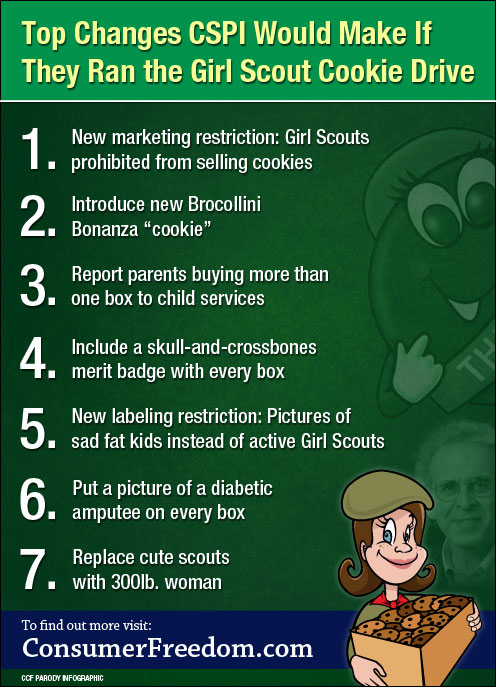
We need to focus on what Elton John sang: "Philadelphia Freedom". (I'm embedding Hall and Oates' version because the video displays the lyrics; Darryl Hall delivers a good interpretation.) The Reason video features a spokesperson for the Center for Consumer Freedom. I have also embedded a tongue-in-cheek cartoon imagining how the Center for Science in the Public Interest (which advocates food and nutrition policies) might approach perennial Girl Scout cookie fundraisers (I think I'll pass on Broccolian Bonanza or, say, Zucchinian Doublestuff Horseradish.)


Courtesy of ConsumrrFreedom
Speak for Yourself, Michelle Obama!
We all believe that no one who serves our country should have to fight for a job once they return home.
I hate with a passion the Obamas' rather transparent pandering to military personnel and their families. Michelle Obama commented on retail giant Walmart's new HR gimmick of guaranteeing honorably discharged veterans jobs. First, Walmart is a key favorite target of their fellow leftists as the soulless destroyer of small town businesses. Second, the government also provides preferential hiring bonus points in civil service.

I don't like government intervention in hiring decisions. Employers need to hire workers based on intrinsic merit (e.g., work ready, experience, productivity, etc.) If an employer hires lesser qualified workers, it affects the bottom line  It may well be that military experience is ideal for Walmart purposes, although that's not obvious to me; I could see how that supply line experience might dovetail with Walmart's legendary logistics operations.

But from a first principles approach, i.e., equal protection, I don't see why a military person is or should be "more equal"; they may fight guerrillas for their very lives, but they should get hiring consideration over, say, a father of four whom has been mostly unemployed for 3 years? When I left the military, I didn't seek or want special treatment; all I wanted was a fair shot to prove myself, nothing more, nothing less, not cuts in the hiring line. (No, I did not serve in a war zone, and I do not identify myself as a veteran on job applications.)

If I was a manager at Target or Costco, I might worry Walmart is getting ready to invade my sales territory...

Laurence Kotlikoff on the Fed Reserve

(HT to Gary North whom featured the clip in a post). I did not realize this Boston University economics professor actually ran for President last year for third-party efforts but ended his candidacy in the late spring when one of the parties decided against fielding a ticket.

I have not read much of Kotlikoff yet (I have some objections to his social security plan (which I see as too redistributive for my tastes)), but I like how he shifts on finance and Medicare reforms to a less statist solution and his version of a fair tax reflects my concern shifting some of the tax burden to consumption.

A recent Yahoo Finance op-ed on the trillion dollar coin kerfuffle is priceless; he basically points out the Fed has been monetizing the debt through bond purchases. (I will point out these "trillion dollar coins/bonds" took place under the debt cap and were not intended to work around it, but I do object to de facto monetizing the debt, which is not only corrosive to the currency but morally hazardous: why should this Congress (particularly the leftist-controlled US Senate and Presidency) engage in serious fiscal reform?)

Some other key insights:
Our country is completely, entirely, and thoroughly broke. In fact, we’re in worst fiscal shape than any developed country, including Greece. We have fantastically large expenditures coming due in the form of Social Security, Medicare, and Medicaid payments to the baby boom generations – I.O.U.s, which we’ve conveniently kept off the books.
In 2007, the monetary base – the amount of money our government printed in its 231 years of existence totaled $800 billion. Today it totals $2.8 trillion. And it increased by this amount via the process just described – the Treasury’s effective minting out of thin air two $1 trillion platinum coins; all this money loses purchasing power. So we are effectively taxed $2 trillion.
What the advocates of the $1 trillion coin are, therefore, proposing is to tax us in a hidden way. This is not just taxation without representation. It’s also taxation with misrepresentation. The fact that a Nobel Laureate in economics would propose this without making clear this fact raises the question of whether his prize should be revoked.
Today, 12 cents out of ever dollar being spent by our government is being printed. As indicated, the money supply has more than tripled. While inflation, let alone hyperinflation, has not yet occurred, everything is in place for this outcome.
I think  Krugman's Nobel Prize will get revoked after Obama's. It'e often difficult to see the stealth decline in purchasing power but I would say in part we see it in the health care system where government policies are exacerbating prices for goods and services. I think we are also seeing some anomalies because of Fed policies, e.g., stocks at a 5-year high in a tepid growth economy. I love Kofilkoff's pointing out the hidden tax of inflation; the Fed is indeed indirectly taxing us without representation.


Political Humor

Happy birthday to first lady Michelle Obama. She turned 49 years old today. She told a reporter she’d like a nice gift from Barack, but nothing extravagant. Oh, don’t worry. Obama is very responsible when he's spending his own money. - Jay Leno

[Jay, Sasha and Malia actually bought the gift, but Daddy O got all the credit (pun intended).]

Cirque du Soleil just announced that it is cutting 400 jobs. So on the downside, hundreds of clowns will lose their jobs. But on the bright side, it’ll free up, like, two spaces in the parking lot. - Jimmy Fallon

[On the plus side, lots of clowns are able to find work in this economy. Consider, for instance, the Congress...]

Musical Interlude: My Favorite Groups

The Stylistics, "You Make Me Feel Brand New". This concludes my Stylistics series. Next up: the Cars.

Thursday, January 17, 2013

Miscellany: 1/17/13

Quote of the Day
Some cause happiness wherever they go, 
others whenever they go.
Oscar Wilde

You Don't Say...

(HT AEI's James Pethokoukis) from the Treasury Dept.:
As of September 30, 2012, the Government held about $2.7 trillion in assets, The $18.8 trillion in total liabilities is comprised mostly of: (1) $11.3 trillion in Federal debt securities held by the public and accrued interest and (2) $6.3 trillion in Federal employee and veteran benefits payable. The Government also reports about $4.9 trillion of intragovernmental debt [e.g., senior entitlement reserves outstanding.] As of September 30, 2012, the Government’s total debt outstanding subject to the debt limit was $16.027 trillion, $367 billion below the current limit. As budget deficits continue to occur, the Government will have to borrow more from the public. Instances where the debt held by the public increases faster than the economy for extended periods can pose additional challenges.
So the Treasury has about net $16T in liabilities, NOT including over $2.5T in senior entitlement reserves (which do count in the debt ceiling) or estimates of up to or over $80T in unfunded senior entitlement liabilities. And only about $2.5T in annual revenues. Folks, even Bernie Madoff realized that he was living on borrowed time. Obama refuses to admit that he has a spending problem...

Buying Obama's Higher Education Hype?
Still Believe in the College Loan Bubble at Taxpayer Expense?

To a certain extent I was blessed compared to other PhD's because MIS was an emerging discipline in business schools (instead of focusing on areas like programming languages, and operating systems of computer science, we focused on the management, design and use of application systems and databases). Business schools were booming in the eighties, and the MBA was one of the "hottest" degrees. I was working as a programmer/analyst in the niche APL programming industry; APL is an interpetive (vs. compiled), concise, very powerful computer language developed by IBM, ideal for rapid application development. The companies I worked with made money by selling premium-priced mainframe computer time running value-added APL applications; a number of our Houston customers, primarily corporate headquarters for major energy companies, used us as a workaround to backlogged computing division bureaucracies. The emerging PC industry undermined the business model, and I believe the local branch offices vanished while I was in the doctoral program.  I had decided, for career advancement, to pursue an MBA (I also hoped that my dating prospects would improve; they did, but I was far more successful in my academic endeavors).

I discovered UH had an MIS doctoral program and applied for admisison before completing my MBA. The MIS discipline was young, with the first major program emerging from the University of Minnesota. Business school accreditation (AACSB) requirements drove demand for faculty from accredited doctoral programs; by the time I graduated there were few openings I knew about at Tier One/land grant universities, but my phone rang off the hook with interview requests from smaller branch universities (the fact that I was one of 2 prospects selected for both the DSI and ICIS consortia during my graduation year probably helped; I actually talked over the phone to a Dartmouth recruiter impressed by that, but there was no follow-up). Little  could I have guessed my academic career would end 5 years later in a nonrenewable visiting professor contract during the GHW Bush recession. To help meet faculty demand, Indiana University, headed by a key Minnesota alumnus, had set up a summer institute to retrain PhD's from other disciplines; with schools also cracking down on ABD's, threatening to make them requalify for candidacy after 5 years (in my field, married spouses, after finishing a required low-paid resident requirement, could make a lot more money by working full-time), slowing enrollments, and even computer science graduates (whom often had contempt for business schools) eyeing openings, I had a difficult time, even with 8 years of teaching  (5 as a professor) and an above-average publication record.

The tables had turned; I was competing for interview slots. One telling example: one school had concurrent interviews going on in the same hotel suite living area when I arrived.

Gary North (HT for the source of the below embedded image) has previously written about the doctoral glut. I can identify with what North was saying; as an undergraduate I was a double major in philosophy (my first love) and math. At least 2 or 3 people had "the talk" with me against pursuing a philosophy doctorate: I was warned my best chance for getting a faculty spot was if a tenured professor on faculty died or retired. As for math, around the time I was admitted, Texas had decided to do something about the nationwide glut of mathematicians (I recall a new PhD had finally landed a position at an obscure Missouri state college), and required passing 6 area qualifying exams for ABD status. I still remember one married couple where the wife made it but her husband finished one exam short.

I never even made it to the exams because I lost my graduate support. I ran into a political problem with an East European immigrant visiting professor. I was set up by the other class TA, JL--we didn't lecture but led calculus problem solving sections; the professor (with heavily accented English--"nature-al numbers" and "recip(e)-rocals")  was idiosyncratic--he would sometimes lose himself after scribbling 7 boards with equations and look at me through his thick glasses and ask, "What was it I was trying to do?" He also required a prospective A student to pass an oral exam. I got caught in the middle; I remember the best student in the class was so upset by one of his exams (we had no clue what he would put on an exam--I think if you got one right, a C; 2, a B;  3 an A), she literally threw her completed exam at and hit my face.

JL. on his initiative, suggested that we have an intervention with the professor. So he had me start off; the professor was quite upset by my description of student conplaints and turned to Jeff and said, "Is this true?" JL said, "I've heard a few complaints, but only from those whom are chronic complainers and would complain no matter who taught the class." To this day, I don't know what motivated JL to lie or backstab me. But the professor was now paranoid and even tailed me going into my graduate real analysis class to bitch about me to the professor. I later got summoned (already convicted by allegation) to a meeting in the department chair's office where I got read the riot act and was made to feel my place in the world was below that of a subatomic particle.

Later next semester I learned that my TA contract would not be renewed. I completed my thesis on a topic in ring theory (abstract algebra); I'll never forget once buying a book on group theory, and the salesgirl asked me what psychology class I was taking (trust me: mathematicians everywhere will think that's funny). I had to get a bridge loan from my reluctant maternal grandfather to pay a $500 fee to get my thesis typed, copied and bound (this was before PC soft fonts in writing math equations/expressions). I intended to join the Air Force (to be trained as a meteorologist). But I was passed over twice in officer selection pools, making me ineligible for 6 months. I tried to get a job teaching at a community college; no luck. I was unsuccessful finding  other work. I was living cheaply off campus--my folks of modest means had given me a small money gift after graduation, but moving home was not an option. The economy was in a recession; as the fall semester approached, I looked into going back to UT to pick up high school math teaching certification, but needed a financial aid package. Since my folks had claimed me as a dependent the prior calendar year, I had to get a financial statement from them. They refused. I pointed out to the college my little brother was enrolled, and the college bureaucrat, with a straight face, claimed use of my parents' financial statement for my brother would violate my brother's data privacy.

There's something that going through several months without a job does to a confident young man. Sure, people told me I should minor in computer science, not philosophy, for my Master's. But it never really occurred to me that someone who had graduated summa cum laude with majors in two intellectually  demanding disciplines, a first-rate thinker, problem solver and communicator, would have problems trying to find an entry-level job. Gary North may have known, but he's an economist.

Incidentally the following image does not apply to me. But I found the PhD was more of a liability than an asset; when I tried to restart my professional career, I was advised by professional recruiters to drop the PhD from the resume. A number of employers made it clear just what they thought of "ivory-tower" academicians whom can't function in the "real world"; almost all gave  no credit for computing experience in academia: I was treated as having been unemployed for the previous 8 years, and my no-longer-in-demand APL skills were suspect as well, judged likely obsolete or degraded. Several companies told me that I would have to compete against former students for entry-level positions, self-righteously proud of the fact they promoted from within for higher-level positions, and almost all of them had no interest in hiring an academician riding out the recession at their expense until hiring in academia improved.

But you still have to make ends meet. And that's how PhD's can sometimes end up in low-skill/low-paid occupations as described below. There but for the grace of God...


An Unconscionable Violation of Privacy
By a Politically Motivated Press
Two handguns and two pistol permits were stolen from the New City home of a man whose name and address are listed on the website of a local newspaper as possessing gun permits, police said.
The thieves ransacked the house Wednesday night, breaking into two safes on the home's third floor and stealing a third safe. The guns were in the stolen safe, police said.
Clarkstown police said they had no evidence the burglary was connected to the controversial map.
The concept of privacy has, unfortunately, been coopted by those whom believe that a pregnant woman has an unrestricted right, for any or no reason, to commit or authorize violence against her preborn child. But we understand intuitively that there are some expectations to be left alone by the government or other people: in our homes, when we are in the bathroom, enter the voting booth, our health details, etc.

There are only a few cases I can think of where the public has a right to know about personal details and even then I  would exercise prudence: for example, if a pro-gun control politician turns out to own a machine gun.

But public disclosure of details could undermine the home's tight to self-defense, expose a citizen to harassment or endangerment or serve to undermine public policy objectives like registration. For example, people's registered guns could be the target of  others whom are restricted from gun ownership (e.g., former felons or mentally ill people).

Musical Interlude: My Favorite Groups

The Stylistics, "Break Up to Make Up"