Analytics

Monday, January 21, 2013

Miscellany: 1/21/13

Quote of the Day
He who smiles rather than rages 
is always the stronger.
Japanese proverb

Sometimes Words Are Just That: Words


New JOTY Nominee

The First Lady is caught rolling her eyes on tape clip (9 s) as Speaker Boehner engages in small talk with the President.


Obama Scorecard: First Term: 
An Abridged Summary

Courtesy of Gallup
The only 2 Presidents with lower mean ratings, both one-term'ers:: Ford and Carter. The Bushes finished just over 60%, most likely a rally-behind-the-Chief, the first Gulf War and 9/11 respectively. What about Obama's bounce last year? In my opinion, a few things. First, the rising stock market, improving housing and auto sectors, and declining official unemployment rate provided the facade of a more robust economy. Second, a lot of that was late in the year as a couple of widely publicized tragedies, Hurricane Sandy and the Newtown Massacre provided Obama to showcase a key strength as Consoler-in-Chief. Third, I think Obama has considerable political skills: he was able to exploit differences between GOP factions, attribute the economic malaise to his predecessor's policies and fear-monger over the GOP (GWB v. 2, "extremist"  candidates, intolerant policies, and politicians of and from the wealthy elite); the President also tried to co-opt a couple of traditional GOP strengths, tax cuts and small businesses.

Other accomplishments (via CBS, others or me*):
Sasha Obama yawning at yet another of her Dad's speeches:
His second Inaugural Address
  • highest average unemployment since the 1930's * (recent improvements in unemployment have more to do with people dropping out of the official labor force than new jobs: recent gains have barely kept up with new labor market entrants/population growth)
  • highest long-term unemployment * (one source I recently saw cited a Fed Reserve study that claims employers have been routinely trashing resumes with a current 6 month or longer gap)
  • lowest labor rate participation rate in decades *
  • declines in household income and net worth (2010 Fed 3-year study, did not improve in 2011, 2012 data not yet available, but unlikely much better in an employer's market)
  • largest accumulated national debt ($5.8T--Obama disingenuously argues that Bush owns the FY2009 deficit, which covers the first 8 months of his Presidency: this ignores the fact a Democratic-controlled Congress did not pass Bush's budget and instead passed continuing resolutions to bridge Bush's final months in office)
  • most overexposed President in history: number of speeches, remarks and comments: 1,852  (with teleprompter: 699, bashing Slurpee-drinking (do-nothing) Republicans: 35), days with no public or press appearances: 93, media interviews: 591 (major TV networks, 104 )
  • number of blue or purple states not visited: 0, red states 6, foreign nations visited at least once: 35
  • vacations: 13 (spanning all or part of 83 days); golf outings: 113; evening outings (dinner, theater, shows): 57
Number of Americans whom wished they could forget the last 4 years? 310 million
Number of people whom will end up paying Obama's overdue bills, may never see the money they put into senior entitlements or US Treasury obligations  paid off? Too many.

Housing Recovery? A Note of Caution

There are a flurry of news reports showing housing starts improving, prices up all over the country year over year, ETFs in home builders or builders and construction registering strong gains for 2012 and continuing into this year , at record-low mortgage rates, low vacancy-rates/increasing rental costs, what could go wrong with this picture? I will say that the contrarian in me gets restless when I read the perpetually perky Carpe Diem blog, with a few threads on low inflation, improving manufacturing base, the shale gas revolution and related hiring boom and lower utility rates, and housing. Perry thinks the upbeat tone and stories draw viewers to his blog; he reasons if you want doom and gloom, there are a lot of sources on the Internet.

To be sure, even the housing bulls pay lip service to caution, and we haven't seen yet the return of the condo-flipping infomercials. I stumbled across a webpage which, among other things noted that nearly a third  of the sales are in cash and/or by investors. I know at least two companies have been investing in single-family homes, hoping to convert them into rentals. The point is, these are speculative plays, and some of the demand is also coming from foreign investors, no doubt also driven by a declining dollar. Even a casual Google search showed about a third of homeowners underwater on their mortgage (and almost half of younger homeowners). This limits, for example, families which can migrate to larger homes. Furthermore in this jobless employers' market, we might see more foreclosures bringing inventory onto the market, dampening prices. In fact, you have to wonder, with many mortgages dependent on two incomes and less than a robust labor market, just how sustainable this recovery and how vulnerable it might be to another economic shock (say, the bursting of the bond bubble) or a second recession (some people are already speculating Obama could face his version of the 1937 recession)

Did Wily SCOTUS Chief Justice Roberts  Insert a Trojan Horse in ObamaCare?

George Will's most recent column focuses on a recent Cato Institute journal paper, dealing with the tax/penalty constraints. Basically the point is this: regulated insurance cannot recover the costs of older/sicker policyholder (community rating) or expensive/preexisting condition (guaranteed issue) policyholders from premiums. They have to make the difference from other (younger/healthier) policyholders. This means the latter are paying more than they should and  elect to self-insure as premiums become unsustainable (supply/demand).

Clearly this is not insurance from the get go if you can defer medical treatment and socialize the balance of your preexisting condition care except a modest capped premium. And chronically ill people may not be able to hold onto a job. You might think, why doesn't the government simply subsidize, on a means-tested basis, the excess costs their policies, including regulated premiums,  do not allow insurers to recapture?

In effect, if you mandate insurance to healthier risks, they end up subsidizing care without formally touching the government's hands. It's a de facto tax.

But how do you enforce it? What's to stop someone, say, a self-employed person, from simply not paying premiums? That's where the tax/penalty come into play.But what Roberts said is the government cannot simply collect on behalf of the insurance company. The tax/penalty must be sufficiently smaller than the premium.

So, just for the sake of argument, insurance costs $9000/year, the penalty is $2000/year, and you need a $5000 operation. Why should you pay $9000/year versus $2000? After all, your $5000 operation is covered either way. Perhaps if the government kicked in a $7000/year voucher to buy insurance... Now the point, where is that $7000/year subsidy coming from? Or how is your operation going to be paid from beyond your tax/penalty?

This is Will's point: the system sounds innocent enough: government protects you from high insurance premiums and guarantees insurance. But, unlike the government, an insurance company must balance its budget. This means the hidden costs of ObamaCare, while ObamaCare supporters still hold will "reduce the deficit" (by accounting gimmicks, like 10 years of taxes for 6 years of benefits), will come to the surface, and how do you think the GOP is going to react when the "deficit-reducing" ObamaCare starts running up huge unplanned bills? I told you so; wouldn't be prudent, not going to do it....

Musical Interlude: My Favorite Groups

The Cars, "Let's Go"

Sunday, January 20, 2013

Miscellany: 1/20/13

Quote of the Day
When you get to the end of your rope, 
tie a knot and hang on.
Franklin D. Roosevelt

Obama Sworn in For Second Term:
America Can Survive Even This
Keep the Faith
There Will Be a Time and Place for Us
Come With Me, and I'll Take You There
Somehow
Someday
Somewhere


Intellectual Property Rights, Aaron Schwartz, 
the State, and Cronyism

After a recession stalled my academic career as an MIS professor and I was faced with having to reinvent myself, I briefly flirted with the idea of going to law school; anyone who has read this blog regularly knows that I am not a fan of the economic rent-seeking legal profession, beyond protecting individual rights. What would possess me to think about join their ranks? Believe it or not, it had nothing to do with ubiquitous legal dramas, wanting to convict a gangster, becoming my generation's Perry Mason, or getting a SCOTUS nomination.

It was inspired by a couple of prominent cases, a sympathetic view of George Harrison whom recorded one of the biggest hits of the early 70's, "My Sweet Lord"; he was sued based on some melodic similaries by the rights holder to an early 60's hit "He's So Fine". (I don't agree with the judgment, but I was delighted when he subsequently responded with "This Song".)

The second was the case of Paperback Software which published cheaper versions of PC software category leading products on the MS/PC-DOS platform, such as Lotus-1-2-3. In fact I bought and used their products. Paperback Software VP Planner did not copy Lotus code but the program had a similar interface which made it easier for experienced users to get productive sooner with the product.(I advocated such designs from a usability perspective.) Borland also published a competitive product called Quattro Pro; in fact, I still have copies of legacy Quattro Pro spreadsheets. Lotus won the first round against Paperback, and Borland won its case while Lotus had its hands full trying to compete with the new category leader on the Windows platform, Microsoft Excel.

Hence I was interested in intellectual property law, not necessarily from the standpoint of a zealous content publisher. Some may wonder, isn't this hypocritical on my part? Haven't I been preaching about the unalienable right of property?

I don't know if George Will has written on this topic, but if he did, he might well start with the notorious cases of 18th century American publisher Benjamin Franklin and/or Charles Dickens, when Americans had liberally republished English poems, novels, etc., without licensing rights:
The rowdy American press, particularly in New York, soon disabused Dickens of his utopian notions vis a vis copyright. Americans, expecting him to be grateful for their warm reception, were staggered when this young British goodwill ambassador at the beginning of 1842, at a dinner held in his honour in Boston, dared to criticize them as pirates while urging the merits of international copyright, which at that point in American history would have seen vast amounts of Yankee capital heading overseas with little reciprocation. He did not back down. A week later, in Hartford, he argued that a native American literature would flourish only when American publishers were compelled by law to pay all writers their due, rather than being able to publish the works of any foreign author for free, a bad custom which only serve to discourage literary production by American citizens. Although the American people were divided on the question of the United States's joining the international copyright union, book, newspaper, and magazine publishers were utterly opposed, and successfully lobbied against any such move in Congress. The opposition maintained that literature, like all imaginative creations, should not be regulated by law and commerce, that undercapitalized nations, without public libraries, needed inexpensive access to ideas and entertainment that they could not generate themselves or afford to purchase at high rates, and that the free availability to publishers of an author's works did more to advance his reputation and long-term earnings than the restricted circulation created by the higher price of books on which a copyright royalty was paid. 
I wonder if some might see the current American government enforcement policies hypocritical given the experience of the early years of the republic. I will say that intellectual rights should be mutually respected and double standards in respecting the rights of domestic authors/publishers are unacceptable. Rights holders need to adapt to the markets, and an argument can be that academic publisher paywalls can constitute a barrier of entry to international scholarship. Aaron Schwartz's suicide in response to government bullying is tragic, and Federal prosecutor Carmen Ortiz in my judgment went over the line in her heavy-handed prosecution of Schwartz and should be discharged.

I have made it clear that one reason I rarely cite WSJ content in the hlog is because other than a teaser lead, they hide the bulk of their content, even op-eds, behind a paywall (even IBD and the Gray Lady don't hide op-eds behind paywalls, and they also have digital subscriptions). I feel when I reference an article, I'm providing a plug for the content provider; I'm very meticulous about referencing sources. In fact, I recently flamed a favorite economist for plugging an op-ed he wrote under a paywall; he emailed back a short apology.


This song ain't black or white and as far as I know
Don't infringe on anyone's copyright, so . . .


Horwitz Interview

I've embedded LearnLiberty videos by a couple of contributors to the Bleeding Heart Libertarian blog, Horwitz (yesterday) and Zwolinkski (a 2-video series on social justice); Horwitz also contributes to the free banking blog. (I haven't added these blogs to my blogroll yet, because the posts can be more theoretical than practical from a political standpoint.) Horwitz is from the Austrian School (Mises, Hayek) versus the more established Keynesian and monetarist (Friedman) schools. The Austrian School is particularly influential with libertarians (e.g., Ron Paul). They are highly critical of the fractional reserve banking system and the Fed,  fiat currencies without commodity backing (e.g., gold/silver); I particularly like his characterization of "pushing-on-a-string" Fed easy money policy; I've had a similar criticisms with market monetarists whom argue that the Fed's policies have been "too tight".


Follow-Up Odds and Ends

In yesterday's post I embedded a Biden gaffe retrospective. Just last fall at a campaign appearance he called Obama 'Clinton', but he topped himself yesterday at an inauguration ball:
Speaking at the Iowa State Society inauguration ball, the Vice President said, "I'm proud to be President of the United States".After some laughter and a nudge from someone on stage, Biden corrected himself. "I'm proud to be Vice President of the United States," he said, "and I'm prouder to be Barack Obama, President Barack Obama's Vice President."
And progressives were worried about Cheney serving under Bush...


Musical Interlude: My Favorite Groups

The Cars, "My Best Friend's Girl".

Saturday, January 19, 2013

Miscellany:1/19/13

Quote of the Day
I had rather do and not promise 
than promise and not do.
Arthur Warwick

NRA Shoots Itself In the Foot

I'm not going to embed the controversial NRA web ad here (you can find it elsewhere, e.g., here as of the date of this post).  The basic idea behind the ad is that Obama is allegedly hypocritical and elitist: his daughters are protected by armed Secret Service agents: your own children don't have comparable protection.

This has to be one of the biggest, most incompetent public relations blunders I've ever seen. Show me a person unmoved by the ghastly murders of innocent first graders, and I'll show you a heartless person. I don't doubt for a second Obama sincerely cares about the security of the nation's  schoolkids. I just don't think his approach is either effective or politically viable; I think the real issue here is a vulnerability in public safety policy failure which needs to be addressed by local/state government (which retains police power by the Constitution).

Launching a personal attack against a personally popular President and his photogenic all-American family may motivate the one-issue activist base which, to be honest, has never liked Barack Obama, but it tunes out the independents and moderates where public policy is decided. I argued during the fall campaign that it wasn't enough to run a campaign based on Obama's record, the issues, and Romney's own resume to resolve them: he also needed a positive, optimistic  message, a vision building on traditional virtues, values, and institutions.

On the Ratings Front

Gallup shows Obama's weekend approval rating heading into his final inauguration actually dipping a bit under 50% (48%, net approval +3) and will likely end his first term average at 49%.. In contrast, the week of his first inauguration. Obama was at 69%. Why the dip? A boost of support after the tragedies of Hurricane Sandy and the Newtown Massacre beginning to fade? Has Obama's increasingly strident, inflexible tone and handling of the fiscal cliff and debt ceiling alienated independents and moderates? Did Obama overplay his hand on gun control and the beloved Second Amendment, one of the third rails of American politics?  Could it be the slipping consumer confidence numbers, worst long-term unemployment since WWII or the lowest labor force participation rate in decades, more than 3 years into the Obama Recovery?

A Vindication for Scott Walker And Wisconsin Taxpayers:
THUMBS UP!

The Chicago Circuit Court of Appeals yesterday upheld in total Wisconsin's 2011  Act 10 (collective bargaining reform), reversing a Milwaukee federal judge's ruling.

A Violation of Student Privacy Rights

The Rutherford Institute is representing Andrea Hernandez, initially a San Antonio Jay High School student. I've touched about this case briefly in the past. Radio-frequency identification (RFID) involves a wireless technology using electromagnetic fields to track an tagged object; the tag includes a chip on which certain object-related information is stored. There are obvious applications in inventory control, asset management--even applications like electronic toll devices, luggage or shipment tracking.

I can understand how RFID applications can be useful, say, for example, in an emergency (fire or  Newtown-like incident) parents want reassurance about their children's status. But the use of the technology can come across as invasive, Orwellian and/or dehumanizing, the equivalent of bureaucratic stalking. There is also a risk of the technology being intercepted by other parties if worn outside the school (e.g., pedophiles). At the very least, the school could provide an exemption for conscientious objectors or allow parental waivers.

Hernandez made appeals based on Texas religious law and the first/fourteenth amendments (the chip is interpreted in the context of Revelations' 'Mark of the Beast') and failed to win an injunction. Hence, the young lady has been expelled for failing to wear the new badge. Thumbs DOWN!


Busting Liberal Myths One at a Time

It is hardly surprising to me when higher-worth individuals transition from a tax-avoidance strategy (with historically lower bond gains to equities, when the government cuts high marginal investment taxes), they can do very well. This is not a zero-sum game but a win-win situation.

Larry Ellison of Oracle has one of the highest net worth of anyone in America, but I've made a decent living  for nearly 2 decades working with Oracle software, many years better than the money I made as professor. I'm sure that I've worked as hard, if not harder than Ellison (DBA's often work holidays and evenings); I don't own a jet or a racing yacht, or import rocks from Japan to build a rock garden. I know, relatively speaking, Ellison has done much better than I have in my post-academic career (when I worked for Oracle directly, I did not get stock options but I did get a chance to buy a certain amount of stock at a discount, a no-brainer and profitable perk). I definitely wasn't an Oracle millionaire (I only worked there about a year--I was unhappy with a couple of project assignments). But Ellison's business success created opportunities to the point I've been offered gigs in multiple foreign countries (including Canada, Mexico, Brazil, England, Iraq and Saudi Arabia). I can honestly say I would be more of a Warren Buffett than Ellison billionaire. (Buffett has lived in the same plain house for decades and drove the same station wagon for years.) I would rather live in a simple townhouse and eat at Goode Company Barbeque in Houston (which I haven't done in years) or even a burger platter at Denny's followed by a hot fudge sundae vs. eat at a 5-star restaurant.

In any event, Horwitz points out the difference between relative and absolute statistics (but doesn't mention many of those classified as poor (nor all) have cell/Obama phones, air conditioning, food stamps, Medicaid, cable TV, televisions, etc.) He also points out that many of the studies used by progressives, are not longitudinal (following the same people over time) but based on summary statistics.


Political Humor

Joe Biden's Greatest Hits Comedy Bits


Musical Interlude: My Favorite Groups

The Cars, "Just What I Needed"

Friday, January 18, 2013

Miscellany: 1/18/13

Quote of the Day
Aim at the sun and you may not reach it;
but your arrow will fly far higher than 
if you had aimed at an object on a level with yourself.
F. Hawes

Yet Another JOTY Nominee

Remember Ray "Chocolate City/School Bus" Nagin, the former New Orleans mayor during the Katrina disaster, not carrying out a preexisting evacuation plan (in fact leaving the school buses in low-lying areas where they flooded out unused during the crisis). In what I consider one of the most incredulous election results ever I remember, Nagin went on to be reelected. It turns out that the Feds are charging Nagin with 21 corruption counts, including alleged post-Katrina kickbacks.

The Nanny of Prince George

I remember heading north on the Metro Green Line one afternoon when a lady of color asked me about the PG stop. I was confused--parental guidance, until I saw her get off the Prince George Plaza stop in Hyattsville, MD. I don't suffer fools gladly; this city councilwoman seems to believe she was elected to limit other people's choices about what and where to eat. (No doubt if it was up to this lady, Little Caesar's would have to reduce their tagline from "Pizza! Pizza!" to one "Pizza!") Weight is a complex, personal issue including activity level; for example, I have had a weight problem for much of my adult life, and I almost never eat out. Then you see the great Olympic swimming champion Michael Phelps whom is the spokesman for a national fast food chain. When I go out to lunch (typically fast food) with work colleagues, most of the customers I see are at a healthy weight: what's the purpose? Should the healthy people in line be deprived of a preferred eatery because a few patrons like me are overweight?

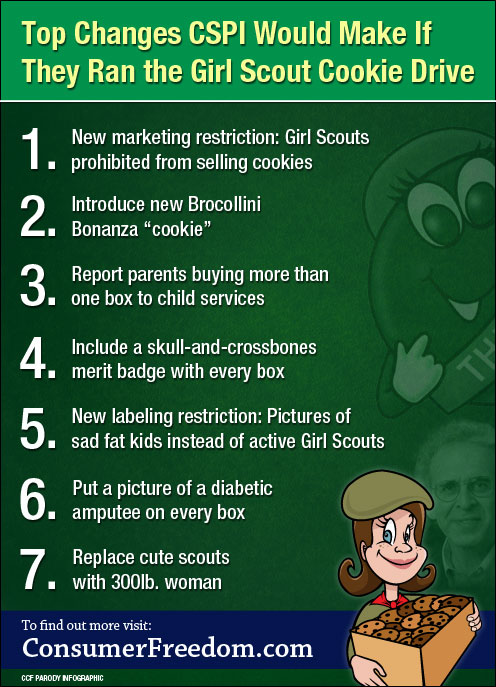
We need to focus on what Elton John sang: "Philadelphia Freedom". (I'm embedding Hall and Oates' version because the video displays the lyrics; Darryl Hall delivers a good interpretation.) The Reason video features a spokesperson for the Center for Consumer Freedom. I have also embedded a tongue-in-cheek cartoon imagining how the Center for Science in the Public Interest (which advocates food and nutrition policies) might approach perennial Girl Scout cookie fundraisers (I think I'll pass on Broccolian Bonanza or, say, Zucchinian Doublestuff Horseradish.)


Courtesy of ConsumrrFreedom
Speak for Yourself, Michelle Obama!
We all believe that no one who serves our country should have to fight for a job once they return home.
I hate with a passion the Obamas' rather transparent pandering to military personnel and their families. Michelle Obama commented on retail giant Walmart's new HR gimmick of guaranteeing honorably discharged veterans jobs. First, Walmart is a key favorite target of their fellow leftists as the soulless destroyer of small town businesses. Second, the government also provides preferential hiring bonus points in civil service.

I don't like government intervention in hiring decisions. Employers need to hire workers based on intrinsic merit (e.g., work ready, experience, productivity, etc.) If an employer hires lesser qualified workers, it affects the bottom line  It may well be that military experience is ideal for Walmart purposes, although that's not obvious to me; I could see how that supply line experience might dovetail with Walmart's legendary logistics operations.

But from a first principles approach, i.e., equal protection, I don't see why a military person is or should be "more equal"; they may fight guerrillas for their very lives, but they should get hiring consideration over, say, a father of four whom has been mostly unemployed for 3 years? When I left the military, I didn't seek or want special treatment; all I wanted was a fair shot to prove myself, nothing more, nothing less, not cuts in the hiring line. (No, I did not serve in a war zone, and I do not identify myself as a veteran on job applications.)

If I was a manager at Target or Costco, I might worry Walmart is getting ready to invade my sales territory...

Laurence Kotlikoff on the Fed Reserve

(HT to Gary North whom featured the clip in a post). I did not realize this Boston University economics professor actually ran for President last year for third-party efforts but ended his candidacy in the late spring when one of the parties decided against fielding a ticket.

I have not read much of Kotlikoff yet (I have some objections to his social security plan (which I see as too redistributive for my tastes)), but I like how he shifts on finance and Medicare reforms to a less statist solution and his version of a fair tax reflects my concern shifting some of the tax burden to consumption.

A recent Yahoo Finance op-ed on the trillion dollar coin kerfuffle is priceless; he basically points out the Fed has been monetizing the debt through bond purchases. (I will point out these "trillion dollar coins/bonds" took place under the debt cap and were not intended to work around it, but I do object to de facto monetizing the debt, which is not only corrosive to the currency but morally hazardous: why should this Congress (particularly the leftist-controlled US Senate and Presidency) engage in serious fiscal reform?)

Some other key insights:
Our country is completely, entirely, and thoroughly broke. In fact, we’re in worst fiscal shape than any developed country, including Greece. We have fantastically large expenditures coming due in the form of Social Security, Medicare, and Medicaid payments to the baby boom generations – I.O.U.s, which we’ve conveniently kept off the books.
In 2007, the monetary base – the amount of money our government printed in its 231 years of existence totaled $800 billion. Today it totals $2.8 trillion. And it increased by this amount via the process just described – the Treasury’s effective minting out of thin air two $1 trillion platinum coins; all this money loses purchasing power. So we are effectively taxed $2 trillion.
What the advocates of the $1 trillion coin are, therefore, proposing is to tax us in a hidden way. This is not just taxation without representation. It’s also taxation with misrepresentation. The fact that a Nobel Laureate in economics would propose this without making clear this fact raises the question of whether his prize should be revoked.
Today, 12 cents out of ever dollar being spent by our government is being printed. As indicated, the money supply has more than tripled. While inflation, let alone hyperinflation, has not yet occurred, everything is in place for this outcome.
I think  Krugman's Nobel Prize will get revoked after Obama's. It'e often difficult to see the stealth decline in purchasing power but I would say in part we see it in the health care system where government policies are exacerbating prices for goods and services. I think we are also seeing some anomalies because of Fed policies, e.g., stocks at a 5-year high in a tepid growth economy. I love Kofilkoff's pointing out the hidden tax of inflation; the Fed is indeed indirectly taxing us without representation.


Political Humor

Happy birthday to first lady Michelle Obama. She turned 49 years old today. She told a reporter she’d like a nice gift from Barack, but nothing extravagant. Oh, don’t worry. Obama is very responsible when he's spending his own money. - Jay Leno

[Jay, Sasha and Malia actually bought the gift, but Daddy O got all the credit (pun intended).]

Cirque du Soleil just announced that it is cutting 400 jobs. So on the downside, hundreds of clowns will lose their jobs. But on the bright side, it’ll free up, like, two spaces in the parking lot. - Jimmy Fallon

[On the plus side, lots of clowns are able to find work in this economy. Consider, for instance, the Congress...]

Musical Interlude: My Favorite Groups

The Stylistics, "You Make Me Feel Brand New". This concludes my Stylistics series. Next up: the Cars.

Thursday, January 17, 2013

Miscellany: 1/17/13

Quote of the Day
Some cause happiness wherever they go, 
others whenever they go.
Oscar Wilde

You Don't Say...

(HT AEI's James Pethokoukis) from the Treasury Dept.:
As of September 30, 2012, the Government held about $2.7 trillion in assets, The $18.8 trillion in total liabilities is comprised mostly of: (1) $11.3 trillion in Federal debt securities held by the public and accrued interest and (2) $6.3 trillion in Federal employee and veteran benefits payable. The Government also reports about $4.9 trillion of intragovernmental debt [e.g., senior entitlement reserves outstanding.] As of September 30, 2012, the Government’s total debt outstanding subject to the debt limit was $16.027 trillion, $367 billion below the current limit. As budget deficits continue to occur, the Government will have to borrow more from the public. Instances where the debt held by the public increases faster than the economy for extended periods can pose additional challenges.
So the Treasury has about net $16T in liabilities, NOT including over $2.5T in senior entitlement reserves (which do count in the debt ceiling) or estimates of up to or over $80T in unfunded senior entitlement liabilities. And only about $2.5T in annual revenues. Folks, even Bernie Madoff realized that he was living on borrowed time. Obama refuses to admit that he has a spending problem...

Buying Obama's Higher Education Hype?
Still Believe in the College Loan Bubble at Taxpayer Expense?

To a certain extent I was blessed compared to other PhD's because MIS was an emerging discipline in business schools (instead of focusing on areas like programming languages, and operating systems of computer science, we focused on the management, design and use of application systems and databases). Business schools were booming in the eighties, and the MBA was one of the "hottest" degrees. I was working as a programmer/analyst in the niche APL programming industry; APL is an interpetive (vs. compiled), concise, very powerful computer language developed by IBM, ideal for rapid application development. The companies I worked with made money by selling premium-priced mainframe computer time running value-added APL applications; a number of our Houston customers, primarily corporate headquarters for major energy companies, used us as a workaround to backlogged computing division bureaucracies. The emerging PC industry undermined the business model, and I believe the local branch offices vanished while I was in the doctoral program.  I had decided, for career advancement, to pursue an MBA (I also hoped that my dating prospects would improve; they did, but I was far more successful in my academic endeavors).

I discovered UH had an MIS doctoral program and applied for admisison before completing my MBA. The MIS discipline was young, with the first major program emerging from the University of Minnesota. Business school accreditation (AACSB) requirements drove demand for faculty from accredited doctoral programs; by the time I graduated there were few openings I knew about at Tier One/land grant universities, but my phone rang off the hook with interview requests from smaller branch universities (the fact that I was one of 2 prospects selected for both the DSI and ICIS consortia during my graduation year probably helped; I actually talked over the phone to a Dartmouth recruiter impressed by that, but there was no follow-up). Little  could I have guessed my academic career would end 5 years later in a nonrenewable visiting professor contract during the GHW Bush recession. To help meet faculty demand, Indiana University, headed by a key Minnesota alumnus, had set up a summer institute to retrain PhD's from other disciplines; with schools also cracking down on ABD's, threatening to make them requalify for candidacy after 5 years (in my field, married spouses, after finishing a required low-paid resident requirement, could make a lot more money by working full-time), slowing enrollments, and even computer science graduates (whom often had contempt for business schools) eyeing openings, I had a difficult time, even with 8 years of teaching  (5 as a professor) and an above-average publication record.

The tables had turned; I was competing for interview slots. One telling example: one school had concurrent interviews going on in the same hotel suite living area when I arrived.

Gary North (HT for the source of the below embedded image) has previously written about the doctoral glut. I can identify with what North was saying; as an undergraduate I was a double major in philosophy (my first love) and math. At least 2 or 3 people had "the talk" with me against pursuing a philosophy doctorate: I was warned my best chance for getting a faculty spot was if a tenured professor on faculty died or retired. As for math, around the time I was admitted, Texas had decided to do something about the nationwide glut of mathematicians (I recall a new PhD had finally landed a position at an obscure Missouri state college), and required passing 6 area qualifying exams for ABD status. I still remember one married couple where the wife made it but her husband finished one exam short.

I never even made it to the exams because I lost my graduate support. I ran into a political problem with an East European immigrant visiting professor. I was set up by the other class TA, JL--we didn't lecture but led calculus problem solving sections; the professor (with heavily accented English--"nature-al numbers" and "recip(e)-rocals")  was idiosyncratic--he would sometimes lose himself after scribbling 7 boards with equations and look at me through his thick glasses and ask, "What was it I was trying to do?" He also required a prospective A student to pass an oral exam. I got caught in the middle; I remember the best student in the class was so upset by one of his exams (we had no clue what he would put on an exam--I think if you got one right, a C; 2, a B;  3 an A), she literally threw her completed exam at and hit my face.

JL. on his initiative, suggested that we have an intervention with the professor. So he had me start off; the professor was quite upset by my description of student conplaints and turned to Jeff and said, "Is this true?" JL said, "I've heard a few complaints, but only from those whom are chronic complainers and would complain no matter who taught the class." To this day, I don't know what motivated JL to lie or backstab me. But the professor was now paranoid and even tailed me going into my graduate real analysis class to bitch about me to the professor. I later got summoned (already convicted by allegation) to a meeting in the department chair's office where I got read the riot act and was made to feel my place in the world was below that of a subatomic particle.

Later next semester I learned that my TA contract would not be renewed. I completed my thesis on a topic in ring theory (abstract algebra); I'll never forget once buying a book on group theory, and the salesgirl asked me what psychology class I was taking (trust me: mathematicians everywhere will think that's funny). I had to get a bridge loan from my reluctant maternal grandfather to pay a $500 fee to get my thesis typed, copied and bound (this was before PC soft fonts in writing math equations/expressions). I intended to join the Air Force (to be trained as a meteorologist). But I was passed over twice in officer selection pools, making me ineligible for 6 months. I tried to get a job teaching at a community college; no luck. I was unsuccessful finding  other work. I was living cheaply off campus--my folks of modest means had given me a small money gift after graduation, but moving home was not an option. The economy was in a recession; as the fall semester approached, I looked into going back to UT to pick up high school math teaching certification, but needed a financial aid package. Since my folks had claimed me as a dependent the prior calendar year, I had to get a financial statement from them. They refused. I pointed out to the college my little brother was enrolled, and the college bureaucrat, with a straight face, claimed use of my parents' financial statement for my brother would violate my brother's data privacy.

There's something that going through several months without a job does to a confident young man. Sure, people told me I should minor in computer science, not philosophy, for my Master's. But it never really occurred to me that someone who had graduated summa cum laude with majors in two intellectually  demanding disciplines, a first-rate thinker, problem solver and communicator, would have problems trying to find an entry-level job. Gary North may have known, but he's an economist.

Incidentally the following image does not apply to me. But I found the PhD was more of a liability than an asset; when I tried to restart my professional career, I was advised by professional recruiters to drop the PhD from the resume. A number of employers made it clear just what they thought of "ivory-tower" academicians whom can't function in the "real world"; almost all gave  no credit for computing experience in academia: I was treated as having been unemployed for the previous 8 years, and my no-longer-in-demand APL skills were suspect as well, judged likely obsolete or degraded. Several companies told me that I would have to compete against former students for entry-level positions, self-righteously proud of the fact they promoted from within for higher-level positions, and almost all of them had no interest in hiring an academician riding out the recession at their expense until hiring in academia improved.

But you still have to make ends meet. And that's how PhD's can sometimes end up in low-skill/low-paid occupations as described below. There but for the grace of God...


An Unconscionable Violation of Privacy
By a Politically Motivated Press
Two handguns and two pistol permits were stolen from the New City home of a man whose name and address are listed on the website of a local newspaper as possessing gun permits, police said.
The thieves ransacked the house Wednesday night, breaking into two safes on the home's third floor and stealing a third safe. The guns were in the stolen safe, police said.
Clarkstown police said they had no evidence the burglary was connected to the controversial map.
The concept of privacy has, unfortunately, been coopted by those whom believe that a pregnant woman has an unrestricted right, for any or no reason, to commit or authorize violence against her preborn child. But we understand intuitively that there are some expectations to be left alone by the government or other people: in our homes, when we are in the bathroom, enter the voting booth, our health details, etc.

There are only a few cases I can think of where the public has a right to know about personal details and even then I  would exercise prudence: for example, if a pro-gun control politician turns out to own a machine gun.

But public disclosure of details could undermine the home's tight to self-defense, expose a citizen to harassment or endangerment or serve to undermine public policy objectives like registration. For example, people's registered guns could be the target of  others whom are restricted from gun ownership (e.g., former felons or mentally ill people).

Musical Interlude: My Favorite Groups

The Stylistics, "Break Up to Make Up"

Wednesday, January 16, 2013

Miscellany: 1/16/13

Quote of the Day
He gains everyone's approval 
who mixes the pleasant with the useful.
Horace

Guns, Obama and the Hubris of "Effective Public Policy'

Let's be clear: nothing I've read today about 23 executive actions and calls for Congressional action will have a practical effect on Newtown-like tragedies. Bureaucrat responses (e.g., task forces, appointments, studies, etc.) are little more than political posturing to show the President is doing something, anything  in reaponse. I see this as little more than a scattershot approach (no pun intended) and of course what plan has Obama ever come up with that doesn't call for spending a lot of other people's money (by one account $500M)?

From a public policy standpoint, I see this as primarily a local/state issue and within that context, a government safety policy failure. I worry about false or unrealistic expectations. There are workarounds for motivated people.

I do find the Cato Institute discussion salient; I do find the argument compelling that citizens should have access to weapons comparable to what police use to stave off attackers until reinforcements arrive. I'm less enthusiastic about throwing money at mental illness. The vast majority of mentally ill people are not violent.


John Cochran, "Two cents on the trillion dollar coin, and a debt-limit schedule": THUMBS UP!

The "grumpy economist"'s column is recommended by Cafe Hayek's Don Boudreaux, and I concur. I have seen so many people use the analogy of not paying the check after having ordered dinner. Cochran here basically debunks a number of myths: the debt ceiling serves as a check on money printing by the government because the Fed has to deal with banks and can only purchase certain assets. Redistribution is a function of fiscal vs. monetary policy. Cochran suggests that the Fed has been engaging in fiscal (vs. monetary) policy since 2008 by buying non-traditional assets like MBS and commercial paper. He then explains how the coin gimmick could have worked for a de facto bridge loan off the books without printing new money by selling its current $1T stash in Treasuries. Alternatively, the Treasury could "borrow" US debt, say held in social security reserves in an IOU shell game with the Fed. He notes that anyone redeeming a Treasury bond opens up room for a new bond under the debt ceiling, so we're only worried about bond interest.

More importantly, he exposes the disingenuous "default" rhetoric for what it is: Obama and his cronies are really looking at federal spending other than interest expense.

Finally, Cochran suggests some reforms to guard against gimmick workarounds (no coins, no use of government held debt) and more of an incremental process of lifting debt ceilings.

Political Humor

Joe Biden finally says something I can fully understand and identify with...


Musical Interlude: My Favorite Groups

The Stylistics, "I'm Stone In Love With You"

Tuesday, January 15, 2013

Miscellany: 1/15/13

Quote of the Day
I only regret that I have but one life to lose for my country.
Nathan Hale

Rant of the Day

From a proprietary financial newsletter;
Watching this administration pretend that refusing to raise the debt ceiling is our real problem, rather than its spending, is simply surreal. All the major players pushing for more debt, including the president, said exactly the opposite just a few years ago. Then, they were criticizing the prior administration, and rightly so, when the debt was $10 trillion. Now, when it's 60% higher, they are feigning outrage that anybody would take their prior position in support of a balanced budget. 
Just to be more precise: Obama's objection was in 2006, the GOP controlled Congress only 4 of Bush's 8 years, and the public debt at the start of the 110th (Dem-controlled) Congress was $8.7T, just over half  (53%) what it is now (and Dems passed continuing resolutions, not the Bush budgets: the purpose, of course, was so they could spend even more under Obama.). And remember how Ted Kennedy thundered with rage when Bush increased education spending by only 70% (and labor by 65%) by 2003? And how the Democrats criticized the unpaid-for Medicare drug benefit--because the government left "doughnut holes" in coverage (that the Dems promptly filled later)?

There is a Sign License Plate of Intelligent Life in California
HT Cafe Hayek

[The rich] consume little more than the poor, and in spite of their natural selfishness and rapacity…they divide with the poor the produce of all their improvements. They are led by an invisible hand to make nearly the same distribution of the necessaries of life, which would have been made, had the earth been divided into equal portions among all its inhabitants, and thus without intending it, without knowing it, advance the interest of the society, and afford means to the multiplication of the species.
Adam Smith, The Theory Of Moral Sentiments, Part IV, Chapter I, pp.184-5, para. 10.
Every individual... neither intends to promote the public interest, nor knows how much he is promoting it... he intends only his own security; and by directing that industry in such a manner as its produce may be of the greatest value, he intends only his own gain, and he is in this, as in many other cases, led by an invisible hand to promote an end which was no part of his intention.
., The Wealth Of Nations, Book IV, Chapter II, p. 456, para. 9.
Misleading Headlines: 
Fitch Warns It May Downgrade US Over Debt Standoff

I saw this headline (I believe from the Houston Chronicle); this is just the sort of incompetent heading that leads progressives to confuse the financial issue with political process. Credit rater Fitch clearly would hit the US hard if it didn't meet its debt obligation (interest payments) but if the US government starts juggling bills and otherwise resorts to gimmicks (like raiding pension funds), Fitch might still nick the government's rating (i.e., a good credit risk can easily handle its obligations). I have already debunked the social security red herring.

A word to Speaker Boehner: after seeing the Hurricane Sandy bill pass (thumbs DOWN!), I suggest tackling budget reform separately. The political risk/reward ratio is too unfavorable. I don't like the idea of caving on the issue but Obama seems ready to risk a shutdown, which is utterly insane. It's more important at this  point to protect confidence in US debt

Hall of Shame: Two More Members (Republicans!)
Bernanke spoke about the misconceptions surrounding the debt ceiling. Contrary to Republican rhetoric, which has suggested that raising the debt ceiling is akin to opening up the spending floodgates, he said it merely allows the government to continue paying its current bills.
He compared not raising the debt ceiling to a family of debtors skipping out on their bills.
"Raising the debt ceiling gives the government the ability to pay its existing bills," Bernanke said. "It doesn't create new deficits. It doesn't create new spending."
Okay, Ben: just to quote the great sage,  pro wrestler/rock band lead singer Chris Jericho: "Would you PLEASE just SHUT THE HELL UP!"  NO, not raising the debt ceiling is more  like a credit card issuer refusing to lend more money that will probably never be paid back. Credit limits don't create new spending (they enable new spending )but when the terms are near zero and your crony bankers are willing to finance whatever spending you do as lender of last resort, it's hard to convince a populist government to live within its means and to say 'no' to politically popular spending.

No, it's not a case of skipping out on bills; it'm more like a family still having to make a minimum payment on their full credit card and learning to live on its income without resorting to using a credit card.
Republican and Democratic supporters of the bill argued throughout the day that everyone should support it, or run the risk of losing votes for future disaster bills that might help people in their districts.
"Florida, good luck with no more hurricanes," Rep. Frank LoBiondo (R-N.J.) shouted to any member who might oppose the bill. "California, congratulations, did you get rid of the Andreas Fault? The Mississippi's in a drought. Do you think you're not going to have a flood again?
"Who are you going to come to when you have these things? We need this, we need it now. Do the right thing, as we have always done for you."
Utterly pathetic--so anxious for a drink from the public teat, trying to pressure members to abandon fiscal discipline to support in total larded up bills financed unknowingly by the nation's children and grandchildren and never having heard the maxim 'haste makes waste'

Impeach Obama? Not Just Yet...

Let us reflect the fact that Clinton was justly impeached. How do we know that? An Arkansas judge suspended his law license for misleading the court. Paula Jones, an Arkansas state employee while Clinton was governor, claimed that Clinton asked her to do something of an intimate nature. Most companies have sexual harassment policies forbidding managers from abusing their power over a subordinate for personal gratification. Even when the subordinate is willing (e.g., Lewinsky), policies frown about that because subordinates may infer it's required if they are to  advance professionally. So when the Jones team found out that a White House intern had had intimate contact with Clinton, they no doubt felt they had established evidence of a pattern of behavior. (Note: it wasn't the sex itself. If Clinton had had a sexual encounter in a Nevada brothel or with a campaign volunteer in some love nest, adultery may have raised issues of Clinton's morality, but it wouldn't have been relevant in the Arkansas court.)

Clinton resisted testifying and tried to defer it until he was out of office. Clinton, when he did testify, was in a state of denial. It then became a classic case of "he said, she said" until Lewinsky provided physical proof of their intimate behavior.

Perhaps, certainly in the case of many people, what constitutes the level of an impeachable offense is subjective. I felt then Clinton, an Ivy League-trained lawyer, knew exactly what he was doing when he misled the court, and a double standard was not an option. The Dems tried to bargain  the charges to a censure but they had enough silent purely partisan votes to block conviction, regardless of the merits.

Word that Obama is in the process of devising a series of executive orders on gun control is probably the straw that broke the camel's back. In looking at the complaints, I have been harshly critical of Obama's arbitrary enforcement of immigration laws, his moratorium on Gulf  of Mexico drilling, his unilateral executive order after the legislative Dream Act failed, I don't like Obama going after an American-born cleric without due process, indefinite detention or other liberties  However, there are ways to uproot a bad executive order, e.g., through the Congress or the courts. Now if Obama was to thumb his nose at legislation passed over his veto or  at court decisions going against him, sign me up. But some of those items, e.g., controversial aspects of the Patriot Act, were also approved by Congress. (But Congress's laws are also subject to judicial review.)

I agree--and have repeatedly warned against--Obama's abuse of executive orders. Obama has never had to negotiate or compromise. He's probably going to push the envelope. But to be honest, if Clinton got acquitted by a GOP-controlled Senate, I find it next to impossible to believe Obama would not be protected by a Dem-controlled Senate.


My Greatest Hits: January 2013

Interestingly, none of my one-off (non-daily miscellany) posts placed. Also, the first post is the runaway most read post, with a bigger pageview gap than between the second and last:
Political Humor

Daniel Day-Lewis won a Golden Globe for playing Abraham Lincoln and Julianne Moore won for playing Sarah Palin. The foreign press realized that the greatest challenge for an actor in Hollywood is pretending to be a Republican. - Jay Leno

[The Governator thinks it's even harder to be a Republican in Hollywood pretending to be an actor.]

President Obama's half-brother is running for political office in Kenya. Donald Trump has already accused him of being born in the United States. - Conan O'Brien

[It's an ObamaNation.]

The Treasury will not mint a trillion-dollar coin. That is a shame. Wouldn't it be nice to mint up nine or 10 and say we're even? jimmy Kimmel

[Bernie Madoff has volunteered to do the coin flip at Obama's Super Bowl party.]

Republicans and Democrats are working on a new bill to streamline the healthcare system. It will reduce the cost of mammograms and prostate exams. But don't worry. They'll still be free at the airport. - Jimmy Fallon

[I think the TSA misunderstood what Obama meant by 'greater transparency' in operations.]

Musical Interlude: My Favorite Groups

The Sylistics, "Betcha By Golly Wow"